.jpg?environment=live)
Marshall Pruett's Tech Mailbag for May 16
Fire away with your tech questions about F1, IndyCar, TUDOR Championship, WEC, Pirelli World Challenge or whatever else that comes to mind from the world of road racing. Please send them to PruettsTechMailbag@Racer.com. We can't guarantee your letter will be published, but I will always reply. -Marshall Pruett
Q: I'm a big fan of your tech mailbag and your great articles on RACER.com. After the thunderstorm passed on Sunday at Barber, I was wondering why they didn't get the IndyCars out on track any sooner as it was just wet, albeit with a few rivers across the track. I'm glad they did get out as it was an interesting race and Bourdais and Montoya both impressed until their incidents. In the post-race interview, RHR stated that the "wets" were like "intermediates." Could you talk about the differences in the inclement weather tires between IndyCar and F1? I know we don't have the budget to bring two levels of rain tires like in F1, but I thought that the rain tires in IndyCar were full wets?
Gabe, Chicago, IL
MP: Firestone uses a single wet tire specification. If there’s a limited amount of standing water, the wets can handle it, but as we saw during the worst portion of the Barber downpour, Noah’s Ark would have been required to get across a few of those lakes that sprang up on the track. Dale Harrigle, Firestone Racing’s chief engineer, added this to the explanation:
Based on our experience in IndyCar, in 2012 Firestone developed a new rain tire that was a bit more
like an intermediate tire then what we had used previously in IndyCar competition. Rain tires based on that design were used at this year’s Barber Race, and were perfectly suited to the drying road course track. For 2013 we released a new rain tire design that is visually quite similar, but has a bit more
tread depth to handle slightly more standing water. This 2013 rain tire will be the tire used full time
in IndyCar competition after the Detroit race. When Bridgestone was involved in Formula 1, we
supplied three rain tire options that the teams could use at their discretion.
Q: Do PCs us the same tires as P2's and DP's? If not, would P2s race better with PC tires?
Ed Joras
MP: Continental’s prototype tires are the same for PC, P2 and DP.
Q: I was going to ask why has the DeltaWing not been given more favorable treatment in the ALMS/IMSA BoP, but then I realized that it never finishes races. I like the concept behind the car, and every time I watch a race I hear how successful the concept has been. But if the car can't finish a race, regardless of whether it's part failure or crash damage, how successful has the concept actually been?
Kyle in Raleigh
MP: It’s a one-off car, with no benchmark for what’s needed to compete with highly developed P2 and DP cars, so it’s not a big surprise the DW has a BoP that looks unlike anything else in the series. It’s a single car working through development on a part-time race schedule, which makes things like reliability more of a long-term solution to find. With two or three cars on track, they’d be on top of reliability by now.
It’s a success as far as I’m concerned – the car’s unique, inventive, odd, and continues the thinning bloodline of actual prototypes in sports car racing. It doesn’t come off of an assembly line, has some wacky ideas, and celebrates creativity. I’d think people would cheer the car more than any of the other cars in the Prototype class simply because it isn’t another cookie-cutter creation built to low-tech or low-cost regulations.
Q: I was wondering about the constant changing of IndyCar liveries. Are the cars painted or are they using a "wrap" system? Wouldn't all the paint build up over the season add weight to the car?
Mark
MP: I had Simon Pagenaud’s engineer Ben Bretzman answer this one for you:
Q: I thought anti-stall was supposed to be mandatory in 2014. What gives at the moment as Chevy, in particular, seem to be having issues at the start. Saavedra has stalled twice as well as Montoya and they both run the Chevy engine, whilst Scott Dixon and Franck Montagny driving Honda's have incidents at Indy but managed to keep their engines running. Is it a case of Honda more up to speed than Chevy when it comes to anti-stall and also if anti-stall is mandatory, what is IndyCar doing to police both Chevy and Honda to make sure that their technology is working properly?
Graeme Watson, Brentwood, Essex, UK
MP: It is required in 2014 – which is new, but as we saw during the GP, being enabled and being functional in the event of a possible stall during a standing start are two different things. By its definition in the rulebook, anti-stall isn’t required to be configured for use in firstst gear… It reads: “Anti-stall must be set to operate effectively in, at least, 2nd and higher gears. The driver may disable it under yellow conditions by using the rotary-switch.” By the way the rule’s written, anti-stall is meant to keep an engine running when the car is in motion and spinning backwards, for example. It isn’t, by definition, a launch control device where it is looking to save a stalling car while it’s sitting still. I confirmed with Chevy that their cars did not have its anti-stall feature enabled.
While I was in the Schmidt Peterson Motorsports garage, I asked Simon Pagenaud, who won the GP, to explain how he executes a standing start.
Q: In F1 they are limited to 100KG of fuel per race. They say this is a third of what they had last year. How many liters of fuel is this?
Nicky Gray, UK
MP: It’s about 140 liters, and about 30 percent less from 2013.
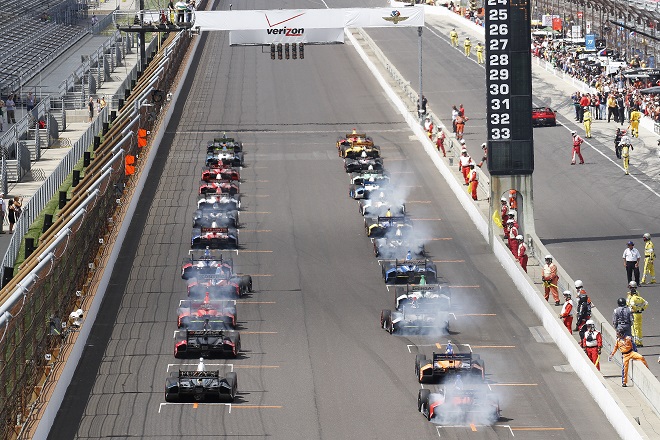
Q: Standing starts…I love them...when they work. I don't recall Champ Car or see F1 today having these kind of technical glitches causing the carbon fiber to fly. I think they create an exciting start and chops up the field, but are Ed Carpenter's comments on ABC representative of owner opinion on standing starts or was he frustrated in the moment? What can be done because I love the standing start?
Gordon from Dallas
MP: one of the best takeaways from the GP of Indy is that the anti-stall devices weren’t shopped and signed off on at a time when IndyCar was seriously thinking about doing standing starts. I’m not saying it wasn’t a possibility, but IndyCar’s tech team and its vendors did not go out looking for a proper “save the car from stalling in all scenarios” type of system. As for what can be done to improve it, I’m afraid it could take a wholesale replacement or a more standardized setup called for by the series.
I spoke with one driver who said some on the grid have a different outlook on how to set up their standing start throttle map and hand-clutch bite point. Some drivers opt to have minimal throttle pedal travel – and keep in mind it’s done through fly-by-wire--to get the high RPMs needed to perform a standing start, while most others prefer a long pedal throw to get those revs. With the long throw – say 80 percent throttle travel – a driver has a lot of room to modulate the throttle if he or she bogs down or has too much wheelspin. They have enough travel to react. For those who go for barely having to touch the throttle to get full standing start revs, they have very little wiggle room to react – the throttle is like an on/off switch. One of the more reputable drivers insists Saavedra was using the latter option…
If IndyCar requires full throttle travel, allows drivers to practice their standing starts on the track surface they’ll use for the race (instead of on pit lane), the situation should be improved.
Q: I was wondering:
1) IndyCars are quite unique on the simple fact that they race on extremely different kinds of tracks. What guidelines do they follow for safety engineering and crash testing? Do they follow FIA, their own, or both? Who is responsible for carrying the test and the post-crash test evaluation? Do they now consider the scenario of a stalled car in a standing start just like we had at Indy?
2) I noticed during the course of the Indianapolis Grand Prix that the Honda powerplants appear to shift faster and almost seamlessly. The Chevrolet cars "misfire" during shifting. Given that the transmission is supplied with the Dallara chassis, did Honda figure out a way to reduce the shift time and/or make a better mapping with the engine that makes it possible to reduce the power flow during shifting? Are they also saving a bit of fuel by reducing unburnt fuel out of the exhaust and using for forward progress? We are talking milliseconds here, but I am more than sure that even if both engines were producing identical power figures and have identical power bands on just a single lap in a racecourse it can add up and be the difference between first and last place.
Please, enlighten me.
Rudy from Ohio
MP: IndyCar has their own standards, but they start with the FIA’s F1 standards, and due to the added speeds encountered in Speedway crashes, the safety measures and the overall strength of the chassis tends to go beyond the norm found in F1, so the testing thresholds are bumped up a decent amount. The cars undergo static crash testing at Dallara’s base in Italy, and the dynamic testing – the crash sled testing – happens at the University of Milan. IndyCar does its own post-crash evaluation, and Dallara takes part in those events.
I was fortunate to be at a few pre-season tests and listened to both Chevy and Honda roll out their faster shifting and shift-cut algorithms. Chevy sounded like they had the edge, then Honda came back and they’ve sounded about equal to my ear right now. The work done to improve shifting speed is all about reducing lap times. If any unspent fuel is saved in the process, it’s an added benefit, but not part of the quest for those milliseconds…
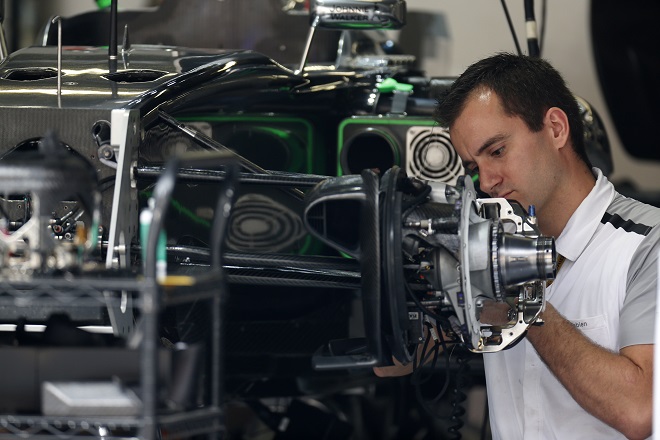
Q: I would like to know how a young intelligent mechanic can become a mechanic for a professional motorsports team, for any series, whether it be F1, United SportsCar, NASCAR, IndyCar, etc.?
Sincerely,
A mechanic with a dream.
Tyler Curley
MP: I asked my friend Damon Sturrock who worked full time with Bryan Herta Autosport through 2013 and came back for the month of May to serve as chief mechanic on Jacques Villeneuve’s car to answer your question. Damon’s come full circle – from a young mechanic to a chief to now but now owning his own performance hot rod shop in Indianapolis – and has lived the life you aspire to have.
Q: It may be a stretch to call this a true tech question, but I think it is in the ballpark. On the Indianapolis Star's Pit Pass Live this past Monday morning Marco Andretti filled in for Andretti Autosport teammate James Hinchcliffe, who suffered a concussion in Saturday's Grand Prix of Indianapolis. Andretti showed off the protective strip that covers the gap between the visor and the helmet, and he said he's been told the piece saved Hinchcliffe "from brain surgery." What is that "protective strip" made of, and how new is that bit of protective technology?
Franz
MP: It’s made from Zylon, the same anti-intrusion composite material used on both sides of the IndyCar cockpit, and became mandatory in 2014.
Q: Can you explain how removing the apron at Indy affected the track so drastically, and when was it officially removed. Also, why do drivers head toward the pit wall when running on the front straight? Wouldn't it be faster in a straight line?!
The tech mailbag is the best thing going. Thank you!
Tim
Q: When is IMS going to raise the hot course wall for safety’s sake of the signaling board men between the start-finish straightaway and the pits? At least there was fencing on it for the MotoGP and F1 events unlike last weekend’s Indy GP.
Paul
MP: It will be happening for next year’s race, and I’d imagine everywhere else standing starts are meant to be performed. Frankly, it should happen everywhere cars race.
Q: How much more downforce do some of the FIA GT3-spec machines have than the Cadillac CTS-V.R in Pirelli World Challenge?
With the 2015 Ford Mustang's all-new chassis, what do you expect to make the biggest difference for that machine in race-trim? Ford says the new suspension allows for less diving under braking.
What development work does the SRT Viper GTS-R need between now and the Watkins Glen 6-hour race? It would be nice to see the Viper win it again because it hasn't raced there since 2000.
Thanks to RACER for showing the excerpt from the book about the Penske PC23 Mercedes-Benz from 1994.
Rick
MP: I’m told anywhere from 20-35 percent more for full GT3-spec cars. The Mustang’s suspension is modern and independent, which is a big improvement over the FR500C. the SRT Vipers distinguished themselves with their damping program last year, and from what I’ve seen trackside this season, they appear to have fallen behind by a significant margin on the lower-grip circuits.
Q: These are some questions I thought of while watching the live stream video of practice on Monday.
1) Do the drivers know the duration of their practice runs prior to pulling out?
2) Are teams experimenting with qualifying setups, race setups, or still just feeling out the car?
3) Is the speedway aero package the same as last year?
Joe Grabianowski
Q: What kind of progress has been made on decreasing steering wheel kickback during contact in IndyCar? We had heard that Dallara may be working on a shock absorber-type system to mitigate dangerously fast steering wheel kickback. What the word, my man?
Eric Hall
MP: IndyCar’s Derrick Walker has the answer: “We commissioned Dallara to build a prototype steering damper in an effort to reduce or eliminate wheel kick back. It will soon be tested and we are hopeful it helps without increasing the steering effort.”
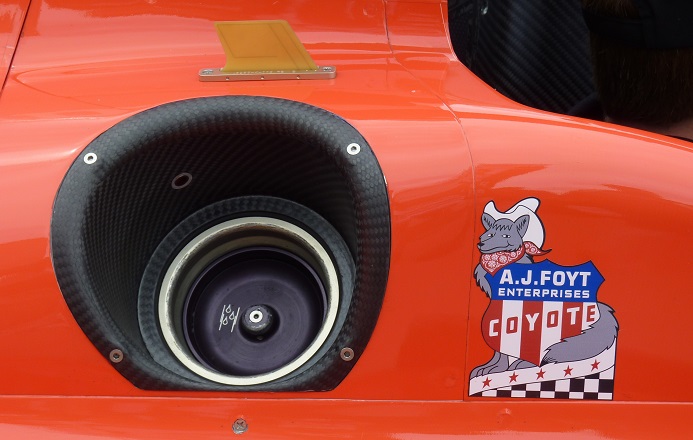
Q: Curious of the function of what appears to be an antenna above the refueling port on the DW12?
J.D. Ellis
MP: That antenna is used to transmit telemetry data back to the pits. Pretty cool little blade antenna, isn’t it?
Q: My question regards dampers – do the dampers change significantly from road course to ovals? And could you give an opinion on who has an edge in development this season?
Henry M, Los Angeles
Q: Some years ago I attended a CART race at Road America. While wandering through the pits I noticed that all the teams had tire warmers with the warmers set at various temperatures. Since accidents are sometimes caused by drivers losing control on cold tires, my question is: Why are IndyCar teams currently not using tire warmers? Expense? Rule changes? Not worth the effort?
Ron Ford, Muskego, Wis.
MP: It’s partially down to expenses, but in a general sense, it just hasn’t been a part of Indy car culture. I don’t recall many IndyCar accidents in recent years due to low tire temperatures – the series and Firestone have been very good at ensuring cars do not run unless a minimum track temperature is met.
Q: What is the problem with standing starts? The cars themselves, or (gulp) driver incompetency? Standing starts are used in many series around the world, but IndyCar just can't seem to consistently get the hang of it! It's embarrassing! Any thoughts?
Bob Hengen, Columbus, OH
our Q&A of earlier today
.Q: I was wondering if you could comment on the differences between IndyCar and Formula 1 cars. What would the difference be on the road courses? Would either have an advantage vs. the other on the same road course?
David Alvarez, Ann Arbor, MI
Q: Being born in 1993, I wasn't around for the turbine cars. I haven't found a good link describing the engines themselves or the chassis. Can you explain to me what made these cars so radical and different.
Chad Frankenfield
MP: It was the insane concept of fitting a turbine to a racing car that was radical and different. Before these aviation powerplants were tried, actual propeller-driven airplane engines made their way into a few racing cars and many of Indy’s greatest engines were derivations of marine motors. The last truly crazy non-automotive engines to find their way into Indy cars were the turbines – I hope something else that ranks as bizarre or different comes along before too long.
Here’s a good link to start and you can find plenty of others: http://www.ultimatecarpage.com/car/2036/Lotus-56-Pratt-and-Whitney.html
Q: Watching your GoPro camera hooked up to Simon Pagenaud's helmet has been one of my favorite things about IndyCar so far this year. Now Graham Rahal has utilized Google Glass to give an even more realistic "driver's eye view" from the cockpit. At Barber, the Pirelli World Challenge guys were using drone cameras to make a weekend highlight video. This kind of stuff is new ground and can involve the viewer like never before.
Is there any hesitancy that you detect among drivers/teams from utilizing on-board cameras, especially newer tech like this? Would anybody ever consider doing this in an actual race? Offering new perspectives and sharing these through social media can really generate excitement and likely intrigue non-fans as well.
Brian Wolfe
MP: We’re working on an alternative to the visor-mounted GoPro at the moment and hope to have that footage available in the near future. Teams and drivers love it, sanctioning bodies appreciate the promotional value but it all needs to be done within their rules – some do not allow helmet-mounted cameras, for example. I would expect first-person viewing from inside the helmet to be a major growth area for auto racing and other popular sports.

Latest News
Comments
Comments are disabled until you accept Social Networking Cookies. Update cookie preferences
If the dialog doesn't appear, ad-blockers are often the cause; try disabling yours or see our Social Features Support.