Joe Skibinski/Penske Entertainment
Manufacturers and teams look to take the next step in Year 2 of hybrid engines at Indy
IndyCar Series teams, along with Chevrolet and Honda, spent last year’s Indianapolis 500 in learning mode with the energy recovery systems installed in the back of their cars. The 2025 Indy 500 was the first for hybrid powerplants, and thanks to the educations and observations gained during the event, teams and manufacturers have been incredibly busy during the opening days of the 2026 event as they take deeper dives into exploiting the system’s full capabilities.
IndyCar has also thrown a new wrinkle into the hybrid rules for this year’s Indy 500, which caused the field of 33 to dedicate plenty of time during practice to test and benchmark the change to each car’s performance.
On debut at the Speedway in 2025, the series set two key limits with a maximum power output for the supercapacitor-based system when it’s deployed – in the same way IndyCar sets a peak horsepower number for the turbochargers to add with Push-to-Pass – and the maximum total amount of power the hybrid can contribute per lap.
One item that went unregulated last year was a minimum hybrid energy deployment number, and that was used in an interesting way by some teams through a "trickle" boost. On road and street course, it’s normal for teams to set their hybrid systems to provide drivers with maximum power deployment when they press the buttons on their steering wheels, and with the short-burst capabilities of the super capacitors, the motor generator units (MGU) can deliver a full shot of 40hp or so in less than five seconds.
But the all-at-once approach wasn’t carried over as the standard method of usage at the Indy 500. The trickle approach, where the hybrid systems are set to slowly dole out the energy stored in the supercapacitors over a longer period, was one of the more fascinating developments. And that’s also where some teams took a creative angle and came up with the "cold trickle" deployment, which has been eliminated as an option in 2026.
Thanks to the absence of a minimum hybrid power deployment setting, some teams used the hybrid as a tool to defeat itself through a "cold trickle" of power that didn’t actually boost the car’s acceleration so much as counteract the negative effects of the MGU.
Prior to the arrival of IndyCar’s hybrid systems, all of the horsepower generated by the twin-turbo V6 motors made by Chevy and Honda was sent from their crankshafts through input shafts to the transmissions without any additional parasitic losses. But with the installation of the hybrids, thick, heavy metal drums – the MGU – have been placed on the input shafts and spin on the shafts to generate electricity that gets sent and stored in the supercapacitors. Raw power from the motors gets sapped while helping to spin the considerable weight of the metal drums, and as some teams realized, the feeding of a small amount of hybrid power was possible to use as nothing more than a tool to negate the power losses caused by the hybrid.
In essence, the cold trickle of hybrid power negated the power being surrendered by the Chevys and Hondas, and that has been outlawed this year at Indy with the creation of a new minimum deployment number of 8 newton meters (Nm) of torque. Although 8Nm is not a hearty amount of hybrid boost, it is much higher than the cold trickle amount and forces teams and drivers to use the hybrid system as it was intended. Simply put, with the 8Nm minimum in place (approximately 6 ft-lbs), the pressing of the hybrid button comes with a genuine power addition to the power made by the combustion engines and can go as high as 55Nm (approximately 40 ft-lbs). Cars are limited to 275kJ (kilojoules) of total energy deployment on each 2.5-mile lap of IMS.
With the 8-55Nm range to play with, teams have tried the trickle method, and can also set the system to give the road racing-style hard boost and rapid depletion, if desired. Teams are allowed to try all manner of deployment methods in practice, but once it’s time to qualify, and race for 500 miles, teams will be required to pick a deployment – trickle at whatever depletion rate they want (known as the slew rate), maximum boost, partial boost, or something else within that 8-55Nm window – and it’s set and cannot be changed.
Said another way, drivers do not have multiple deployment settings to employ during time trials or the race; once the team and driver pick their preferred deployment method, that’s what they have to live with while qualifying and while competing for 200 laps on Sunday, May 24.
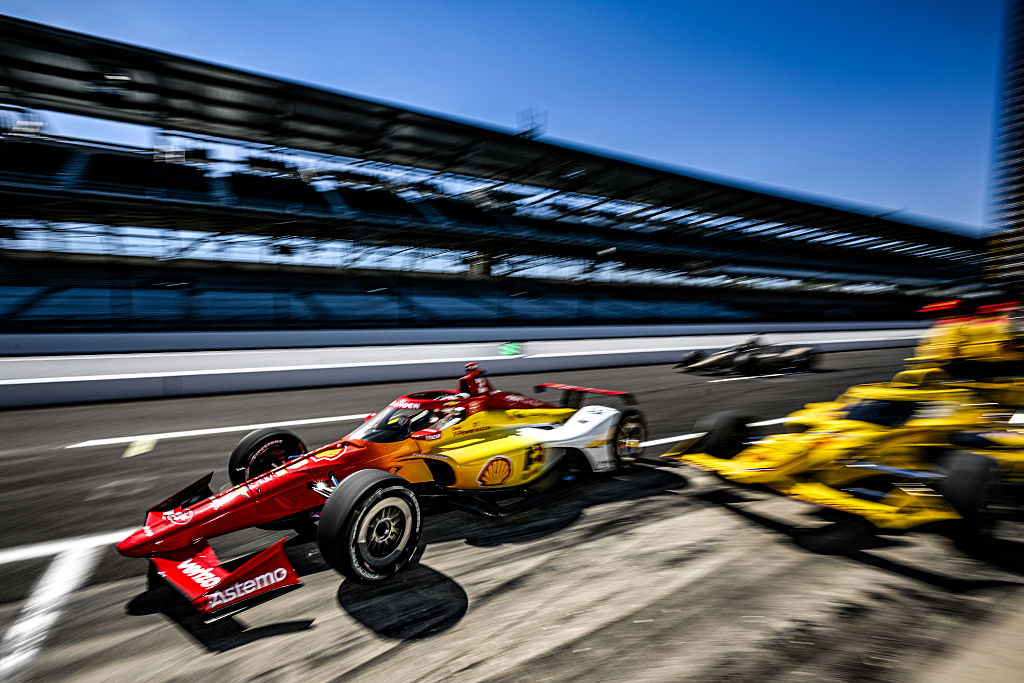
Lots of numbers to crunch in setting hybrid deployment strategies. Brandon Badraoui/Lumen via Getty Images
That’s the deployment side of the hybrid power. The harvesting side is more open to preference where drivers can manually charge their supercapacitors by squeezing a lever or pressing a button on their steering wheels, and set the software to automatically charge in a variety of conditions like when they’re off throttle or while they’re at full throttle, or somewhere between.
On Thursday during his final qualifying simulation runs, Arrow McLaren’s Pato O’Ward was shown lapping with his hybrid set to trickle on deployment and automatic harvesting the moment the supercapacitors were drained to zero. The moment the hybrid battery was empty, the system charged itself back to 100 percent and process started anew as it went from 100 to zero and back to 100 throughout all four laps.
Team Penske was observed testing bigger deployment punches with a tailwind to measure how much the hybrid power added to its top speed, and others were seen using two hard shots of power per lap, onto the main straights.
Of interest, all of the hybrid usage at the standard turbo boost level was useful for learning about race-day harvesting and deployment strategies, but the lessons will start over again on Fast Friday as the big hike in turbo boost – worth at least 100hp – will have a greater effect on lap speeds and overall performance and limit the effect of the hybrid’s contribution.
Once Fast Friday gets rolling, keep a watchful eye on how, when and where drivers bring their hybrids into play and take note of trends to see if teams have happened upon the same idea or strayed into their own directions.
Presented by:

Marshall Pruett
The 2026 season marks Marshall Pruett's 40th year working in the sport. In his role today for RACER, Pruett covers open-wheel and sports car racing as a writer, reporter, photographer, and filmmaker. In his previous career, he served as a mechanic, engineer, and team manager in a variety of series, including IndyCar, IMSA, and World Challenge.
Read Marshall Pruett's articles
Latest News
Comments
Comments are disabled until you accept Social Networking Cookies. Update cookie preferences
If the dialog doesn't appear, ad-blockers are often the cause; try disabling yours or see our Social Features Support.