Dana Garrett/Penske Entertainment
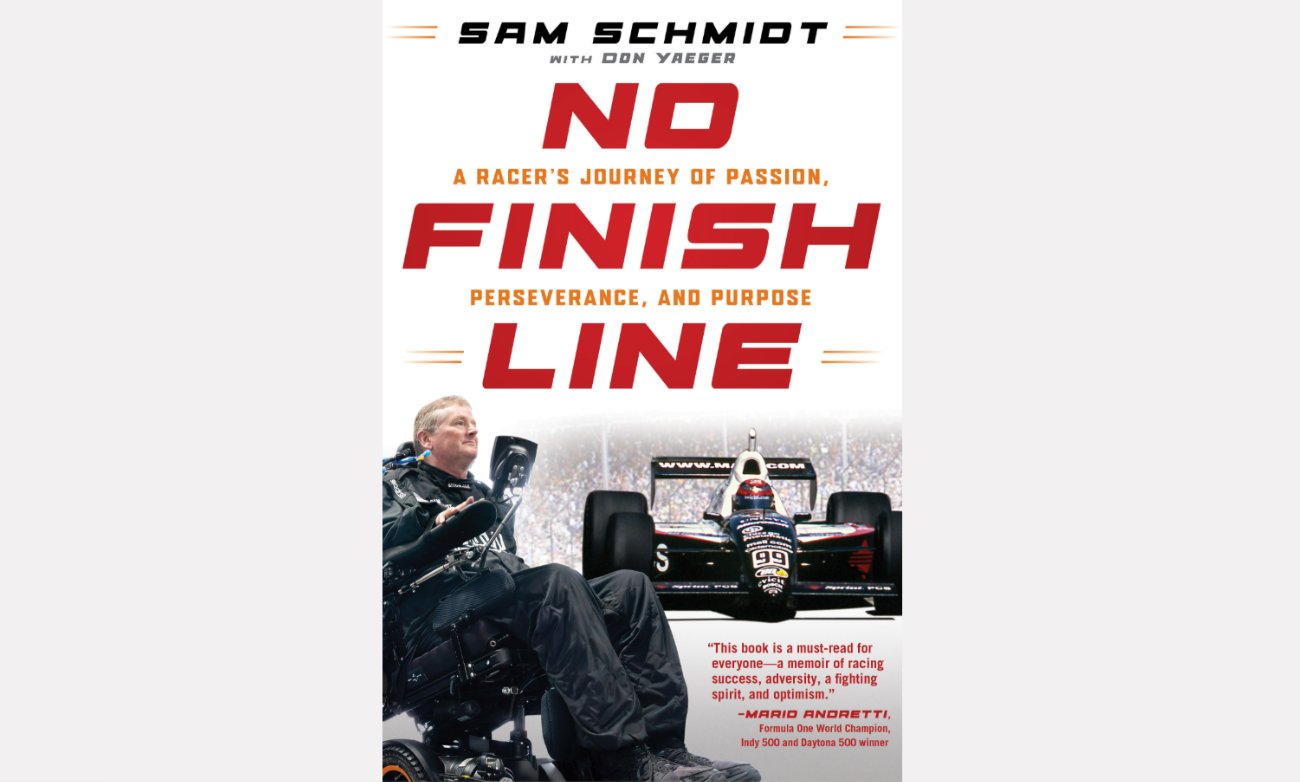
BOOK REVIEW: ‘Sam Schmidt: No Finish Line’
Marv Schmidt was leading his class in the 1974 Ensenada 300 when a chase truck, going the wrong way along the course, T-boned his race car, after Marv slid his car sideways to avoid a head-on collision. Initially feeling he’d gotten away with just a bad headache, after a couple of hours, Marv collapsed with a subdural hematoma. His right side was paralyzed, and he couldn’t speak.
While 10-year-old Sam was absolutely and understandably gutted by the sight of his father unable to walk or talk, still more upsetting to him was witnessing the rehabilitation.
“I was traumatized by what I saw from his painful experience,” Sam writes in his new autobiography, co-written with New York Times best-selling author Don Yaeger. “My father looked so weak as he fought to move even a tiny bit, struggling with each of the exercises, barely able to move a hand or a foot. To me it felt like he was in some kind of prison, not a healthcare facility. Dad yelled and screamed just to simply move his leg a few inches. The aggravation, to my young eyes, seemed like it was killing him, not making him stronger. Yet I’d never seen such determination and will…”
Some two years later, Marv defied the medical verdicts of the time and learned to walk, with the aid of a brace on the right leg, and to talk. Sam, who had been racing motocross, had stopped during his father’s recuperation, not because he considered the sport dangerous but without his father there, there was less impetus. But Marv retained an interest in the sport, even co-owning an Indy 500 team in the ’70s, taking part in the coast-to-coast Great American race, and working for Copart.
As Sam concludes: “In a way, he was setting a blueprint for me. Little did I realize at the time just what his example would mean for me some 26 years later.”
People tend to forget that despite loving racing, Schmidt (Junior, that is) came very late to the sport, and only after going through college and setting up auto-related businesses. Occasionally jalopy racing in a 1966 Chevrolet Impala on the dirt ovals of Southern California, this Lincoln, Neb.-born 20-something then started helping his uncle run a Chevy Camaro in SCCA racing. It was then that the bug bit. At the end of 1991, now aged 27, Sam started seeking opportunities – and determined to make some.
He made his first IndyCar start in 1997 in the Indy Racing League, a 33-year-old debutant. Second in IRL’s ’98 season finale at Las Vegas, Schmidt built momentum with Treadway Racing throughout ’99, and scored his first win at Vegas, but this time it was the penultimate race of the year. The last round was in Texas Motor Speedway, and there he struck the wall hard, damaging his legs and feet, which he describes as “insanely painful.”
Schmidt was barely walking again by the new year, yet despite this, he was spoken of as a potential Indy 500 winner and IRL champion in 2000. Then, while testing at the now defunct Walt Disney World Speedway on Jan. 6, came the hideous 180mph crash that saw Sam’s life change forever. I shall not go into the details here, but we could have lost him that day, if not for the work of IRL’s first responders. Even with their aid, Sam had stopped breathing for five minutes.
Schmidt’s rationalization of the crash is enlightening, and whether that is because of or despite his deep faith in God, it’s impressive. Its effects were of course life-changing but he is living proof that they need not be beyond-all-hope devastating. And for that, Sam thanks not only a higher power but also his wife Sheila. God alone knows what they have been through, individually and as a pairing, in their darker moments, but “power-couple” doesn’t begin to describe them as a unit.
In this book, Schmidt doesn’t delve into team ownership as much as some RACER readers might wish, but then again, we have history books – or more instantly, the internet – to tell us that he is one of the most significant team owners in the history of the Indy Lights feeder series, that his graduation to IndyCar was a smart, gradual process, and that he made his team so desirable that McLaren wished to purchase it after a partnership that allowed the powers-that-be to examine in close detail the workings of the squad.
What “No Finish Line” does examine in detail is the deal with Arrow Electronics, a Denver, Colo.-based company that not only came to back his IndyCar team – and continues to do so under McLaren’s leadership – but also transformed Schmidt’s life. Who can forget those emotional laps he turned at Indianapolis Motor Speedway in 2014 in the S.A.M. car, a Corvette C7 equipped with Arrow’s extraordinary driving system? Sam blew through a tube to apply throttle, sucked to apply brakes – known as sip–’n’–puff technology – and then using special headgear transmitting to four infrared sensors within the car, he would turn his head to alter steering angle. He reached 100mph on the straights in the run the week before that year’s Indy 500 pole day; afterward, he would eventually lap the course at 106!
The progress that Schmidt and Arrow made thereafter has changed lives and will continue to do so. The same is true of the Sam Schmidt Paralysis Foundation which was rebranded as Conquer Paralysis Now a dozen years ago, to invest research into recovery programs and support people with disabilities. Now there is the DRIVEN NeuroRecovery Center, “where individuals with disabilities can improve their physical, mental and emotional health, increase independence, and enhance their overall quality of life using a holistic approach to wellness.” Worth noting is that this is not just for those who have suffered a life-changing spinal cord injury, but also for those with multiple sclerosis, Parkinson’s, cerebral palsy, transverse myelitis, etc. Little wonder that, despite being a racer at heart, Schmidt is finding his post-team-ownership life just as fulfilling.
The book is well written, but that almost goes without saying: Schmidt is an entirely authentic individual who expresses himself in an eloquent manner, and Yaeger doubtless kept the narrative on track, polished the grammar, and made sure that the correct tone was achieved. Schmidt would have spurned anything that portrayed him as emotionally overwrought or cold and calculated.
Over the last two decades I have seen Sam tearful – for positive and negative reasons – and comfortable to show it without qualm, yet I’ve also seen him suppress his feelings in order to come across as the resolute and rational business owner, thereby hiding the inner racer! I’ve witnessed and passed judgment on his good and bold choices, just as I’ve seen and heard the fallout from his harsh decisions. Like all of us, he’ll have mean and petty thoughts, but in between there’s so much wit, magnanimity and genuine desire to do good and make a difference.
What Schmidt has achieved is greatness in a manner that he never expected when he first became an IndyCar driver some 30 years ago. While No Finish Line is not a racing biography, as such, it will be inspirational to those living with similar injuries, and I hope it also spreads a little more empathy and understanding in our benighted society for those in Sam’s situation. Fate, faith and determination have made him much more than a former racing driver. What he’s been through, and what he’s made of his life in the last 26 years, makes this book much more than a former racer’s biography.
Hardcover: $29.99 USD, $39.99 CAN
Ebook: $19.99 USD, $26.99 CAN
On sale from May 19, 2026.
Presented by:

David Malsher-Lopez
Read David Malsher-Lopez's articles
Latest News
Comments
Comments are disabled until you accept Social Networking Cookies. Update cookie preferences
If the dialog doesn't appear, ad-blockers are often the cause; try disabling yours or see our Social Features Support.
.png?environment=live)