Pirelli
Pirelli sets its sights on a safer, smarter future for America's streets with new state-of-the-art Cyber Tyre
Italian tire manufacturer Pirelli has had an American presence since 2002, when it constructed its flagship stateside manufacturing plant in Rome, Georgia, but as it approaches its 25th year of high-end tire production for some of the most technologically advanced vehicles around, the company is going all in on the U.S. market with a $1.2b investment aimed at expanding its Rome facility and drastically ramping up its annual production capacity.
At the center of Pirelli’s new venture is its hypermodern Cyber Tyre technology, which gathers real-time tire data through a 13g sensor in the tread and transmits it via Bluetooth to dashboard displays, allowing vehicles to make responsive adjustments to changing road conditions instantaneously while also informing drivers of each piece of information it collects.
When work on the plant’s big upgrade begins in 2027, Pirelli expects it to generate up to 1,000 new jobs in the area, with much of the project focused on updating and expanding the facility’s state-of-the-art automated production system to increase its output from 500,000 units per year to 6,000,000 by 2033. The Italian outfit plans to partner with local universities to fill some of these new positions, offering students an opportunity to get on-the-job experience in the engineering and automotive industries.
An investment so large into what is presently a relatively niche corner of the market may appear bold on paper, but with the U.S. leading the world in consumption of high-end automotive products, Pirelli not only sees the country as worthy of such a commitment but believes it to be critical to the next era of its business.
So how does the Cyber Tyre tech work, exactly? RACER and other select outlets were given an opportunity to put Pirelli’s latest innovation to the test firsthand during a track day at Las Vegas Motor Speedway ahead of F1’s Las Vegas Grand Prix. Here’s what went down.
The Cyber Tyre testing experience
Journalists trialed three of the Cyber Tyre’s marquee offerings: multi-setting traction control, ABS, and real-time feedback about tire pressure, temperature, acceleration data, and tread wear under high-speed conditions.
The first exercise, designed to demonstrate the tire’s three-pronged traction control capabilities, was the most impressive of the day. Journalists took a corner at 45mph while using each of the P Zero MS all-season tires’ three settings – its default summer mode, a higher-grip winter mode designed for wet or muddy conditions, and the adaptive Cyber Tyre mode – to experience the differences in grip between each. The Cyber Tyre’s real-time adjustments delivered the smoothest ride of the three; while the summer mode setting felt overly tight and stifling – opposite to the winter mode, which was considerably looser and allowed for more slide upon exit of the apex – the Cyber Tyre mode introduced an instantly-palpable increase in grip that allowed the car to comfortably hug the corner and provided the strongest sense of control on track.
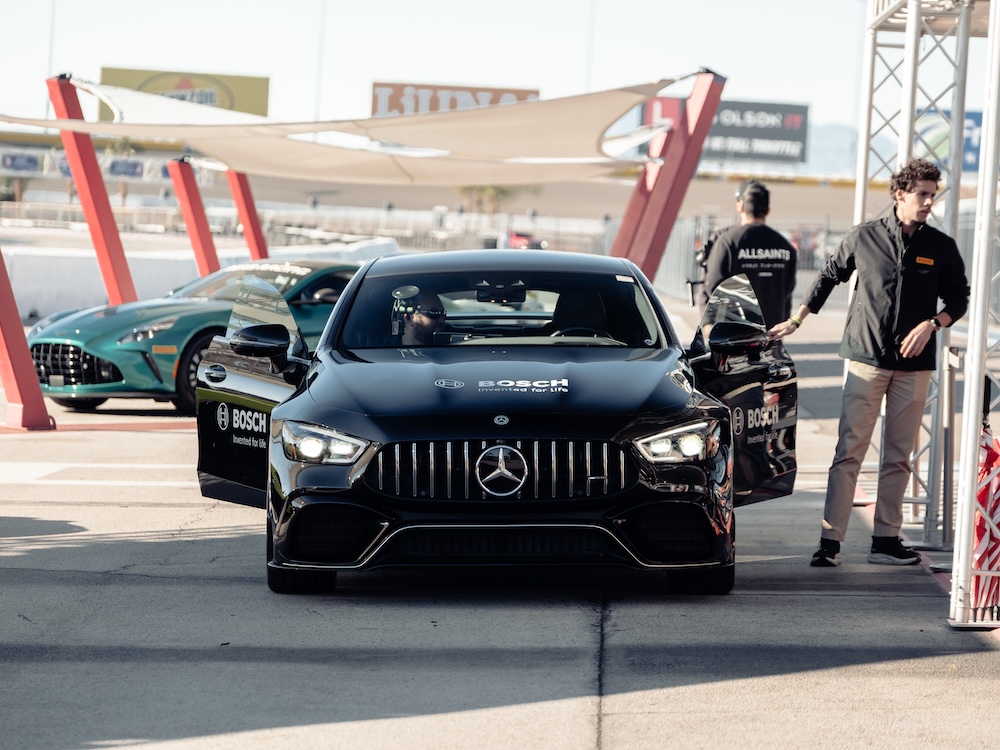
This Mercedes-AMG GT served as the test vehicle for journalists' cornering runs and offered a nice contrast to the Pagani Utopia Roadster. Pirelli
Second was a demonstration of the tire’s unique engagement with anti-lock braking systems. Live data on the tire’s point of maximum grip, transmitted to the car’s infotainment system, allows drivers to shorten braking distances and extend overall tire life. In this writer’s test run, the Cyber Tyre setting saved about 0.5m compared to an ABS stoppage without Cyber Tyre tech turned on. The distance saved varied unpredictably between outings, leaving the feature's true capabilities somewhat unclear. As a result, this feature seemed the least useful to the everyday driver of them all, but it could be helpful under certain conditions.
Finally, the Cyber Tyre’s capabilities at high speed were shown via a hot lap in a Pagani Utopia Roadster, the first vehicle on the market to come equipped with the Cyber Tyre as its base set. While the cornering test was the most impressive, the Pagani run was far and away the most thrilling. Special proprietary software integration allows the Utopia Roadster to adjust torque management as tire temperatures change throughout a lap; data about each adaptation, including shifts in tire pressure and tread wear, is transmitted via a Bluetooth chip and displayed for drivers as it happens.
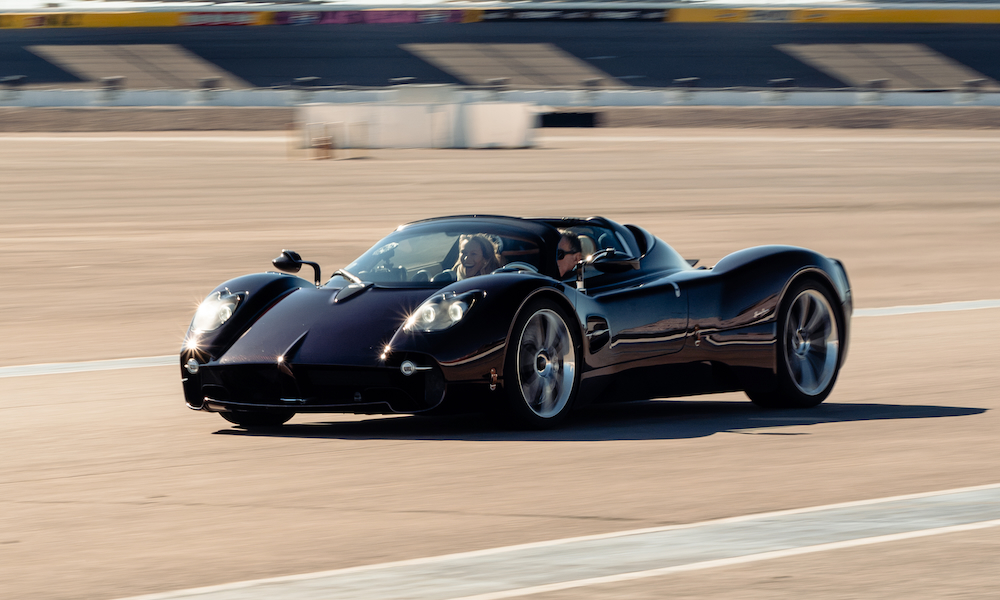
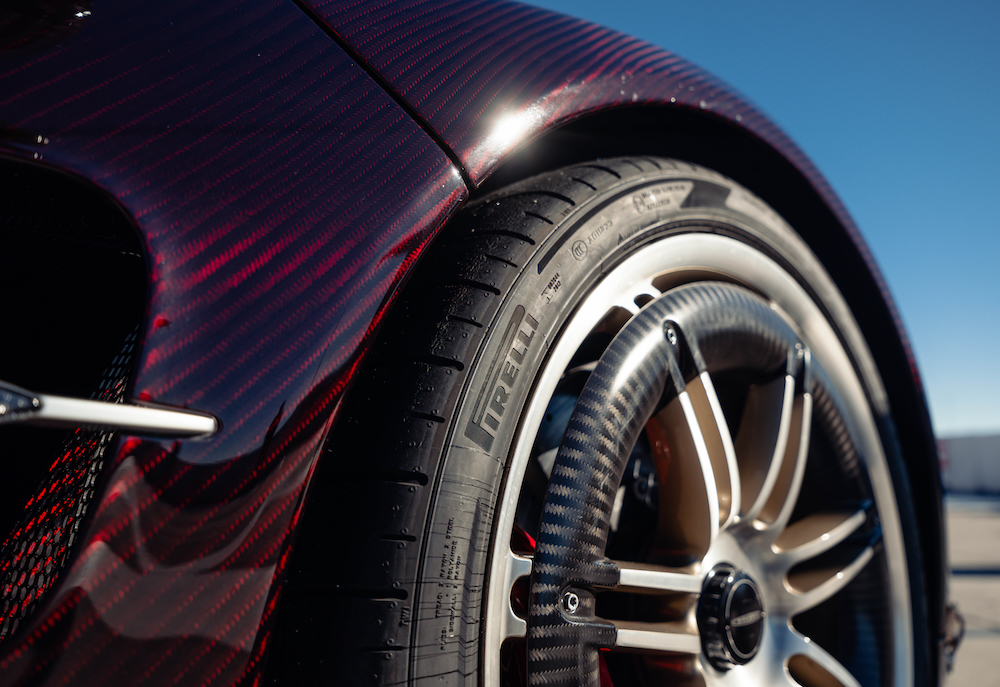
An absolute stunner inside and out, the Pagani Utopia Roadster is a work of art down to the smallest detail. This Hypercar can be yours for just $3.4m. Pirelli
Future applications of Pirelli’s Cyber Tyre tech
Though Cyber Tyre technology is already available to consumers, Pirelli envisions the product having its most significant impact on the automotive industry in the years to come, particularly as autonomous driving takes on a larger share of the market. The tire has several safety-focused features designed to lower accident risk and protect drivers and their passengers, including early aquaplaning detection and road hazard identification.
In the future, Pirelli hopes data collected by its Cyber Tyre-equipped tires can be shared with municipalities across the country to aid in infrastructure maintenance planning, making roads safer for all drivers. The company also aims to make the technology available to a broader range of vehicles – at present, only Pagani, McLaren and Tesla have seen it integrated into some of their offerings – and is actively working with American manufacturers like Ford and Dodge to expand access to the everyday consumer, with Pirelli executives naming the Ford F-150 as one of several target vehicles.
RACER’s verdict on the Cyber Tyre
While the product seems to have a somewhat limited use at the time of writing, the potential for it to develop into a truly meaningful driving aid that genuinely improves road safety is not only easy to envision, but actually seems like it could be feasible. Whether or not the project succeeds in its goals depends entirely on Pirelli’s ability to bring a broader range of customers into the fold and share a bit of its top-shelf prestige with average Americans. Doing so may cost the brand some of its air of exclusivity. Still, as its U.S. profile grows in tandem with its motorsport partners like Formula 1, MotoGP, SRO (Intercontinental GT Challenge/GT World Challenge), HSR and the American Rally Association, among others, the benefit would far outweigh the cost.

Emily Maxwell
A longtime motorsport fan, Emily joined RACER with a background in music and chess and a passion for connecting readers to the human side of sport. She has previously written for American Songwriter Magazine, the US Chess Federation and Chess.com, among others. When she’s not watching or writing about racing, you can find her drafting novels, writing songs and yapping about basketball.
Read Emily Maxwell's articles
Latest News
Comments
Comments are disabled until you accept Social Networking Cookies. Update cookie preferences
If the dialog doesn't appear, ad-blockers are often the cause; try disabling yours or see our Social Features Support.