GM News
One of GM's elusive Futurliners just took a lap around NYC ahead of Retromobile NYC
Despite what you may have heard, New York isn’t the greatest city in the world because of all the spacious apartments and majestic wildlife; it’s because it regularly hosts cultural moments like this. New York got a pretty spectacular visitor this past weekend: a 1939 General Motors Futurliner. The enormous Art Deco bus was spotted making its way around the city as a rolling preview of Retromobile NYC, which opens Nov 19th and runs through the weekend at the Javits Center. And if you thought the bus was impressive cruising through Manhattan, wait until you see it up close.
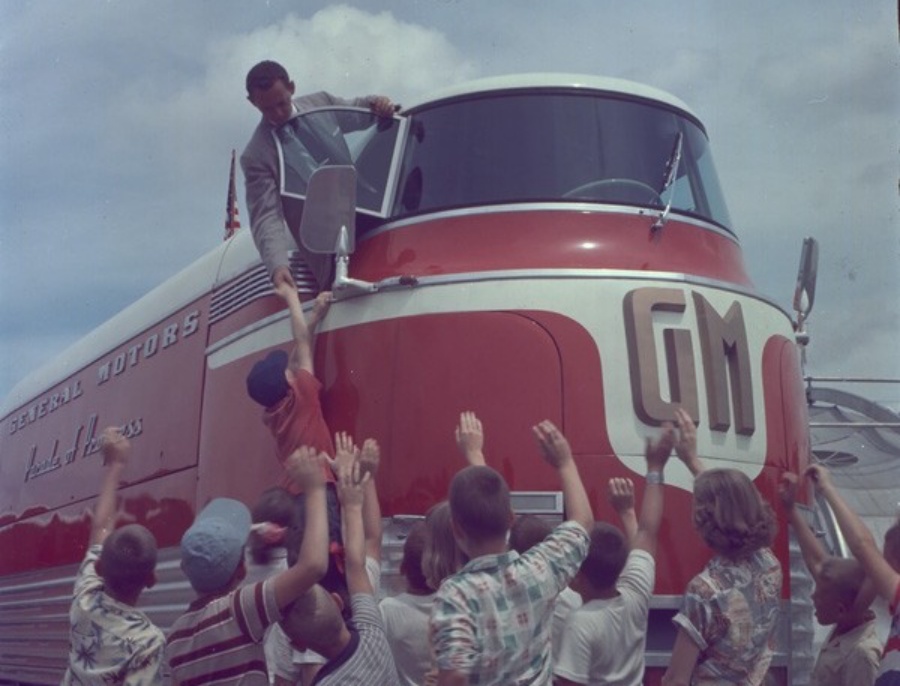
Just so we're clear on how special this bus is, the retrofuturist craft is one of only 12 Futurliners built for General Motors' traveling Parade of Progress; this 33-foot-long machine is among the rarest and most recognizable pieces of American automotive history. Born from the wonderful mind of legendary GM stylist Harley Earl, the Futurliners were essentially traveling science exhibitions, built to bring demonstrations of emerging technology to communities across the country. Only nine are known to survive today, making this freshly restored example a particularly special sight.
GM took the future on the road
Long before the internet made the world's latest technological advances available at the tap of a screen, seeing the future required a little more effort. In the 1930s, World's Fairs were among the best places to get a glimpse of what was coming next. General Motors decided that experience shouldn't be limited to people who could make it to a fairground, so it took the show on the road.
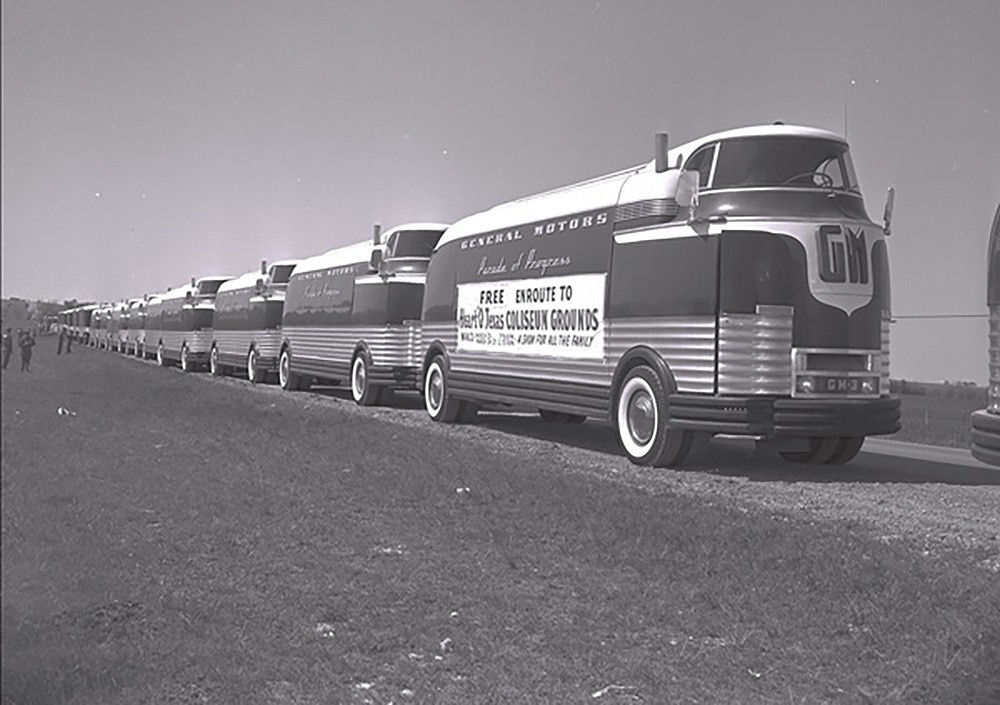
Futurliners in a row | GM
The idea came from GM research chief Charles F. Kettering, who attended the 1933 Chicago World's Fair and saw an opportunity to bring its demonstrations of science and technology to a much wider audience. By 1936, GM had launched its Parade of Progress, a traveling exhibition featuring enormous transport vehicles that doubled as mobile showrooms. Their colossal side panels opened to reveal modular stages and exhibits covering everything from industrial machinery and jet engines to television. A crew of roughly 60 recent college graduates traveled with the caravan, giving presentations and answering questions from curious crowds.
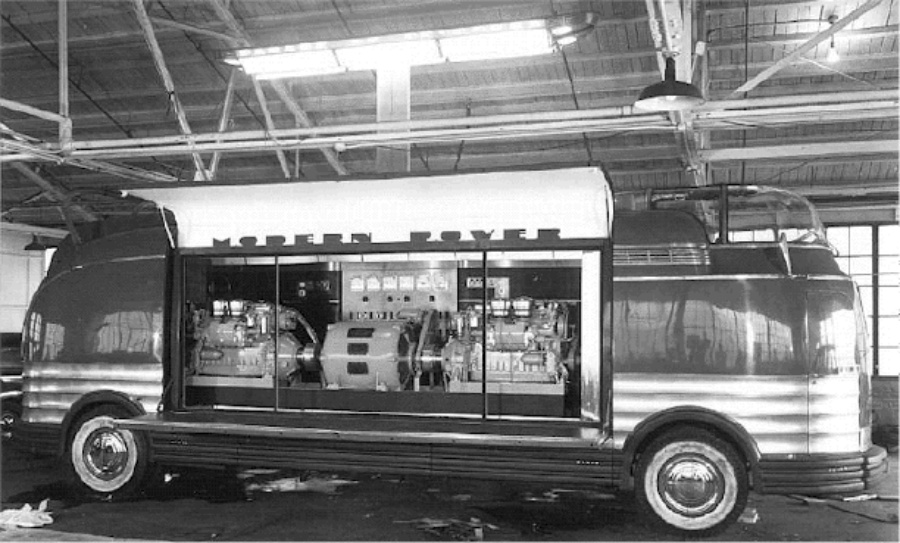
Futurliner in display mode | GM
The Parade of Progress was expanded in 1940, when GM commissioned 12 new exhibition vehicles under the direction of legendary designer Harley Earl. Built by Fisher Body on chassis supplied by Yellow Truck & Coach Manufacturing, the Futurliners were 33 feet long, eight feet wide, and weighed nearly 12 tons. Their most striking feature was the elevated central cockpit, which put the driver roughly 10 feet above the pavement. Access required climbing a spiral staircase, making the whole business feel more like boarding a futuristic aircraft than getting behind the wheel of a bus.
The Futurliners toured the United States and Canada in 1940 and 1941 before World War II brought the program to a halt. GM revived the Parade of Progress in 1953, sending the refurbished vehicles back out for another three years of demonstrations. By 1956, however, attendance had begun to decline, and the traveling exhibition was retired. GM distributed the Futurliners to various businesses and organizations, and their days as rolling ambassadors of the future came to an end.
Of the 12 originally built, nine are known to survive today. Only a handful have undergone full restorations, and one sold at Barrett-Jackson for $4.32 million in 2006. More than eight decades after their debut, the Futurliners remain remarkable artifacts of an era when the future was something you could pull into town, park in the town square, and invite everyone to see.
A Futurliner returns to its original form
This particular example has just completed an extensive restoration by New Jersey-based craftsman Rob Ida, whose goal was to return it to Earl's original 1939 design rather than the updated appearance it received in 1953. That involved replacing the body panels and recreating the original bubble canopy over the cockpit. The result is reportedly the only surviving Futurliner accurately restored to Earl's original styling, with one modern concession in the form of air conditioning.
Ida is no stranger to ambitious automotive restorations. A third-generation craftsman whose grandfather opened a Tucker dealership in Yonkers, he previously restored Tucker 1044 to first-place finishes at Amelia Island and Greenwich. In 2025, the Greenwich Concours d'Elegance recognized him as its featured restorer.
The Futurliner will make its first public appearance since the restoration at Retromobile New York, where Ida will unveil it exclusively for show attendees. It's a fitting centerpiece for the event, particularly given the Futurliner's connection to the 1939 New York World's Fair, which helped inspire its name and design. More than 85 years later, one of GM's original visions of the future has returned to the city.
Retromobile New York runs November 19-22 at the Javits Center, bringing the celebrated Paris collector-car show to the United States for the first time. With more than 200 exhibitors and Gooding & Christie's as its official auction house, there's plenty to see, but the freshly restored Futurliner is going to be tough to miss. After all, there aren't many opportunities to stand next to one of just nine surviving examples of one of GM's most ambitious creations, especially one that looks the way its designers originally intended.

Peter Corn
Peter Corn is an automotive writer and storyteller. Peter has spent nearly a decade writing about cars, trucks, and motorcycles for some of the best publications in the business. He believes the best automotive stories aren't really about the machines at all, but instead, the people who love them.
Read Peter Corn's articles
Latest News

Comments
Comments are disabled until you accept Social Networking Cookies. Update cookie preferences
If the dialog doesn't appear, ad-blockers are often the cause; try disabling yours or see our Social Features Support.