Ford
Ford debuts new 5.4L V8 Hypercar engine spec at successful first endurance test
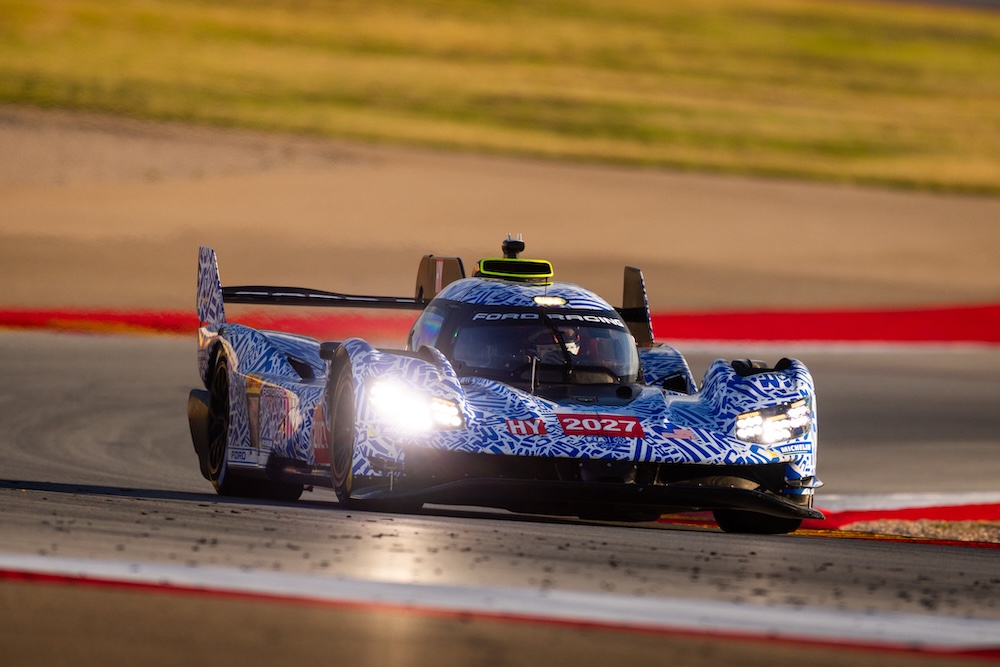
Ford debuted a new specification of its 5.4-liter V8 Hypercar engine during a successful first endurance test at Motorland Aragón, Spain last week as the testing phase for its FIA WEC-bound ORECA-based LMDh reached a major milestone.
The updated powerplant offers both increased power and reduced mass, with its latest specification having completed 30 hours on a powertrain dyno before being installed in both cars for the Aragón test.
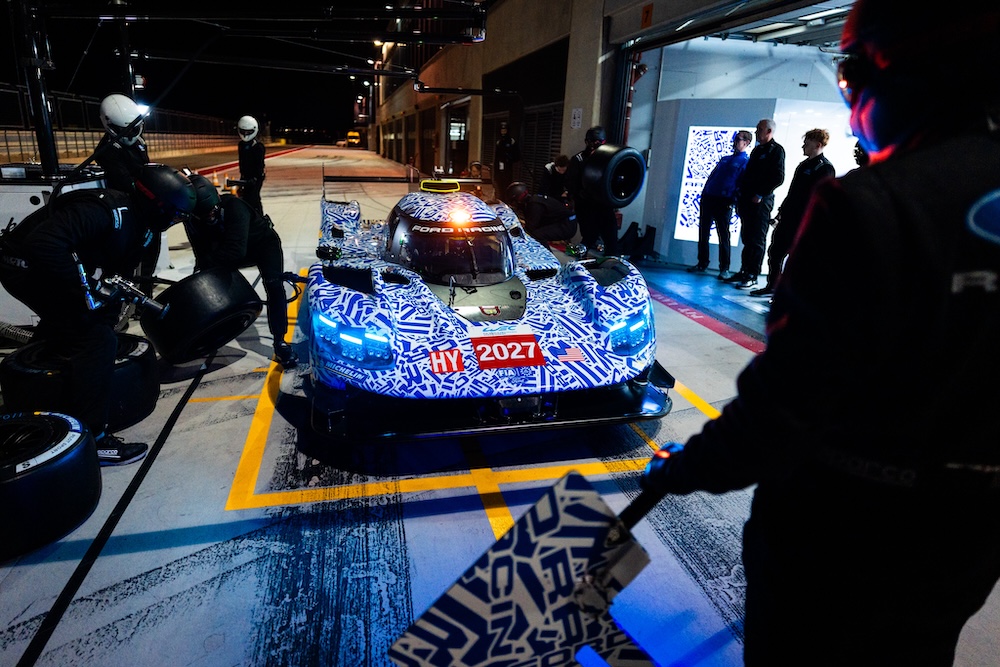
The American marque ran two cars at the Spanish venue, with one focused on performance running while the other attempted a 30-hour endurance run.
The endurance car completed more than 24 hours of near-continuous running, with stops scheduled every six hours to remove bodywork and perform a visual inspection. An unscheduled stop overnight was required to change the engine because of a straightforward cooling issue. The pause also provided an opportunity to apply lessons learned from the performance car to improve the quality of the remaining running.
The mileage accumulated at Aragón – more than 7,300 kilometers across both cars – more than doubled the total distance covered by Ford's test program to date, bringing the manufacturer's running to approximately 14,400 kilometers.
“It was our first attempt at a 30-hour endurance test,” Ford Racing's FIA WEC program manager Dan Sayers told reporters, including RACER.
“We hadn't done more than about a stint and a half of continuous running before this, so it was quite a leap into the unknown despite it being a fairly well-proven chassis from ORECA. The hybrid system is obviously quite far through development, but it was our own engine, bodywork, and all the small intricacies like the wiring loom harnesses and the routings. There's a lot to go wrong.
“We learned a huge amount. There were no failures that we're concerned about. The cooling issue was extremely simple, which is probably why it's even more frustrating. I would class it as a very successful first endurance test.
"It was good for the performance car too. We made some significant improvements. I think Imola was pretty good, and ever since Silverstone, we made good progression. It's also all tying back to the simulator in Concord. We're aware that when you go to an event in WEC, you need the car in the performance window straight away. You haven't got time to start essentially re-doing all your set up. So we're using the performance car to iterate and correlate to prefect the car model in the simulator.
"We hadn't got much data on Motorland before going there, so the guys did a good job in the sim before. We then did mechanical set up for some of the time, then systems, then control blocks. We focused hard this time on shifting and braking, and got the drivers quite a bit happier in terms of confidence and feeling."
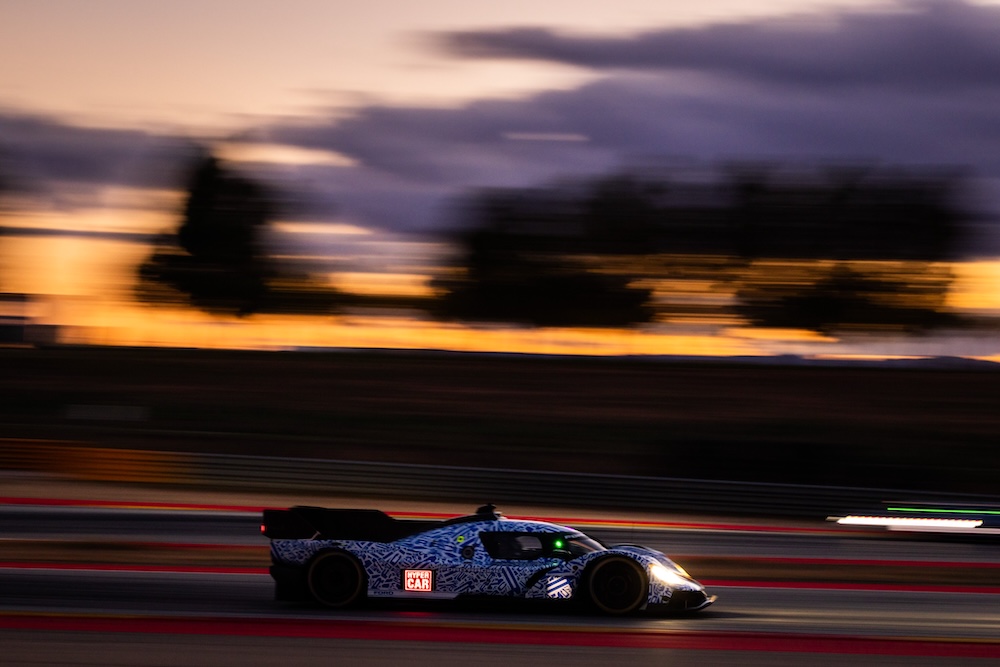
The mileage accumulated at Aragón – more than 7,300 kilometers across both cars – more than doubled the total distance covered by Ford's test program to date, bringing the manufacturer's running to approximately 14,400 kilometers. Ford
Putting the new engine specification on a powertrain dyno before being installed in the car was critical, giving Ford the confidence to run it in both prototypes during this critical phase of the test program.
“I would say I'm fairly risk-averse, and it’s a slight risk putting the powertrain in the car and going for 30 hours rather than doing a test beforehand. But that's what a condensed test programme does," Sayers stated.
“There are developments that happen all the time, not just for performance, but for reliability and packaging. It’s come a long way, and we're very happy with the latest spec of engine. We are very happy with the reliability. I think they had a bearing issue on the 30-hour run on the dyno, but generally it’s been very good."
When asked by RACER for more details on the changes made to the engine, Sayers explained that its main structure "has gone on a serious diet."
"The block, the heads, cam covers, all light weighting. They've upped the power through compression ratio predominantly, so it's quite a big change on the specification."
All six full-time Ford Racing Hypercar drivers attended the Aragón test, plus its newly announced reserve driver Tom Dillmann. Illness, though, impacted the camp; Logan Sargeant did not drive due to illness, while Mike Rockenfeller was only able to complete a few short runs.
Thankfully it didn't impact the run plan. In fact, it allowed Dillmann, who had previously joined Ford for a shakedown test, to benefit from more time behind the wheel in his first significant run in the car, allowing him to contribute to the effort immediately.
“I've got to say I was pretty impressed,” Sayers admitted when asked about Dillmann's performance. “No surprises there, to be honest. He's very easy to work with, very relaxed, super competent in a prototype, straight up to speed and giving very good feedback.
“We're keen to get him in the simulator as well, so he'll be in the simulator soon out in Concord, preparing and correlating from previous tests, and then we'll have to see how we work that into next year. He'll certainly be on standby at the track for the longer races, but in the shorter ones we might even do some live simulator running at the same time.”
Alongside having all seven drivers present, Ford Racing now also has its full staff in place for 2027, a situation that has been the case since its recent test at Imola.
All six full-time Ford Racing Hypercar drivers attended the Aragón test, plus its newly announced reserve driver Tom Dillmann. Ford
That means Ford is unlikely, at least in the short term, to recruit from Peugeot following the French manufacturer's last-minute exit from Hypercar. Ford has signed up talent from other teams though, with Sayers noting that Ford had signed an engineer from Alpine, which has also pulled out of the WEC ahead of 2027.
“Others withdrawing from the series has opened up opportunities," said Sayers. "Unfortunately, it probably is too late for a lot of them, but it is opening up opportunities to get more experienced people in.
“But we are pretty happy with the team we’ve got already. A lot of LMDh experience, a lot of WEC experience, and a lot of systems and controls experience. We have taken people from other series, and that's been a specific target and objective, but someone with Hypercar experience is always listened to, and we get contacted quite often. We have quite a pool to choose from at the moment.”
Motorland Aragón was an ideal venue for Ford Racing to conduct its first 30-hour endurance test due to its winter climate and the characteristics of the layout, which features a lengthy back straight, making it an ideal venue to prep for the most important race of the season.
“The beauty about Motorland was we used the configuration where you're doing speeds that are slightly greater than Le Mans down the back straight, so you're putting all the bodywork under the aero loads that you'll see at Le Mans,” Sayers explained.
“There's a very hard brake into the hairpin at the end of that, so you're testing all the brake systems, the aero, everything … it's as representative of Le Mans as we can get at those speeds.”
Ford Racing's Hypercar test program will now move to North America, with key tests at Sebring scheduled for either side of the New Year. The first will be a standard test, allowing the team to establish a baseline ahead of a 30-hour endurance test in January, where Sayers is well aware, things may break on the notoriously bumpy circuit.
That endurance test will take place with the car fully homologated, with homologation scheduled for next month. Ford Racing currently has a dedicated wind tunnel car based in North America, which has been consistently updated in line with the test program.
Further testing is planned at two venues that feature on the WEC calendar: Circuit of The Americas in Texas, and the Lusail International Circuit in Qatar, where the car is due to make its debut in the WEC.
Interestingly, it seems there was a chance Ford could have debuted its unnamed LMDh earlier than expected, in the Asian Le Mans Series, which has a class for Hypercars as of this season. However, the timing of the Sebring and Lusail tests has — barring a cancellation of its plans in the Gulf — ruled out a possibility for Ford to gain some early racing experience in a lower-pressure environment ahead of the WEC season opener.
“Let's see what happens with Qatar,” Sayers said to RACER, “because nobody really knows at the moment. We're all planning that it will go ahead, but yes, we had considered it, or I had, anyway."

Stephen Kilbey
UK-based Stephen Kilbey is RACER.com's FIA World Endurance Championship correspondent, and is also Deputy Editor of Dailysportscar.com He has a first-class honours degree in Sports Journalism and is a previous winner of the UK Guild of Motoring Writers Sir William Lyons Award.
Read Stephen Kilbey's articles
Latest News
Comments
Comments are disabled until you accept Social Networking Cookies. Update cookie preferences
If the dialog doesn't appear, ad-blockers are often the cause; try disabling yours or see our Social Features Support.