Glenn Dunbar/Getty Images
Why aren't female F1 team principals more common?
Dorilton Capital's takeover of the Williams Formula 1 team was a significant moment in the sport’s history.
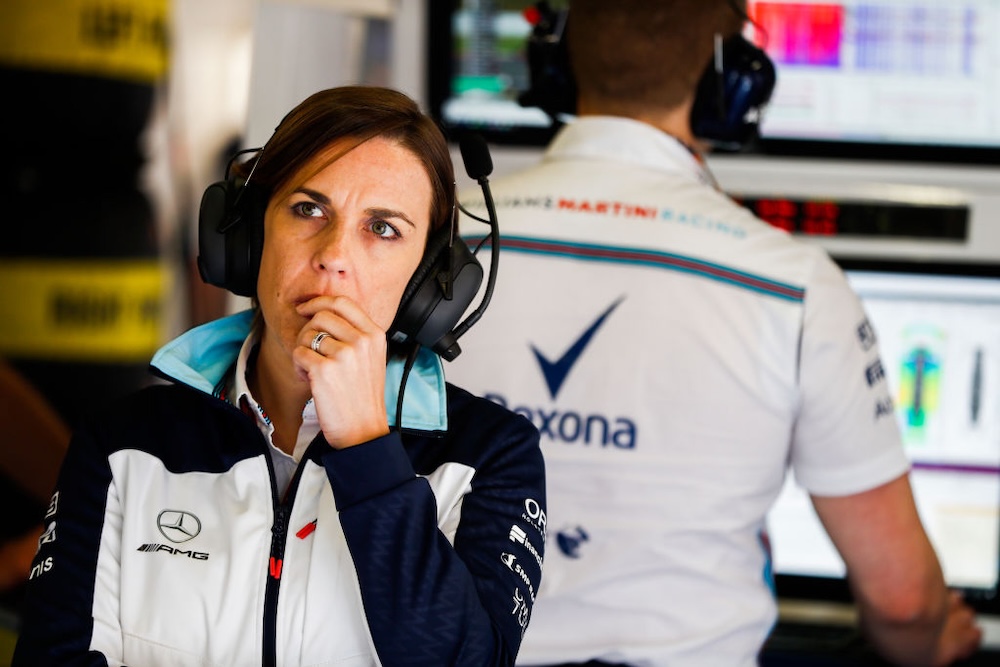
A team that had been one of the most successful in F1 was no longer family-controlled, and with it, the de-facto team principal Claire Williams (main image) opted for a clean break. Satisfied that Dorilton would protect and honor the team’s legacy – something she says remains true to this day – she explored “what else the world has to offer” while caring for her father and team founder Frank until he passed away in 2021.
Fueled by her passion for the sport, Williams has since increased her connection to it through public speaking engagements, advisory positions and some punditry on British television. And that allows her the opportunity to talk about - among other things - how much F1 has changed in terms of female representation.
Generally, that’s from a positive perspective. But the significant moment triggered by Dorilton’s takeover is it marks the last time a female was in charge of an F1 team.
Go back a decade, and two of the 11 teams competing in the 2016 season were run by women. As well as Williams, Monisha Kaltenborn was the team principal of Sauber, and it felt like a particularly progressive time: one that has not carried through to todaym despite strides in many other areas.
“This is one of the reasons why I really like being out and talking about my role in the sport,” Williams says. “Because I think it's important that we keep reminding people that there have been female team principals, because we see now 11 male team bosses.
“There is so much work going on in order to promote roles within the sport for women, but roles in the car and then roles in the garage – and I know still there are a lot of women working behind the scenes – but I do find it interesting that there hasn't been another female team principal since I was in the sport.
“It’s six years and I always say … if I can do it I don't see why anyone else can’t, because I was nothing special and there are women that are far smarter than I am. So why wouldn't there be another female team principal? I don't know if it is because the pathway isn't there for women coming up in those more administrative, business-side of the roles within the sport, where the leadership isn't looking at women and actively promoting on that side?
"(Or) whether the focus is too much on finding the next female driver? I'm not saying that it is, I'm saying that, is there any focus being put on finding a female team principal? It shouldn't be done for gimmick, it should be done for merit, but I think it's a really important role that needs to be filled. When you're a female team principal you can you can be so powerful, because you've got such a powerful platform.
“I felt the power of my platform when I was using it to promote women in motorsport, women in engineering, and we don't have that at the moment. We don't have a woman at the helm using that powerful platform, and it is so much more powerful (now) than it was in my day. If there was a female team principal still in the sport, you can only imagine what that would do to the next generation of women looking at the sport across all of the different roles.
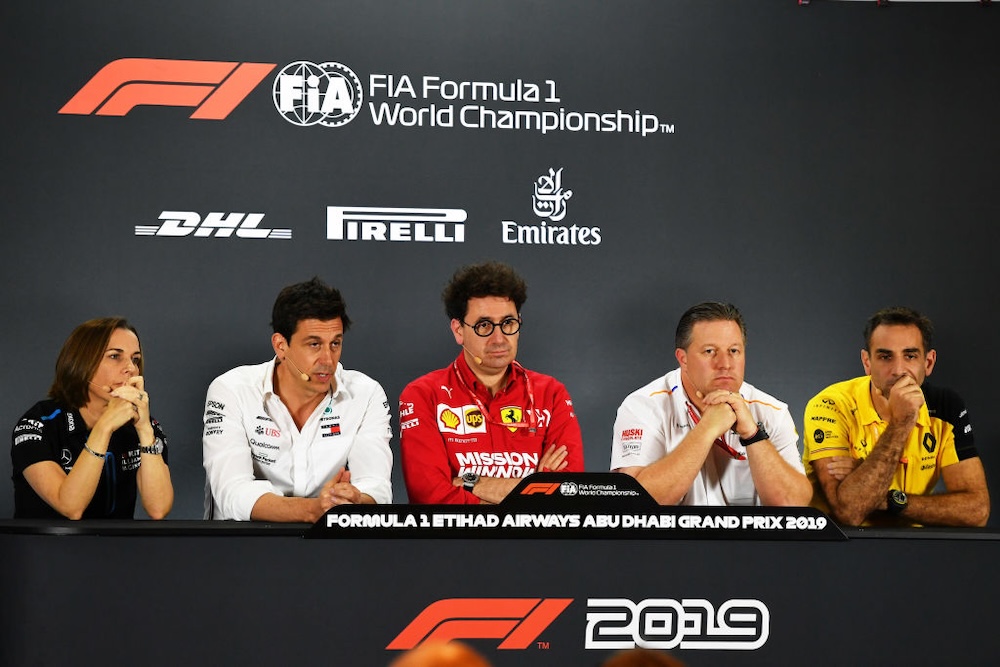
Williams suspects that a lack of current role models and absence of a pipeline to develop female managerial talent are among the possible reasons why there haven't been any women at the helm of an F1 team since she left Williams in 2020. Simon Galloway/Gewtty Images
“It would be so powerful, and I think it's a real shame. But I could not tell you why why there isn't one, except perhaps maybe it is the same theory that Susie [Wolff] has around the driver side of things, that there isn't the pipeline, there isn't the the number at grassroots level. Maybe that's the same, maybe there isn't the number of women coming through the younger stages or the lower tiers in an organization in a team that are then being promoted up.”
Aside from a potentially smaller pool of future leaders, Williams has first-hand experience of another challenge that faces many women as they progress with their careers in any industry: motherhood.
Her son was born in 2017, and despite her position in charge of the team, the then-41-year-old still found it an extremely testing time.
“You equally can't get away from the fact – unfortunately I've been through it, and I'm a woman and I can talk about it – but you cannot take away from the fact how hard it is to be a woman that is reaching a particular point in their career that invariably then coincides with wanting to start a family.
“If you are running a Formula 1 team and you're trying to start a family, having first-hand experience of that is one of the hardest things that I've ever done. And yet I had all the support of my team around me. And I think because I owned the team – or my dad owned the team – and it was family, that really helped as well.
“Leaving leaving your family when you've just had a newborn, for example, like I had to do for 22 races of the year, is is a really hard sacrifice to make. But that's a personal choice, and I did it. I was able to bring my child with me to races, or to a handful of them, but that's really challenging, and I think that might be one of the issues that we're facing.
“You can put as much infrastructure and support around a female team principal to manage that situation, but it's a sacrifice, and it's it's a really challenging environment to operate in.”
Not that Williams believes F1 isn’t moving in the right direction, especially as it now speaks to a younger and more diverse fanbase. But in terms of the overall team leadership, a current example for aspiring female executives to follow remains absent.
“It looks so different, and it's brilliant," Williams says. "I was always such a keen advocate for more women in motorsport and across all of the different disciplines that we have, and we had so many programs in order to try and achieve that at Williams.
“Actually it was one of the things that when I left, as much as I was sad about the competition and the people, not being able to continue that work to me was a real cause for disappointment, because I felt so passionate about trying to bring more women in and create a better environment and better pathways.
“I think the work has absolutely continued. But it's a never-ending story, it's a never-ending piece of work that needs to be done to try and drive a greater gender balance within Formula 1.
"So much more is being done, and it's about having role models, at the end of the day. It's, 'if you can see it, you can be it'. If you see women that are in the garage, that are sat on the pit wall, that are doing the aerodynamics in the wind tunnel, then everyone else can see it that's coming up and choosing their careers. And that's so important.”
Chris Medland
While studying Sports Journalism at the University of Central Lancashire, Chris managed to talk his way into working at the British Grand Prix in 2008 and was retained for three years before joining ESPN F1 as Assistant Editor. After three further years at ESPN, a spell as F1 Editor at Crash Media Group was followed by the major task of launching F1i.com’s English-language website and running it as Editor. Present at every race since the start of 2014, he has continued building his freelance portfolio, working with international titles. As well as writing for RACER, his broadcast work includes television appearances on F1 TV and as a presenter and reporter on North America's live radio coverage on SiriusXM.
Read Chris Medland's articles
Latest News

Comments
Comments are disabled until you accept Social Networking Cookies. Update cookie preferences
If the dialog doesn't appear, ad-blockers are often the cause; try disabling yours or see our Social Features Support.