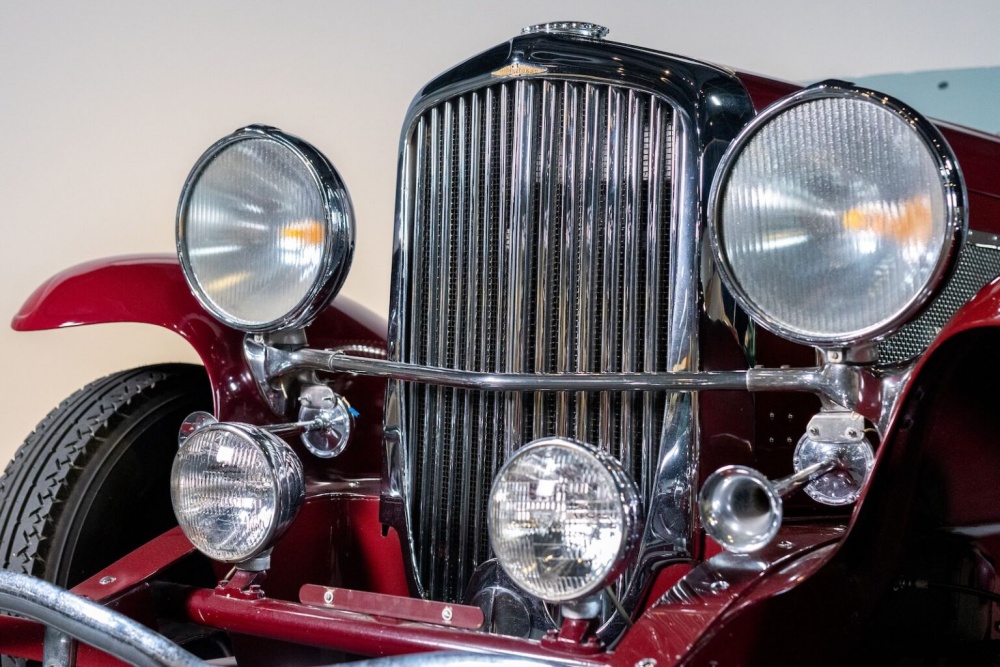
Courtesy of Bonhams
Sammy Davis Jr.’s Duesenberg is the latest reminder that he was on another level of cool
Coolness is easy to spot in the wild. Still, it's almost impossible to define what it actually means, who has it, and whether it can be manufactured or whether it only arrives after you’ve given up looking for it. Despite knowing all of these things to be true, we still somehow understand the simple fact that Sammy Davis Jr. wasn’t just cool, he was perafrost in people form.
Samuel George Davis Jr., or “Poppa” as his dad called him for some unknown, cool-guy reason, was brought up in Harlem watching his parents and eventually performing vaudeville at the age of three. By the time most people his age were figuring out which shoe goes on which foot, Sammy was already singing and dancing professionally. People didn’t need much convincing, even in these early years, that Little Sammy had something special about him. He exploded following a nightclub performance at Ciro's after the 1951 Academy Awards. Sammy David Jr. quickly became an icon. His coolness was a mist that grew endlessly in depth and range, utterly encircling him. By his 20s, Davis was one of the most well-rounded entertainers the world had ever known.
Chita Rivera, who once dated Davis, in an interview with Rocca, remarked on his talents, “He was everything. He could play any instrument, he could sing, he could dance like a maniac.” Let me clarify a few things here: he wasn’t just a dancer, dude, could dance damn-near any style; he was also an actor, comedian, activist, impressionist, and he was a legit gunslinger.
Being one of the coolest people who ever lived, Sammy Davis Jr was only driving the coolest cars, of which he had many. In fact, in 1954, still early in his career, he crashed his 1954 Cadillac Eldorado on Route 66. The Eldorado was a serious luxury model at the time, but its pursuit of style cost SD Jr. an eye. The 54’ Eldorado had a conical spike in the center of the steering wheel, pointed directly at the driver. Cool? Yes. Bad design choice? Hell yes. When he crashed the Eldorado, the spike did what spikes so often do, and punctured his head, nearly killing him. Before his false eye, he donned an eye patch for a time, again, deepening his well of coolness.
What followed was a career so broad, so relentlessly accomplished, and so resistant to categorization that it feels appropriate to call him professionally cool. Davis was a veritable human Venn diagram who overlapped with most of the key figures in American culture in the twentieth century, often as a transitional figure between two extremely antithetical personalities. As a member of the Rat Pack — Frank Sinatra, Dean Martin, Joey Bishop, and Peter Lawford — Davis helped bring record-breaking crowds to Las Vegas and made millions for Hollywood's box office. He performed ten songs in a single Broadway musical, four of them solos, with a meticulously choreographed fight sequence for the finale, eight shows a week, while simultaneously recording albums, doing charity benefits, and smoking three packs of cigarettes a day.
The cultural terrain Davis navigated was as complicated as it was remarkable. He developed all of these skills and successes and adoration, all while wrestling through the hazards, fear, and brutality of Jim Crow. A remarkable man indeed.
He was also, and this is where our story becomes a bit more in focus, a man with an extraordinary taste in cars. We already mentioned his infamous Cadillac, but Sammy Davis Jr. had plenty more. Although it's tough to nail down a complete list, some of the cars that best show off his tastes were a 1981 DMC DeLorean, a 1972 Ford TitanGeorge Barris Build, a coachbuilt 1976 Cadillac Fleetwood station wagon, a 1968 Maserati Ghibli Berlinetta, a 1963 Rolls-Royce Silver Cloud, just so many more. He collected cars the way he collected skills — in abundance and immodestly, which brings us to a 1971 Duesenberg SSJ Roadster.
The most powerful car in the world
Buying an original SSJ wasn’t a real option in 1971. So Sammy Davis Jr., not to be out-cooled because of something dumb like low production numbers and the Great Depression, had to find another way to drive a Duesenberg, and he did. You might notice that 1971 isn’t exactly the year we think of when the illustrious Duesenberg name is mentioned, but there’s a story here.
In order for us to understand how cool Sammy Davis Jr.’s SSJ Roadster is, we must first discuss the original SSJ. Duesenberg took the bones of the already formidable Model J — a 6.9-liter supercharged straight-eight with twin overhead cams, four valves per cylinder, a five-main-bearing bottom end, full-pressure lubrication, and a dual-carburetor "ram's-horn" intake feeding a centrifugal supercharger- and set to work on building something more extravagant. By 1935, the Duesenberg SSJ was technically available, making 400 horsepower and 425 lb-ft of torque, numbers that we barely even had a frame of reference for at the time. Top speed was 135 mph. For reference, the Mercedes-Benz 540K made 180 horsepower. The Rolls-Royce Phantom III pushed roughly the same. Even the mighty Bentley 8-liter managed around 220. The SSJ was far and away the most powerful car on the market, and also one of the most luxurious.
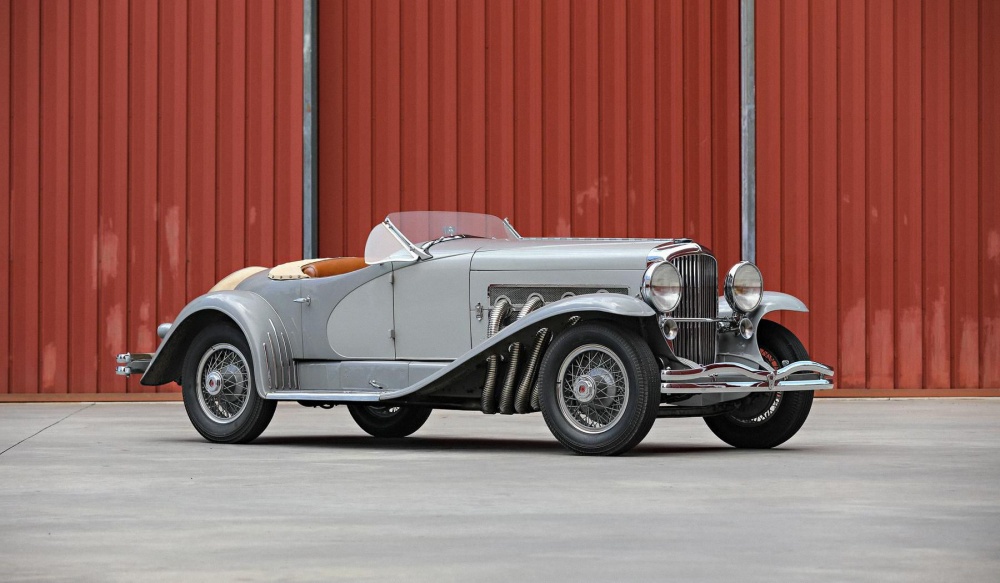
Courtesy of Gooding & Company
To make sure none of that power went to waste, Duesenberg shortened the Model J's wheelbase from as much as 153.5 inches down to 125 inches, fitted it with a lightweight LaGrande open roadster body, and gave it a chassis tuned for sharp, responsive handling (for 1935) rather than the stately float of its donor car. The result was something that had no real business existing in the middle of a country buried alive by the Great Depression, and only two were ever built. Both went to movie stars, Gary Cooper and Clark Gable. Cooper's example sold at auction by Gooding & Company in 2018 for $22 million, making it the most expensive American car ever sold at that point in history.
The Miller era
Bernard Miller, a Duesenberg enthusiast and Model J owner, purchased the Duesenberg Corporation name in 1970 and set about building the most serious continuation of the original SSJ ever attempted.
Miller used templates from the original 1935 SSJ La Grande body and classic coachbuilding methods — hand-formed aluminum panels over an inner ash wood framework — mounted on a 128-inch-wheelbase Dodge truck chassis. Power came from a supercharged Chrysler 383 cubic inch V8 paired with a LoadFlite automatic transmission, with reported output somewhere in the neighborhood of 300 to 500 horsepower, depending on the specific car; Sammy Davis’ Jr’s clocking in at 504 HP. One of the changes Miller made was to lengthen the wheelbase to 128 inches using a Dodge truck chassis with independent front suspension and four-wheel hydraulic brakes. Road & Track founder John Bond featured the Miller SSJ in the magazine's February 1971 issue and called it "the best replica yet." Production numbers remain somewhat contested, with estimates around eight, but maybe a few more completed cars between 1970 and 1975. Ultimately, another very rare Duesenberg.
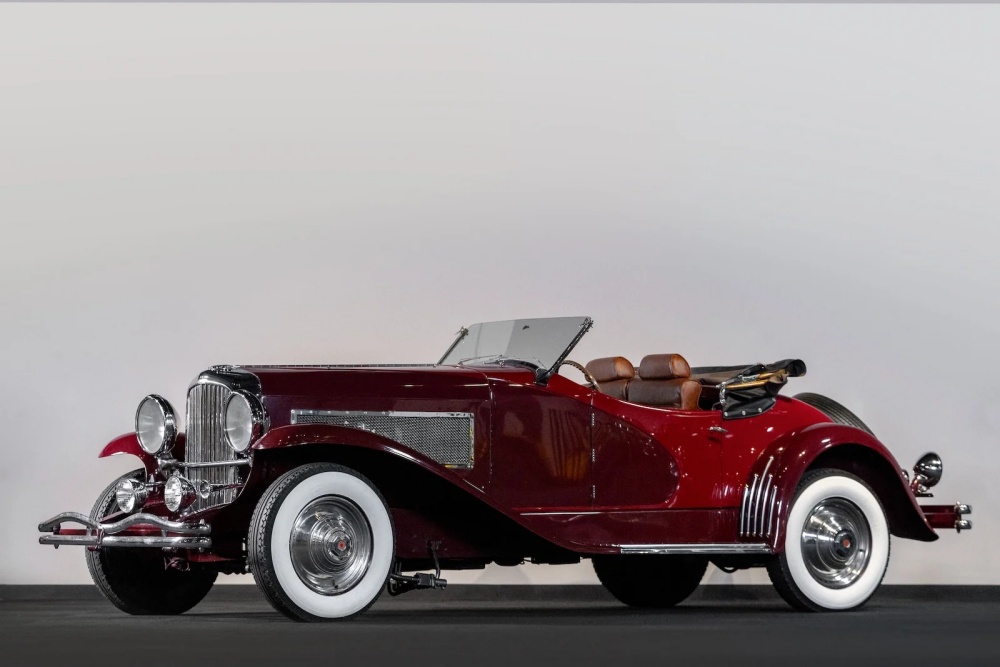
Courtesy of Bonhams
As you might have expected, these cars were not cheap. The original asking price for a Miller SSJ was around $24,500, which was enough to get a pair of matching Cadillacs instead. The Miller-era Duesenbergs were finished to their owner’s individual specs with bespoke paint, interior materials, and equipment.
Sammy Davis Jr’s 1971 Duesenberg SSJ Roadster
This particular example was purchased new in 1972 by Bill Harrah — the casino owner and legendary collector — through Leo Gephart, a man who handled more than 80 Duesenbergs during his career and whose involvement carries significant credibility. The car was made available to Davis during his frequent performing engagements at Harrah's Lake Tahoe and Harrah's Reno. Seeing as how Davis made Bill Harrah silly amounts of money — according to documented records, Davis performed a total of 684 shows at Lake Tahoe and 256 at Reno, often three shows per night – it makes sense that Davis was free to drive the car. But borrowing ain’t cool. The title was eventually formally transferred to Davis as his personal property. A 1970s Ebony magazine feature captured him posing on the running board, surrounded by other cars from his collection, looking so damn cool you’d think he had just smoked a mile-long cigarette.
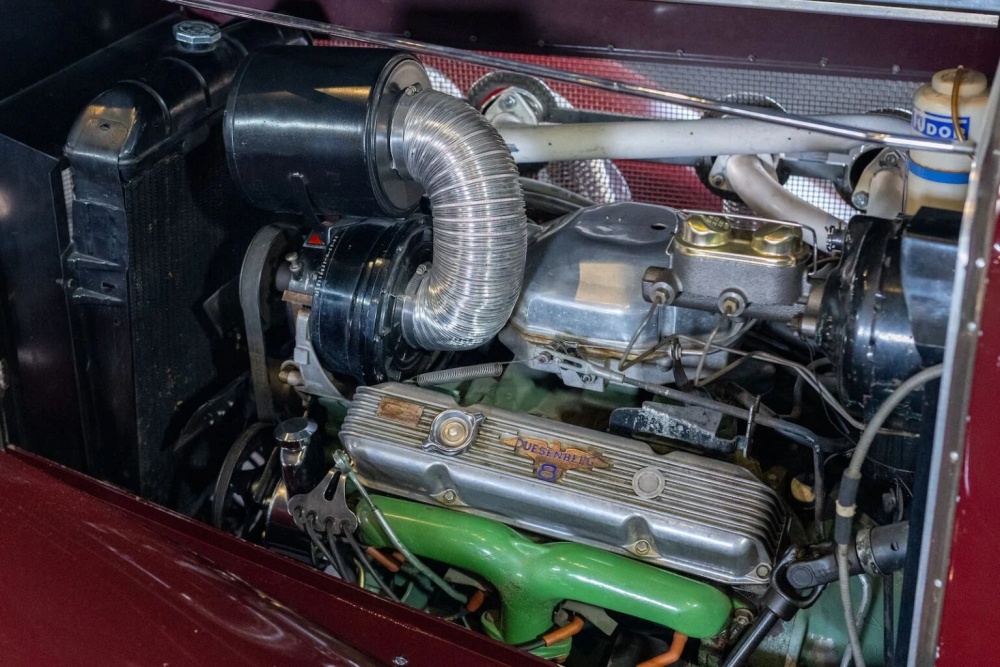
Years later, Davis donated the car to the Harrah Automobile Foundation in 1987. It has been at the National Automobile Museum ever since, preserved in original condition, wearing its original paint, original interior, and 5,247 miles of a life well lived.
The Duesenberg is not what made Sammy Davis Jr. cool. Nothing made him cool — he arrived that way and spent his entire life being it. A Duesenberg is simply the kind of car that anyone this cool, in this time, was always going to end up in. It is hand-built, unique, supercharged, historically significant, visually outrageous, and completely impossible to ignore.
Mr. Entertainment’s 1971 Duesenberg II SSJ Roadster Chassis no. J-103 is heading to auction at Bonhams on June 12, 2026. No telling what it will bring, but it’s sure to be a deal compared to one of the originals.

Peter Corn
Peter Corn is an automotive writer and storyteller. Peter has spent nearly a decade writing about cars, trucks, and motorcycles for some of the best publications in the business. He believes the best automotive stories aren't really about the machines at all, but instead, the people who love them.
Read Peter Corn's articles
Latest News
Comments
Comments are disabled until you accept Social Networking Cookies. Update cookie preferences
If the dialog doesn't appear, ad-blockers are often the cause; try disabling yours or see our Social Features Support.
_.jpg?environment=live)