Low-mileage unrestored 1969 Ford Mustang Boss 429 is heading to all-new Barrett-Jackson auction
There is a door plate inside every Boss 429 Mustang that tells you, in plain language, exactly why the car exists. It carries a KK number – the Kar Kraft production designation – and a NASCAR identification stamp that essentially reads: this car was built to go racing. No other American muscle car was quite so blunt.
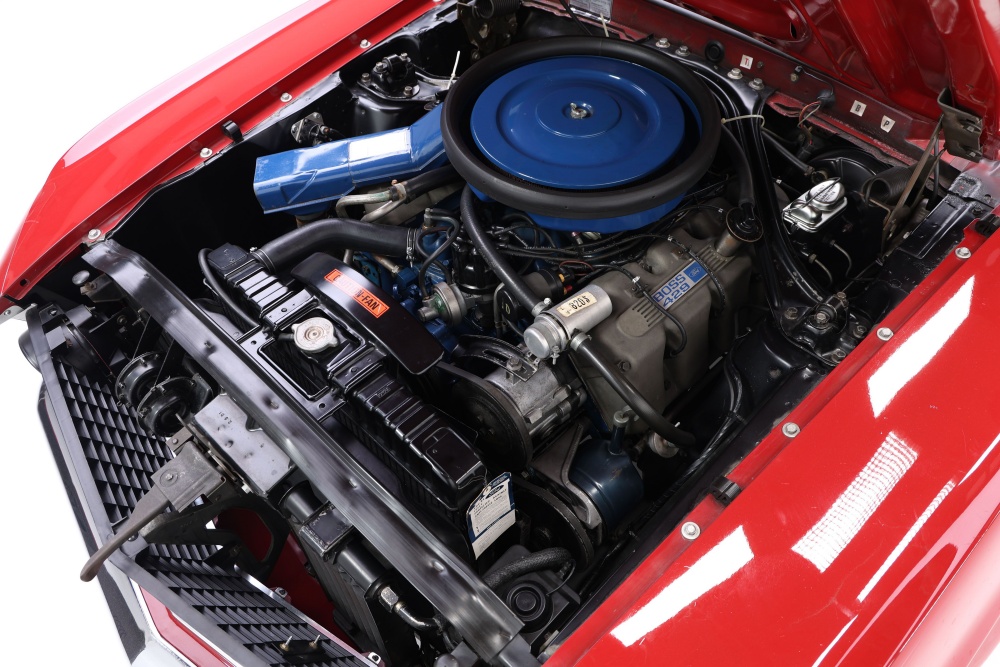
The Boss 429 was not a normal product in the conventional sense. It was Ford’s homologation special of the day. This weird racing rule is one of the only times in human history where a bureaucratic requirement results in something so cool. The road car version of the Boss existed because NASCAR required manufacturers to sell at least 500 street-legal examples of any engine they wanted to race. This was a common racing rule in those days. The homologation requirements resulted in many of the coolest road cars the tarmac has ever seen. The Boss engine was a direct effort from Ford to match the Chrysler Hemi on the superspeedways. 859 of them were built in 1969, carrying one of the most serious engines ever dropped into a production street car at the time.
Barrett-Jackson
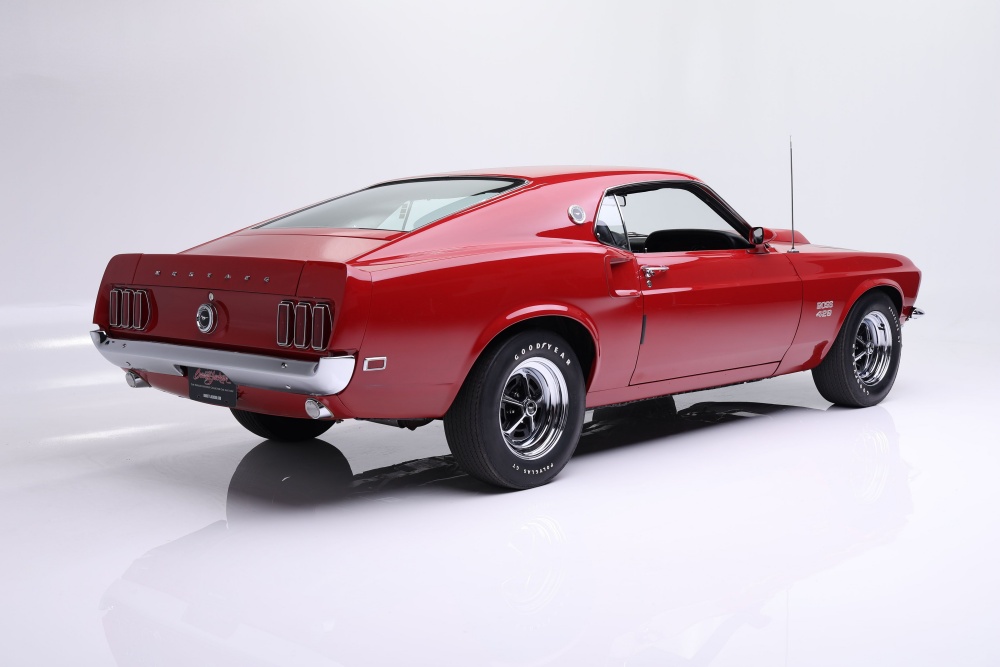
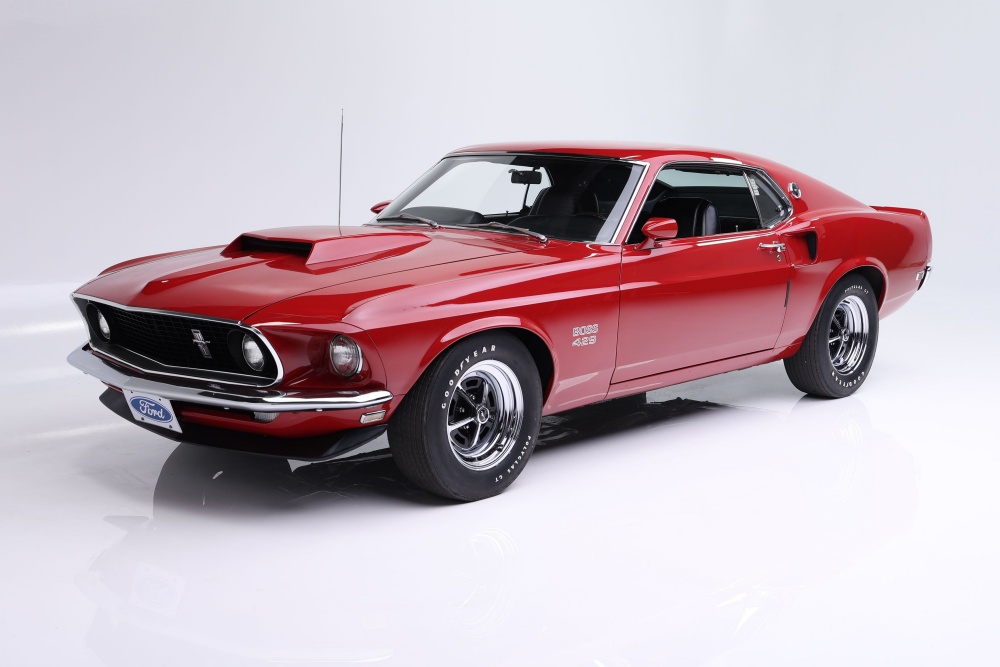
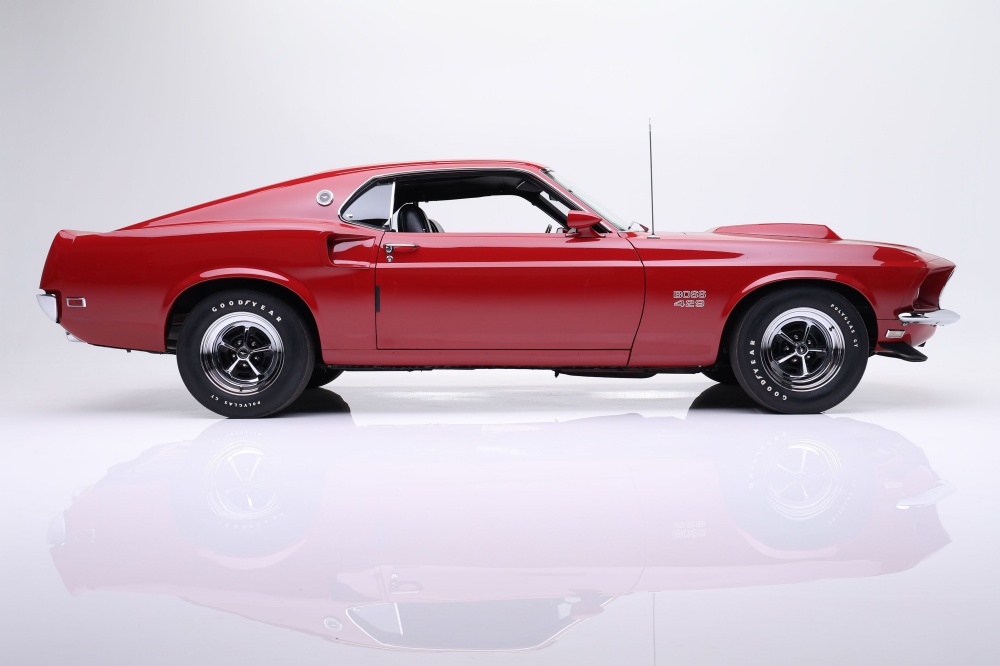
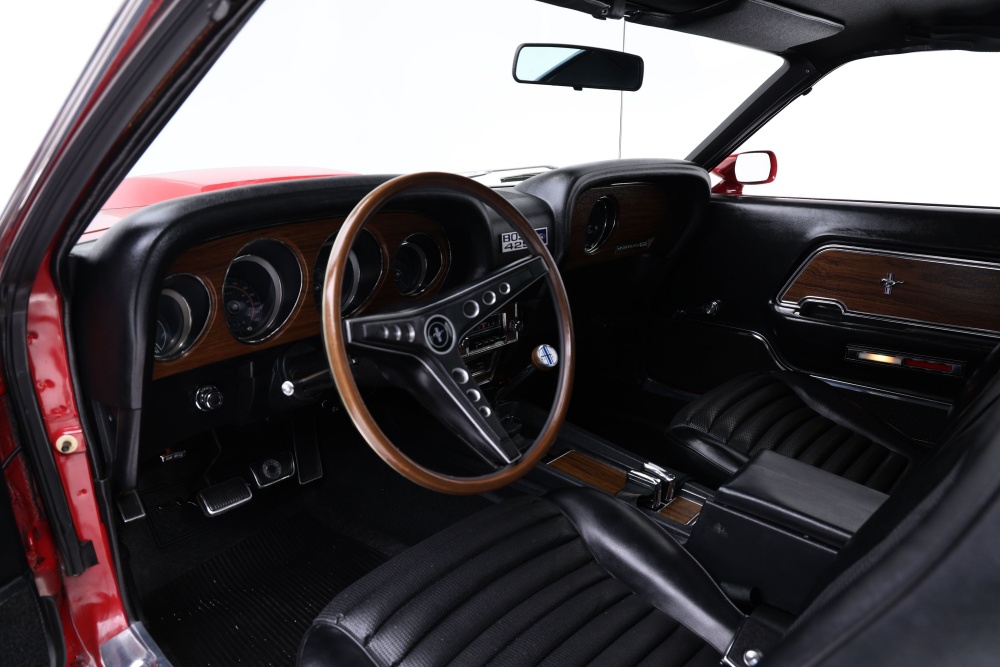
Lot #743 at the very first Barrett-Jackson Columbus Auction – running June 25 through 27 at the Ohio Expo Center and State Fairgrounds – is KK number 1412. It is a 1969 Ford Mustang Boss 429, finished in Candy Apple Red over a black bucket-seat interior, with 4,435 original miles on the odometer. It has never been restored. It is, by every available measure, the real thing.
This 1969 Ford Mustang Boss 429 is special in more ways than one
Understanding why this specific car matters requires a little bit of inside baseball. The massive Boss 429 engine would not fit a standard Mustang engine bay. Ford, not to be defeated by something so trivial as the size of an engine bay, contracted Kar-Kraft to open things up a bit – the space between the shock towers was widened, the battery was relocated to the trunk, and suspension geometry was revised. Every single car was essentially hand-built at Kar Kraft's facility in Brighton, Mich., after leaving the Ford assembly line as a standard Mustang shell. The engine itself – a 429 cubic inch semi-hemispherical V8 with aluminum heads, large-valve architecture, and a forged steel crankshaft – was intentionally underrated at 375 horsepower. Real-world figures were widely believed to be significantly higher in stock form, with some modifications pushing output to 600 hp. Ford was navigating increasingly hostile insurance regulations and government scrutiny of high-performance cars in the late 1960s and chose its numbers carefully, hiding its true potential from less scrupulous buyers.
Barrett-Jackson
Of the 859 Boss 429s produced for 1969, the first 279 cars off the line carried a special designation: the S-code engine specification, featuring NASCAR-spec connecting rods, heavy-duty half-inch rod bolts, and cross-drilled forged crankshafts that went beyond what the standard production engine required. KK 1412 is one of those 279 cars. It is a matching-numbers S-code example — matching 429 engine, matching four-speed manual transmission, matching 3.91 Traction-Lok rear axle — and it received a perfect 100-point appraisal from renowned Boss 429 expert Bob Perkins, confirming its authenticity and its time capsule-y condition.
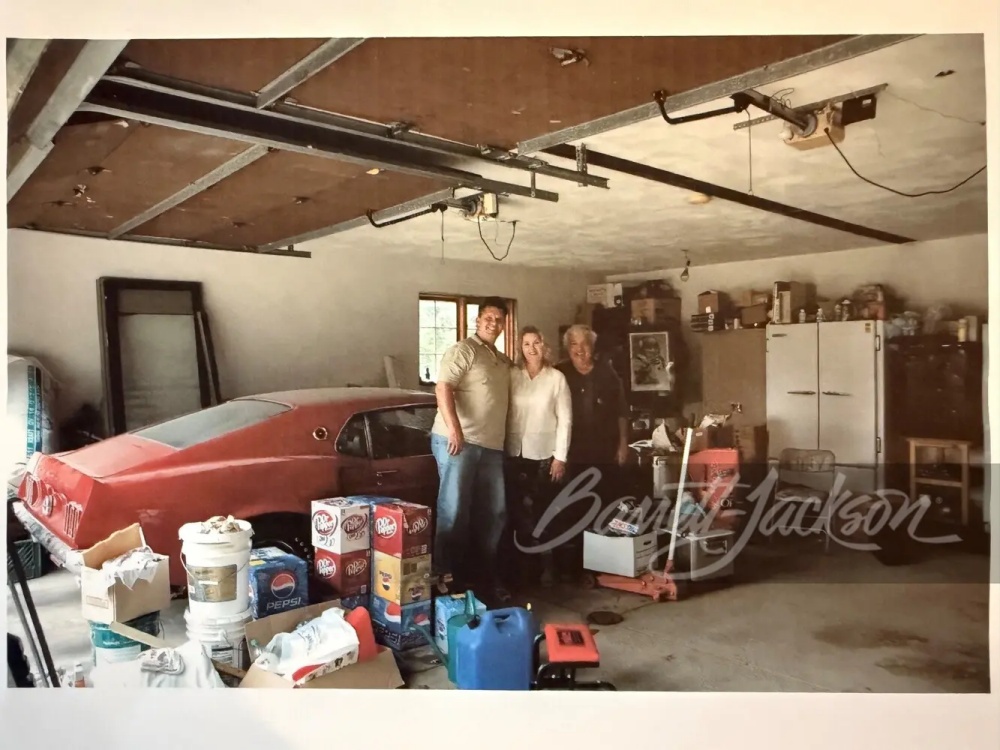
The documentation pile alone is enough to make serious collectors stand at attention. Two original build sheets. The original owner card. The original warranty card and supplemental books in their original sleeve. The original owner's manual. Original safety guidebooks. Original keys with the dealer-issued key holder. Photographs of the original owner with the car. And a handwritten history from that original owner detailing the vehicle's provenance from new. The car is certainly the coolest part of the package, but this kind of primary source documentation is what most collector cars lost to time, attic floods, and indifference decades ago. A rare package indeed.
Barrett-Jackson
The exterior retains its original exhaust system, original headlamp adjusters, original buck tag, and original door tag. The original Magnum 500 wheels and Goodyear Polyglas tires are not currently mounted on the car but are included with the sale. The interior shows its original factory-correct finishes throughout. There is a subtle yet undeniable gloriole that dons original, unrestored cars, giving them an immediate and palpable presence.
Barrett-Jackson
Most muscle cars of the era were thrashed by teenagers and then left to rust behind the shed. The Boss 429 was too expensive, too strange, and too limited for many to be found in any condition, much less in a forgotten Mustang-shaped pile of metal and rubber. The car started at roughly $4,900 in 1969 – nearly double a base Mustang – and the buyers who could afford one tended to understand what they had. KK 1412 has been understood from the beginning, and it shows in every original component and piece of ephemera that remains on the car fifty-seven years later.
The Ford Mustang Boss 429 didn’t get much time in the sun
The Boss 429 wasn't just a homologation special built to satisfy NASCAR rulemakers. Its Earth-moving big-block V8 quickly proved its worth on Sunday afternoons, powering Ford's stock car assault during one of the most fiercely contested eras in the sport. In 1969, Boss 429-powered machines carried Cale Yarborough and LeeRoy Yarbrough to victory lane, while David Pearson drove his 429 Ford Torino Talladega to the NASCAR Grand National championship. The momentum continued into 1970. Although Bobby Isaac ultimately secured the season title for Chrysler, Ford's Boss 429 campaign remained a formidable force, highlighted by A.J. Foyt's victory at the season-opening Motor Trend 500 at Riverside. Throughout the year, Ford drivers, including Pearson, Yarborough, Donnie Allison, James Hylton and Yarbrough kept the Blue Oval at the sharp end of the field, cementing the Boss 429's reputation as one of NASCAR's most potent engines.
Barrett-Jackson
Despite the 429’s success with the Torino and Cyclone, the life and death of the Mustang Boss 429 was short and brutal: by the time Ford had met the homologation requirement and delivered enough cars to dealerships, the company had already changed direction internally. The racing program was quietly shut down. The Boss 429 never got its intended chance to race in NASCAR. It was a weapon that arrived after the war was over. What was left behind was something arguably more interesting – a race engine delivered directly to the American public, in a red Mustang, with a door jamb plate that made sure to fill in the gaps in its unmet potential.
The inaugural Barrett-Jackson Columbus Auction runs June 25 through 27 at the Ohio Expo Center and State Fairgrounds. Lot #743 sells with no reserve.

Peter Corn
Peter Corn is an automotive writer and storyteller. Peter has spent nearly a decade writing about cars, trucks, and motorcycles for some of the best publications in the business. He believes the best automotive stories aren't really about the machines at all, but instead, the people who love them.
Read Peter Corn's articles
Latest News
Comments
Comments are disabled until you accept Social Networking Cookies. Update cookie preferences
If the dialog doesn't appear, ad-blockers are often the cause; try disabling yours or see our Social Features Support.