Image courtesy Mike Follmer
PRUETT: The oral history of Fast Masters
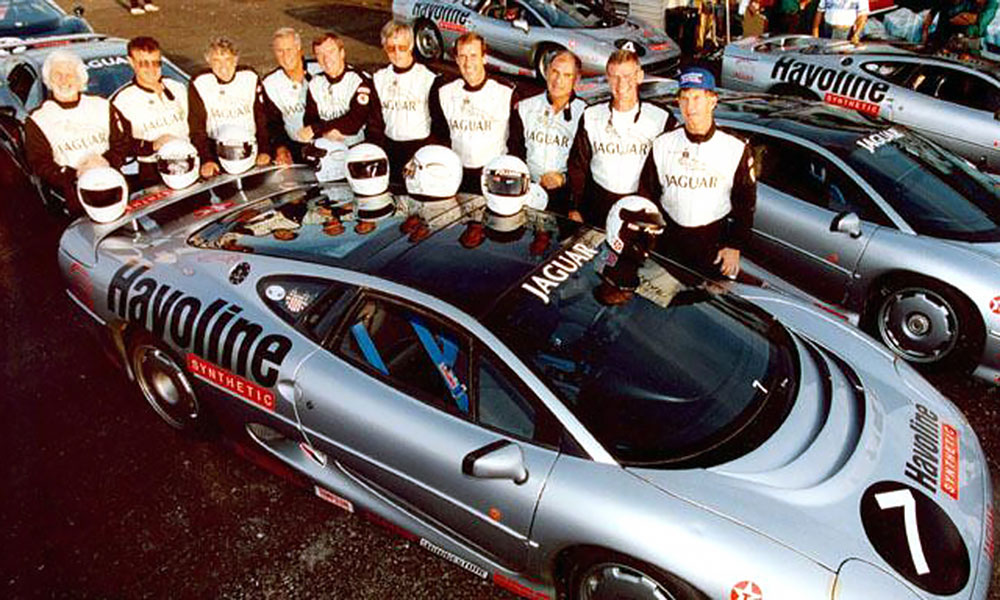
Bring some of racing’s biggest names out of retirement from Indy car, sports cars, NASCAR, and even the NHRA, wedge them into 12 of Jaguar’s brand-new, ultra-rare $1.3 million road racing XJ220C supercars, then drop the aging heroes onto the claustrophobic 0.686-mile Indianapolis Raceway Park oval and eventually its ‘roval’ as part of the first made-for-TV racing series for 50-and-older icons.
What could go wrong?
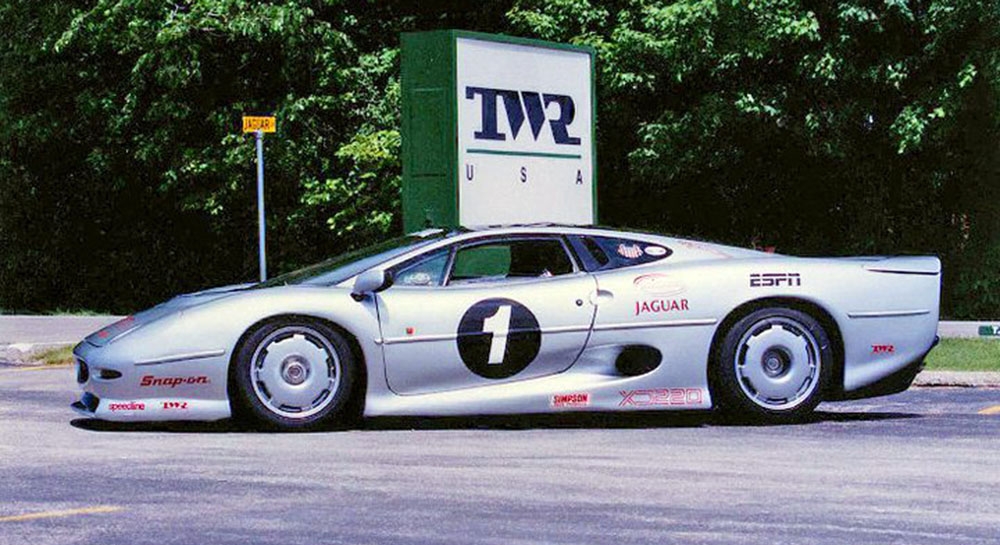
Image courtesy Tony Dowe
Back in the summer of 1993, the gorgeous XJ220Cs, built in England by Tom Walkinshaw Racing, were bashed and battered for our amusement like demolition derby cars at the county fair. The six-week special airing on ESPN, modeled off the cable channel’s Thursday Night Thunder concept, delivered five weeks of heat races to whittle down the grid for Fast Masters' grand finale. Quickly dubbed the ‘Crash Masters,’ it received the most accurate nickname in the sport.
The open-wheelers and a few of the sports car legends feasted on their fellow luminaries with the 550hp twin-turbo V6-powered beasts. Moments into the very first broadcast (and moments after the shot below), beloved Indy 500 driver Jim McElreath and stock car great Dick Trickle tangled coming off Turn 4, rocketing the two onto pit lane. Trickle then hit and obliterated victory lane, prompting Fast Masters' first caution period. It would be the first of many.
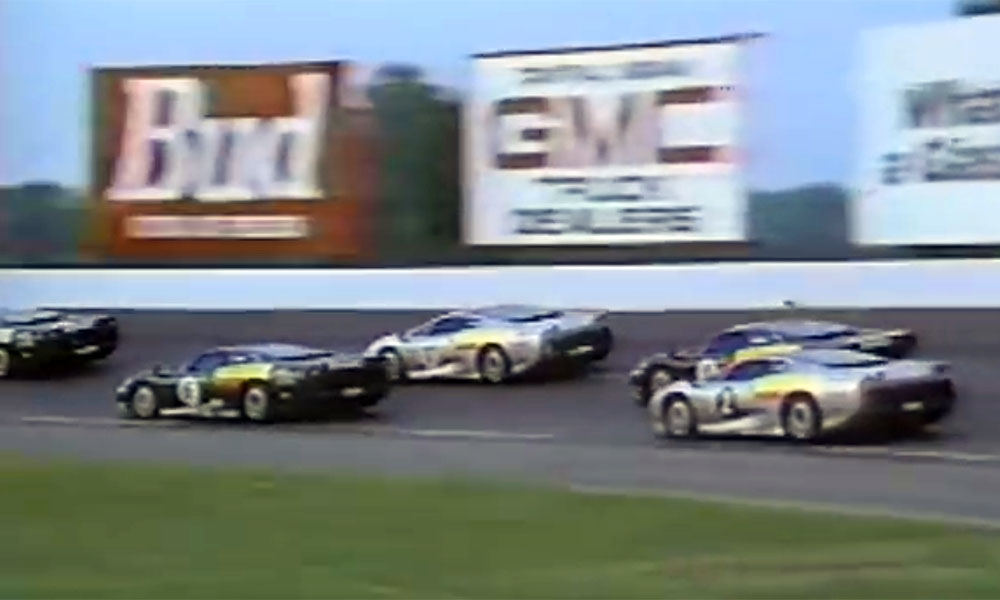
Across the numerous practice sessions and knockout-style heat races, all of the Jags were introduced to IRP’s walls. If the drivers weren’t crashing on their own, multi-car pileups were almost guaranteed when the green flag waved. An adjustment was soon made for the practices; fearing a shortage of functional cars to put in front of the cameras, two spare cars were rolled out as sacrificial lambs for the masters to learn the circuit and, inevitably, return dangling various bits and pieces from the cars’ extremities.
TWR’s mechanics, based out of the same Valparaiso, Indiana shop where its fearsome IMSA GTP Jaguars were prepped, grew so tired of trailering the second-hand XJ220Cs to the crosstown auto body shop for repairs, they took to strapping in and driving the mangled race cars to and from the facility on public roads.
The same TWR crew, coming off a magic year of running the all-time great 1992 Jaguar XJR-14 GTP machine, attempted mutiny after the first Fast Masters event. Little did they know their pains were nearly avoided when the series’ creator came close to striking a deal with budget supercar manufacturer Consulier before it went sideways and Jaguar entered the frame.
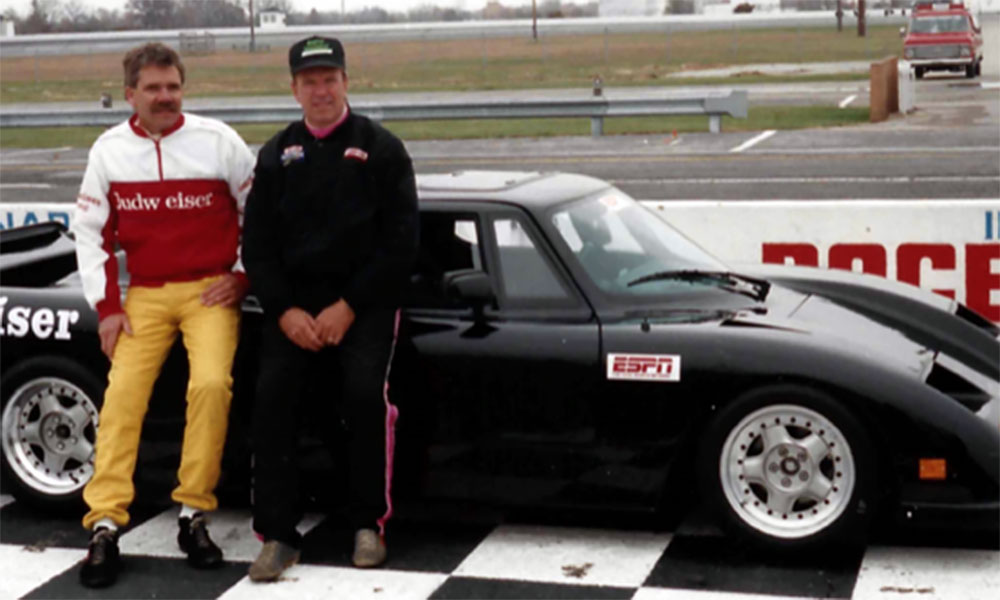
Image courtesy Terry Lingner
And there was a mighty fine carrot being dangled in front of aging lions: $100,000 -- almost $175 grand in today’s dollars -- for the winner of the inaugural Fast Masters championship.
Paul Newman, Bobby Unser, David Pearson, George Follmer, Parnelli Jones, Bob Akin, Johnny Rutherford, Bobby Allison, Ed McCulloch, Harry Gant, David Hobbs, Troy Ruttman, Eddie Hill, Derek Bell, Gary Bettenhausen, Fred Lorenzen, and dozens of revered stars signed on to pursue the six-figure prize.
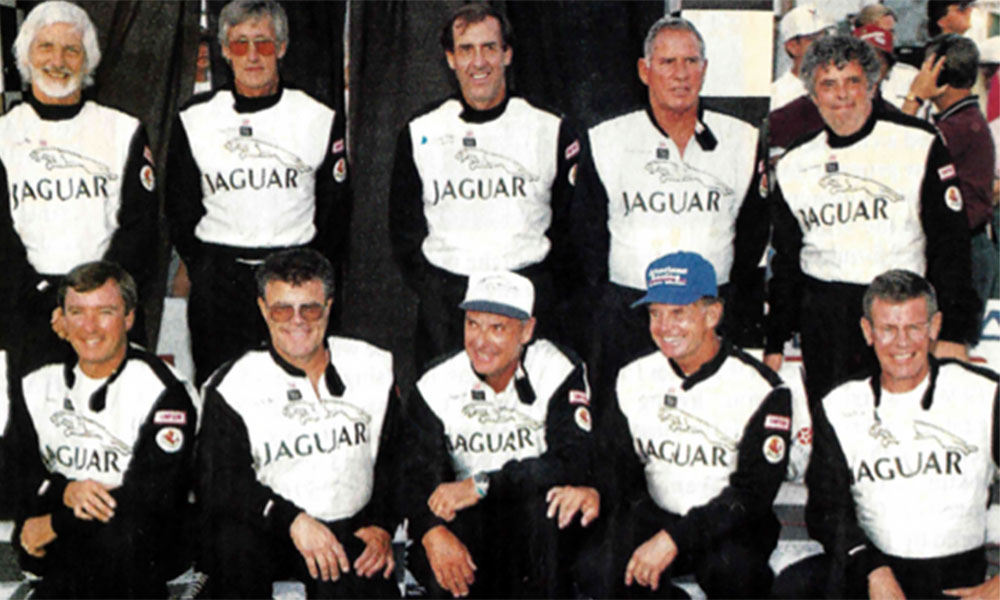
Image courtesy Terry Lingner
And carnage ensued.
On its 25th anniversary, the Fast Masters series continues to stand as one of the most delightfully unhinged racing concepts to become a reality.
Told by Terry Lingner, the series’ creator and producer, Bobby Unser, its first and only champion, and TWR USA boss Tony Dowe, who supplied and maintained the cars on behalf of Jaguar, here are some of the story’s highlights taken from the full-length podcast captured earlier this year.
TERRY LINGNER: It really came as an offshoot of just being involved for such a long time, obviously, but at the time I was doing a lot more NASCAR and I was struck by the idea that the Bobby Allisons and the Pettys and the Pearsons of the world could still haul the mail and the idea that maybe a stock car, you could do like seniors’ golf. Why not have a Saturday race for guys over 45? Literally, at ESPN, I was just trying to think of a way to maybe create some more programming, but maybe a 100-mile race. Even on race day, which is sacrilegious in NASCAR, you know. Only one race.
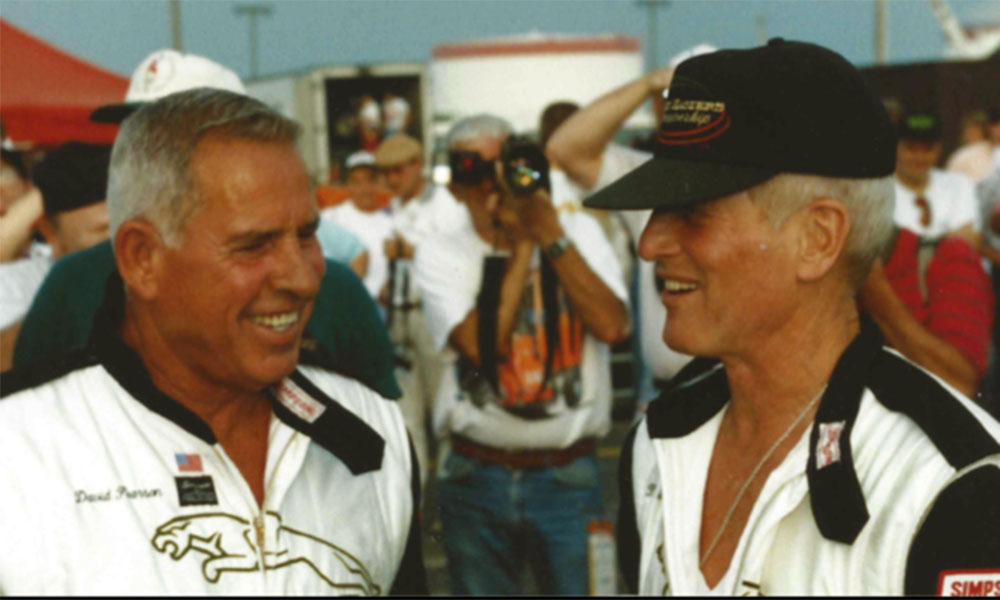
David Pearson and Paul Newman (Image courtesy Terry Lingner)
But it just kind of came out of that, that the people that built the sport on their backs, and then you obviously throw Mario and Parnelli, all these guys, but it never did seem practical that you would ever want to do something like that in an open-wheel car, but I was really ... honestly, my first thought was, how could I create a 10-race seniors package for NASCAR? And that got it percolating.
TONY DOWE: Jaguar were pulling out of racing in North America, and there was still one year of a contract to go, and Tom [Walkinshaw] had gone to New York to meet with [Jaguar executives] Mike Dale and Bob Burton and so on, and he came onto me. He said, "Well, they'll go another year. However, what they want is they want to be in the series with more relevancy to the product, and they also, it needs to have international appeal with drivers, and it needs to be on TV. Live TV. What can you do?"
So I called Rod Campbell, and I said, "You got any ideas?" And he said, "The only thing I can think of is Terry Lingner's been trying to put a deal together with the guy up in Charlotte that does the little midget races, but nobody wants to climb in them. And I said, "Well, what about a really expensive Jag?" And he said, "Well, give it a go."
So I called Terry and I met him where Purdue University is. He drove north and I drove south and we met up somewhere there. And I basically put on my best English voice and said, "Look, you know, mate. If you've got XJ220s, a supercar with all these drivers in, and Jaguar is helping up and we put up a big prize fund, that's got to be better than what you're looking at with this midget car thing."
With the Jaguar and TWR agreements in motion, Lingner’s next job was to finalize the venue for Fast Masters.
LINGNER: The real beauty for Thunder across the board and why I think it was successful was that we left all of our [TV camera] cable at the time in two spots: at [Indianapolis] Raceway Park and in Ventura. So we could plug and play. We could show up at 3:00 in the afternoon. Everybody [on the TV crew] gets a single day pay. We would get in and out. It was a perfect venue, a perfect way for television, actually, with heat races and the last chance race. Everything fit so nicely, so even going to the road course wasn't even an option.
I'd also say one of the things I think made this easy to sign people, even at the time, like a Parnelli or a Pearson or Bobby Allison making his comeback, was that there was a wall. They're not seeing 185 down the front stretch at Raceway Park. It's like, hey, let's all get together, put a driver's suit on again, and let's have some fun. I'll get a lot of people on the air and... it should work out. So that had a lot to do with it, but mainly, again, TV. That cost [ESPN] nothing for television.
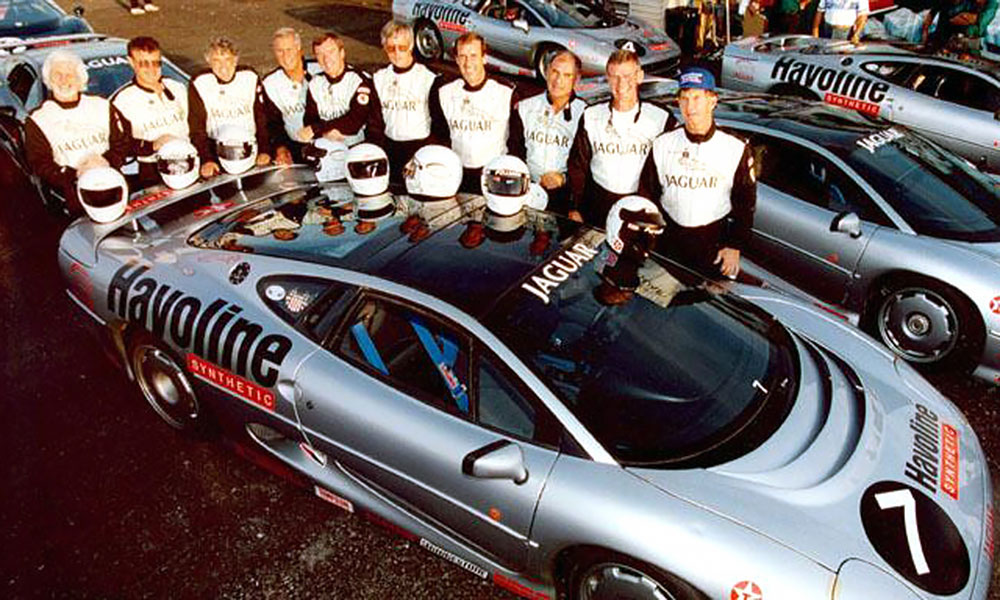
Image courtesy Mike Follmer
DOWE: We finished up having an agreement and it met all the criteria for Jaguar. So they had to stay in the deal. So then, Tom shipped across 12 XJ220s, which weren't going to sell. First of all, they were illegal to import into the country. You couldn't use them on the road, for sure. They have to come in as race cars, and they're the V6 turbo, which was prone to getting air pockets in the water system and blowing itself up and so on like that.
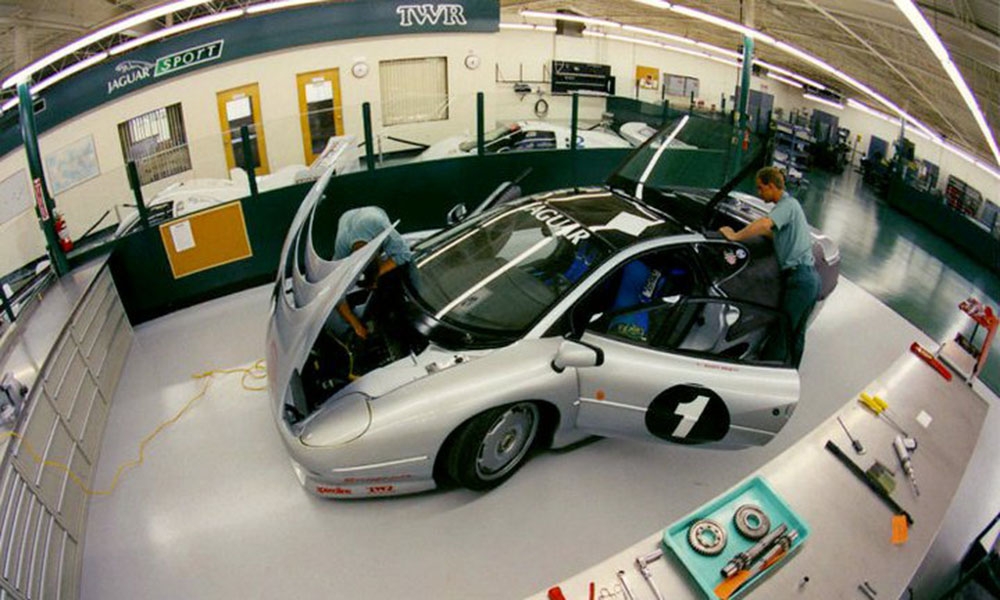
Image courtesy Tony Dowe
TWR, a company with no oval racing experience, with a dozen Jaguars that were never meant to compete on ovals, were tasked with developing the hulking cars into left-turning machines.
DOWE: We had no budget to change springs or roll bars. They had a viscous differential which around off banking, when they lifted off, would uncouple, which is why they quite often backed into the wall. Oh, yeah. And we had to use the standard Bridgestone tires that came on, which actually weren't that bad, although we had to pump the pressures up a bit, and we never put roll cages in the bloody things, but decent seat belts and so on, and it really was a dog's dinner, to say the least. After the first week, I had every guy on the team hand their notice in.
Three-time Indy 500 winner and Fast Masters competitor Johnny ‘Lone Star JR’ Rutherford was chosen as the lead test pilot.
LINGNER: I don't mean to throw JR under the bus, but he was going to be our original test driver and he only made it to Turn 1 at Raceway Park... JR had crashed the car and then the light went on, and it's like, "Uh, oh." So we got Scott Pruett to set the cars up, and that ended up being a pretty good decision of having somebody super active and still in his prime.
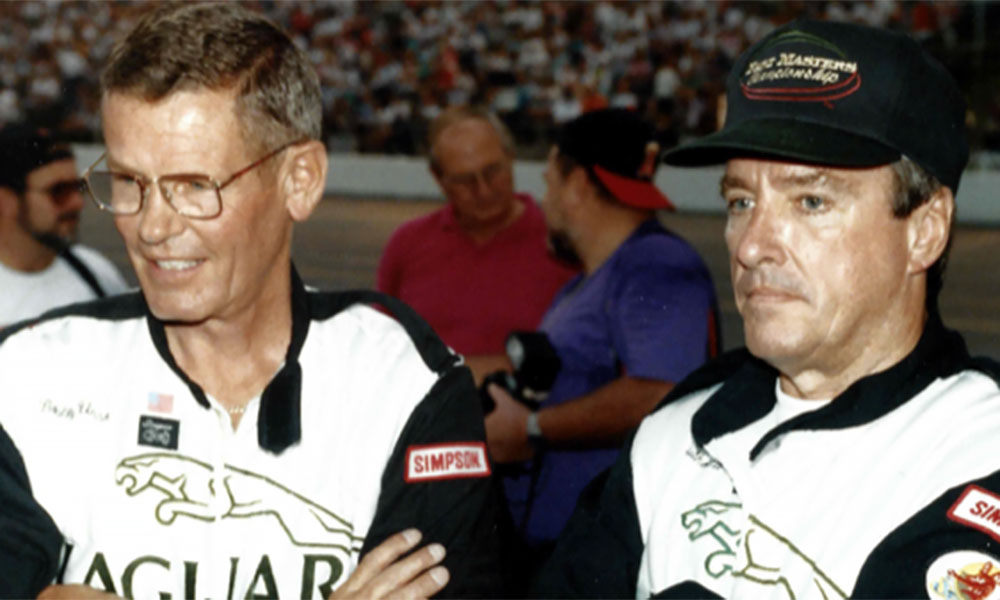
Bobby Unser and Johnny Rutherford (Image courtesy Terry Lingner)
After lobbying, albeit unsuccessfully, to replace his friend Rutherford as test driver, Uncle Bobby gave his unsolicited approval for Pruett to do the work. Producing 12 XJ220Cs that offered identical performance was the goal, and to ensure questions of cheating or favoritism was addressed over the six-week run, cars were rotated between drivers on a regular basis.
BOBBY UNSER: Scott Pruett … he's good, see? The cars really handled well. They couldn't do much racing, side by side. That's where the problem happened. But, man, I'm telling you what. Whooo! I mean, I'd go on that turn three on the track that's there, these five-eighths mile, and, man, I'd go in there wide open. And crack [the throttle] a little bit and make it through that turn. And it didn't make any difference which car I was in. Everybody was real careful to make sure I don't get the same car, you know. Because, they all think I'm going to go a little bit fast. So they're just worried about it, and I don't blame them, you know. It's a hundred thousand bucks!
A renowned lover of money, Unser was drawn to the big purse on offer for the eventual champion, and even the lesser amounts handed out for heat win.
UNSER: And then I got it for the heat race, too, I think, that was another 15 [thousand] or whatever, you know? And I mean, s***, they talk about getting me ready for a race. S***. I didn't make that much personally in my first Indy win.
The star power contained within the Fast Masters’ driver pool was otherworldly, but Lingner felt he needed one more name to push it over the top.
DOWE: Before the series started, Lingner was like, "Can we get Paul Newman in it?" And so I'd worked for him and knew him from Newman/Haas and so on. And I've worked for him in Can-Am and so on. So I called him up and he was like, "Well I've looked at it and I was quite keen but you know, I don't wanna look silly." And the rules were, you weren't allowed to drive one before the racing. And I said, "Look come down to IRP and drive it, see what you think and then make a decision." Which was totally against the [rules]. But to get Newman in the car [that’s] was what we did.
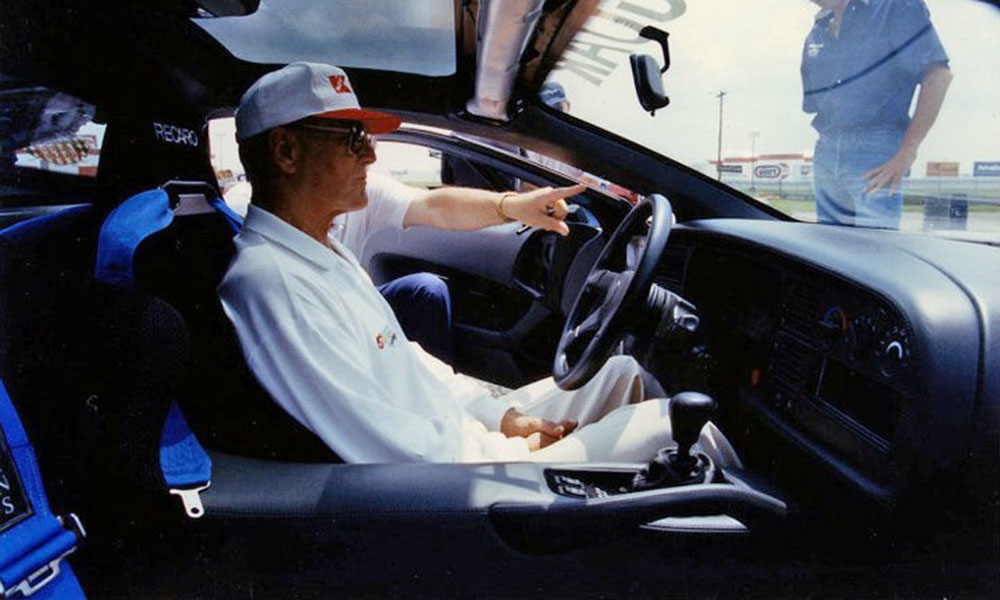
Paul Newman (Image courtesy Tony Dowe)
Saturday, June 19, 1993 marked the first Fast Masters event, aired live on ESPN. All manner of racing-related cable shows that have followed owe Lingner and his team a debt of gratitude.
LINGNER: You know if you think about it, it was serial reality television before its time.
Race 1 became an instant hit, but for all the wrong reasons. By Monday morning, the U.S. racing scene was alight with talk of the insane spectacle at IRP, and some had legitimate questions as to whether ‘Crash Masters’ would return in a matter of days for Race 2.
LINGNER: Yeah, we made it, but it was that first race. I’ve got to be honest with you, [with] all that was at stake, you know, I'm working with the Walkinshaw name and here I am, little Terry Linger, and that first lap when Dick Trickle took out the victory lane ... When it was all said and done, actually, Tom came running in the truck, and he says, "You've got to stop this now!"
I actually got my old little MGB and I literally went and drove around [Highway] 465 for a couple of hours. I just had to get my head clear, thinking, “God, I've just bankrupted my company.” But like anything, if you sleep on it, don't do anything too rash, and plus if you say you're going to do something that, you got to follow through. So it was pretty hairy there.
Looking like the fleet of Jaguars had been attacked with baseball bats from nose to tail, TWR USA honored its word and performed miracles -- once more, the first of many -- to return the big cats to IRP for the second event in functional condition.
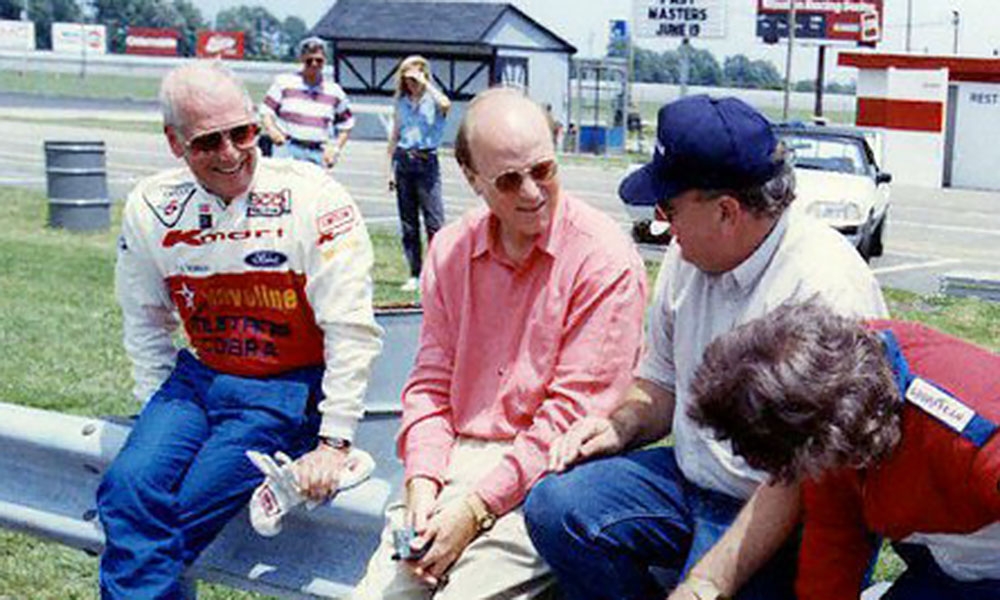
Paul Newman, with Terry Lingner and Tony Dowe (Image courtesy Tony Dowe)
LINGNER: Now they just went to work. As again, for anybody that's listening that even remotely knows Tony [Dowe], he is relentless and a brilliant man, not always the most fun to be around, but a lot of times the brilliant guys aren't. But he was same deal. It's like we made this deal, we've made the commitment to the Jaguar board.
DOWE: Don’t forget all the panels were aluminum. There was no [carbon fiber] composites anywhere. There was some large areas of aluminum panels. We had zero spares, so we were beating them out. The ones that finished up were 50-percent Bondo in them... They were aluminum-Bondo composite…
Although it was Lingner’s series in every way, a sanctioning body was still needed to officiate the Fast Masters. USAC -- the United States Auto Club, whose stewardship included decades of facilitating the Indy 500, and sprint and midget short-track oval racing that normally featured at IRP, was hired to govern Lingner’s events.
USAC boss Johnny Capels, who hailed from New Mexico like Uncle Bobby, and spent plenty of time around Unser as a mechanic on the Indy car trail, had become a target. Fears of the made-for-TV racing series being artificially manipulated by Capels to amuse ESPN’s audience continue to draw the Albuquerque native’s ire.
UNSER: I told [Capels] what the rules were going to be for the drivers, that means for me, in the race. If you don’t like the way I start the race, we’ll run ‘em until we run out of gas. So I told Capels off. I know what Johnny was going to try and do. He thinks all of a sudden he’s a big shot. He’s gonna sit up there and dial it like NASCAR; ‘time for a NASCAR yellow. Boom.’ They did the same thing.
Despite his reservations for Capels and USAC, Uncle Bobby sailed through his heat races and faced off against Follmer, who earned pole, Pearson, Redman, Hobbs, and Jones in the six-driver, 12-lap finale. Starting outside Follmer on the front row, Unser put USAC’s officials through one hell of a stress test on the way to visiting the rebuilt victory lane.
UNSER: I just got meaner and worse. I did my tricks worse, and harder. And you’d think Capels would learn, and I’m not going for it. I told Lingner that. I don’t like fixed things. NASCAR was always good to me, but I don’t like the concept of NASCAR yellows.
With his lead over Follmer erased, Uncle Bobby got his revenge.
UNSER: So when the green does come out, man, I walked them so g**damn bad. I got everything back that they took away from me and went on won the race. If it’s gonna make it a television thing, I’m gonna make sure they see what’s going on. And they didn’t like it. It’s Capels. He knows what he wants, and he wants it to be real close. Pardon my French, but close my ass! A hundred thousand bucks for winning it!
Fully aware the XJ220Cs were in their final race, Unser didn’t mind leaving Dowe’s team some work to do in the weeks that followed.
UNSER: That Follmer and I had a knock-down drag-out [fight], because first place, George is really good, and he really understands that type of deal and the cars ended up handling really well on that track. [But] we used those cars really hard.
We're out there doing our pace laps, Follmer is alongside of me. I just ran my car over one time, scraped the whole mirror off. I mean, really messed up the right side of the car. I just run my car right down the side of his, took off his rear mirror and everything. And what was that for? That was to show him I'm serious. Hey, I'm here. You know, this is going to be a terrible battle. This is what this is about.
Talked to George later, who's obviously a good friend. I didn't hurt the car that much. But the mirror, I know how much that mirror cost, but I'll guarantee it cost a bunch. But that's the way I did all the guys there. It was just going to be a hell of a battle, so get ready.
LINGNER: Bobby showed how good he was, but I mean Parnelli was in. Brian Redman, David Hobbs. I mean, there was nobody that skated into the final. Parnelli, if I already said him. People may not know this, but Parnelli broke a rib, and Hobbs was trying to go down underneath in [Turns] 3 and 4 and push Parnelli up, and he hit a lot harder than when we first realized, but man, they were really good. Obviously, all the other people in the final accused Bobby of trying to work Tony Dowe and getting the good car…
With inflation factored in, taking the Fast Masters title paid more than the upcoming winner of January’s Rolex 24 At Daytona, or the polesitter for May’s Indy 500 will earn.
LINGNER: I mean, we had $100,000 in cash afterwards, and Bobby was very happy to receive that. But yeah, as I say, I think some people may have questioned some of the people we invited, but ultimately, what I thought about, is that the guys that were really good, that had a lot of wins, still made it to the final.
UNSER: That's a lot of money. Poor Follmer, he got knocked out, and I happen to know how bad George needed the money. I felt sorry for him, but I don't really feel sorry for him.
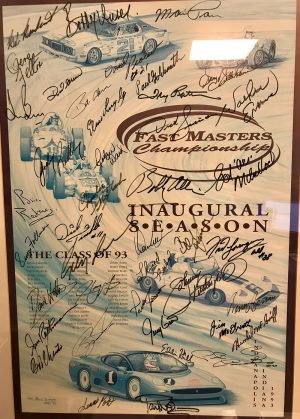
LINGNER: I just think, honestly, the circumstances were so unique to be able to pull this off. I think we extended the [broadcast] air window by like a half hour is all [we needed] to accomplish this. Because again, if people remember, we're running either with Sprints or Midgets as well. How much further than a USAC Midget can you get from than a super car?
It was just so ironic. It was so unique. I don't think anybody thought we were going to go do this year after year. It almost didn't [survive for Race 2]. It was pretty hairy after the first one…
What happened to the XJ220Cs after Fast Masters? That story, and many more, are in the full-length episode below:
[protected-iframe id="bd24c6e0d50f0c8768ddada4b7d734bf-139854255-134414717" info="https://www.podbean.com/media/player/zv5xn-a2a8bf?from=yiiadmin&download=1&version=1" width="100%" height="122" frameborder="0" scrolling="no"]
International Link: https://marshallpruett.podbean.com/e/mp-445-the-oral-history-of-the-fast-masters-series/
Marshall Pruett
The 2026 season marks Marshall Pruett's 40th year working in the sport. In his role today for RACER, Pruett covers open-wheel and sports car racing as a writer, reporter, photographer, and filmmaker. In his previous career, he served as a mechanic, engineer, and team manager in a variety of series, including IndyCar, IMSA, and World Challenge.
Read Marshall Pruett's articles
Latest News
Comments
Comments are disabled until you accept Social Networking Cookies. Update cookie preferences
If the dialog doesn't appear, ad-blockers are often the cause; try disabling yours or see our Social Features Support.