.jpg?environment=live)
Chain of Command
ABOVE: Bernie Ecclestone (left) and FIA President Jean Todt top a complex leadership pyramid.
If you’ve wondered how Formula 1 decides its rules, but don’t know your Strategy Group from your Formula One Commission, read on from this excerpt from THE INSIDER ISSUE of RACER Magazine, on sale now.
As anyone with a passing interest in Formula 1 probably knows, its commercial side has traditionally been governed by the Concorde Agreement. But after the last one expired at the end of 2012 we’re still in a strange limbo: a “Concorde Implementation Agreement” exists, signed by F1’s governing body, the FIA, and its commercial rights holder, Formula One Management (FOM), but not the teams. It’s still not clear what the next step will be.
Leaving aside those commercial aspects, the sport itself is governed by three key FIA documents. The basic framework for all FIA-regulated competition is the International Sporting Code, which in essence outlines how a race meeting is organized and run, and defines the powers of the stewards and so on. With specific reference to F1, it also contains information related to superlicenses and the licensing of senior staff, brought in after the 2007 McLaren/Ferrari “Spygate” scandal.
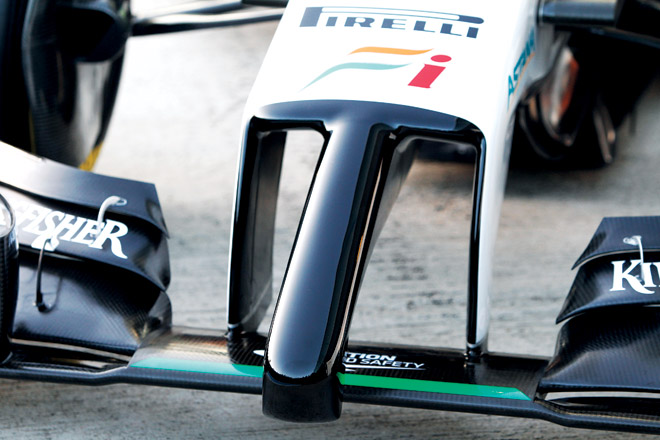
In addition, as seen in the past, rules can be fast-tracked on safety grounds. The actual phrasing in the International Sporting Code reads: “Changes that the FIA makes to the regulations for safety may come into effect without notice or delay.”
The Sporting Regulations contain everything related to the running of a grand prix event, and that includes some crossover with the technical side in terms of specifying such things as the number of tires permitted over a weekend, rules relating to usage of gearboxes and associated with any transgression.
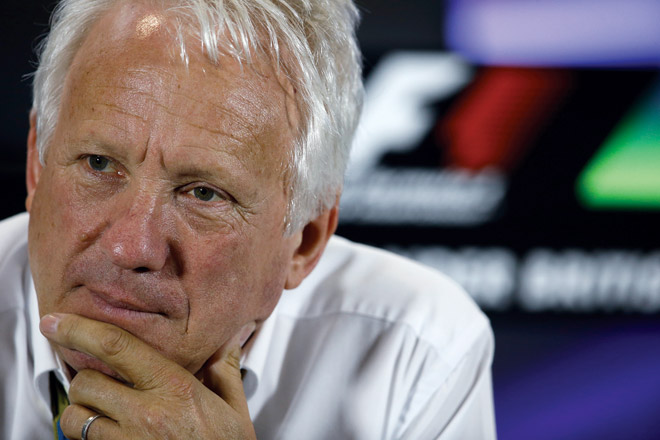
Overseen by the FIA’s Charlie Whiting, the Sporting and Technical Regulations are organic, tweaked and updated every year. But how does that process occur?
Until recently there existed a Sporting Working Group, made up of the 11 F1 team managers and the FIA, and a Technical Working Group – the 11 technical directors. All the teams had a say as ideas were discussed, agreed, then passed up the chain via the F1 Commission for ratification by the World Motor Sport Council.
Amid some controversy, the process was changed after the old Concorde Agreement ran out. Now there is a body known as the Strategy Group, on which only six of the 11 teams are represented. There are five permanent members in power unit elements, and the penalties Ferrari, Red Bull Racing, McLaren, Mercedes and Williams, while the next best-placed team in the championship becomes a member for the following year. So that honor currently belongs to Lotus.
Each team has a vote, while the FIA and FOM (in other words F1 commercial czar Bernie Ecclestone) have six votes each, with decisions requiring a simple majority. The other five teams, namely Force India, Sauber, Toro Rosso, Caterham and Marussia, are not involved, to their obvious frustration. They get no official information about what happens in those meetings, and they don’t have a formal opportunity to contribute to new ideas, other than by asking a Strategy Group member to put them on the agenda of a meeting.
However, they do have some input by participating in “informal” sporting and technical meetings, which involve all the teams, but are only used to refine ideas that come from the Strategy Group.
There is some logic to the principle of the big decisions emerging from a group of team principals, rather than technical directors or team managers, even if it doesn’t include all 11 players.
“Previously, everything went into the Working Groups and got discussed there,” says Whiting. “When they were happy with it, it was sent up to the Formula One Commission. In theory, the first time the F1 Commission heard about anything was when it arrived there from the Working Groups. So the perception was that it was all being driven from the bottom up. We have more of a top-down approach now.”
Want more...?
Print + instant access digital subscription
Order a digital subscription to RACER for only $9.99
Find RACER on the newsstand

Latest News

Comments
Comments are disabled until you accept Social Networking Cookies. Update cookie preferences
If the dialog doesn't appear, ad-blockers are often the cause; try disabling yours or see our Social Features Support.