OPINION: IndyCar Officiating needs to stop being the story
IndyCar Officiating finds itself with a reputational problem to solve after the mess it made at the Indianapolis Grand Prix in May was then compounded last weekend in Detroit, where a whiplash approach to officiating left nobody on pit lane feeling impressed.
In the wake of its prolonged inaction around Alexander Rossi’s broken car at the Indy GP and the volley of criticism for failing to call for a full-course yellow (FCY) in a timely manner, IndyCar Officiating announced it would no longer wait to go FCY in the future. In the moment, the change of approach seemed reasonable.
Rossi, left stranded on the front straight by the start/finish line after his hybrid unit failed, sat, and sat, and sat while waiting for a FCY to be thrown. Long after it was clear his car would not be restarting and driven away, Rossi chose to climb from his car – as cars streaked by at a high rate of speed under a local caution – jumped out, and ran across pit lane.
The willingness by race control to leave the pits open for the leaders to stop before going FCY and closing the pits outweighed the concern Rossi had for his own safety, and in response, the expectation was for Race Director Kyle Novak to trim the excess and call future road and street course FCYs with more urgency.
Then, Sunday at the Chevrolet Detroit Grand Prix arrived and the post-Rossi resolution was revealed to be a series of gross overreactions. No thinking required, just smash the FCY button as fast as possible like you’re a contestant on Family Feud.
Bryan Herta, Kyle Kirkwood’s race strategist at Andretti Global, was the first to criticize the new independent officiating group for treating everything it saw at Detroit like a 10-car pileup took place.
"Now we're just gonna go yellow as soon as a hot dog wrapper blows on the track...” Herta said with plenty of sarcasm.
And Herta isn’t the only elite strategist to question why IndyCar Officiating is using its failings with the Rossi ordeal as an excuse to go to instant extremes when faced with anything other than perfect order.
“We need to go somewhere in the middle,” Mike Hull, who’s won more IndyCar races than any other race strategist, told RACER. “That's what I think. That's what Bryan Herta was trying to say. It seems like the people calling the races are doing this now because they’re afraid they’ll lose their job if they don’t, and if that’s what we’re dealing with – they should have more support for doing their jobs.”
Andretti Global team principal Ron Ruzewski, who also serves as Will Power’s race strategist, is of the same opinion.
“I think we worked really hard to get to a decent place over the years,” Ruzewski told RACER. “I also think that most of the time, IndyCar gets it right. But Detroit was a little bit over the top, and I don't think that's necessarily a good thing for anybody. I think there's a happy medium someplace.”
The hardest part of the job for any referee is reading a situation and deciding whether to blow the whistle or let the game play on without interruption, and in response to the drubbing IndyCar's officials took on Rossi, there’s the feeling of pettiness – a point being proven over who’s in control – in the hardcore stance demonstrated in Detroit. Don’t think. Maximum escalation. Smash the FCY button.
“It should not be black and white; it should be situational,” said Graham Rahal, who became the poster boy for IndyCar Officiating’s new hair-trigger FCY usage. “The issue that we’ve got is, it was situational before, and it went too far in one direction with the Rossi deal. So they’ve gone fully in the other direction.”
One of the big promotional points around the introduction of the hybrid in 2024 was the ability for drivers to restart their cars and eliminate cautions with the newfound ability to fire stalled engines and drive away from minor hits and spins.
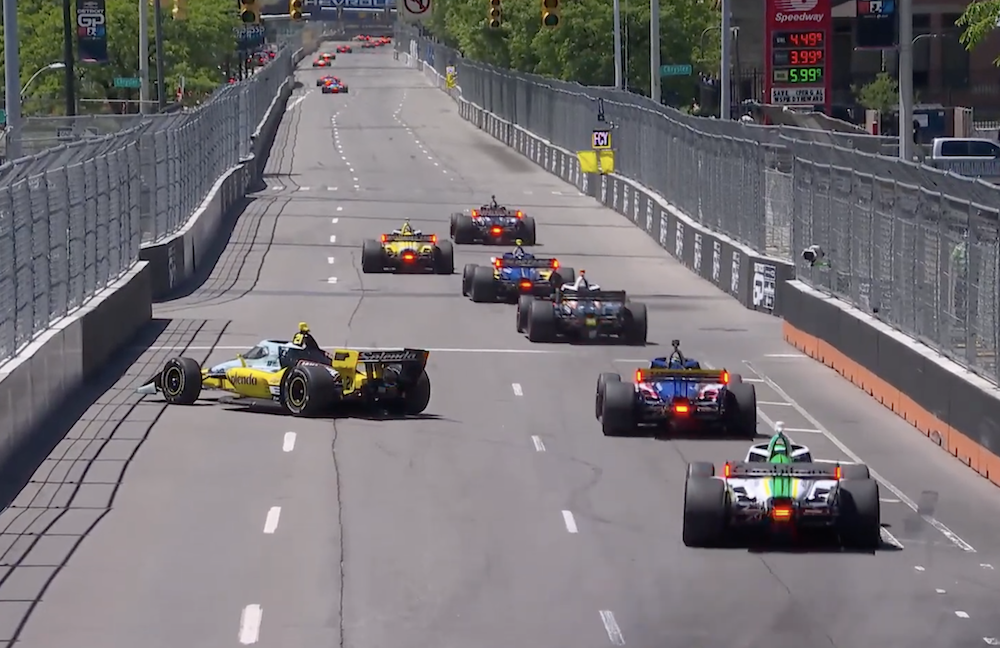
The comedy of IndyCar Officiating’s all-FCY approach was cemented when Kyffin Simpson blew through the braking zone entering the Turn 3 hairpin and knocked Rahal into a half spin. Local yellows could have covered the brief period Rahal needed to start his engine, reverse, and drive away, but that wasn’t the choice taken by race control. Instead, it was an instant FCY, and moments after it was put into effect, Rahal was gone from the scene.
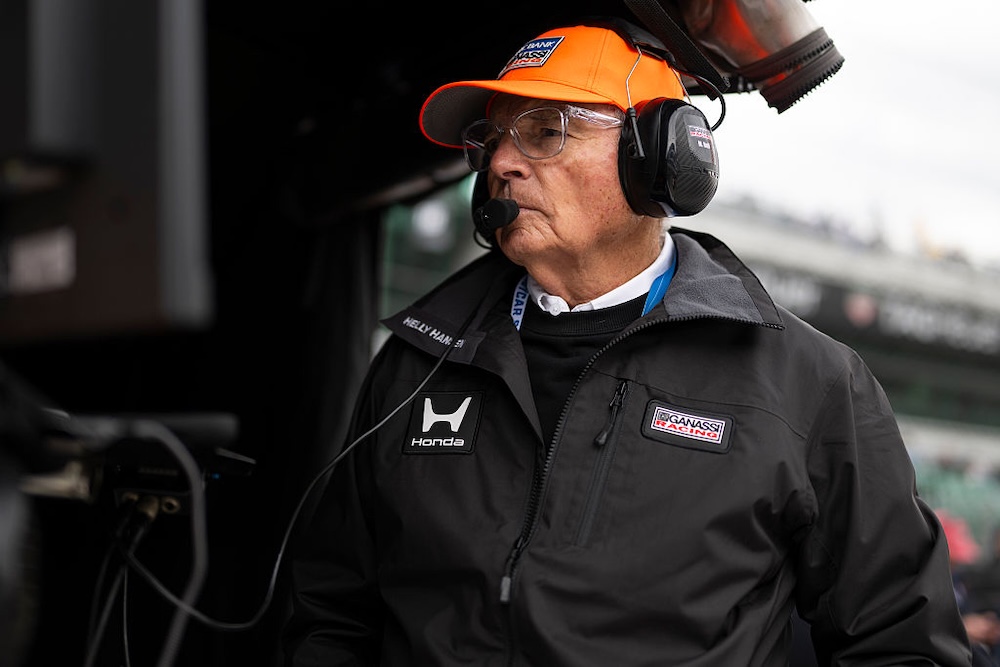
After IndyCar Officiating explored both ends of the extreme with its calls at the Indy GP and Detroit, Ganassi's Mike Hull is one of several figures on pit lane asking for a return to a more balanced approach. Geoff Miller/Lumen via Getty Images
FOX showed a replay of the incident, returned to a live shot at Turn 3 expecting to have a stalled car in the center of the frame, but found it empty…
With the briefest grace period given to Rahal to use the hybrid as intended, the local yellows could have been rescinded and the race would have resumed without interruption. Rahal estimated it took 10-15 seconds to clear himself from the Simpson-induced spin, but IndyCar Officiating has apparently removed the one acknowledged positive brought by IndyCar’s hybrid.
“We don't even have enough time to start the car, and it's already yellow,” Ruzewski said.
Five laps of FCY were lost to this asinine button-smashing scenario. And it wasn’t the last.
Santino Ferrucci tagged Rinus VeeKay exiting Turn 5 and both spun, which created a temporary traffic jam, but both were able to get moving on their own and cleared the problem in a short amount of time. Local problem, resolved without the need for the AMR Safety Team in an expedited manner by Ferrucci and VeeKay.
Nonetheless, it was handled with an instant FCY for cars that were gone from Turn 5 moments after the FCY went live. Six laps were lost.
Both were perfect examples of the after effects from Rossi’s stalled car at the Indy GP: Too much time was taken there, so now, no time is taken.
Is that a mature or nuanced response to an officiating error? Until IndyCar Officiating rediscovers the desire to do more than pounce on the FCY button, teams will need to make drastic changes to how they approach race strategy at upcoming road and street races.
“We're going to have to call races differently,” Hull said. “After we’re done with Gateway, we're going to go to Road America, but if they choose to call the race the same way in Road America like they called Detroit, with the big separation of cars there, you're going to end up stopping 10 times. It's going to be a joke. Every two laps you're going to have a full course yellow if every driver who has a minor problem is treated the way they were in Detroit.
“There's only going to be 10 laps of racing because of how long the track is and how long it takes to pack everyone up and get everyone in order. Think about that. You can't call a natural-terrain road course race then like you call a street race, but we’ll wait and see what they do or don’t come up with.”
Based upon the response on Thursday from the Independent Officiating Board (IOB) – IndyCar Officiating’s oversight group – there’s a confounding belief it did not overreact at Detroit with instant FCYs and treated each incident in a unique manner.
“We're comfortable with the direction we went in,” said IOB chairman Raj Nair. “I think Kyle [Novak] has done an amazing job in calling [races] with the prior direction, and he's supportive of this change, and he's the best in the business.
“Full course yellows and incidents affect competition. Us trying to do something different that's not based on where the incident is, and the safety impact of the incident, before we throw the full course yellows is affecting competition. So in our mind, we're actually getting out of that aspect of the judgment and just calling it based on the incident.”
Barely a week goes by without the need to mention IndyCar Officiating and the IOB. For those of us who are here for the racing and not the referees, it would be a wonderful development for that to change. Returning to a place where making calls ‘based on the incident’ would be a welcome correction to whatever the hell that was in Detroit.
It fumbled the call on Rossi, and since then, the teams and drivers moved on. It’s time for IndyCar Officiating to do the same, and leave the extremes behind.
Marshall Pruett
The 2026 season marks Marshall Pruett's 40th year working in the sport. In his role today for RACER, Pruett covers open-wheel and sports car racing as a writer, reporter, photographer, and filmmaker. In his previous career, he served as a mechanic, engineer, and team manager in a variety of series, including IndyCar, IMSA, and World Challenge.
Read Marshall Pruett's articles
Latest News
Comments
Comments are disabled until you accept Social Networking Cookies. Update cookie preferences
If the dialog doesn't appear, ad-blockers are often the cause; try disabling yours or see our Social Features Support.