Marshall Pruett photo
How dampers work
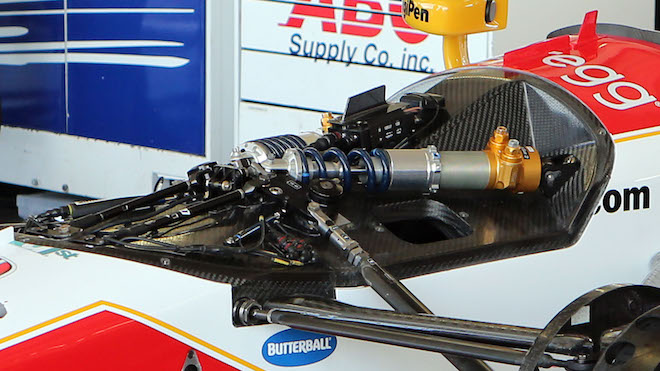
A damper (shock absorber) is part of the suspension system that controls how quickly the springs compress and extend as the car hits bumps, curbs, or transfers weight under braking/acceleration/cornering.
Each wheel has a spring, which absorbs the physical impact of bumps and supports the car's weight, and a damper, which sits alongside or around the spring.
Without a damper, a compressed spring would just keep oscillating (bouncing) after hitting a bump. The damper's job is to control and dissipate that energy, usually by forcing hydraulic fluid through small internal valves/orifices as the damper compresses (or "bumps" and extends (or "rebounds").
Engineers can tune the damper's resistance separately for bump and rebound, and often at different speeds of movement – slow-speed damping for gradual weight transfer like braking/cornering, and fast-speed damping for sudden inputs like curbs or bumps. This offers very fine control over how the car's body moves relative to its wheels in different situations.
The overall goal is to keep the tire's contact patch pressed consistently against the track, maximizing grip, while controlling body movement (pitch under braking, roll in corners, squat under acceleration) so the car's aerodynamic platform stays stable.
Why dampers matter so much in IndyCar specifically
This comes down to IndyCar's spec chassis rules. Dallara supplies a standardized chassis, and most major components are spec parts, but dampers are one of the few areas where teams can meaningfully develop and differentiate their cars. Teams spend enormous engineering effort tuning damper packages.
Ride height control: Since IndyCar generates significant downforce through underbody tunnels (ground effect), damper tuning is central to keeping the floor at the optimal height relative to the track through every phase of a corner. Too much movement, and the car loses the aero platform it depends on for grip.
Tire performance optimization: Damper tuning affects how quickly a tire switches on (reaches operating temperature/grip) and how evenly it wears over a stint, which given the earlier discussion on tire degradation and fuel/tire strategy, is a major factor in race results.
Track-specific tuning: Every track calls for different damper settings depending on bump severity, banking, and corner types, meaning teams do extensive setup work adjusting damper response for each specific circuit.
Inerters: Since 2012, IndyCar teams have also had access to a component called an inerter – a mechanical device that resists relative acceleration between its two connection points, working alongside dampers. These add another layer of suspension tuning sophistication that top teams invest heavily in.
Latest News


Comments
Comments are disabled until you accept Social Networking Cookies. Update cookie preferences
If the dialog doesn't appear, ad-blockers are often the cause; try disabling yours or see our Social Features Support.