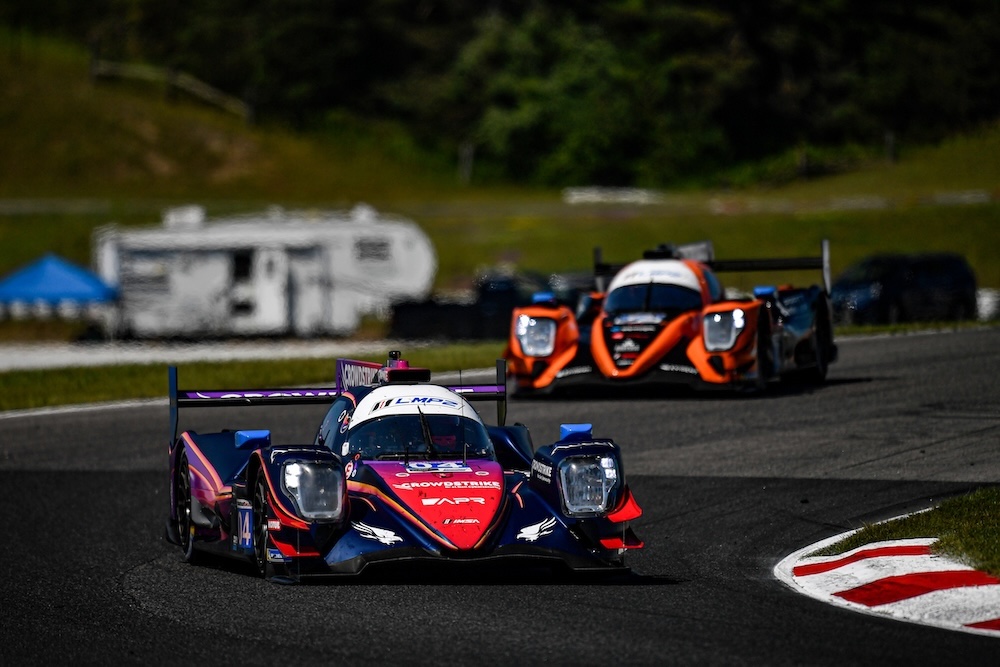
Brandon Badraoui/IMSA
What are oversteer and understeer?
Oversteer and understeer describe the two basic ways a car can misbehave when cornering – essentially, which end of the car loses grip first.
Understeer
The front tires lose grip before the rear tires. The car doesn't turn as much as the driver is asking for with the steering wheel. It keeps pushing wide, toward the outside of the corner, even with full steering lock applied. This is what drivers are referring to when they describe the car "not wanting to turn in."
It's generally considered the safer failure mode because it's more predictable and easier to control. You can usually correct it by easing off the throttle/brakes and reducing steering angle to regain front grip.
Common causes can include too much front-end aero grip loss, worn front tires, entering a corner too fast, or a setup with too much rear grip relative to the front.
Oversteer
The rear tires lose grip before the front tires.
The back of the car steps out, or rotates, more than intended. The rear slides toward the outside of the corner while the front keeps gripping, which can spin the car if not corrected. It's often described as the car being "loose."
Oversteer is more unpredictable than understeer because it can escalate quickly into a spin, and requires quick corrective steering (steering into the slide, or "catching" it) to recover.
Common causes include too much rear grip loss relative to front, aggressive throttle application mid-corner (especially in rear-wheel-drive cars), worn rear tires, or a setup with too much front grip relative to the rear.
How it applies across motorsport
- Setup and driving style matter enormously here. Race engineers tune suspension, aero balance (front vs rear wing/downforce split), and tire pressures to dial a car toward a neutral balance. Ideally a car that's just on the edge of oversteer/understeer but controllable, since a perfectly neutral car is fastest but hardest to drive right at the limit.
- Drift competitors deliberately induce and sustain oversteer as the entire point of the discipline.
- Rally driving often uses controlled oversteer (e.g., the Scandinavian flick) to rotate the car quickly through tight corners on loose surfaces.
- Drivers across different series often talk about a car being "balanced," "loose" (oversteer-prone), or "tight"/"pushing" (understeer-prone). Driver feedback on this balance is a constant part of race engineering conversations, especially as tire wear or fuel load changes the balance over a stint.
- NASCAR commonly uses "loose" (oversteer) and "tight" (understeer) as the standard terminology, and setup adjustments (wedge, track bar, tire pressure) are made specifically to dial out whichever condition the driver reports. Understanding this balance is central to both race engineering (setup) and driving technique (how a driver manages weight transfer, throttle, and steering inputs to keep the car at its grip limit.)
Latest News
Comments
Comments are disabled until you accept Social Networking Cookies. Update cookie preferences
If the dialog doesn't appear, ad-blockers are often the cause; try disabling yours or see our Social Features Support.