Dashmoto
The dash 3 Williams: F1 tech, three wheels and carbon fiber
Formula 1 technology has a habit of escaping the racetrack. Carbon fiber, hybrid powertrains, regenerative braking, and increasingly sophisticated electronic systems have all found lives in regular road cars, even if most of us will never get anywhere near the sort of machinery that produces them. Now some of that stratospheric technology has found its way into our daily lives again, but this time in a bit more of an unexpected way.
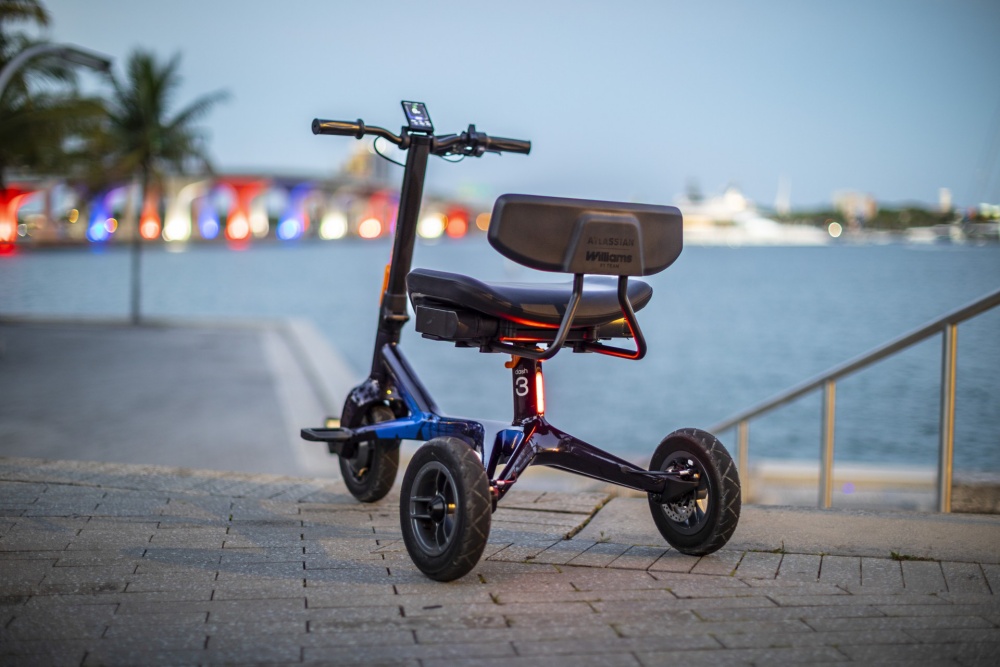
Dashmoto, a San Francisco-based mobility company, has teamed up with the Atlassian Williams F1 Team to create the dash 3 Williams, a three-wheel electric mobility scooter that looks like it belongs somewhere between a pit lane and a city sidewalk. It isn't simply a standard scooter wearing a Williams Racing livery, either. The collaboration brings changes to the machine's motor, braking system, wheels and battery, including a regenerative braking system inspired by the energy recovery systems used in Formula 1.
The result is a rather unusual piece of motorsport technology: a mobility scooter capable of 20 mph, which is an interesting number, but it isn't really the point. The more interesting story is why Dashmoto exists in the first place, and why Williams thought there was something worth bringing from the world of Grand Prix racing into personal mobility.
From motorcycle enthusiast to mobility entrepreneur
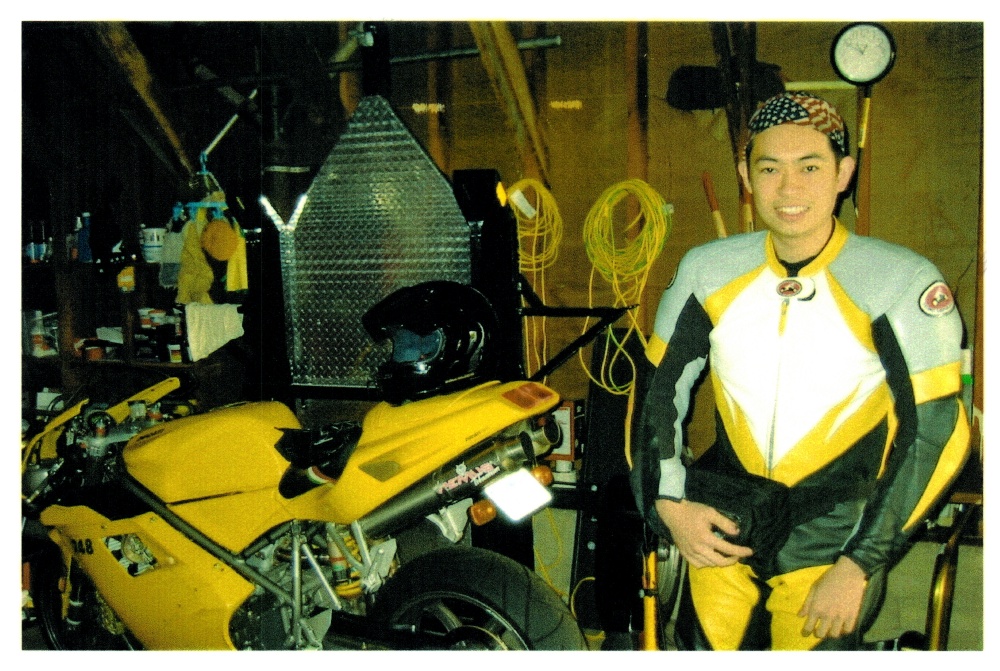
Dashmoto founder Kim Ng's interest in mobility began long before he started designing scooters. Ng was a motorcycle enthusiast, and the freedom and physical connection that came with riding were a significant part of his life. A motorcycle accident that resulted in severe spinal trauma changed that relationship with movement.
Dashmoto
His recovery included months of rehabilitation, but it also introduced him to a problem that had little to do with motorcycles. The mobility devices available to him often seemed designed primarily around function. They got people from one place to another, but they didn't necessarily inspire the same sense of independence, control, or enjoyment that Ng associated with riding.
Instead of treating a mobility scooter as a medical appliance first and a vehicle second, Ng wanted to approach it as a vehicle. That meant paying attention to the things enthusiasts instinctively care about: how it responds, how it looks, how it feels from the driver's seat, and whether using it feels like an active part of getting somewhere rather than simply being transported.
The original dash 3 emerged from that philosophy. Its carbon-fiber frame, three-wheel layout, 500-watt motor, and folding design were intended to make something that could be both practical and engaging. The standard dash 3 reaches 18 mph and has a claimed range of up to 15 miles. The Williams version takes that idea several steps further.
What makes the dash 3 Williams different than a regular mobility scooter?
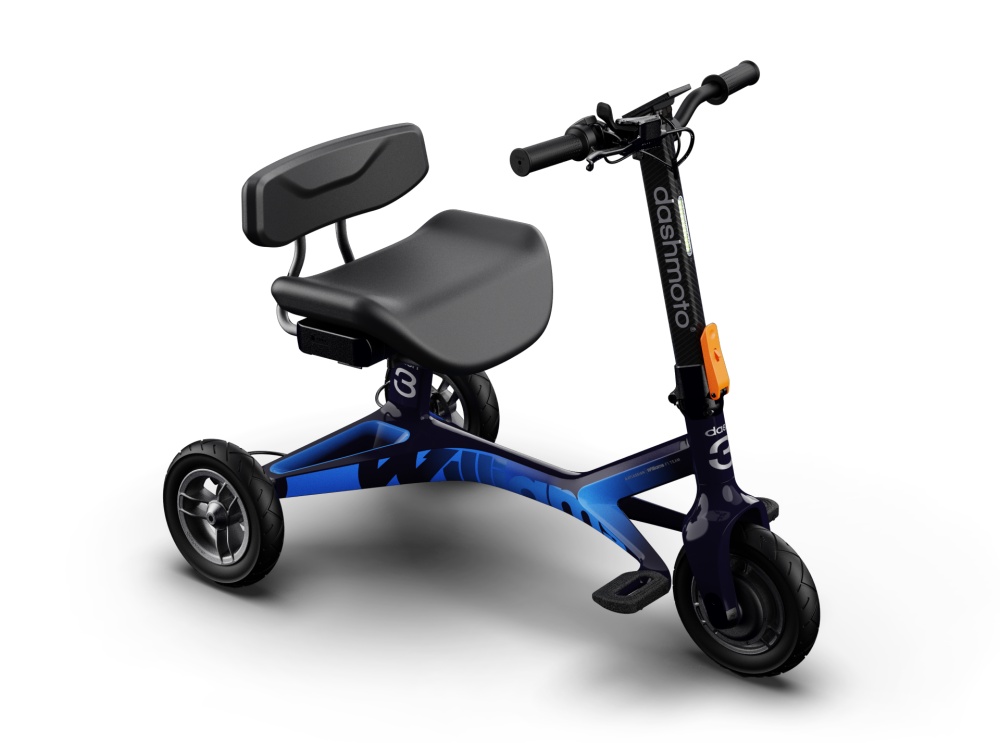
The dash 3 Williams uses a carbon fiber monocoque chassis, a 500-watt magnesium hub motor, and a 477-Wh Samsung lithium-ion battery. Dashmoto claims up to 25 miles of range and a 3.5-hour charging time, although, as with any electric vehicle, actual range depends on speed and conditions.
Dashmoto
It weighs 46.5 pounds with the seat installed and 28.7 pounds with the seat removed. The folding mechanism allows the scooter to fit into relatively small spaces, including the trunks of many cars. Its three-wheel configuration is intended to provide stability, while 10-inch alloy wheels and puncture-resistant tubeless tires give it a little more hardware between the rider and the pavement.
The performance numbers are where the Williams connection becomes harder to dismiss as a branding exercise. The scooter has four ride modes: Walk, Cruise, Sport, and Reverse. Sport mode allows the full 20-mph top speed, while cruise control is available for longer stretches of riding. The scooter also uses dual hydraulic rear disc brakes with regenerative braking.
Dashmoto
Dashmoto calls the latter KERS F1-inspired regenerative braking. In Formula 1, kinetic energy recovery systems capture energy that would otherwise be lost and convert it into electrical energy that can be used elsewhere in the powertrain. The dash 3 Williams applies the same broad principle to a much smaller vehicle, recovering energy during braking and feeding it back into the battery.
Nobody is going to confuse a 46.5-pound mobility scooter with a 2026 Williams Grand Prix car. But the underlying engineering principle is legitimate, and that is what makes the collaboration more interesting than simply applying some famous blue paint.
A mobility scooter that goes with you
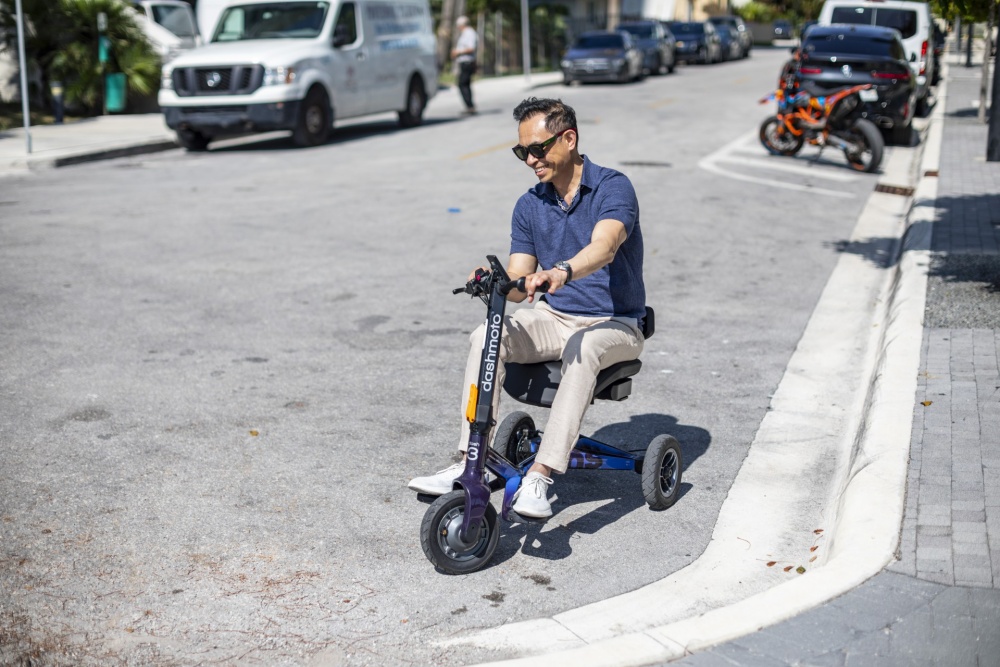
Performance is only part of the equation here. Mobility machines can be remarkably capable and still be of limited use if getting it to the place where you need it requires a logistics operation. Portability is one of the more important pieces of the dash 3's design. The scooter folds down to be more portable and can be configured without its seat to reduce its weight, making it easier to load into a vehicle or load in and out of storage. That makes the dash less of a vehicle that lives at home and more of a piece of personal mobility that actually goes with its user.
Kim Ng puts that idea to practical use himself. He regularly brings his dash to major race weekends, including MotoGP and Formula 1 events at Circuit of the Americas, where there is often a sea of parking lots and concrete between different parts of the facility.
Dashmoto
That is a particularly appropriate test case for the product. COTA is a huge facility, and attending a race there means covering a lot of ground. Bringing a mobility scooter that can be folded up and transported to the event allows for navigating the circuit without having to sacrifice the portability that made getting there possible in the first place.
It also gets at something that can be lost when mobility products are discussed primarily through specifications. The point isn't simply that the dash can go 20 mph or fit into a vehicle. It is that a person can take it along for the day, unload it, use it to explore a sprawling venue, and then pack it away again when the event is over.
What can F1 tech actually bring to a scooter?
The obvious question is what an F1 team is doing in the mobility-scooter business in the first place. If your first thought was that this feels like overkill, it was mine, too, but the Williams and Dashmoto partnership managed to bring real performance to a market that assumes its users don’t care about stuff like that. But don’t fall for the temptation to think “performance” can only mean speed. The collaboration isn't about shrinking a Formula 1 car until it fits in a scooter frame. Instead, the two companies took to the project from different ends of the same problem: how do you make a machine respond better to the person operating it? That is real performance.
For Williams, that means decades of experience chasing marginal gains in aerodynamics, material weight, efficiency, braking, and vehicle dynamics. For Dashmoto, it means applying those ideas to a product whose primary purpose isn't setting the fastest lap, but giving somebody greater freedom to only just move around the world faster, in a way that feels representative of the diversity of people who use mobility scooters.
That distinction matters. The most useful motorsport technology isn't necessarily the stuff that makes a race car more powerful; in fact, it rarely is. Sometimes it is the engineering philosophy behind it: reduce unnecessary weight, make the controls intuitive, extract more energy from the system, and design the machine around the person using it.
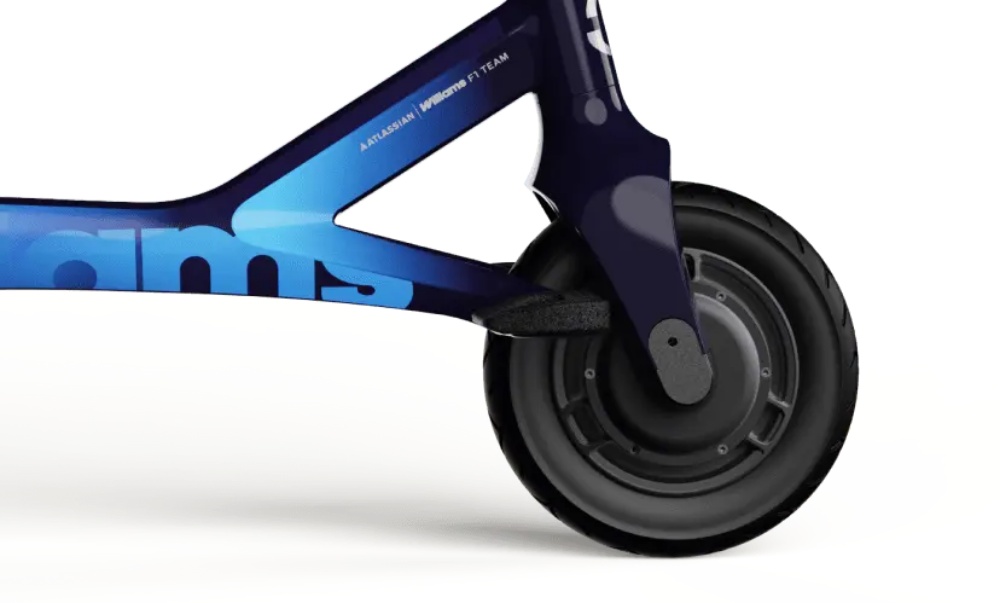
The dash 3 Williams also gets a visual connection to Williams through its blue Heritage livery and hand-finished paintwork. That's the part of the collaboration that is easiest to understand. The technical changes are more revealing.
More than a Williams scooter
That is ultimately what makes the Dashmoto and Williams collaboration worth looking at beyond the novelty of an F1 team making a scooter.
Mobility technology has traditionally been discussed in terms of necessity, often offering only the bare essentials. A device provides transportation because somebody needs transportation. Dashmoto is trying to introduce a different idea: that a mobility device can also be desirable. Dashmoto believes they can be made with intention and thoughtfulness that stretches beyond necessity and reaches for something someone might actually enjoy.

Dashmoto
For Ng, this isn’t a nice idea; it's an honest desire which unfortunately came from personal experience. He knew what it felt like to have movement shift from a source of joy and entertainment to something aching and difficult, and he also knew what it felt like for that movement to suddenly be associated with freedom or a lack of it. The goal was to build something that didn't force users to surrender one idea in exchange for the other.
Williams brings another layer to that philosophy. Formula 1 is an absurdly expensive laboratory for understanding movement, efficiency, and control. Most of what happens inside an F1 engineering department will never be useful to somebody heading to the grocery store. But some of the underlying ideas are remarkably transferable.
The dash 3 Williams is therefore an unusual kind of motorsport collaboration. It isn't trying to make a mobility scooter into a race car. It is taking the mindset developed around racing and asking where else that mindset might be useful.
And if the answer is a three-wheeled, 20-mph scooter with a racing livery that gives somebody back a little more freedom, that's a considerably more interesting application of Formula 1 technology than another set of carbon fiber trim pieces on your Camry or whatever. Check out Dashmoto for more information about the dash 3 Williams.

Peter Corn
Peter Corn is an automotive writer and storyteller. Peter has spent nearly a decade writing about cars, trucks, and motorcycles for some of the best publications in the business. He believes the best automotive stories aren't really about the machines at all, but instead, the people who love them.
Read Peter Corn's articles
Latest News
Comments
Comments are disabled until you accept Social Networking Cookies. Update cookie preferences
If the dialog doesn't appear, ad-blockers are often the cause; try disabling yours or see our Social Features Support.