Alastair Staley/Getty Images
Williams expect biggest performance gains after summer break
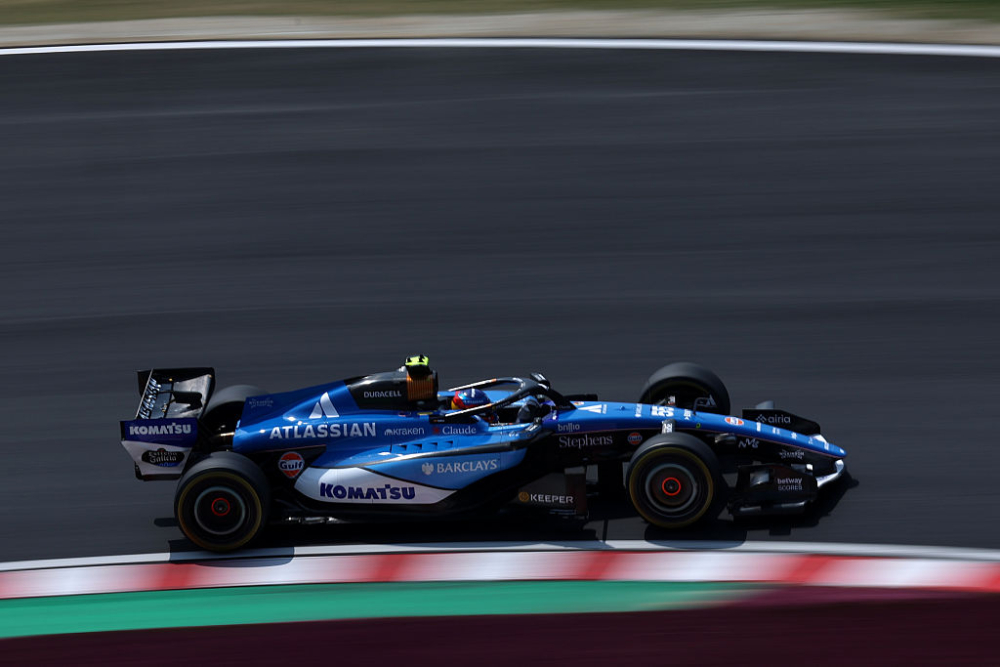
Williams has long-term developments in the pipeline that are likely to deliver the biggest performance gains after this season’s summer break, according to team principal James Vowles.
Williams has been struggling to get out of Q1 after a poor start to the 2026 season, and has scored a point on just one occasion in China. The team has cited the weight of the car as a significant factor that it will be looking to address during the current break in races, but Vowles says the end of the European season after the August shutdown is when the larger performance updates are provisionally set to be delivered.
“You can see that bundle of cars around P5 to P7 is incredibly close, there’s not a lot in it,” Vowles said. “So the issue with the word consistently is even those teams are not consistently scoring points, you have to be elevated and ahead of all that.
“Right now what I can really forecast forward is we have a huge amount of work going all the way through and beyond the August break to effectively add performance to the car. Now, other teams will as well, it’s a relative game. Some of that performance I think on the stronger end will be coming post-August break.”
To try and ensure the work being done back at the factory is effective, Vowles says Williams even used the latter stages of the Japanese Grand Prix as a test session with Alex Albon, completing multiple pit stops to make car changes.
“We know we weren’t in a point-scoring position but equally we want to maximize our learning in all of these races while that is the case” he said. “In order to correlate between track and our wind tunnel and CFD facilities, you can do a number of things. For example, you sometimes see flo-viz being added to the car, being sprayed with paint. You sometimes see rakes being run, especially in a free practice – that’s clearly not something that we’re going to go and fit in a race.
“For us, what we were doing was actually going up and down on front wing angle and ensuring that what we were showing as a map for the amount of downforce we had at the front of the car but also at the rear of the car, correlated exactly across three or four different angles.
“What it helps us do is just make sure we haven’t got any other gains or losses we wouldn’t expect otherwise, and that the map we are using is somewhat correct as we move forward in the wind tunnel.”
Chris Medland
While studying Sports Journalism at the University of Central Lancashire, Chris managed to talk his way into working at the British Grand Prix in 2008 and was retained for three years before joining ESPN F1 as Assistant Editor. After three further years at ESPN, a spell as F1 Editor at Crash Media Group was followed by the major task of launching F1i.com’s English-language website and running it as Editor. Present at every race since the start of 2014, he has continued building his freelance portfolio, working with international titles. As well as writing for RACER, his broadcast work includes television appearances on F1 TV and as a presenter and reporter on North America's live radio coverage on SiriusXM.
Read Chris Medland's articles
Latest News

Comments
Comments are disabled until you accept Social Networking Cookies. Update cookie preferences
If the dialog doesn't appear, ad-blockers are often the cause; try disabling yours or see our Social Features Support.