Courtesy of Bonhams
A chemical company created one of the most innovative show cars of the 1950s as propaganda
In 1959, a mining and chemical conglomerate paid a Milwaukee industrial designer to build three of the most striking show cars of the decade, had them constructed by the same German coachbuilder making Porsche 356 bodies, debuted them at the Geneva Motor Show, and sent them on a tour of auto shows across Europe and America. The cars were beautiful, innovative, and genuinely forward-thinking. They were also, without apology, a materials sales pitch.
Courtesy of the Brooks Stevens Estate
The Olin Mathieson Chemical Corporation wanted the automotive industry to start using more aluminum, and the Scimitar EX project was its argument. There’s a bitter sort of aftertaste to something as wonderfully and strangely designed as this when it's undergirded by a mining company trying to sell more aluminum.
Brooks Stevens turned an aluminum sales pitch Into automotive art
The man Olin Mathieson hired for the job was Brooks Stevens, who turned out to be an excellent pick. Born in Milwaukee in 1911, Stevens had contracted polio as a child and spent his infirm youth drawing. By the late 1950s, his portfolio was full of legendary automotive icons like the Willys Jeepster, the Harley-Davidson Hydra-Glide, the Studebaker Gran Turismo Hawk, the Jeep Wagoneer, and even the Oscar Mayer Wienermobile, which is either the most American sentence in the history of industrial design or proof that Stevens simply could not say no to an interesting design problem. I think, maybe, both. The connection to Olin Mathieson came through Thomas S. Nicholson, the company's chairman and a personal friend of Stevens, who had a specific problem he needed solved elegantly and covertly.
Courtesy of the Brooks Stevens Estate
The problem was this: car bodies in 1959 were built almost entirely from steel, a material that would damn-near flash rust when exposed to the road salt and winter slush that characterized life across the northern United States for four or five months of every year.
The folks responsible for mining and selling aluminum were keen to share the gospel of the non-rusting, lighter-weight super metal. Olin had made a major push into aluminum production in 1956 and 1957 through its Olin Aluminum interests. He saw an enormous untapped market sitting in Detroit, largely unconvinced that aluminum was a viable structural material for production automobiles. What Nicholson needed was an undeniable proof of concept. What Stevens delivered was three of them.
The Schimitar project was pretty damn cool
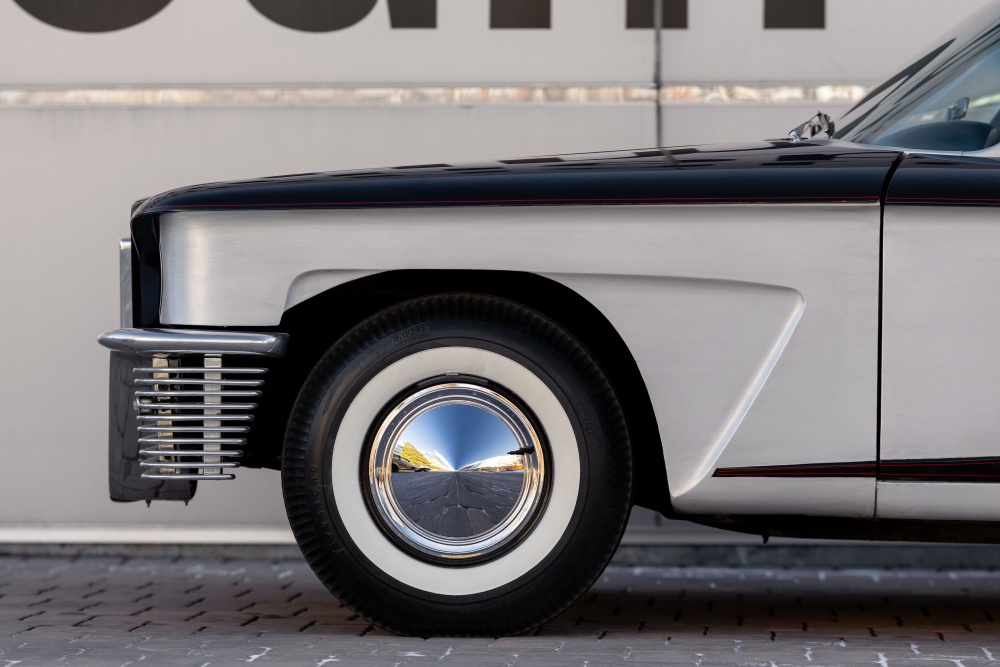
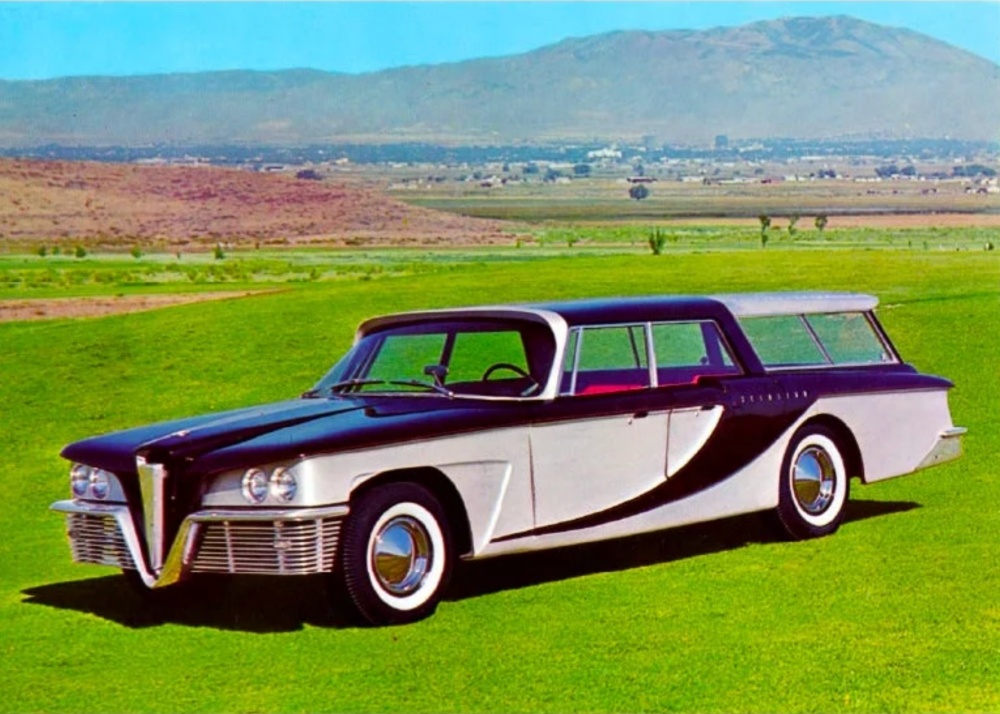
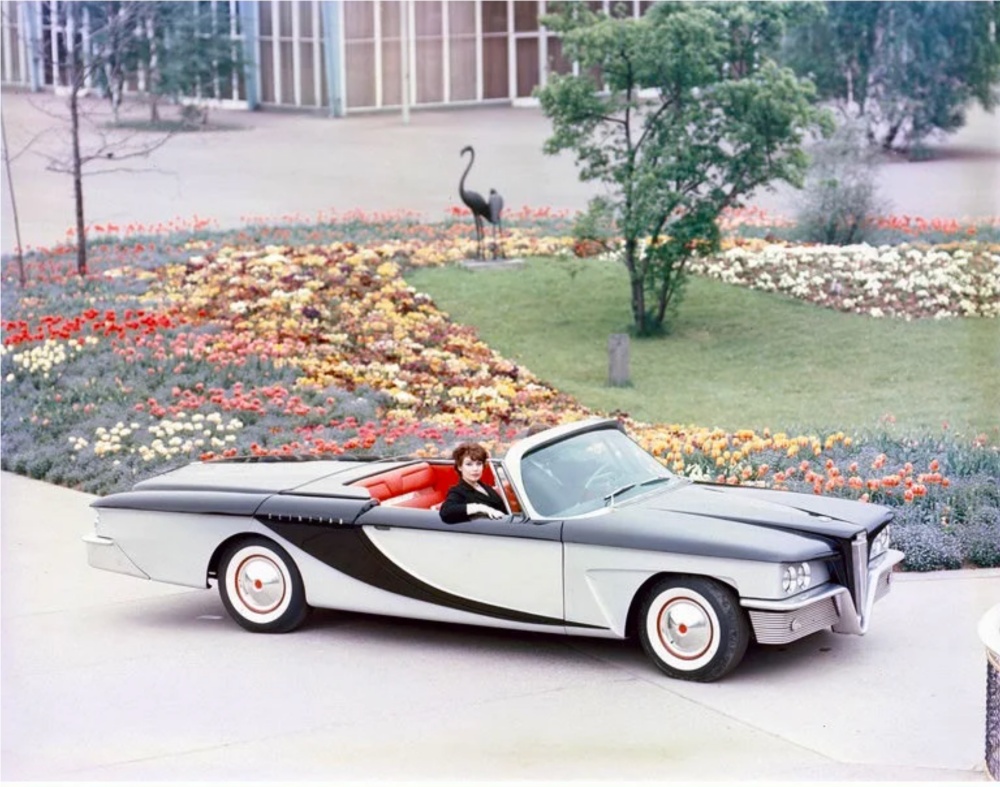
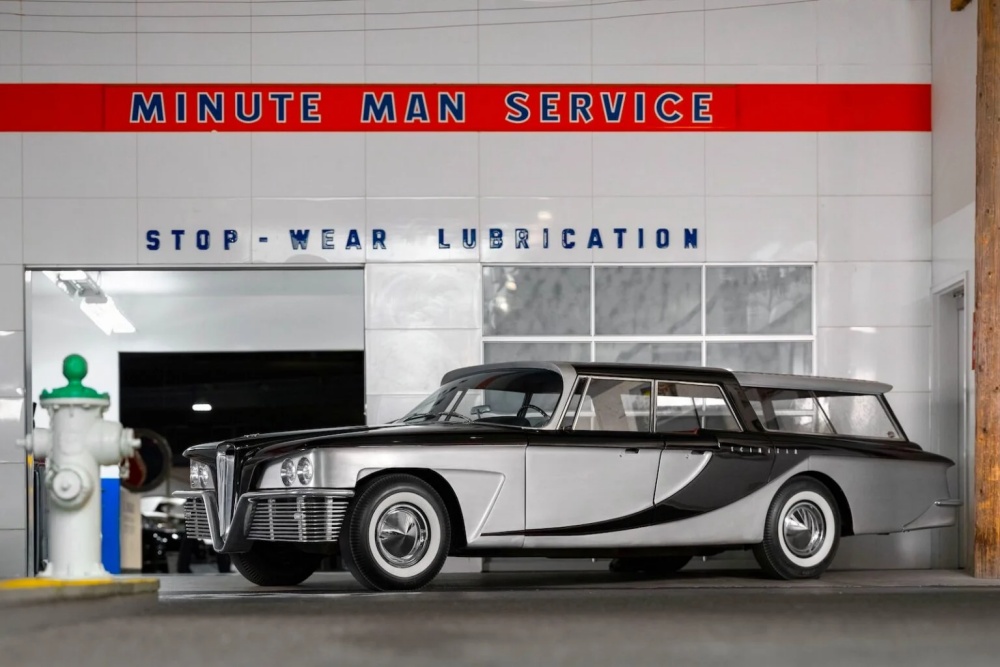
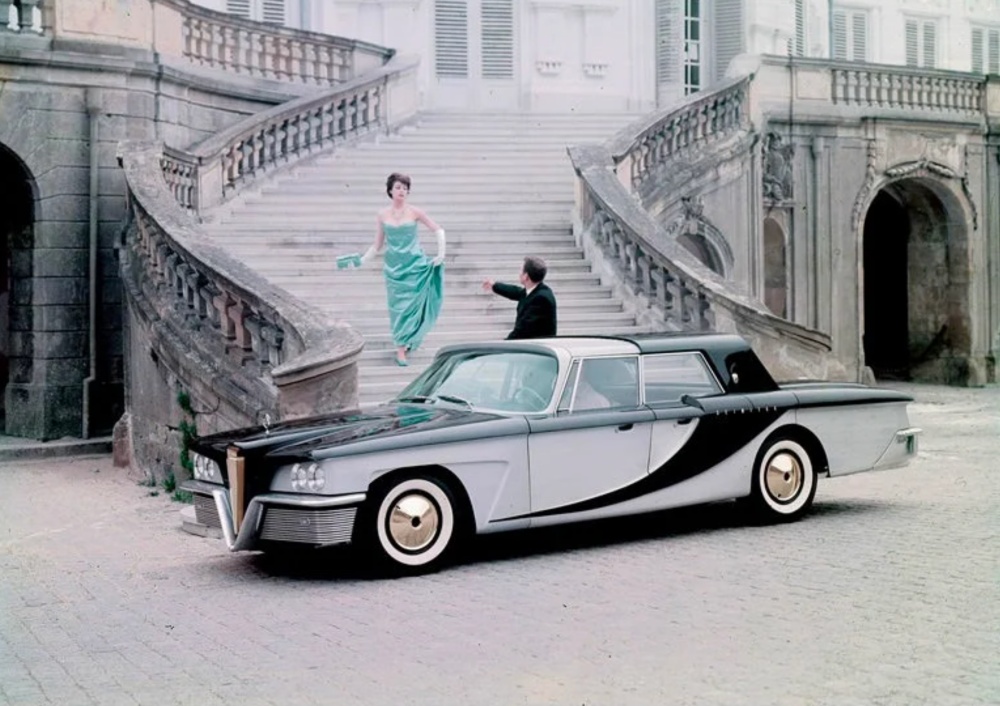
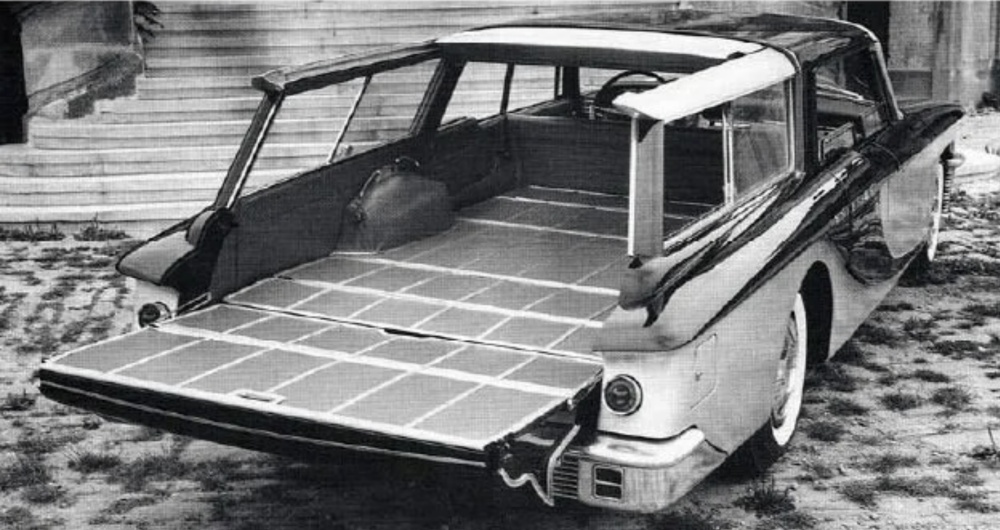
The Scimitar project produced three distinct body styles built from a shared design language: A two-door Hardtop Convertible with a fully retractable metal roof, A four-door Town Car Phaeton configurable as a formal sedan, and the All-Purpose Sedan — a pillarless station wagon with a sliding rear roof panel that opened the cargo area completely to the sky, allowing the car to haul objects that would never fit in a conventional wagon. All three shared a prominent V-shaped aluminum grille (similar to the Edsel cars) that doubled as a bumper, a motif Stevens had developed for his earlier Cadillac-based Die Valkyrie show car of 1954. The name itself came from Stevens directly — in a 1992 interview with Hemmings Special Interest Automobiles, he explained that the sweep of the body panel resembled the curved blade of a Turkish scimitar sword. The upswept black steel side panels flanked by brushed aluminum fenders made that association immediately apparent.
Courtesy Bonhams
How did the Schimitar project sell more aluminum?
The material strategy was deliberate and instructive. Everything that appeared silver was rust-free aluminum — fenders, bumpers, grilles, wheel covers, trim — specifically placed in the areas most vulnerable to corrosion. The contrasting dark panels were conventional steel, used where corrosion was less of a concern. The cars were essentially annotated arguments: look where we put the aluminum, look where the rust would otherwise be, consider the implications. That is a remarkably sophisticated way to make a corporate case, and it worked better in V8 mode than any number of reports, graphs, and other such standard corporate ephemera.
Courtesy of Bonhams
For the mechanical underpinnings, Stevens went to his friend Virgil Exner, head of design at Chrysler, who provided access to the 1959 New Yorker platform — a 127-inch wheelbase chassis powered by a 413 cubic inch V8 producing 350 horsepower, mated to Chrysler's TorqueFlite three-speed automatic transmission. Front suspension used longitudinal torsion bars with an independent setup; a live rear axle on leaf springs handled the rear. Four-wheel power-assisted hydraulic drum brakes rounded out the rolling corporate presentation.
Courtesy of the Brooks Stevens Estate
Nerd note: 1959 was the final year Chrysler used traditional body-on-frame construction for its full-size cars before switching to unibody, making the Scimitars the last period-produced coachbuilt cars on a Chrysler chassis — a historical footnote that serves as little consequence but a fun little bit of trivia for those nerds who care.
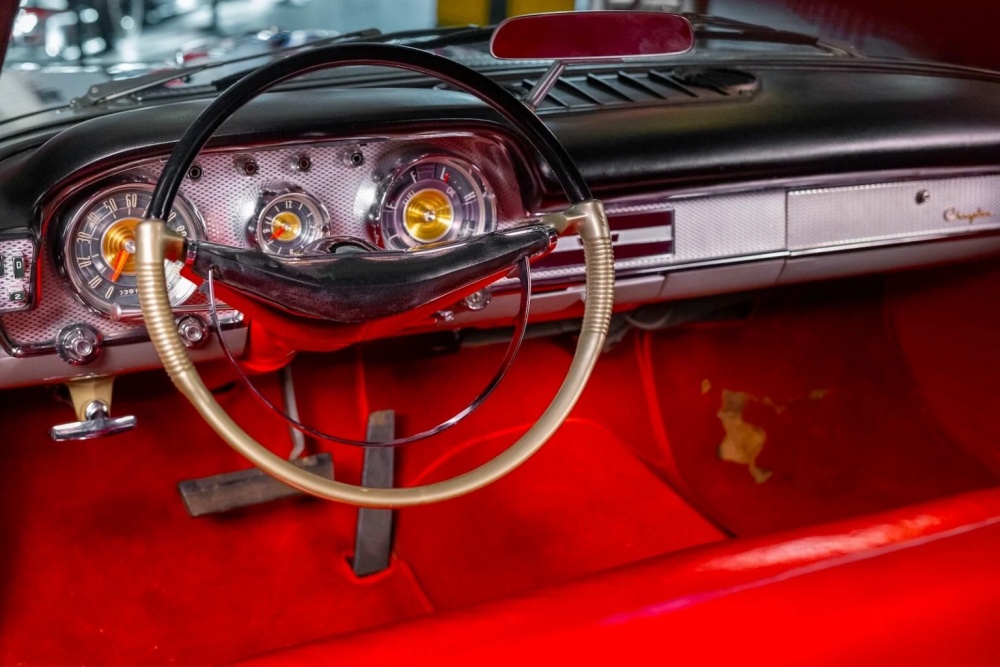
The bodies were built by Karosseriewerk Reutter in Stuttgart, Germany. If that sounds familiar, it’s the same coachbuilder responsible for the steel bodies of the Porsche 356 and the early 901/911 prototypes. Reutter's experience with one-off construction and both steel and aluminum fabrication made them the logical choice. The dashboard was pure 1959 Chrysler. The six taillights, you might notice, came from the 1958 Chevrolet Impala. Essentially, everything else was made from scratch.
The Scimitar EX was packed with ideas ahead of its time
The All-Purpose Sedan's sliding roof concept turned out to be the most durable idea in the collection. Stevens adapted it directly for the production Studebaker Wagonaire, introduced for the 1963 model year. Although the feature was extremely cool, only 12,000 buyers over four years bought the Studebaker wagon. As cool as this retractable-roof wagon was, persistent water leaks ended the experiment. GM revisited the same idea with the 2004 GMC Envoy XUV. The concept refused to entirely die, which is either a testament to its genuine utility or proof that every generation of automotive engineers believes it can solve the leak problem. So far, it seems, they cannot.
Courtesy of the Brooks Stevens Estate
All three Scimitars debuted at the Geneva Motor Show in March 1959, toured Europe, and then crossed back to the United States for appearances in Chicago, California, New York, and Miami. According to Silodrome, the All-Purpose Sedan was eventually purchased by Bill Harrah in 1965 from a fellow named Paul Stock in Cody, Wyoming, with 3,910 miles on the odometer, and has lived at the National Automobile Museum in Reno — the successor to Harrah's legendary collection — ever since. All three Scimitars survive today. They were reunited at the Amelia Island Concours d'Elegance as recently as 2020. The All-Purpose Sedan was recently sold through the Bonhams auction about two weeks ago for $156,000.
How the Scimitar EX influenced automotive design long after 1959
Did the Scimitar project convince Detroit to adopt aluminum? Incrementally and eventually, yes — the material's automotive applications expanded significantly through the following decades, driven by exactly the kind of weight and corrosion arguments Olin Mathieson was making in 1959. Whether the show cars moved the needle directly is impossible to measure. What is measurable is that the cars themselves were extraordinary — genuinely innovative in concept, beautifully executed in detail, and durable enough in practice that their most forward-thinking features kept resurfacing for decades.

Peter Corn
Peter Corn is an automotive writer and storyteller. Peter has spent nearly a decade writing about cars, trucks, and motorcycles for some of the best publications in the business. He believes the best automotive stories aren't really about the machines at all, but instead, the people who love them.
Read Peter Corn's articles
Latest News



Comments
Comments are disabled until you accept Social Networking Cookies. Update cookie preferences
If the dialog doesn't appear, ad-blockers are often the cause; try disabling yours or see our Social Features Support.