What mysterious Viking swords can teach us about the new Lego Koenigsegg Sadair's Spear
Long before Scandinavia gave us flat-pack furniture, turbocharged hypercars, and little plastic bricks capable of bankrupting grown adults, the region had already built a reputation for making things absurdly well. Sometime between the ninth and 11th centuries, a Viking blacksmith, possibly more than one, introduced an enigmatic new weapon to the world known as the Ulfberht swords. These swords weren’t ornate or visually unique, but what they were was higher quality than any swords the region had ever seen. These swords were of such quality and advanced engineering that an archaeologist once described a Viking with one of these swords as being “like a Jedi with a lightsaber” compared to the majority of other weapons at the time.
Around 170 examples have survived, each bearing the mysterious "+VLFBERHT+" inscription, a mark that became synonymous with wealth and unrivaled quality. These weren't ordinary Viking swords hammered together in somebody's shed. Many were forged from extraordinarily pure, high-carbon crucible steel, a material so advanced for the period that historians are still debating exactly how Scandinavian smiths got their hands on it. Some believe the raw material traveled thousands of miles along ancient trade routes before ending up in Nordic forges.
The Ulfberht became something more than a weapon. It was a status symbol, a luxury good, and a piece of engineering so well executed that people copied (or, at least, tried to copy it) it for centuries, complete with counterfeit versions trying to cash in on the name. Sound familiar?
This isn’t an article about swords. It’s not an article about Vikings or historical northern Europe. It’s an article about toys. I say all of this to say that the same part of the world that once produced the finest swords ancient Europe had seen would eventually give us companies like Lego and Koenigsegg. Scandinavia has been doing this sort of thing for a very long time.
Here are two brands that stake their reputations for design and quality with the same stubborn belief that clever engineering and fiercely beautiful execution are nonnegotiables, which brings us to the announcement of one of the most Scandinavian collaborations imaginable: Koenigsegg and Lego teaming up for the next in the Lego Technic Ultimate Car Concept Series.
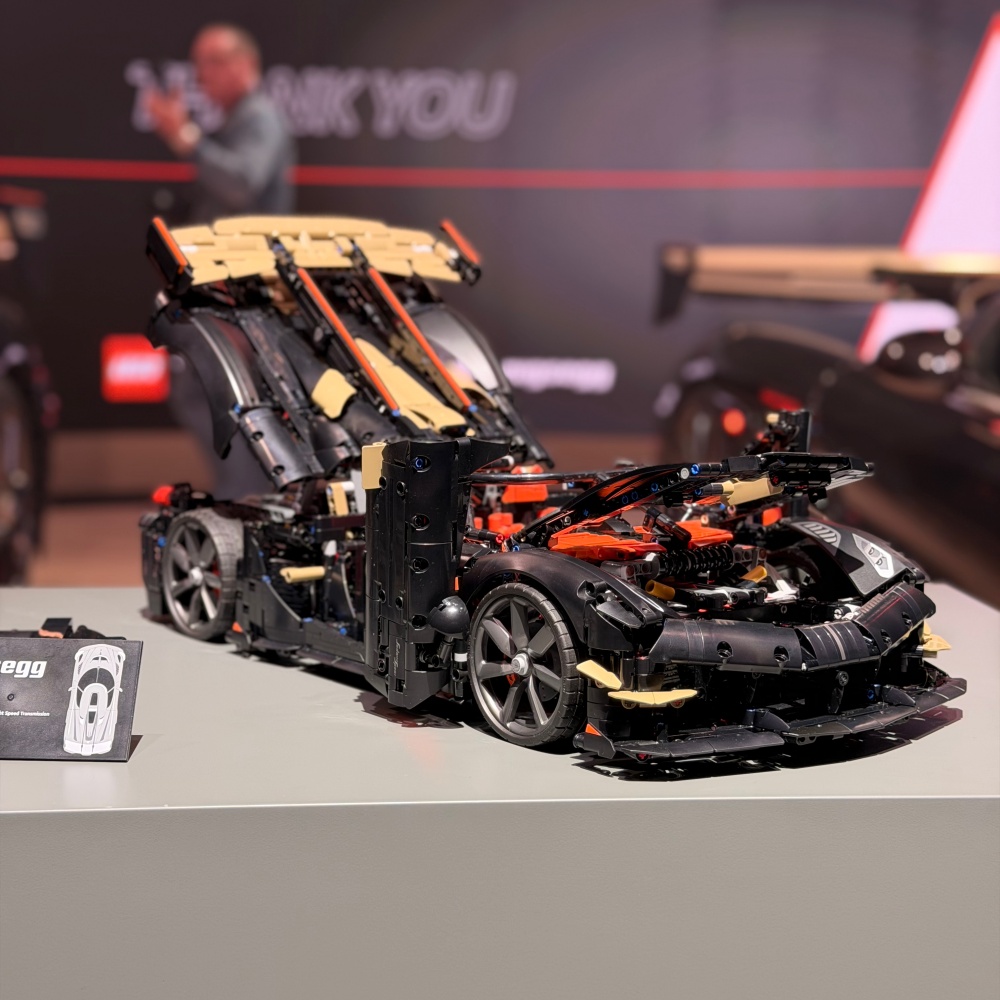
The collaboration centers on the new Lego Technic Koenigsegg Sadair's Spear, a 4,104-piece, 1:8 scale model. That's fitting because the real Sadair's Spear isn't exactly an ordinary supercar. Named after Christian von Koenigsegg's father, Jesko von Koenigsegg's favorite racehorse, Lego could have simply built a pretty display model and called it a day. Instead, it approached the project with the same level of obsessive detail as Koenigsegg itself. The newly announced Lego set is the most complex Technic Ultimate Car Concept to date. To the uninitiated, the Lego Sadair’s Spear price tag of $449.99 might seem like a big number for a toy, but you’d be wrong. Not to mention, considering that the real Sadair’s Spear would run you around $5 million if you could even still order one (it's sold out), this 1:8 scale Lego set is the closest most of us will ever get to the Spear.

Peter Corn
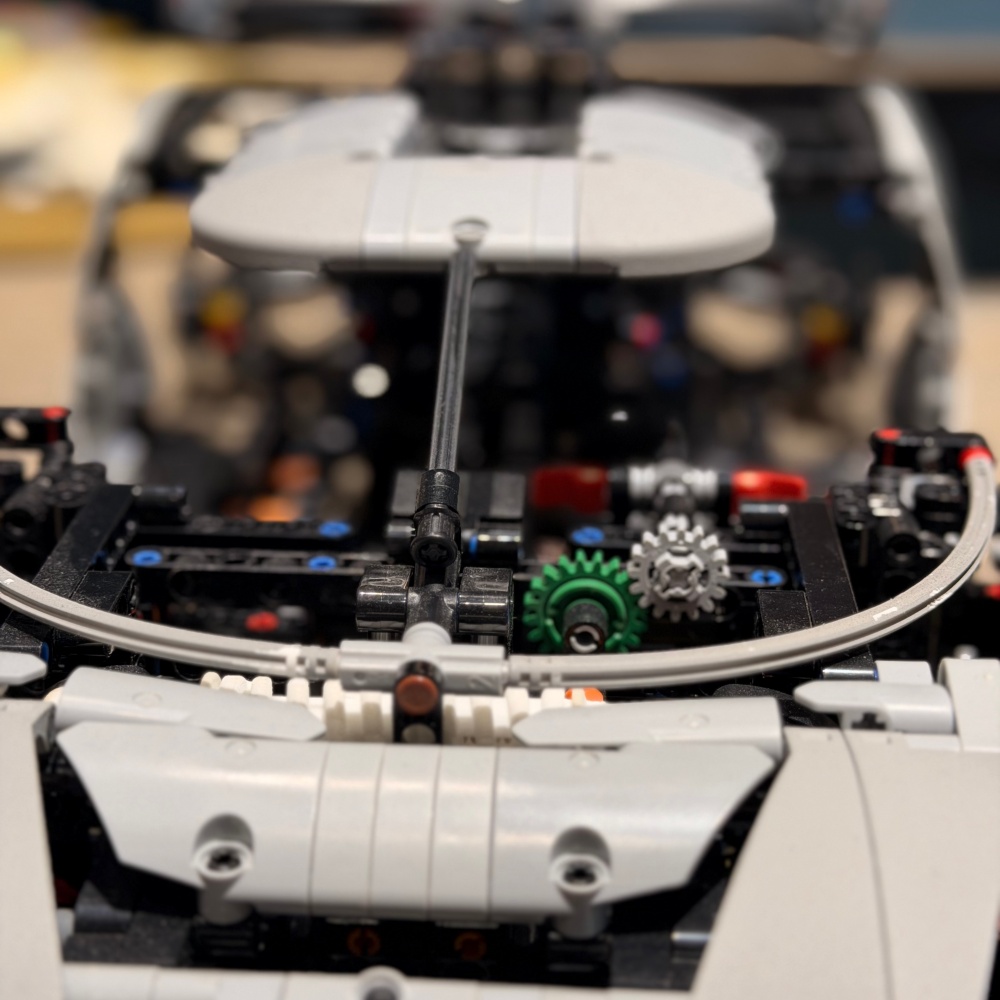
The Lego Technic model features a functional V8 piston engine, a mind-blowing working nine-speed transmission, Koenigsegg's distinctive Triplex suspension system, steering, a removable roof, and perhaps most impressively, a functioning version of the company's famous Ghost Mode. With a single movement, the rear clam lifts, the dihedral synchro-helix doors swing open, the hood raises, hell, the mirrors even fold in, mirroring the sequence of the real car. There's even a new rotating gear indicator that physically displays which gear the transmission is in. It's the kind of tiny mechanical flourish that absolutely nobody needed to engineer and exactly the sort of thing both companies seem incapable of resisting.
Peter Corn
The similarities between the two brands become even clearer when you look beyond the model itself. Koenigsegg has spent three decades building a reputation by refusing to accept conventional solutions, whether that's the Triplex suspension, the Light Speed Transmission, or the Freevalve camless engine project. Lego Technic has built its own identity around teaching mechanical principles through physical interaction, turning concepts like gear reduction, suspension geometry, and drivetrain layouts into something you can hold in your hands, having built it yourself.
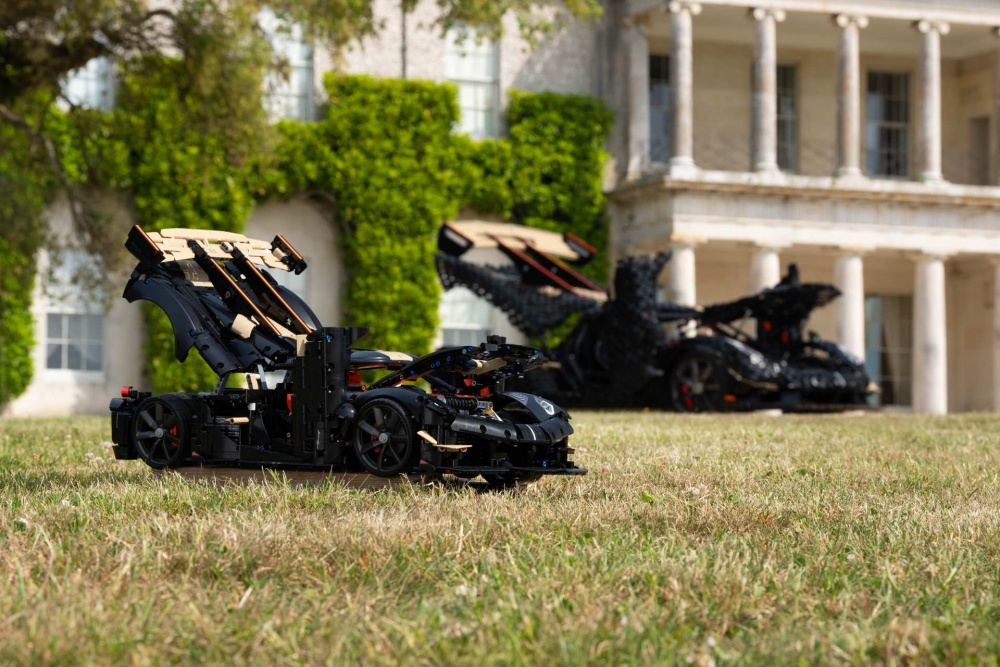
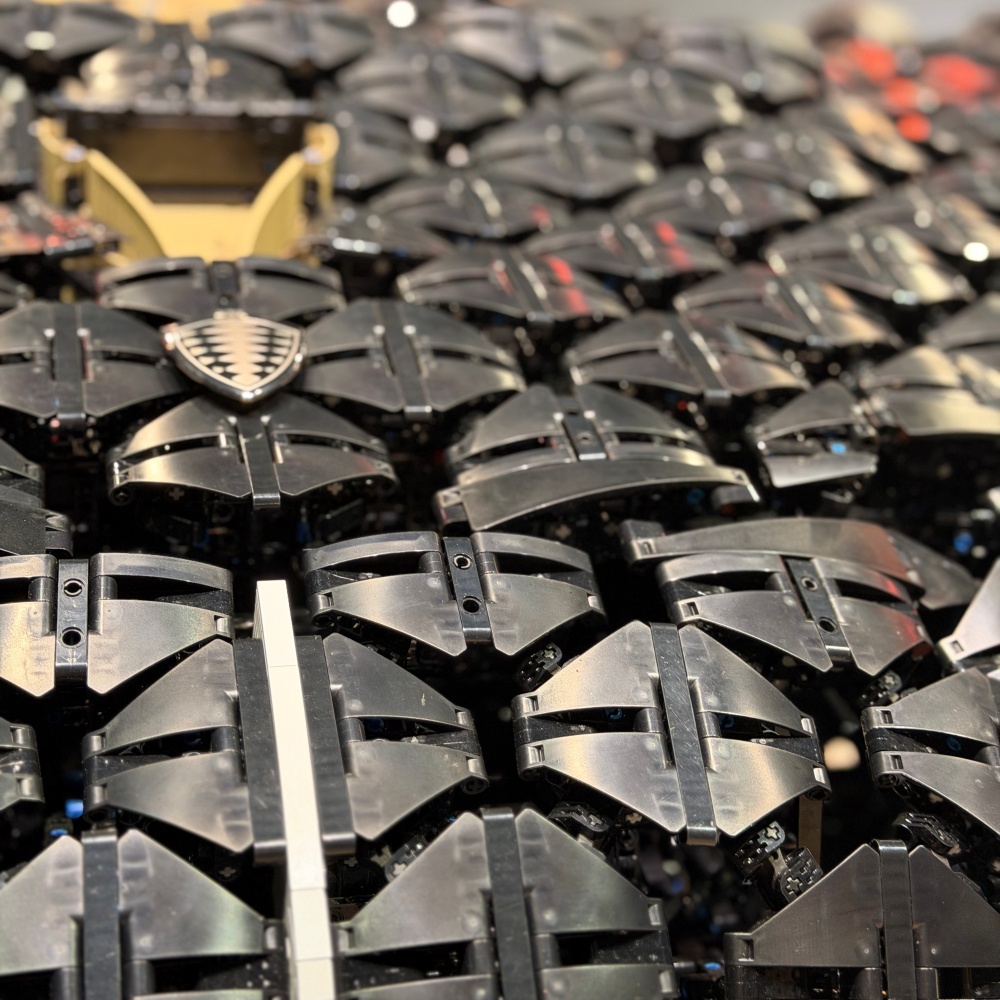
Naturally, the two companies couldn't stop at a 1:8 scale model. To celebrate the launch, Lego and Koenigsegg built a full-size, drivable Lego Technic Sadair's Spear and took it to the Goodwood Estate. When I say it's a car made of Lego, I mean, this thing is made out of Lego! I know, I poked it.
Peter Corn
Driven by Koenigsegg test driver Markus Lundh, the giant brick-built creation reached 111 km/h, setting a new speed record for a drivable Lego vehicle and more than doubling the previous benchmark. The feat was also a nod to Lundh's 2025 Goodwood Festival of Speed hill climb record in the actual Sadair's Spear, adding another layer of Sacandi overachieving to the project.
The full-scale build is almost as absurd as it is impressive. It uses 327,906 Lego elements, weighs around 1,800 kilograms, including roughly 400 kilograms of Lego pieces, and required more than 9,400 hours of development and construction. Somehow, the giant model also incorporates functioning Ghost Mode and even a Lego version of Koenigsegg's signature key. It exists in that strange place where engineering demonstration, art project, and publicity stunt all overlap.
Peter Corn
Maybe that's the real through line connecting these two companies. Neither has ever been content to make something that merely works. Something that is “good enough.” We spend an entire day touring the Koenigsegg factory alongside the Lego team. While we were guided through the production lines, offices, and test track at Gripen Atelier, the stories of the famed Viking sword stuck in my head. The Ulfberht sword wasn't simply a tool. It was a demonstration that exceptional craftsmanship could become a symbol in its own right, exceeding whatever its intended purpose, even one as grim as a tool of war. Lego and Koenigsegg operate with a similar philosophy. One builds toys that are so well-engineered that assembling a set inherently teaches the user about engineering. The other builds hypercars (Megacars) that rewrote what automotive engineering can accomplish. Put them together, and a 4,104-piece Sadair's Spear suddenly feels less like a marketing exercise and more like a very old Scandinavian tradition: building something designed so well that there simply can’t be an equivalent.
It’s hard to process the depth and scale of what these two companies did to make this new collaboration work. Still, Christian von Koenigsegg, CEO of Koenigsegg, put it well when he said, “Innovation and extreme performance are at the core of everything we do. To see the Sadair’s Spear recreated not only as a highly detailed 1:8 scale Lego Technic model, but also as a full-scale, drivable vehicle, is truly remarkable. Our partnership with the Lego Group demonstrates how a shared passion for engineering and creativity can result in something extraordinary.”

Peter Corn
Peter Corn is an automotive writer and storyteller. Peter has spent nearly a decade writing about cars, trucks, and motorcycles for some of the best publications in the business. He believes the best automotive stories aren't really about the machines at all, but instead, the people who love them.
Read Peter Corn's articles
Latest News



Comments
Comments are disabled until you accept Social Networking Cookies. Update cookie preferences
If the dialog doesn't appear, ad-blockers are often the cause; try disabling yours or see our Social Features Support.