Image Courtesy of Mecum
The Morgan that belonged to a counterculture icon
At the risk of turning what could, maybe should, be a short article talking about a cool car, there doesn’t seem to be any interesting or dutiful way to write about Michael Lang’s Morgan Plus 4 without exploring a bit both the strange and wonderful history of Morgan and the cultural avalanche brought on by Woodstock.
A very brief history of a very old car company
Morgan is one of those companies that feels like it shouldn't exist. It’s a bit of a brain tickler, nearly anachronistic. Morgan survived two world wars, the collapse of the British auto industry, countless recessions, changing safety regulations, being hopelessly outdated, and over a century’s worth of termites.
Despite it all, Morgan has stubbornly soldiered on, building sports cars by hand in the same small English town, using a car ingredient that simply doesn’t make sense: wood. Morgan, by and large, uses the same ash wood body frames paired with steel chassis construction that defined the company before the First World War. In an industry obsessed with the next technological revolution, Morgan has stuck to the charming and endearing roots that built its reputation.
As much as the Morgan legendarium was built with planers, saw blades, and chisels, there is a secondary layer of foundational oddity: the three-wheeler. According to our friends at Silodrome, before Henry Frederick Stanley (HFS) began Morgan, he started with a bizarre single-seat three-wheeler. All vehicles in 1909 were strange, cartoony things by our standards today, but even still, the prop-Morgan was a spectacle indeed. It was crude and rough, little more than a seven-HP Puegot engine strapped to a frame, “controlled” by a stick such as you might find on a small outboard motor boat. For all its crudity, HFS engineered a clever independent front suspension.
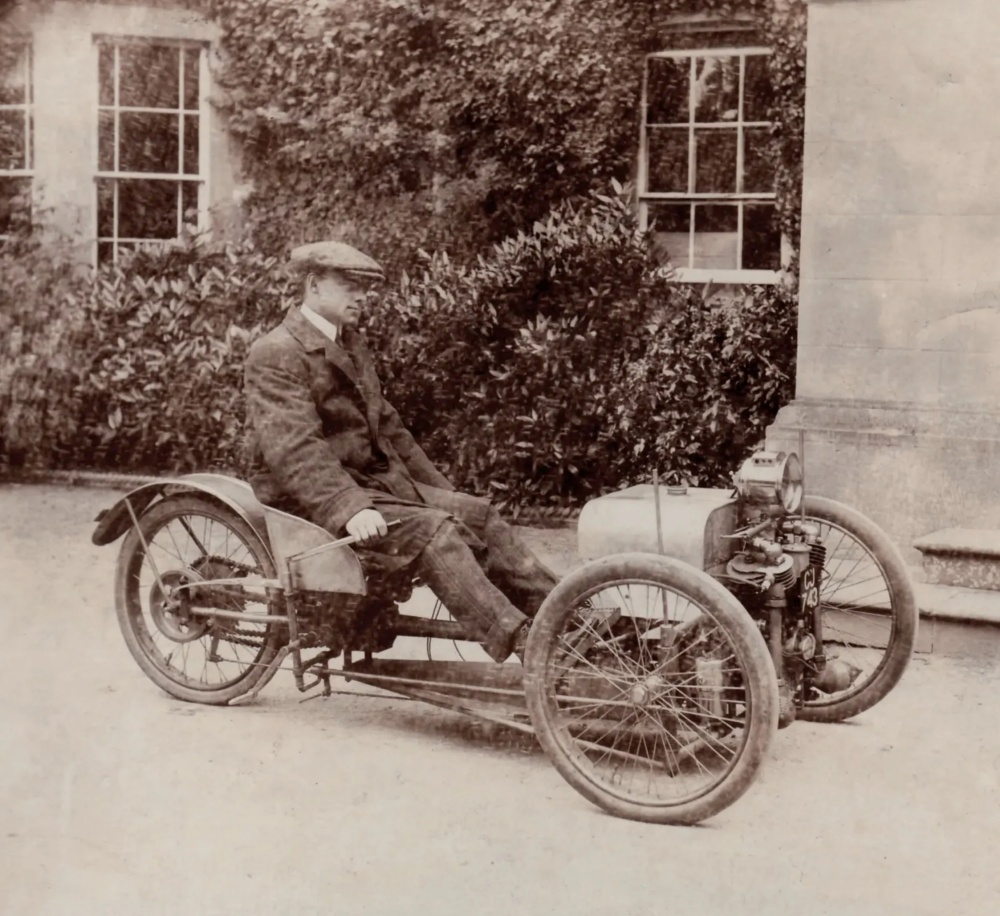
Image courtesy of the Morgan Motor Company
People were talking.
By 1910, HFS had taken his little three-wheeler to the Olympia Motor Show in London. The following year, he expanded his idea to include a two-seater version, which the department store Harrods had proudly for sale in its window for the hefty sum of £65, which, at the time, was probably something close to many people’s yearly wages. In 1912, HFS, with the help of his father’s financial backing, took Morgan to market, formally registered as a private limited company. I wonder if ol’ HFS or his dad could have ever guessed that over a century later – after major automakers have come and gone, humans went to space, the internet, microwaves, AI, and all the other achievements and blunders of mankind – that his weird little car company would still be buzzing around the globe, dripping in style and class?
The Morgan Plus 4
For all of Morgan’s style and grace, this plinth-hatted, old-world philosophy reached its peak in the form of the Morgan Plus 4. Introduced in 1950, the Plus 4 wasn't a clean-sheet design so much as a contiuation/evolution of the iconic 4/4. Engineers widened and strengthened the chassis, stretched the wheelbase, and installed a larger Standard Vanguard engine before later upgrading to Triumph powerplants, for the first time, making these cars genuinely capable sports machines. Hydraulic brakes, disc brakes, and progressively more powerful engines modernized the mechanical package, but the formula never changed. The Plus 4 remained light, simple, mechanically honest, and unmistakably British.
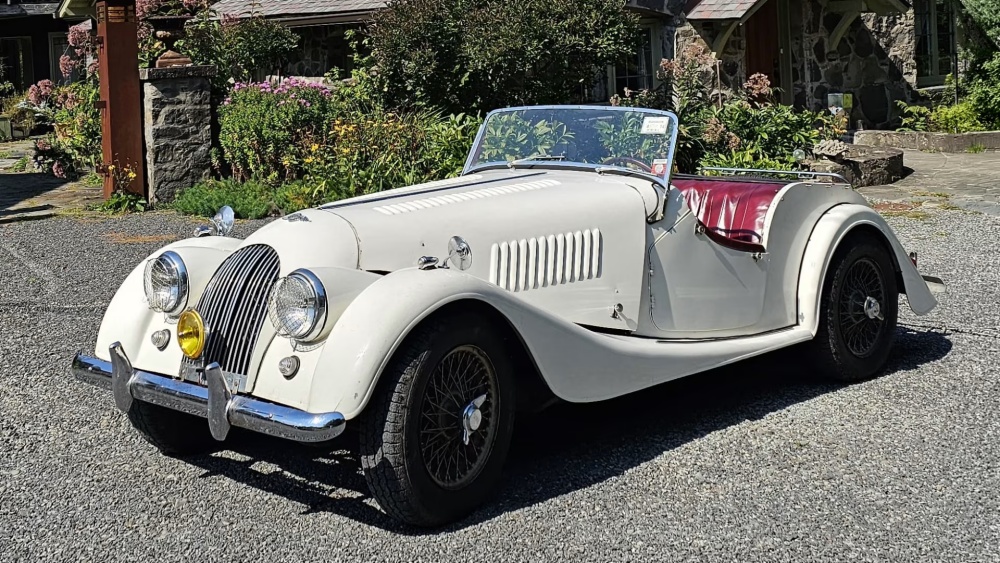
Image courtesy of Mecum
That simplicity is precisely what made the car unignorable. While many manufacturers chased horsepower figures and ever-more complicated engineering, Morgan focused on wood. The ash wood frame wasn't some marketing gimmick or nostalgic flourish. I mean, maybe it was also those things, but it was more than that. It had been part of the company's construction method since the beginning, allowing skilled artisans to build each body by hand before attaching aluminum panels over the wooden furniture underneath. Even as the rest of the automotive world embraced robotics and mass production, Morgan continued relying on people with woodworking tools and decades of experience. More than a hundred years later, the company still builds cars this way in Malvern, England, producing only a few hundred vehicles each year.
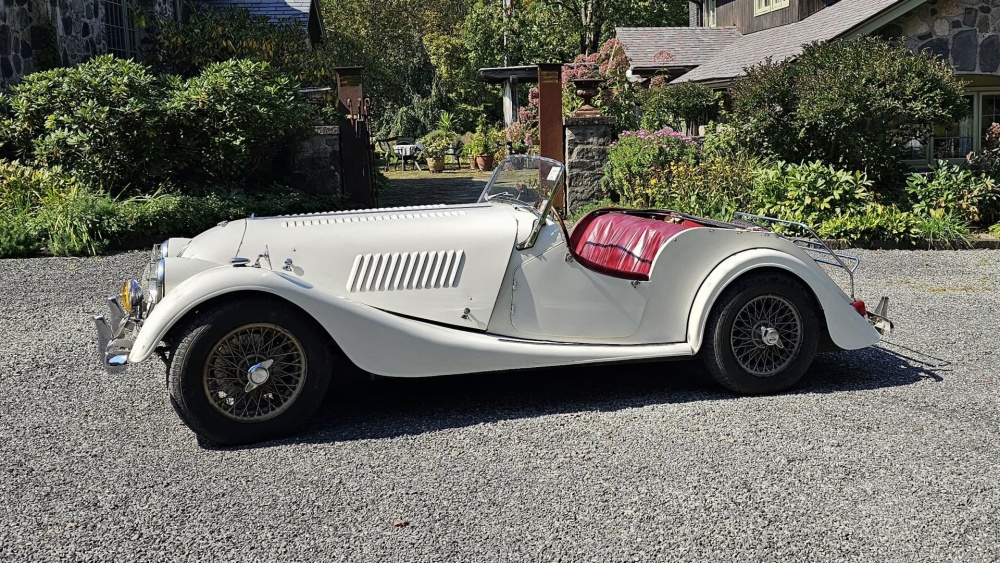
Image courtesy of Mecum
That commitment to tradition never came at the expense of performance. The Plus 4 proved itself in competition almost immediately, most famously earning a class victory at the 1962 24 Hours of Le Mans. It was an extraordinary achievement for what was, at its heart, a hand-built roadster with an ash frame and steel ladder chassis competing against purpose-built sports cars from much larger manufacturers. The victory cemented Morgan's reputation and led directly to the lightweight Plus 4 Super Sports, one of the company's most desirable models today.
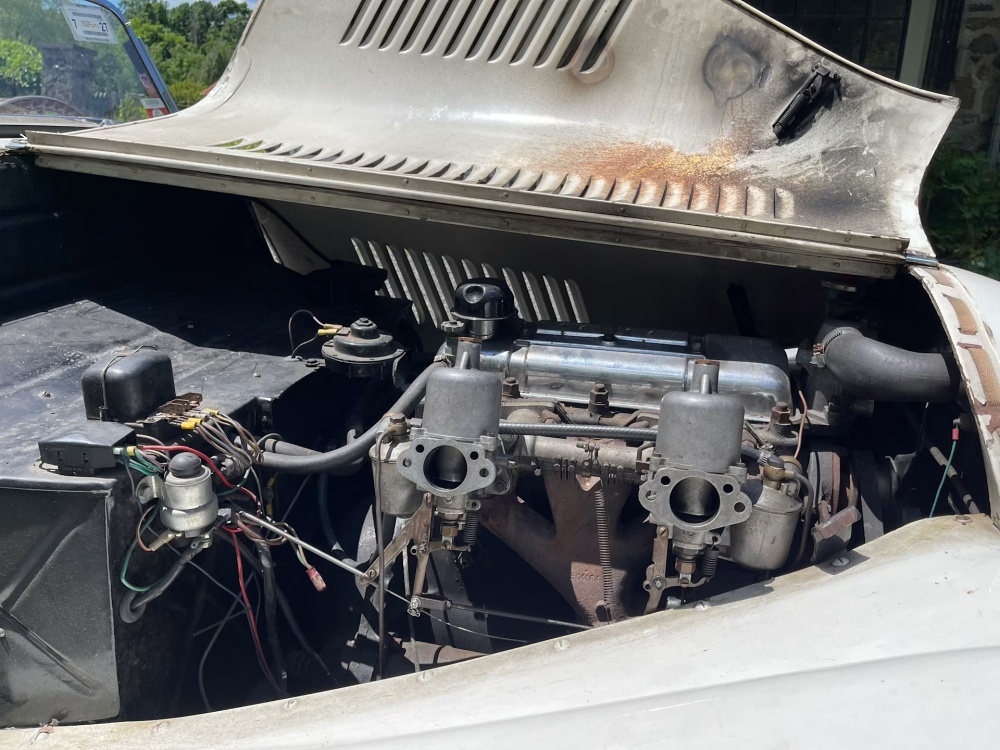
Image courtesy of Mecum
The remarkable thing is that the Plus 4 refused to disappear. When Triumph stopped supplying engines in 1969, production ended after 4,584 examples, but only temporarily. The model returned in 1985 with Fiat power, later adopted Rover and Ford engines, and ultimately remained in production until 2020, when it evolved into the BMW-powered Plus Four. Across seven decades, the recipe changed remarkably little because it never really needed to. It simply kept proving that there was still an audience for lightweight sports cars built the old-fashioned way.
Three days of Peace and Morgan
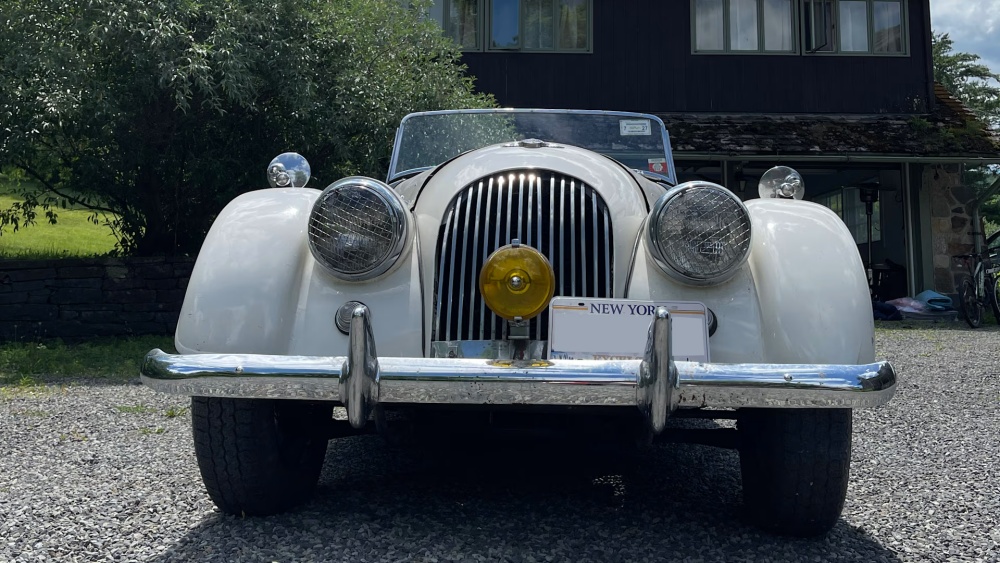
That enduring appeal helps explain why Morgan owners are often an eclectic bunch. Which brings us to this particular 1964 Morgan Plus 4, a cream-over-red example powered by the desirable Triumph TR4 2.1-liter inline-four and four-speed manual transmission. Before becoming a collectible classic, it belonged to Michael Lang, a concert promoter who would stumble upon the creation of one of the most influential cultural events in American history. It's a fitting pairing. Like Morgan, Lang built a career by doing things his own way and accidentally creating an event that encapsulated the paradigm-shifting movement that challenged art, music, culture, and American society at its core.
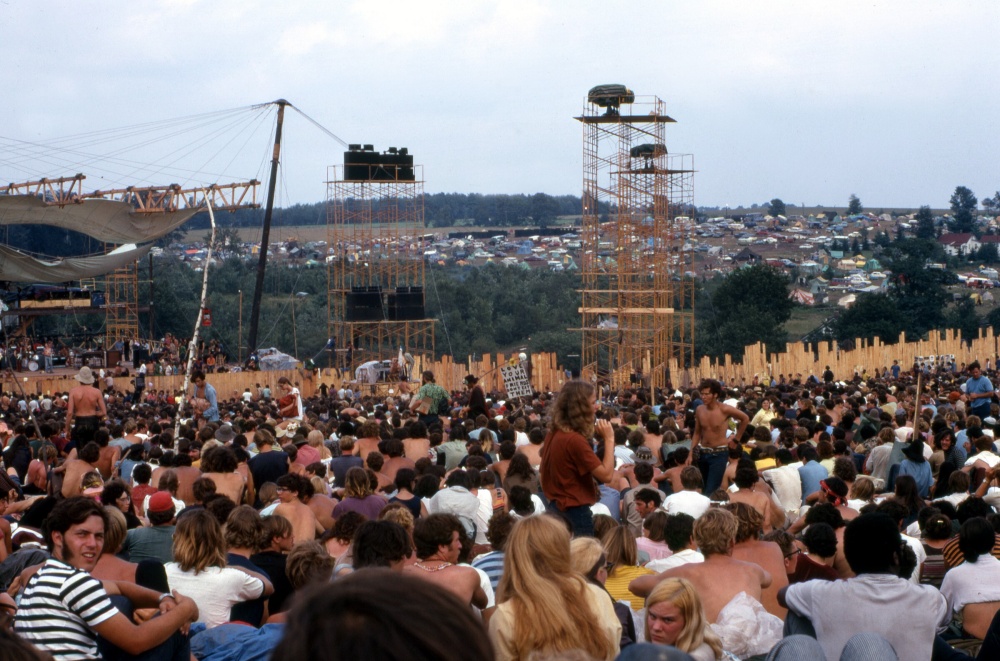
WIkimedia Commons
Before we get too carried away, Lang wasn’t the only madman responsible for the music festival on Max Yasgur’s farm outside of Bethel, NY, otherwise, and perhaps better known as Woodstock. I doubt anyone needs me to rehash the most famous concert in human history (and, no, this really isn’t up for debate, but feel free to sound off in the comments), except to make sure we all understand the spiritual connection between the iconic festival and the little Morgan Lang couldn’t resist.
Woodstock wasn’t originally meant to be the giant thumb mashing the scales of the zeitgeist. In its earliest form, it was supposed to be a for-profit music festival that would help finance a recording studio in the town of Woodstock, New York, where The Band, Dylan, Joni Mitchell, and many, many more were known to tool around. Promoters Michael Lang, Artie Kornfeld, Joel Rosenman, and John Roberts envisioned a ticketed event for around 50,000 people, complete with fences, ticket booths, and enough infrastructure to operate like any other large concert. As interest exploded, the people of Wallkill, the actual township meant to host the show originally, let their prejudice and squareness get the better of them, leading to the cancellation of the permit needed to put on the show. However, after some serious scrambling, the organizers were forced to relocate to Max Yasgur's dairy farm in Bethel, New York, just weeks before the festival began.
By the time the gates opened on August 15, 1969, those plans had unraveled completely. An estimated 400,000 people arrived, overwhelming the site's roads, security, and ticketing system. Fences were dismantled and eventually abandoned, making Woodstock effectively a free festival by accident. Heavy rain turned much of the venue into a sea of mud, food and sanitation quickly became major concerns, and the weekend teetered on the edge of a logistical razor blade. Yet despite the chaos and winding road of troubles along the way, the festival remained remarkably peaceful, punctuating the point the counterculture had been making. Performances included Jimi Hendrix, Janis Joplin, Santana, The Who, Crosby, Stills, Nash & Young, Joe Cocker, Richie Havens, Ravi Shankar, John Sebastian, The Grateful Dead, Sly & the Family Stone, and just so much more.
These instantly iconic performances transformed what had been intended as a capitalist venture into one of the defining cultural moments of the twentieth century. Woodstock didn't become legendary because some logistical professionals nailed a perfect plan, doing what everyone else does. It became legendary because, against all odds, against mountains of failure and resistance, it pursued something fundamental that reflected the realities of the middle of the 20th century in America and the promise and yearning for peace held by the young people of the day. I'm not sure that this has anything to do with a wooden-framed British sports car.
This is a bit belabored, maybe, but let's try: I'd like to think Morgan has some of the same magic. I’d argue Morgan isn’t as popular or culturally defining or smelly as Woodstock, but there’s a throughline of sticking to the dream, no matter how crazy it gets as the world changes around you (them). I’m also not arguing that this possibly thin connection is why Lang bought a Morgan Plus 4. Still, I feel safe assuming that the same spirit that made Lang undertake something like Woodstock is the same thing that ordered his tastes in such a way that led him to buy an expensive car with a wooden frame in 1977.
Lang’s Morgan Plus 4 is the coolest Woodstock memorabilia
Sure, having Hendrix's headband, or a bit of Townshend’s exploded SG, or Wavy Gravy’s bong, or Richie Havens' wrecked guitar strings, or any other number of artifacts might be a bit more quintessentially “Woodstock” than the Morgan Lang bought nearly 10 years later. Still, those kinds of things are unicorn hair; you ain’t gettin’ any. The Morgan just went to auction at Mecum last week and sold for $18,700. Stop here. Think about what endless list of boring nothingness you can get for that money. A used Kia? A quarter of a downpayment on a home? Like three months of healthcare premiums? You get the picture.
$18k feels like the biggest missed opportunity for anyone who is not put off by wooden-framed cars and the greatest artistic showcase in American history. And to sum up Woodstock and Morgan in one wonderful quote, "Financially, this is a disaster... But, I'm very happy" – Artie Kornfeld.

Peter Corn
Peter Corn is an automotive writer and storyteller. Peter has spent nearly a decade writing about cars, trucks, and motorcycles for some of the best publications in the business. He believes the best automotive stories aren't really about the machines at all, but instead, the people who love them.
Read Peter Corn's articles
Latest News
Comments
Comments are disabled until you accept Social Networking Cookies. Update cookie preferences
If the dialog doesn't appear, ad-blockers are often the cause; try disabling yours or see our Social Features Support.

_.jpg?environment=live)