Great American Truck Racing Series
Too fast, too heavy, too American: The glorious and doomed story of the Great American Truck Racing Series
There is a particular strain of American ingenuity, if that’s even the right word for it, that operates entirely outside the bounds of what reasonable people would consider, well, reasonable. It’s almost childlike, not in a patronizing way, although sometimes that might be fair. No, that American thing that makes us – whatever we are – feels as much to do with a certain malleability of spirit as it does our lack of regulatory sense, as a general rule. Whatever it is that’s right/wrong with America, it, at times, can manifest itself as something so devastatingly brilliant and in such unquestionably poor judgment that no one would stop the idea of taking a bunch of six-ton semi trucks, with tandem rear axles and street tires, and throw them around a banked oval at 150mph. And then actually does it – for over a decade.
The Great American Truck Racing Series perfectly embodied that strain of whatever curious, adventurous, fearless, beer- and tobacco-stained spirit is at its absolute peak, and the fact that it eventually destroyed itself – literally, by consuming the racetracks it competed on – is the most American ending to the most American thing imaginable.
The Great American Racing Series
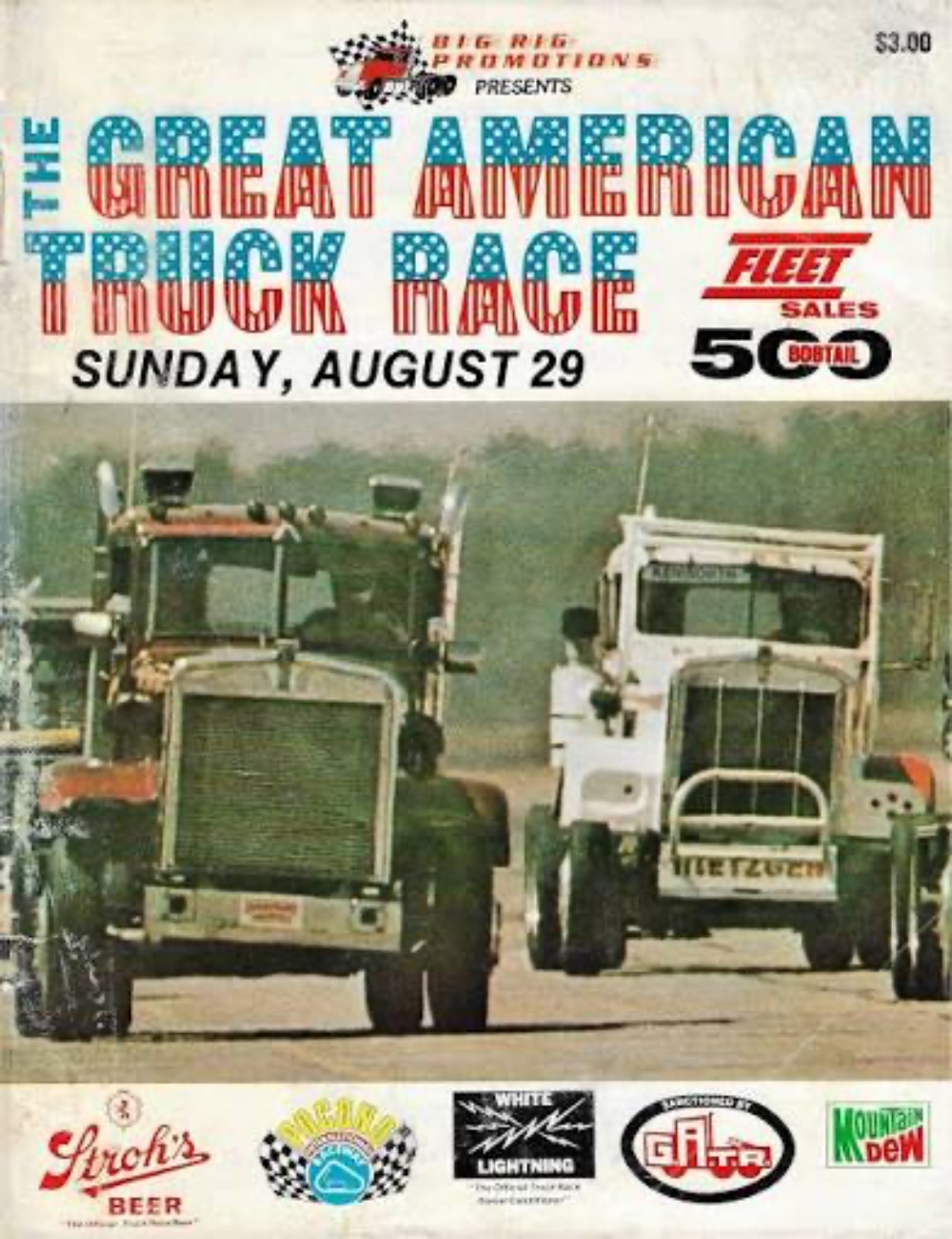
The whole thing started on June 17, 1979 at Atlanta Motor Speedway, organized and promoted by a man named Jim Donahoe out of Nashville who believed in the Americaness of Americans so much that he knew a crowd would show up to watch semi trucks race if only he would build it – a real "Field of Dreams" moment. The race ran right on the heels of the 1970s oil crisis. The oil crisis was a seriously disruptive economic quake. The entirety of the automotive industry not just shifted, but nearly inverted in a polar shift that left titanic American car makers suddenly fighting for air beneath the paradigm-shifting Japanese carmakers. American cars quickly withered, shrinking and choking under the new regulations. So, the idea of 1,000-hp, diesel-burning trucks bashing around racing ovals felt closer to trophy hunting while people were hungry. Alas, we dared defend our rights, and all that.
Meanwhile, truckers saw this as an open protest against the 55mph national speed limit set by President Richard Nixon in response to the fuel shortages. The race was politically divisive before it even got started, which meant it was already perfectly American before a single truck turned a lap. People tried to stop it. They couldn't. The trucks ran anyway. Sigh
The series began as the American Truck Racing Association in 1979, was sold in 1982, and became the Great American Truck Racing circuit – GATR – under new ownership. The trucks that competed were, in the early going, essentially the same working vehicles you cuss at on the highway. Street-legal tractors with tandem rear axles running on regrooved tires that were shaved down to keep heat from building up in the standard deep tread. This was a simple enough answer to the more complicated problem that there simply weren’t racing tires that fit a semi truck, because until approximately 1979, nobody had considered that a problem requiring a solution. The series featured GMC Generals competing against Brockways, Macks, Peterbilts, Internationals, and whatever else could be modified to run – a grid that looked less like a racing field and more like a Waffle House parking lot, whose every guest had collectively lost their minds.
How fast could racing trucks actually go?
For good or ill, the speeds were not theoretical. According to Dork-O-motive host Brian Lohnes, reports from Pocono Raceway clocked driver Charlie Baker at bouncing around 150 to 155mph on the long straight. A closed-course record of 132mph was set at Texas World Speedway in 1982. These were working trucks, running on street tires on oval tracks, and the results were exactly as spectacular and destructive as you would expect from that combination of variables.
Semi trucks on oval tracks was one of the best ideas anyone has ever had. Physics disagreed.
Death and destruction. These trucks were not kind to the infrastructure they raced on. The combination of a narrow tire contact patch, six tons of vehicle weight, and the lateral forces generated at banking speeds produced a mechanical effect on asphalt that engineers had never needed to account for, because nobody before 1979 had tried something so obviously awesome and stupid. At Pocono and Rockingham, the trucks stripped the top layer of pavement in the racing groove over the course of a single event. On shorter, more steeply banked tracks, the damage was exponentially worse. And when the trucks crashed, which was as certain as the rising and setting sun, bad things happened.
There are accounts of trucks hitting concrete retaining walls with enough force to plow through them rather than rebound off them, which is a sentence that requires a moment to fully absorb. The crashes were massive. Flaming trucks dashing themselves on the walls of racetracks and other trucks reflected some strange echo of the days of war-gaming chariot races. There are also reports that a race at a track in Cayuga, Canada, left the surface in such condition that it had effectively been converted from pavement to dirt by the time the trucks were done with it. The trucks were not racing on the track so much as consuming it, not unlike fuel or tires.
Right-front tires were the particular weak point. Imagine the geometry of a six-ton vehicle entering a banked corner at over a 100mph and consider what level of cosmic forces the right-front tire, with that much sidewall, is enduring in that moment. Tire failures at wild speeds became a recurring feature of the series, and the wreckage was cinematic.
The series was profitable and genuinely popular through the early and middle 1980s. Crowds showed up. Television covered it. The spectacle delivered. But as costs to compete escalated and technology became more complex, fields began to shrink. Insurance rates climbed. And the largest tracks in the country, increasingly unwilling to host an event that essentially sandblasted their racing surfaces, began declining to book the series. Some accounts suggest that NASCAR's acquisition of major tracks through this period further reduced available venues, pushing the series off the prestigious ovals and onto a predominantly dirt schedule that took the trucks largely out of the public eye. The series shuttered operations in the U.S. in the early 1990s.
Europe keeps the dream alive
While other countries kept racing trucks long after the American big rigs were sent back to the Love's parking lots, the idea, however, did not disappear. The Brazilian Formula Truck series (pictured below) was a popular spectacle until it eventually met its demise in 2017. But our pals across the way have been fighting the good fight since 1985, when the FIA established the European Truck Racing Championship, which took the core concept – modified heavy trucks on road courses – and applied enough regulatory structure to keep the machines and the venues intact. Speed is capped. Weight limits are enforced. The trucks are purpose-built for competition rather than conscripted into service from a freight yard.
The dream of racing big trucks continues today as the Goodyear FIA European Truck Racing Championship, even racing at circuits as prestigious as Hockenheim in Germany, and has become one of the more entertaining and well-attended niche motorsport series in Europe. The Old World apparently had the discipline to enjoy this sport without letting it destroy its racetracks and spectators.
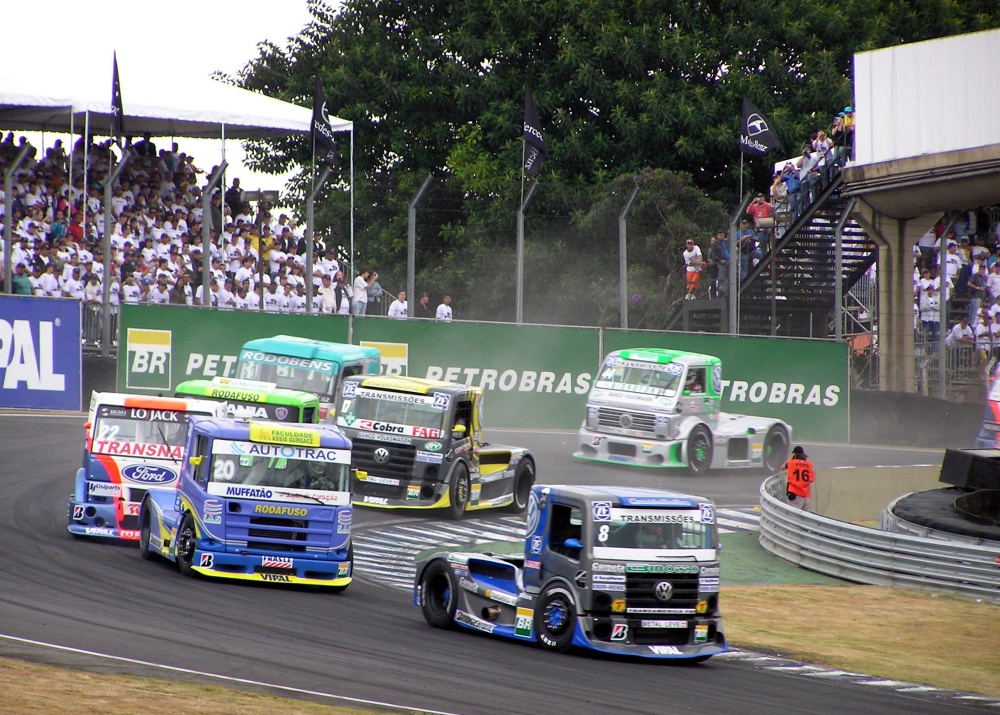
Wikimedia Commons Formula Truck
America, characteristically, did it bigger, louder, faster, and more destructively, and ran it like racetracks were disposable. The Great American Truck Racing Series was not sustainable. It was also completely extraordinary, and the fact that it happened at all – that someone looked at a Peterbilt or Kenworth and saw race cars, that tracks agreed to host it, that crowds showed up to watch it – is the kind of story that only makes sense in a country that has always confused the question "can we do this?" with the question "should we do this?" and decided both answers were “Dunno. Let’s try.”

Peter Corn
Peter Corn is an automotive writer and storyteller. Peter has spent nearly a decade writing about cars, trucks, and motorcycles for some of the best publications in the business. He believes the best automotive stories aren't really about the machines at all, but instead, the people who love them.
Read Peter Corn's articles
Latest News
Comments
Comments are disabled until you accept Social Networking Cookies. Update cookie preferences
If the dialog doesn't appear, ad-blockers are often the cause; try disabling yours or see our Social Features Support.