Joe Skibinski/Penske Entertainment
The best and the worst: Ryan Hunter-Reay on his career highs and lows
BEST CAREER DECISION
When I got fired by Rocketsports in 2005 – that year was the purgatory of my whole career – I could have bailed. Now I was broke. I tried to go back to school. But instead I doubled down and hitchhiked my way to as many racetracks as I could, just to be present. That tenacity through the struggle, I think, made me stronger and resilient in the long run.
In my quest to find a ride, at Long Beach in 2007, I spoke to Scott Roembke, team manager at Rahal Letterman Racing as it was then, and Bobby Rahal himself. They had made the switch to Indy Racing League but they were there for the IMSA race. I told them, “Hey, if anything arises, please give me a shot, and I’ll be there and I won’t let you down.” I got the call after the Nashville race [Round 11]. And my first weekend on the job was at their home race in Mid-Ohio with David Letterman there, so that seemed a lot of pressure, but I was forever grateful for it.
The remainder of that season, was just having to prove I’m fast and make a big contribution outside of the car, but at the same time, not crashing. Having been out of Champ Car and Indy cars for a year and a half, it was hard not to overreach myself, and try and prove it all with one massive weekend. In the end it went well and I got the ride for ’08, and we won a race.
WORST CAREER DECISION
I’m one of the elite group who has turned down an offer to join Team Penske. It was just before the final round of 2012, and I’d been fighting Will Power and Penske all year. The offer came saying they’d match whatever I was being paid by Michael Andretti. But I’m loyal to a fault, and I’ll always be grateful that Michael in 2010 gave me a chance to be with his powerhouse team after near-oblivion in my career with Vision Racing and then subbing for Vitor Meira at AJ Foyt Racing. That paid off [see next answer!] but in the bigger scheme of things, maybe I should be kicking myself over what could have been. I don’t know. That’s to take nothing away from Andretti, but… it’s Penske, right? When I was growing up, my entire room – walls and ceiling! – was covered in Penske posters and banners.
GREATEST RACE
This ties in with the last answer, endorsing my decision to stay at Andretti, because it’s the 2014 Indy 500, and in order to win it, I had to fight Penske and Helio [Castroneves] so hard. It was the first year where Race Control elected to red flag the race to clear up a late crash to try and make sure it finished under green. Me and Helio delivered one of the classics, I think.
But an honorable mention is also my win at Baltimore in 2012, because I feel that ultimately won me the championship. In the wet, on slicks, and having to come through traffic, the restart that I had to retain the lead… I mean, I almost hit the wall several times, writing big checks not knowing if my account was going to honor them.
MOST DISAPPOINTING RACE?
Indy 2025 with Dreyer & Reinbold. We led 48 laps, we should have come out of the last stop ahead of [eventual winner] Alex Palou. There was a miscalculation on the amount of fuel that had gone into the car at the prior stop, because the visual tube didn’t give an accurate reading.
The team was kind of questioning it, and we’d have been fine if we’d just pitted the lap before, but we were really pushing the fuel situation as far as it could go so we wouldn’t have to save fuel in the final stint. Well, it coughed as I exited Turn 4 and when these engines do that, it’s a problem because suddenly you’re running air through the lines. It kept idling during the pitstop, but as soon as I released the clutch, and got on the throttle, it died. Then it wouldn’t fire after it stalled.
And now it’s even more upsetting because Dennis Reinbold has gone. So many people told me after the race that it looked liked Dennis was going to get the 500 after decades of trying. I know what it would have meant to him, and I’d have loved to deliver him that win. So that’s why it had to be my most disappointing race, because Dennis epitomized what Indy is all about. There’s no other one-off team for the 500 in this century that was run so professionally, that looked like they belonged and could threaten the big teams. I’m pleased they’re coming back full-time.
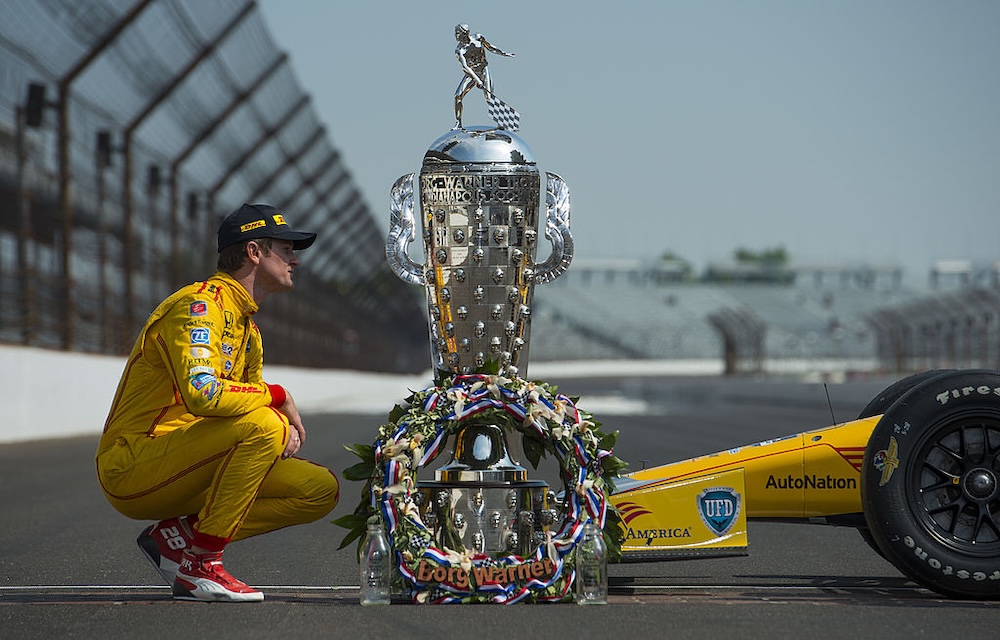
As is probably the case for most Indy winners, Hunter-Reay puts his 2014 triumph at the top of his personal 'all-time greatest victory' list. Robert Laberge/Getty Images
MOST SIGNIFICANT WIN
Sorry to repeat myself but the 2014 Indy 500. How can it not be?! It wasn’t just the win, but the nature of the win. There are very few times in my life where I’ve been so saturated in the moment that when I got out of the car, there were quite a few details that I couldn’t recall. I had to go and watch the replay because my mind was on another planet for some time afterward.
WHAT WIN WOULD YOU MOST LIKE ON YOUR RESUME?
If we were to sit here and discuss the IndyCar wins I could or should have had, we’d be here for some time, and I’d start with the 2016 Indy 500. But in terms of wins I never got a shot at, it’s gotta be the 24 Hours of Le Mans. I was driving the IMSA endurance races for the SRT Viper team in 2014, and I couldn’t get clearance from the FIA or ACO to race at Le Mans because I didn’t make the pre-test test because it clashed with an IndyCar race.
Since then, there were some talks here and there about running Le Mans, but they never went too deep. The whole dynamic of sports cars has changed: it used to be plug and play for IndyCar drivers to help out teams in the endurance races when they needed a third or fourth driver. But even over the last 10 years, it’s shifted; the drivers are sports car specialists, and the manufacturers have young guys in the pipeline ready to join the established guys, so there are limited opportunities for non-specialists to join the squads.
BEST TEAMMATE
I have been blessed to have many great teammates. My first at Champ Car/IndyCar level was Jimmy Vasser – a proven champion and a great driver.
But I know it sounds convenient to say this now he’s my direct boss at McLaren, but I’m going for Tony Kanaan. I think when I joined Andretti Autosport in 2010, from the first preseason test at Sebring, there was no ego, we were all about collaborating and developing setups that would help turn the team around. And he was fast: we each forced the other one to bring his A game. We were pushing each other further and further.
There were very few situations that were that impactful on my mental makeup and approach. Tony left at the end of the season [for KV Racing] but in 2010 I learned that your teammate does not have to be your main rival. Prior to then, my objective on a race weekend was to finish in front of the sister car, or cars, but that season, I discovered if I really work with someone and engage and communicate, then it means form can improve, team chemistry improves and the whole team gains momentum. So while I loved working with Marco [Andretti] and James [Hinchcliffe], it was working with TK that helped mold the driver I became in the following years.
WORST TEAMMATE
It’s a tough phrase to use because I’m sure all the people you’ve interviewed for this series will tell you that you can learn from all your teammates and it strengthens you. I was most entertained on this subject by Christophe Bouchut, a teammate at Level 5 Motorsports in sports cars. He was… something else.
He’d even race me hard in practice! He drove me off the road on the back straight at Sebring as I was passing him for the lead in the 12 Hours. And in practice, if I put up a fast lap with 20 minutes left, he’d demand the team put him on fresh tires to go and beat my time. To be fair, we were at different stages of our career [Bouchut is 14 years older] because he was established as a sports car ace and I was still pursuing the open-wheel dream. But I appreciated the experience, because it was almost the opposite of what I’d felt with Kanaan: it was a lesson that just because the guy has the same brands as you on his firesuit and an identical car, he doesn’t necessarily have your best intentions at heart. Bouchut was brutal and cold out of the car and in it.
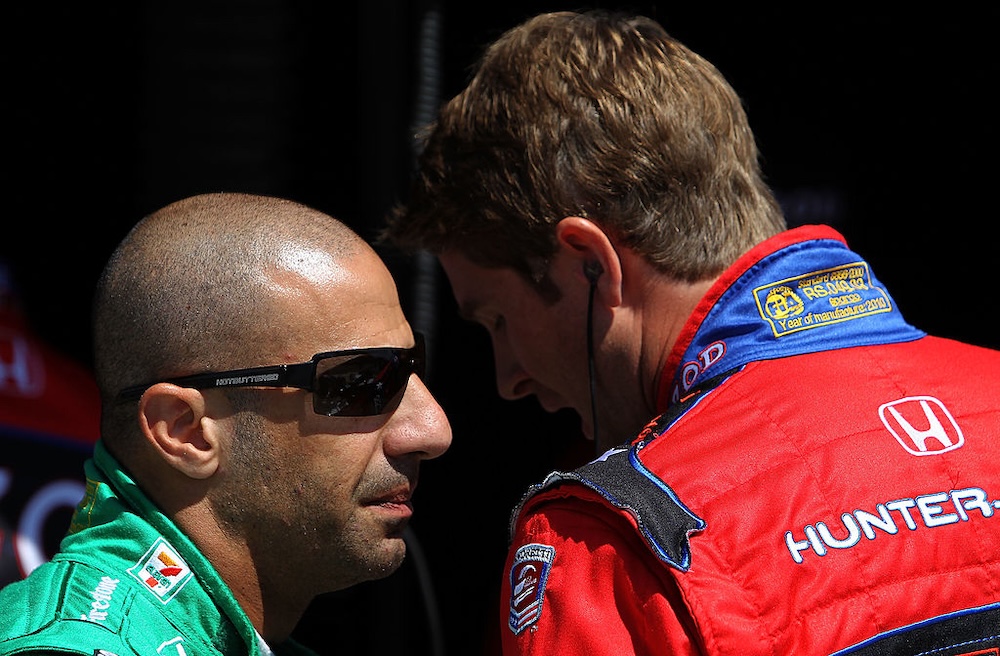
Working alongside Tony Kanaan in 2010 taught Hunter-Reay that teammates don't need to be bitter rivals. Nick Laham/Getty Images
BEST RACECAR
The Herdez Racing Lola Champ Car I had at Milwaukee in 2004. We led all 250 laps and if that race had gone green all the way, we’d have lapped everyone. I went into it knowing I had a good shot at winning because the car was doing everything I wanted it to do, but I didn’t expect to be looking in my mirrors and seeing my rivals getting smaller and smaller. And even when we hit traffic, I could put the car where others weren’t and I never felt held up: it was like I had an extra power.
WORST RACECAR
When I was driving anything to keep my career alive in 2006, I drove Super Late Models in southern California. It wasn’t a bad car, but gave me my worst racing experience. To that point, I’d driven cars where, to a point, the harder you drive them, the faster you go, but those cars, that didn’t apply. It felt like everything was backward. And then to add to that, the others knew I’d won a couple of Indy car races, so I might as well have just had targets on my head, my back, my bumper and both sides. They all just drove over me or through me. It felt like this was the worst, dirtiest kinda racing I’d ever experienced.
I had some terrible Indy cars, too, but that experience, maybe because it came when my career was on hold and I had a very uncertain future, was the worst.
BEST TRACK YOU’VE RACED ON
Indianapolis Motor Speedway. If I’m walking out to pit lane in practice even for the tracks I respect next most – say, Road America, Mid-Ohio, Long Beach – the gravity of the situation is nothing like it is at Indy. You know you’re going out to do something heavy, something serious with major consequences. And you’re buzzing around at 225, 228, 230mph. It demands so much respect, and a level of attention that I have not experienced anywhere else.
If you’re getting in the car and the team tells you, “OK, we’ve trimmed out, this is a qualifying sim,” there’s nothing going on in your head other than that. And if you’ve just done a q-sim and the car’s really on edge, there’s nothing else going on in your head for a while afterward, either! It demands that much of you – and that’s just a practice session!
WHAT TRACK WOULD YOU LOVE TO RACE ON?
The Nürburgring. Endless days I spent as a kid racing there on PlayStation and thinking how cool it would be to do it for real. It remains on my bucket list – I will get it done at some point.
WHAT CAR FROM HISTORY WOULD YOU LIKE TO HAVE RACED?
The Indy cars I was watching when I was in my early teens in the early- to mid-90s, the heyday of CART. The power, the sound, the look of them – they were incredible. I got a small taste of it with the Reynard as a rookie in 2003, but by then, CART was a spec formula. You didn’t have the big budget horsepower wars, chassis wars and tire wars, like you did in the early ’90s when development kinda went unchecked. If I had to pick one, I’d go for Al Unser Jr.’s No. 31 Penske PC23 from 1994.
ADVICE FOR BEGINNERS IN MOTORSPORT
It has to be everything to you. You have to be obsessed. And even if it is, be aware that it may still not be enough: there will be others out there doing a little more or doing it a little better. So you have to remain committed. And if you want to reach a high level, you can’t pick it up and put it down, because you won’t improve fast enough. You need to accept the life of going from Hampton Inn to Hampton Inn, or living in an RV at the racetracks. The moment you come home from school, you need to be working on your craft and let it be your entire life. Then you might stand a chance.
CLICK HERE to purchase the new issue of RACER. Get 6 print issues of RACER Magazine, unlimited digital access to the RACER archive, and 24/7 motorsports streaming on the RACER+ App for one year at only $8.33/month, two years at $7.71/month, or three years at $7.22/month. CLICK HERE and subscribe now for the ultimate motorsports fan experience.
And for the ultimate motorsports fan experience, join R92, RACER’s all-access membership, for just $99 for one year. You’ll get 24/7 motorsports streaming on the RACER+ app, six print and digital issues of RACER magazine, unlimited digital access to the RACER archive, and exclusive member perks. CLICK HERE.
Presented by:
David Malsher-Lopez
David Malsher-Lopez is editor-at-large for RACER magazine and RACER.com. He has worked for a variety of titles in his 30 years of motorsport coverage, including for Racer Media & Marketing from 2008 through 2015, to which he returned in May 2023. David wrote Will Power’s biography, The Sheer Force of Will Power, in 2015. He doesn’t do Facebook and is incompetent on Instagram, but he does do Twitter – @DavidMalsher – and occasionally regrets it.
Read David Malsher-Lopez's articles
Latest News
Comments
Comments are disabled until you accept Social Networking Cookies. Update cookie preferences
If the dialog doesn't appear, ad-blockers are often the cause; try disabling yours or see our Social Features Support.