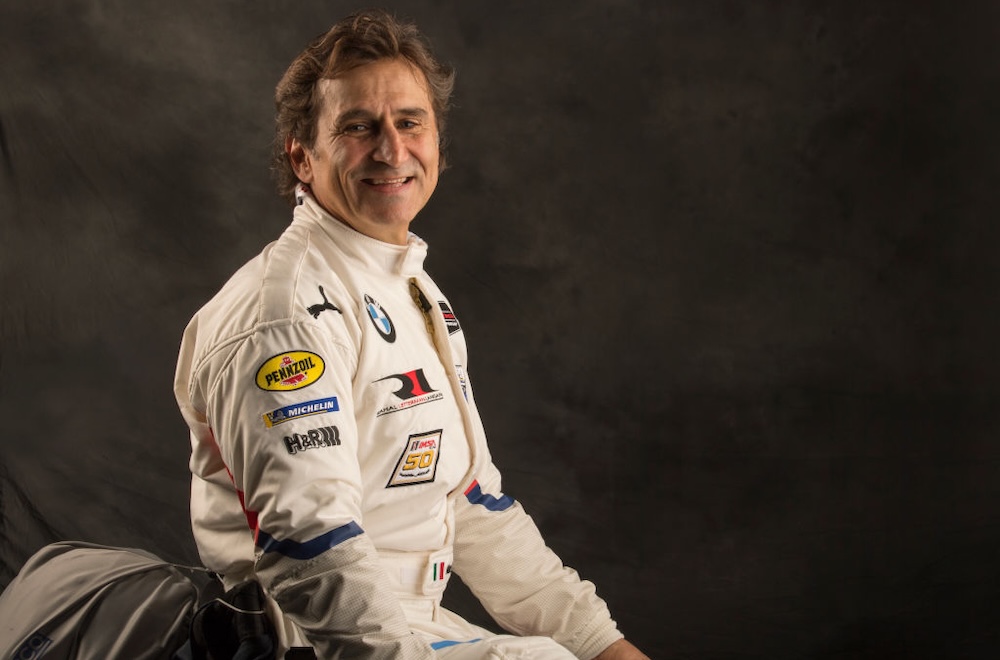
Rick Dole/Getty Images
Alex Zanardi 1966 – 2026
As a Paralympian, Alex Zanardi became a household name and an inspiration to millions. But his indomitable spirit and speed in a racecar had already made him a hero.
After Alex Zanardi and the CART Indy car Safety Team felled the Grim Reaper back in September 2001, we thought he was indestructible. His success in the Paralympics surely proved it. Yet now he is gone and we are left devastated. What a man he was. What a hero he is.
Bologna-born Zanardi started racing a self-built kart in 1979, the same year his sister Cristina died in a streetcar accident. Naturally his parents became overprotective, but equally they could see that nothing could stop him from pursuing his dream, and they learned to have faith in what he rapidly proved to be a considerable talent. That saw him rise from karts to reach Italian Formula 3 in 1988. After showing promise and strong results, overachieving in an underpowered car, he graduated to Formula 3000 in 1991 with the Il Barone Rampante team.
A season-long battle with Christian Fittipaldi saw the Italian play a starring role – two wins, four runner-up finishes – but he came up slightly short in the points table at year’s end. However, by then he had become a Formula 1 driver. The fallout from the unsavory late-season Benetton/Jordan dispute over Michael Schumacher’s services involved Roberto Moreno being cast aside by both teams, and Eddie Jordan drafting Zanardi into his squad to partner Andrea de Cesaris for the final three F1 rounds. Zanardi scored two top-10 finishes (not worth points in those days) but was left on the sidelines for ’92, three more starts coming only as sub for the injured Fittipaldi at Minardi.
However, for 1993 Zanardi was signed full-time by Team Lotus, in the hallowed squad’s penultimate season of Grand Prix racing. Alongside the more experienced Johnny Herbert, Alex not only scored his first point – sixth place in Interlagos – he also proved himself a hard fighter in wheel-to-wheel battles. However, a huge shunt during practice for the Belgian Grand Prix at Spa-Francorchamps left him with neck injuries that curtailed his season.
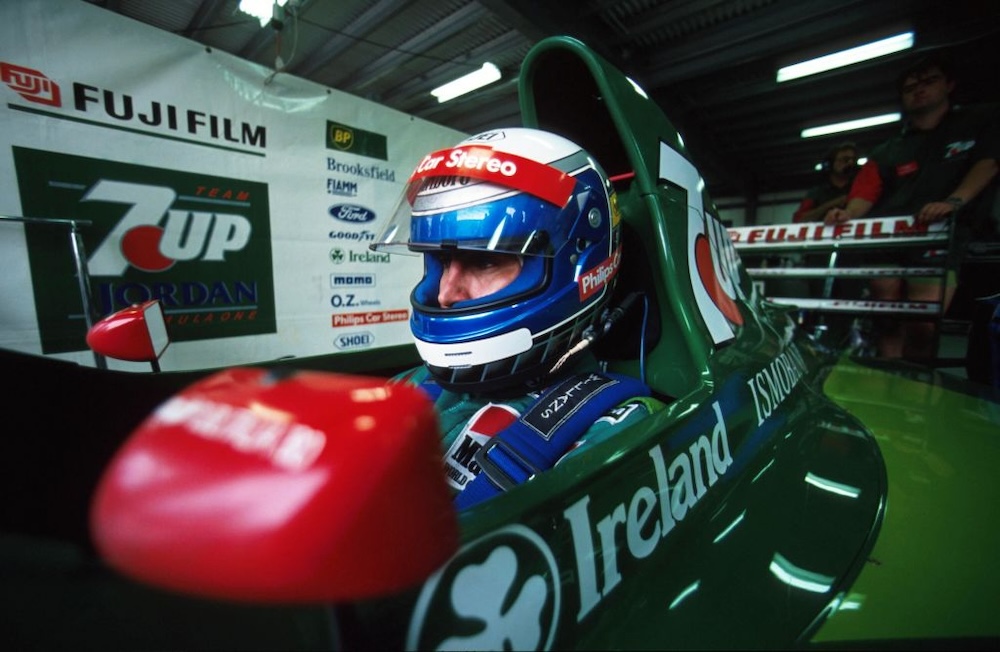
Zanardi's first opportunity came in the form of a late season call-up by Jordan in 1991. Sutton/Getty Images
He returned to action for the team in 1994 to sub for the injured Pedro Lamy – the man who had subbed for him after the Spa crash – but Lotus’s parlous financial state later obliged team management to drop him for a couple of events in order to run the well-funded Philippe Adams. The team submerged at season’s end.
With no more opportunities in F1, Zanardi killed time with some sportscar racing in ’95 but turned his attention to the U.S. open-wheel scene. Chip Ganassi, whose team had landed its first two CART Indy car wins in 1994, needed a partner for Jimmy Vasser in ’96 and duly signed the 29-year-old Italian.
The timing was perfect for an ambitious driver whose career had in recent years become a patchwork of high promise and thwarted potential. Chip Ganassi Racing, which in the off-season had switched from Ford to Honda engines and from Goodyear to Firestone tires, now entered a golden era. Vasser won the ’96 championship, while his ever-improving rookie teammate earned three wins, six pole positions and third in the championship.
Zanardi’s technique meshed beautifully with cars that provided a great amount of “feel” to drivers as they tried to put 900hp to the ground. He proved he could monster the car in flamboyant manner or apply smooth inputs with great self-restraint. Whatever was required to extract the most from the tires, the car, the track and the moment, he would do it. As one of his most prominent fans, Mario Andretti explained it thus: “Alex was superb if everything was perfect, but even better if everything wasn’t.”
Zanardi’s natural aggression in competition raised the hackles of some drivers throughout his three seasons at Ganassi, but he took his lumps from both them and the stewards, and would firmly rebuff criticism whenever he felt wronged. Over the course of time he earned their respect. Alex also formed a lifelong bond with his teammate Vasser and a hugely productive relationship with his chief engineer, the former Ensign F1 team owner Mo Nunn.
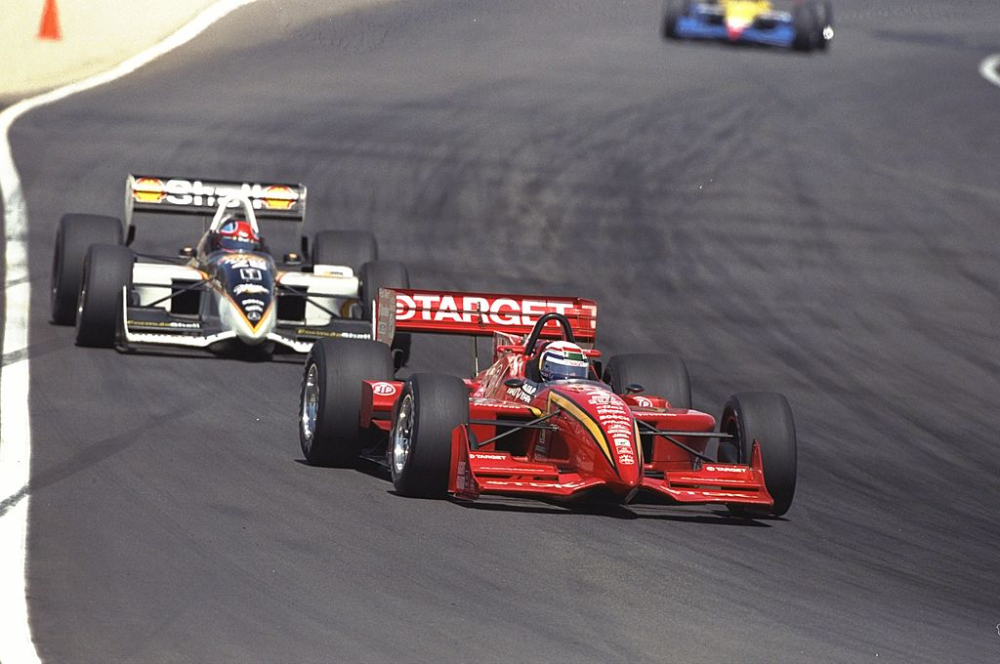
Arguably Zanardi's most famous win: He triumphed at Laguna Seca in 1996 after "The Pass" on Bryan Herta. Jamie Squire/Getty Images
As well as being appreciated by fans for his friendliness and approachability off-track, the in-cockpit aggression that needled his rivals was regarded by trackside and TV spectators as an admirable and exciting trait: he was simply irrepressible. This was never better demonstrated than in his famous pass on Bryan Herta to grab the lead on the last lap of the ’96 season finale at Laguna Seca, or his storm from the back of the field at Long Beach in 1998 to snatch an unlikely victory. Far more often than not across the ’97 and ’98 seasons, Zanardi was the man to beat – and no one could do it consistently enough to stop him racking up two straight championships and 12 more wins.
As Zanardi fought for his life in 2020, one of his strongest rivals from the late 1990s, Dario Franchitti, tweeted: “He has defied the odds his whole life, always done the seemingly impossible. When we raced against each other, I realized there was never a point in any race that in his mind he was beaten.”
Yet despite loving the varied skillset required to be a successful Indy car driver and thoroughly enjoying Chip Ganassi’s ever responsive team environment, Alex couldn’t resist the call from Williams Formula 1 team to head back over the Atlantic for 1999… but it was not without a backward glance. In his brilliant 2004 autobiography, My Sweetest Victory, Zanardi wrote: “After my family and my parents, I am most grateful to Chip and wish that I had told him how much he impacted on my life. Needless to say, I went to drive my last race for him with a heavy heart.”
Throughout 1999, he doubtless continued to look wistfully at images of the beautiful Target-colored Ganassi Reynard-Honda he had left in the hands of his replacement, Juan Pablo Montoya. The Colombian rookie went on to nail the team’s fourth straight title. Zanardi failed even to score a point on his F1 return. The contrast was starker even than the Nigel Mansell/Michael Andretti transatlantic “swap” of six years earlier. Williams was going through a lull with the Renault-based Supertec engine in ’99, and Zanardi’s car had frequent reliability issues that hurt his chances of honing his car’s handling characteristics to best suit him. As a result, that season he was rarely on the qualifying pace of teammate Ralf Schumacher.
Alex admitted he loathed the grooved tires being used in F1 in that era, for they allowed hardly any time to work on setup before they went off. He also confessed that he wasted too much test and practice time – and too many tires – trying to adapt the Williams FW21 to his driving style, rather than adjusting his own modus operandi to fit with the optimal setup of the car.
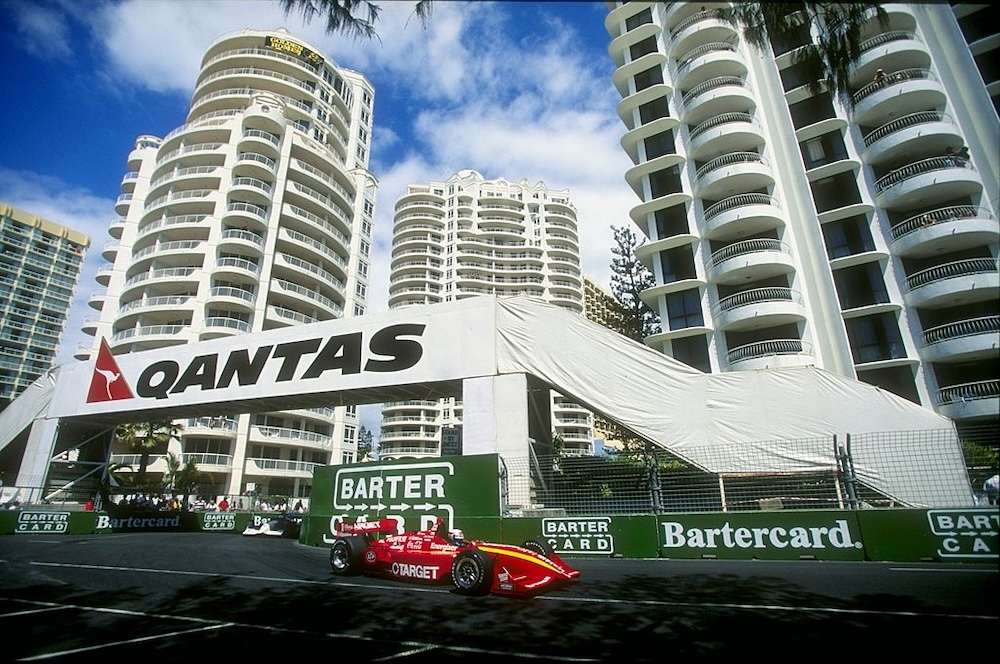
Zanardi claimed his final win with Chip Ganassi Racing at Surfers Paradise in 1998. Robert Laberge/Getty Images
But there were additional complications. Zanardi felt the team lost faith in him very early in the season, and blamed himself for not standing his ground on technical matters at the time when team owner Sir Frank Williams and chief engineer Patrick Head still regarded his opinion as having some merit.
Whatever the myriad colors and forms that comprised the full picture, the facts are that Zanardi would often start races mid-grid whereas teammate R. Schumacher would regularly be a yapping, snapping underdog on the heels of Ferrari and McLaren. Then, whenever the Italian seemed set for a confidence-building breakthrough result, his car would falter or fail, or something would go wrong in a pitstop. After a dispiriting season – one he described as “soul-destroying” – Zanardi and the team split.
Given this huge setback, Zanardi was more than happy to take a sabbatical in 2000, enjoying life in Europe once more with his beautiful wife Daniela and their two-year-old son Niccolo. This domestic bliss meant he dithered over – or spurned – offers from some of the bigger Indy car teams (including Newman/Haas Racing and Ganassi) that were trying to lure him back to the U.S. Yet following irritation-laced persuasion from dear friend Vasser, Zanardi would give himself a mental reboot and decide that no, he didn’t want to be a retired racecar driver aged only 34 – but now there were few attractive options left open to him.
However, his old engineer Mo Nunn had left Ganassi to set up his own team, and some big sponsors and Honda backing persuaded Zanardi that this team was on the fast-track, and a deal was struck for 2001. Yet Alex swiftly discovered he hadn’t appreciated the size of the challenge, for while the team’s funding wasn’t a problem, its relative newness as a unit was definitely a hindrance. Mo Nunn Racing had only started in 2000, and ’01 was the first year in which it had run two cars. Zanardi was also at first bewildered and then frustrated by what he perceived as Nunn’s loss of interest in engineering in order to focus on team ownership.
In truth, Alex himself was also struggling to recapture his form in a type of car that he hadn’t raced in well over two years, and he was often shown up by teammate, the rising star and future Indy Racing League champion Tony Kanaan. Yet at midseason, despite still struggling in qualifying, Zanardi was clearly making progress with his raceday setups. Indeed, he was highly unfortunate not to land podium finishes at both Cleveland and Toronto.
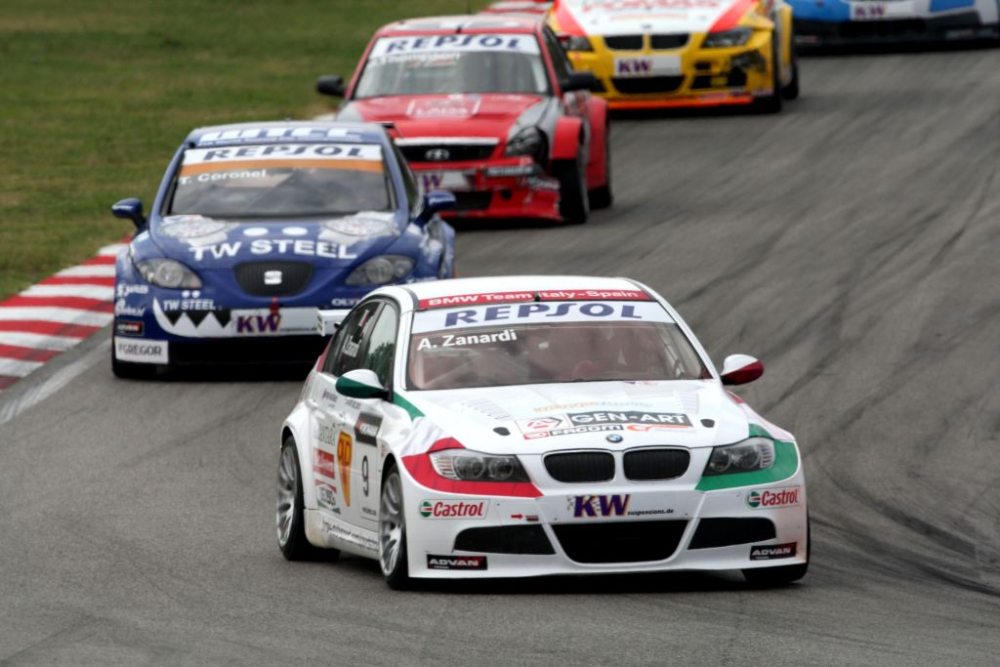
After his accident Zanardi rebounded in touring cars. Daniel Kalisz/Getty Images
Ironically, he was in his most competitive oval showing of the season at Lausitzring in Germany, when he spun out of the pitlane having made his final stop. As his car slid broadside across the track, the cockpit area was impaled by Alex Tagliani’s Forsythe Racing entry traveling at over 200mph. The impact tore off Zanardi’s legs and only masterful work by the CART Safety Team prevented the severe blood loss from costing the Italian his life.
“For a few seconds, the accident didn’t seem that bad,” Alex wrote. “If the car hadn’t split in two, I would have had to have absorbed all the energy from the impact, and I hardly felt a thing – my helmet didn’t even have a dent. I must have realized something though when I looked in front of me and saw no front to the car… and no legs. Before fainting, I must have realized something. From time to time, if I really try hard – I don’t know if it’s my imagination or disjointed memories – but some images come to the surface in my mind. Maybe one day the whole event will come back to me. I’m not afraid of it though, because all the damage has already been done.”
Following expert work at hospital to seal and heal, Zanardi’s rehabilitation program saw him fitted with prosthetic limbs. When CART revisited Lausitzring in 2003, he ran a demo in an Indy car fitted with hand controls, driving the 13 laps he failed to complete there two years earlier, and lapped at a speed that would have seen him qualify on the third row of the grid for that weekend’s race. Aside from reducing all onlookers to tears – especially the CART Safety Team members – the event sparked in Zanardi the thought that a return to the sport might be viable. An outing in a BMW touring car further cemented his resolve.
Joining touring car legend Roberto Ravaglia’s BMW team for the European Touring Car Championship in 2004, Alex drove a heavily adapted BMW 320i, and when that series evolved into the World Touring Car Championship in ’05, Zanardi stayed on. He earned a win in Oschersleben and several more Top 10 finishes that year, and over the next four seasons, he would add a further hat-trick of WTCC triumphs to his résumé.
By now, however, he was also forging a name for himself in handcycling. Finishing fourth in this division in the 2007 New York City Marathon, he went on to win similar events in Venice and Rome, before returning to NYC in 2011 and nailing victory. Zanardi’s performances were enough to earn a spot in the Italian team for the 2012 Paralympics, and he went on to win Gold Medals in the Road Time Trial H4 and the Road Race, and a Silver Medal in the Road Team Relay, events all held at Brands Hatch. Four years later, in the next Paralympics at Rio, he again nailed two Golds and one Silver.
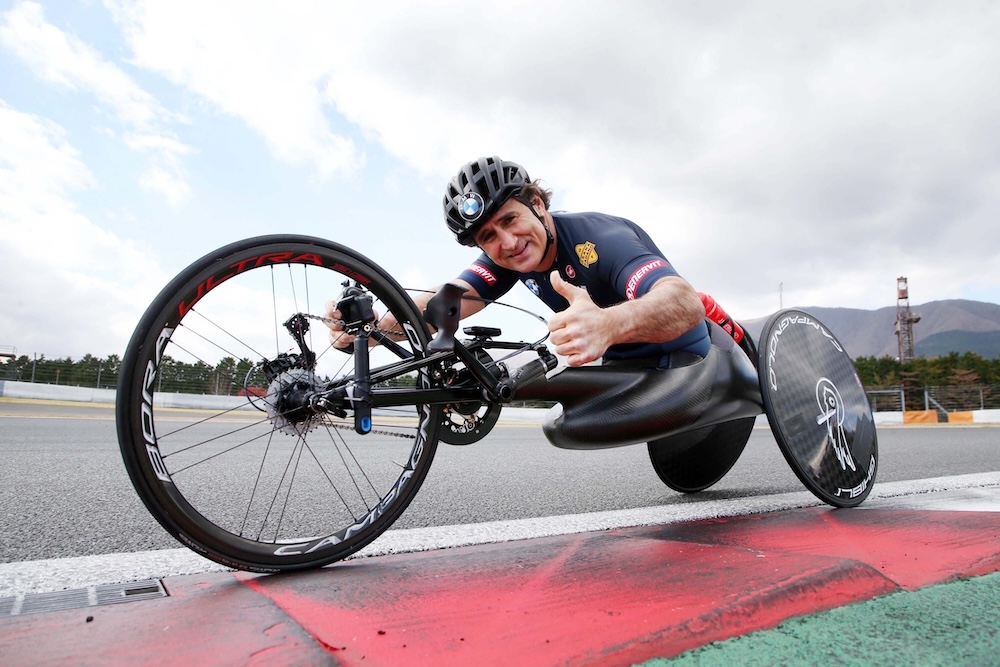
The competitive spirit that served Zanardi so well in motorsports proved equally potent in handcycling, where he won multiple paralymic medals and some of the world's biggest marathons. Image by BMW Sport
Zanardi hadn’t quit motorsport, competing in the full 2014 Blancpain Sprint Series season in a BMW Z4 and starring in a one-off appearance in DTM, driving a BMW M4 to fifth in the wet at Misano. His return to U.S. racing came in the 2019 Rolex 24 Hours at Daytona, sharing one of the Rahal Letterman Lanigan Racing-run works BMW M8s with John Edwards, Jesse Krohn and Chaz Mostert. The quartet finished ninth in the GTLM class.
Who knows how long this true ironman would have continued finding success in handcycles without his 2020 accident, or along which path his inquisitive mind and resolute spirit might have led him? Whatever, we can be certain this human dynamo would have made a success of it, because that’s just how he always was: audacious and dauntless.
In his foreword to Zanardi’s book, Mario Andretti wrote: “Alex’s stories are not about this rotten, unfair thing that happened to him. They are about having the power to adapt to change and about scoring a victory over, rather than becoming a victim of, the accident.”
Most would surely agree that even before his 2020 accident, Zanardi and his loved ones had been through too much already. Few really knew what they went through subsequently. Today, through the tears, we salute a fantastic driver, but also a wonderful man and an example to all. Ciao, Alessandro. We may never see your like again.
David Malsher-Lopez
David Malsher-Lopez is editor-at-large for RACER magazine and RACER.com. He has worked for a variety of titles in his 30 years of motorsport coverage, including for Racer Media & Marketing from 2008 through 2015, to which he returned in May 2023. David wrote Will Power’s biography, The Sheer Force of Will Power, in 2015. He doesn’t do Facebook and is incompetent on Instagram, but he does do Twitter – @DavidMalsher – and occasionally regrets it.
Read David Malsher-Lopez's articles
Latest News
Comments
Comments are disabled until you accept Social Networking Cookies. Update cookie preferences
If the dialog doesn't appear, ad-blockers are often the cause; try disabling yours or see our Social Features Support.