Chris Owens/IMS
Lapping Milwaukee with Scott Dixon
Wisconsin’s 1.015-mile Milwaukee Mile is the oldest extant racetrack in the world, dating back to 1903. Six-time IndyCar Series champion Scott Dixon – who conquered the Mile in both Indy Lights (2000) and IndyCar (2009) – is your guide.
“We describe Milwaukee Mile as a flat oval because it’s the flattest we go to – flattest I’ve ever gone to, I think. There is banking there [nine degrees in the turns, 2.5 on the straights] but it feels pretty flat, like Indy. Honestly, Turn 1 at Milwaukee actually feels like it’s off camber, maybe because you also feel like you’re going slightly downhill, and the car never loads up in the way it does at Iowa or places like that.
“Having raced there in Lights cars, Champ Car, the old IRL Indy car and now the DW12, the driving style has changed a fair bit, but I’m not sure that’s because of the cars changing or the track evolving. I think it’s more down to the different tire compounds we’ve run there. I mean, I’d say Iowa this year required a different technique compared with last year.
“Milwaukee, historically, has been very much about trying to have a car that didn’t give you too much tire deg. If you had good traction on the exit of Turns 2 and 4, then you could pass people down the straights. But now you can run in alternate lanes at both ends of the track, which is quite fun. Last year even from Race 1 to Race 2, there was quite a change in how you could tackle the turns: the low line in Turns 3 and 4 were almost unusable on the second day, which made it interesting.
“There were years in the late 2000s and early 2010s when we had one preferred line and you passed people because you had less tire deg, and you got the power down and it was all done in acceleration. Now, there are multiple lanes again, and you can get people going into the turns. [Santino] Ferrucci, for example, was very good last year in doing slide jobs into Turn 3, slinging it down the inside and then drifting up through the turn to complete the pass.
“So that’s one of the cool things about Milwaukee in that it demands you read the track a little more and you have to be up for changing your lines according to track conditions and the condition of your tires. If you just use the low line or just the high line, you’re going to get beaten. You’ve got to be on your toes and adaptable.
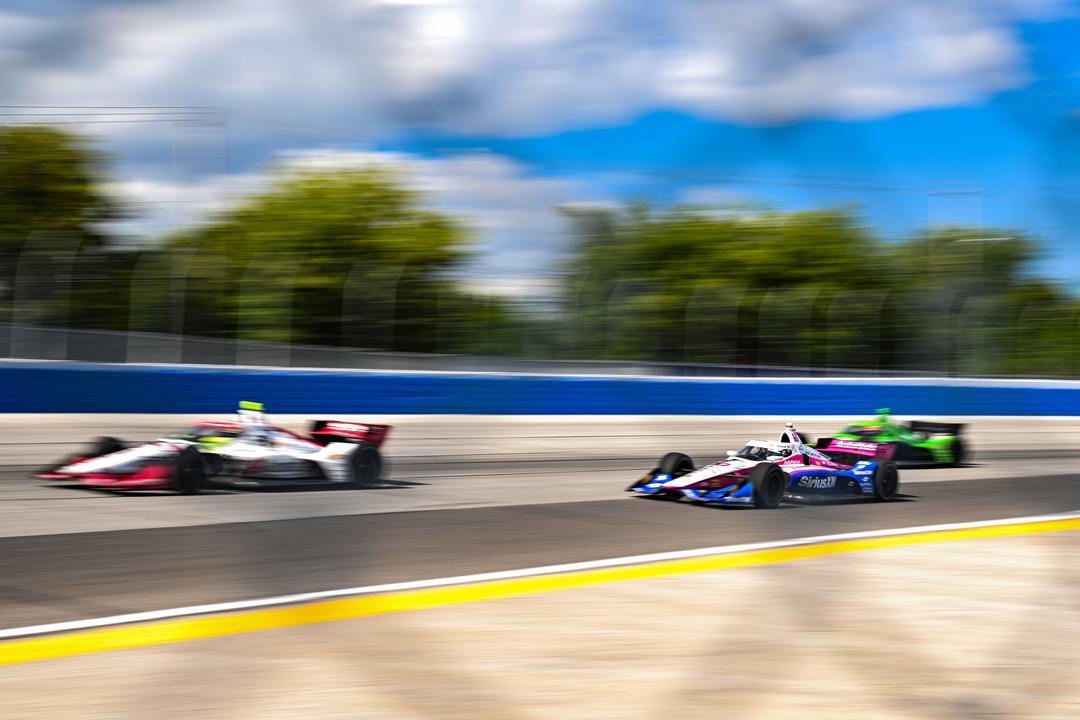
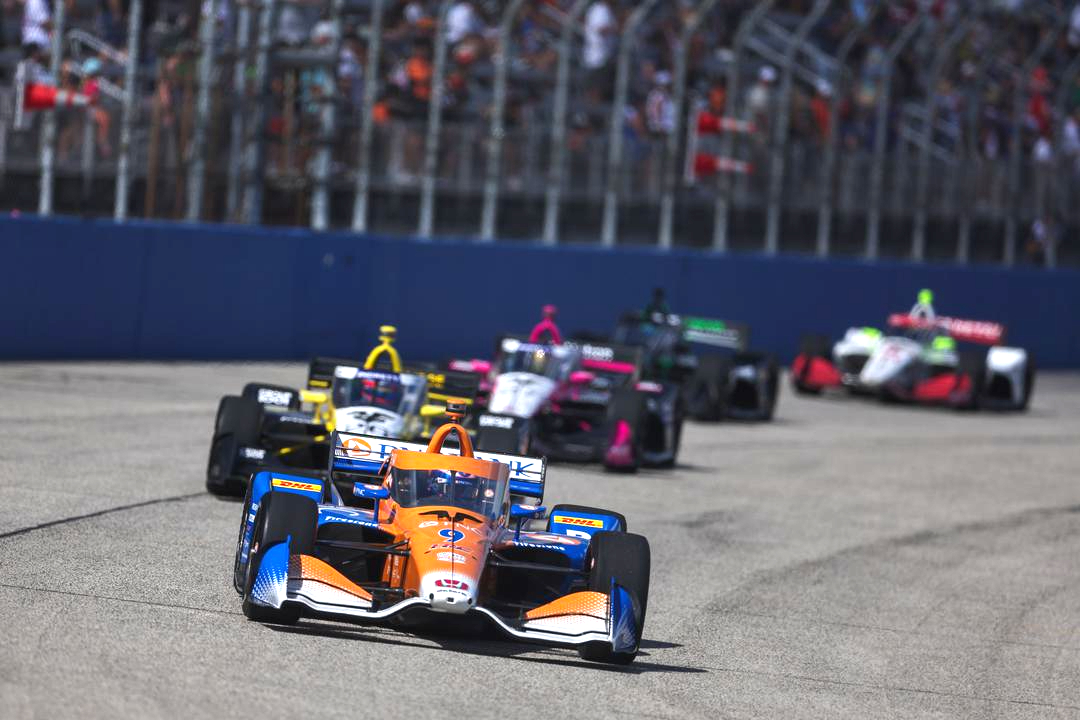
One line or two? Dixon says it depends... which is part of what makes Milwaukee so interesting. James Black/IMS
“Qualifying is different. You’ve got two laps and at that point of the weekend, there will be a preferred line, a line where there’s more grip, thanks to the rubber we’ve laid down in practice, so pretty much everyone will follow that line. Typically it’s about just keeping your right-side tires off the black stuff, but some of it obviously depends also on your handling setup. Through practice last year, we had a lot of understeer, so for qualifying we added just one turn of front wing and suddenly the nose was pinned and I almost spun at both ends of the track!
“Another big difference is that in qualifying you’re going to be running a lower ride height, because you’re going faster, because you’ve got cleaner air so the downforce is greater. But being an old track, Milwaukee is quite bumpy. There are pretty big bumps on the exit of Turn 4, especially if you start to drift high, and then the approach to Turn 1 there can be skipping over smaller bumps that come in quick succession. In the race, across a stint, if you’re just slightly bottoming out over the bumps at the start, once you start slowing down due to tire deg and running in dirty air while you’re lapping people, your lap times go up by about two seconds and the car rises up enough where you’re not bottoming out at all.
“Starting a qualifying run, as you come out of Turn 4, you’ll be in fourth carrying a lot of speed and deploying the hybrid boost and you’ll snatch fifth just before the start/finish line. Going into Turn 1 you’ll be re-genning and you’ll go down one or two gears depending on whether you need rear-end security or you need more weight on the front.
“Then you’re trying to roll all the speed through the apex and get back to full throttle as soon as possible and deploying the hybrid again, and getting up to fifth again before you hit the re-gen button, and then again, down one or two gears.
“In the race, oversteer is going to kill your speed over a stint because as the tail slides, your rear tire deg gets worse and worse, which hurts your traction and kills your acceleration down the short straights. And with the hybrid adding so much weight to the rear, this car’s already saturating its rear tires.
“Understeer’s much easier to manage at Milwaukee because the racing surface is nice and wide. You can drive it hard into the turns and then use the brakes to control your trajectory.
“Strategy-wise, Milwaukee’s not usually about fuel saving; the number of stops you make and when you make them is dictated by… well, cautions obviously, but primarily about tire deg. Coming back to tracks where we’ve already experienced the effects of the hybrid is quite a big help. I mean, honestly, it was a help last year when Milwaukee was a doubleheader: we had a pretty crappy Race 1, so overnight we threw the kitchen sink at it and had a strong car for Race 2, and we climbed from somewhere low [17th] on the grid and finished second. And again at Iowa this year, Race 1 was almost a test session and then we were better in Race 2.
“So yeah, anywhere we return to, where we can implement what we learned about the effects of the hybrid, it’s a hell of a lot easier to hit the ground running."
AT A GLANCE
Race distance: 250 laps/253.75 miles
2024 pole time: Race 1: 22.5082s/162.341mph (Scott McLaughlin, Team Penske); Race 2: 22.6980s/160.983 (Josef Newgarden, Team Penske)
2024 winner: Race 1: Pato O'Ward (Arrow McLaren Chevrolet); Race 2: Scott McLaughlin (Team Penske Chevrolet)
Hybrid energy deployment parameters: Unlimited activation with a maximum deployment of 150 kilojoules (kJ) per lap.
Firestone tire allotment: Ten sets for use through the event weekend. An additional set is available so teams can participate in the group session on Saturday.
NTT INDYCAR SERIES WEEKEND SCHEDULE (all times local):
Saturday, August 23
9:45 a.m. – Installation laps
10:00am-11:00am – First practice, FS1
1:05pm – Qualifying (single car, two laps), FS1
3:45pm-4:15pm – Group session (two groups, 15 minutes each), FS2
4:30pm-5:30pm – Final practice, FS2
Sunday, August 24
1:15 p.m. – "Drivers, start your engines”
1:20 p.m. – Snap-on Milwaukee Mile 250 (250 laps/253.75 miles), FOX (Live)

David Malsher-Lopez
David Malsher-Lopez is editor-at-large for RACER magazine and RACER.com. He has worked for a variety of titles in his 30 years of motorsport coverage, including for Racer Media & Marketing from 2008 through 2015, to which he returned in May 2023. David wrote Will Power’s biography, The Sheer Force of Will Power, in 2015. He doesn’t do Facebook and is incompetent on Instagram, but he does do Twitter – @DavidMalsher – and occasionally regrets it.
Read David Malsher-Lopez's articles
Latest News
Comments
Comments are disabled until you accept Social Networking Cookies. Update cookie preferences
If the dialog doesn't appear, ad-blockers are often the cause; try disabling yours or see our Social Features Support.