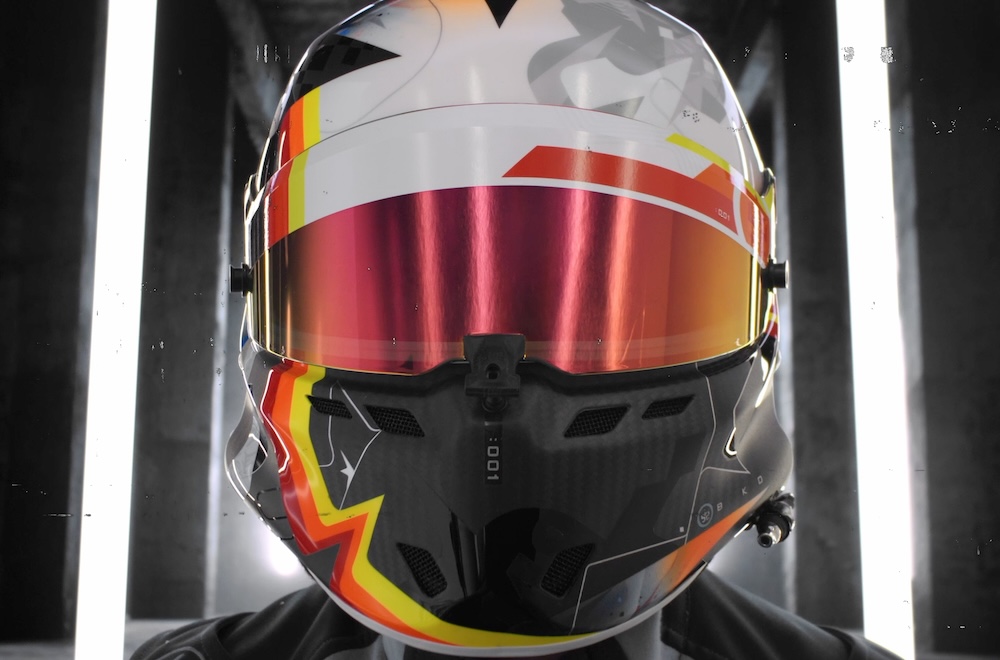
The Canvas Project: Helmets as art
Given that helmets were worn as part of a knight’s armor a thousand years ago, it’s amazing that it took so long for hard headgear to become de rigueur in dangerous sports such as auto racing and motorcycle racing. Perhaps it was one of the many symptoms of an attitude necessarily imbued in drivers of these perilous times – that he (or in exceptionally rare examples, she) was fully in control of the environment, that potentially life-threatening accidents were always going to happen to the other guy.
The cloth and linen helmets utilized in the first 40 years of the sport did little more than keep floppy hair out of a driver’s face when his chosen pomade gave up the unequal battle with a 140mph headwind. The leather helmets that became the choice of many often contained more padding than their linen equivalents, but would only barely reduce the impact on the skull when a driver encountered a flint fired at him by the wayward Dunlop of the car he was pursuing. Given the conditions of the tracks and the diminutiveness and fragility of the windshield of, say, a Maserati 4CL, the chances of a rock meeting a not-so-hard place at triple-figure speeds was not to be ignored. Except, of course, it was.
However, motorsport history is sprinkled with technology transfer between itself and the world of aviation and, soon after World War II, pilots had forsaken their leather helmets for rigid devices, as planes grew faster, cockpits grew sleeker – thus bringing the cockpit’s dome down closer to the pilot’s head – and ejection seats became mandatory. Cork-based helmets, as used by motorcyclists for several years already, became mandatory in Formula 1 in 1952, and while they gave drivers the appearance of one of those "human cannonball” stuntmen, they were a major step forward. One can only imagine the neck-tugging turbulence once peaks were added to these helmets. Heck, even the cloth-cap brigade from half a century earlier had seen the wisdom of swiveling their headgear through 180 degrees.
Certain drivers – notably 1958 world champion Mike Hawthorn – eventually eschewed the traditional goggles to adopt an integrated visor fitted to the peak of his helmet, so one might reasonably expect the next stage, full-face helmet, would follow shortly after. But no: it wasn’t until 1968 that Dan Gurney encouraged Bell Helmets to develop a device that protected the whole head. He used the device at the Indy 500 and the German Grand Prix at the Nürburgring that year.
Meanwhile, a less important development had already taken place in terms of headgear: unique designs were catching on, and were starting to become part of a driver’s identity. French F1 ace Jean Behra had a distinctive checkered strip around his helmet, Parnelli Jones had a simple red peak that swiftly evolved into a dark blue star outlined by red; Graham Hill carried the colors of the London Rowing Club; Jimmy Clark had a blue helmet with white peak; Bobby Unser had a dayglo orange helmet with his name on the side; Jackie Stewart had a band of tartan; New Zealander Chris Amon’s helmet carried blue and red flashes that started thin at the back, came up over the crown of the lid and flared out above the face-opening, with a kiwi on each side of the helmet. It was a design so cool and identifiable that James Garner adopted it for his star role in the 1966 film Grand Prix (minus the birds, of course).
Through the 1970s, the trend for distinctive helmets continued, but the stars of the day had also appreciated the efficacy of full protection for their skulls. Clay Regazzoni’s win in the 1970 Italian Grand Prix was the last time the victor of an F1 race wore an open-face helmet, although as late as the summer of ’74, Leo Kinnunen did start a GP with face exposed.
Since then the helmet’s construction evolution has continued, becoming tougher and lighter – switching to carbon fiber in the early ’80s resulted in a huge step for both properties – while the color schemes have become ever more intricate and imaginative. But are they art? The Canvas Project makes a strong case for it.
Brett King of Brett King Designs – a dealer for Stilo, Bell, Arai and Schuberth helmets – was asked by one collector to come up with a design of his own for a Stilo. He was to give no consideration of sponsorship, liveries or the collector’s favorite colors. He had the equivalent of a blank canvas, hence the project’s name.
“The collector is an art lover who’s been a client of mine for 10 years,” explains King. “He reached out to me and asked, ‘How would you feel about a project that’s all about you and what you envision? I don’t care how long it takes or how much it costs.’ So that was a really cool opportunity, and he’ll be the owner of 001 in the Canvas Project collection.
“At first it’s a little daunting because when you like and do so many things, it’s hard to pinpoint what you love above all, so once I was able to find a basis and direction and a theme, it all started falling into place. Normally a client has certain needs – space for logos, color requirements and so on – and that establishes certain constraints and you work within that framework. When you do something that’s no-holds-barred, it can be a little difficult until you remember that you don’t have to put everything in there on this one piece of art!
“But that’s what’s cool about this Canvas Project. This is just the first one, and it’s about my history and places I’ve lived. But the next one will have other things it was based on, it will have a different feel, might be based on a different part of my life, a different experience.”
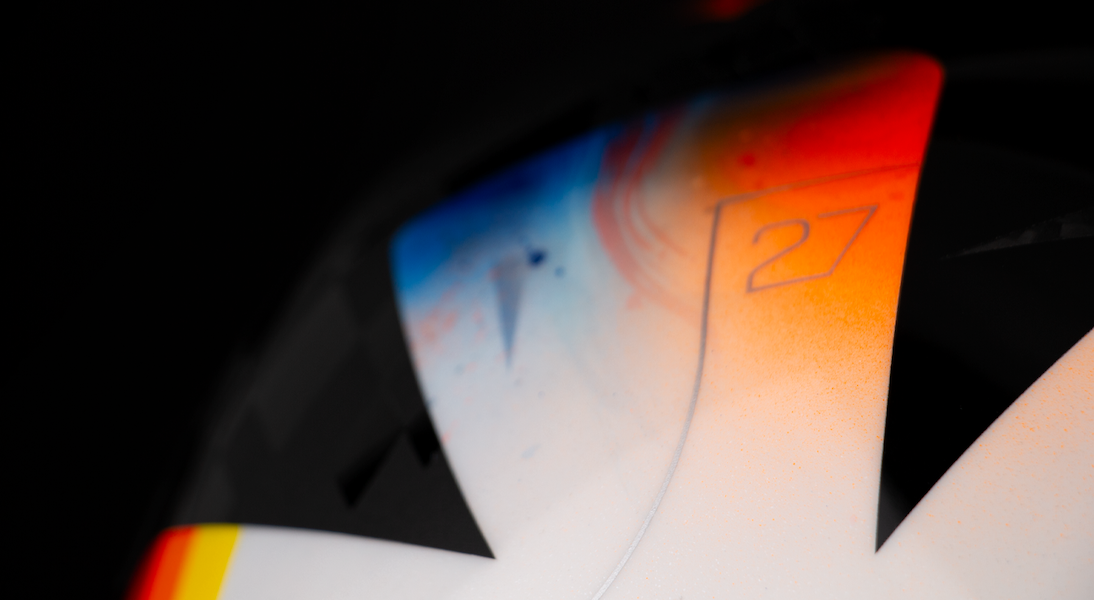
The Canvas Project is an experiment in giving artists complete design freedom using a race helmet as the canvas.
The collector’s idea is that King’s first effort is one of several and that, sometime in the future, all the helmets in the series – just like any artist's successful series or works – will go on an art gallery tour. Imagine it: next to paintings and sculptures one might see a series of racing helmets. And unlike a painting which contains only the artist's story, the helmets will uniquely possess the dual story of the artist's vision and the driver’s events and outcomes. That's something that's quite different in the art world.
One person who has been all-in on the project is Preston Folkestad, the director of marketing for the safety division at the famous Simpson Race Products.
“The collector in question and Brett already had plenty of knowledge of the Stilo brand,” he says, “and one of the things that Stilo prides itself on is not only the product quality in itself, but also its style. ‘Stilo’ is literally the Italian for ‘style’. So this Canvas Project is a natural fit, as it emphasizes art and design.
“Without wishing to sound like a press release, Stilo, which was established in 1999, competes with the longer-established brands with its enhanced features and customer service. Specifically, our market started in rallying, and Stilo looked at the core challenges those competitors faced, came up with accessories, and it grew from there. Drivers in IMSA, F1, drag racing get not only the Stilo helmet but a tool-kit of accessories – comms systems and aero systems, different visors for different environments – and our core foundation is that a driver can use one Stilo for any type of competition.
“What I liked about the Canvas Project was that helmet design is probably the most personal part of a driver’s safety system, so it made total sense for the helmet to be the ‘canvas’ in this case. And the great thing about Stilo – and I am biased here, of course! – is that Stilo helmets have an iconic look about them. We don’t need to include a logo on our helmets for people to immediately see it’s a Stilo, so it’s the ideal ‘canvas’ for this project.”
King, whose company is younger even than Stilo – BKD was founded in 2011 – is nonetheless comfortable praising fellow helmet designers without being influenced by them.
“Although it wasn’t painted, I thought Sebastian Vettel’s ‘Lego helmet’ was super-cool, maybe because I grew up loving Lego,” says King. “And Koop Kustoms did a really good TAG Heuer helmet for Andre Lotterer, where it had an image of a watch on the side and then it became a hand-drawn sketch of the watch. That was very good. And then Lando Norris’s 'beachball helmet' was really simple and clever.”
And admirably asymmetric, as is King’s own design shown here.
“Yeah, a lot of people want their helmet design to be symmetrical, but this Canvas Project allowed me to just have fun and ensure it isn’t cookie cutter, and there’s lots to find in it and there’s more to see the more you look. Totally unconstrained.
“I’m hoping that this Canvas Project will open the minds of the next generation of driver to look at helmet design in a different way. It’s not just about me and what I’m doing: it’s about bringing a different perspective to helmet-painting as an art form. Drivers may have their requirements for sponsors, but not all drivers have sponsors so I think it would be a good thing if people looked at helmets as not only being utility but as a piece of true art.
“And it doesn’t have to be an expression of themselves but it may be an expression of their taste. When a person goes to buy a piece of fine art in a gallery, 98 percent of the time, that choice has nothing to do with what it is, it just appeals to them. I think the Canvas Project can change the mindset of what helmet-painting is and what it could be.”
Indeed, the Canvas Project breaks the tradition of a client or brand directing helmet, giving free rein to the artist’s talent and imagination. What collectors then choose to do with the finished product – collect, display or use in competition – is of course up to them.
For full details of King’s design, check out the video below. While Canvas Project: 001 is not for sale, you can own a little slice of the project's design spirit by checking out the store at Brett King Design.

David Malsher-Lopez
David Malsher-Lopez is editor-at-large for RACER magazine and RACER.com. He has worked for a variety of titles in his 30 years of motorsport coverage, including for Racer Media & Marketing from 2008 through 2015, to which he returned in May 2023. David wrote Will Power’s biography, The Sheer Force of Will Power, in 2015. He doesn’t do Facebook and is incompetent on Instagram, but he does do Twitter – @DavidMalsher – and occasionally regrets it.
Read David Malsher-Lopez's articles
Latest News


Comments
Comments are disabled until you accept Social Networking Cookies. Update cookie preferences
If the dialog doesn't appear, ad-blockers are often the cause; try disabling yours or see our Social Features Support.
.png?environment=live)