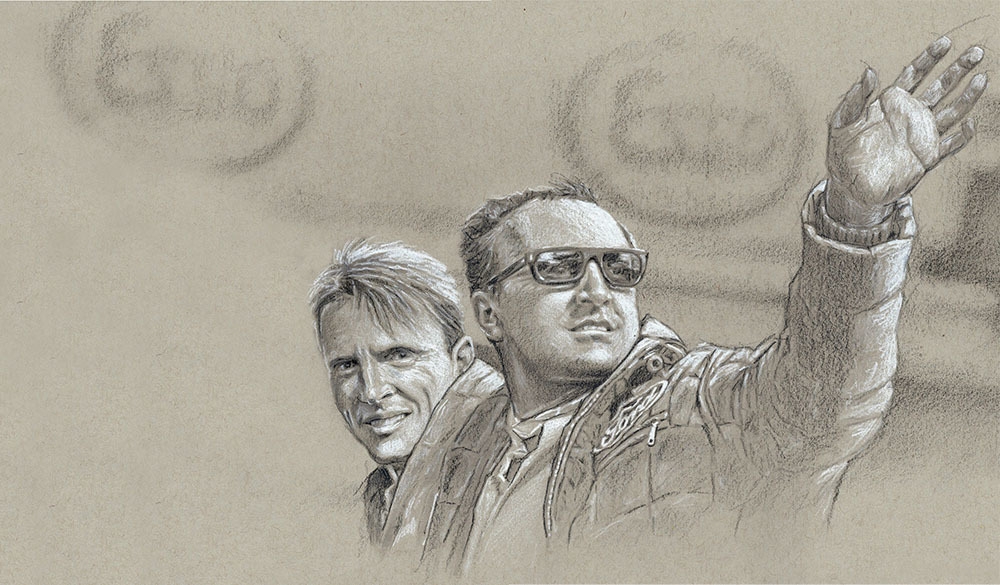
Illustration by Paul Laguette
From the vault: "I Thought I Could Beat Anybody"
“A.J. had the talent to do it whether I was there or not. He was a genuine winner, and that’s what his fans have felt all along." Dan Gurney was a sincere man, and what he said of A.J. Foyt and their shared 1967 24 Hours of Le Mans win, when interviewed by the late Robin Miller for RACER magazine 50 years after the fact, was heartfelt. The tall all-American and the less tall all-Texan had combined forces to put themselves, their home nation and Ford into the record books with victory in the 35th Grand Prix of Endurance in their Ford GT40 MkIV. Foyt was fresh off his third Indy 500 win, Gurney was just a week away from winning the Formula 1 Belgian Grand Prix in his own company’s Eagle-Weslake.
It was a heady time for the pair of them.
And a relief for FoMoCo, which needed a positive story. Its previous year’s Le Mans triumph over the erstwhile dominant Ferrari – the GT40’s whole purpose of being – had been clouded by a fatal accident for Walt Hansgen in the April pre-race test and by controversy regarding the finish between Ken Miles/Denny Hulme and Bruce McLaren/Chris Amon. Then Miles crashed to his death at Riverside while testing the "J-car," the link between the MkIIs of ’66 and the longer-nosed, longer-tailed MkIVs of ’67.
Ford had wanted Foyt to race a GT40 at Le Mans in ’66, but the already two-time Indy winner and four-time USAC National Champion (equivalent to IndyCar champ today) had still been recovering from burns suffered in an Indy car shunt at Milwaukee, and had been unable to take part.
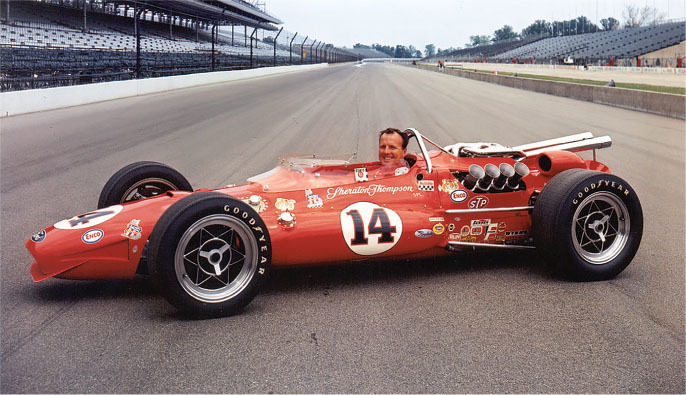
A.J. Foyt arrived in France for his 24 Hours of Le Mans debut fresh off scoring his third Indianapolis 500 victory in the handsome Coyote-Ford. IMS Archive
But in ’67, Foyt was riding high and fellow Texan Carroll Shelby was keen to have him join Gurney in his MkIV, alongside Ronnie Bucknum and Paul Hawkins in a MkIIB. He needed the star power, as his squad would be compared directly with Holman & Moody, whose three MkIVs contained Mario Andretti/Lucien Bianchi, McLaren/Mark Donohue, and Hulme/Lloyd Ruby.
Foyt was happy with the opportunity presented for three principal reasons.
"Carroll had seen me race out in the Bahamas [at Nassau Speed Weeks] and I guess he figured teaming me and Dan together, we’d be hard to beat," he recalls. "I was honored to be driving with Dan Gurney. He was a hell of a road racer. And I figured Carroll knew a lot more about road racing than Holman & Moody. It was two factory teams competing against each other and I was on the right factory team. Plus, he hired Phil Remington, and he was a very good engineer and mechanic."
Foyt’s right: Shelby’s experience in road racing probably gave his side of the factory-backed GT40 lineup a crucial edge. He’d won the 1959 edition of the race as a driver, sharing an Aston Martin DBR1 with Roy Salvadori, so he knew what it took.
That said, there were no guarantees. Having won at Daytona, Sebring and Le Mans in ’66, Ford found life tougher in ’67. Ferrari had red-washed Daytona with a 1-2-3, while Ford had wilted with a welter of gearbox issues before the Foyt/Gurney car died completely with zero compression.
The Twelve Hours of Sebring had been more convincing for the Blue Oval. Andretti and McLaren qualified their MkIV on pole, Foyt and Ruby started their MkIIB from third, and the cars finished first and second, respectively. But still there were causes for concern: the winners had suffered fuel feed issues that meant they could get only 90 minutes of drive time between stops, instead of 2hr15m, while the Foyt/Ruby car broke a camshaft 30 minutes from the finish and the pair was lucky to have a sizeable margin over the third placed Porsche 910. The German car had just got back on the same lap as the stationary Ford when the 12 hours was up.
Foyt, who had seen Andretti take the 1965 and ’66 Indy car championships, was embroiled in another fight with Andretti and Bobby Unser for the ’67 crown, but says his day job in the States wasn’t going to be negatively affected by a day-night-day job at La Sarthe. "At that time I thought I could beat anybody so I wasn’t bothered by it," he shrugs.
But he was well aware that his task was a tough one. He ran just a handful of laps in practice before handing off to Gurney for qualifying. Ninth on the grid wasn’t worrying: Dan, as a Le Mans veteran, was prudently taking it easy on the car. More of an issue was that all four MkIVs suffered windshield problems on the Mulsanne at 210mph, so modified screens had to be flown in from Detroit before the race.
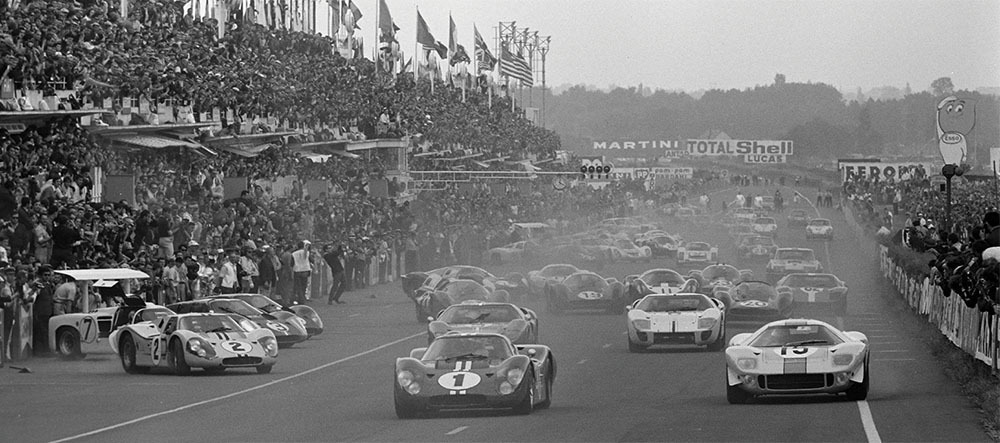
Getty Images
Gurney was at the wheel of the No. 1 car for the start, and at the end of the opening lap he was up to seventh. By the time he handed off to Foyt, he was second. Newbie Foyt acquitted himself extremely well, just as Gurney had predicted, but it was far from an easy ride for either of them. Remington had masterfully added a dome in the roof of the car to accommodate Gurney’s 6ft 4in frame, but there was no adjustment for seat and pedals. So one was cramped, the other on the stretch.
"Gurney was so much bigger than me – his arms were about four or five inches longer – so it was pretty rough in there," says Foyt. "We kind of split the difference. Nowadays, the drivers have all got to have their special seats and all that; we just had to make do with what we had."
But talent, adrenaline, pride and cussedness can overcome a lot.
"When I got in, I was behind Denis Hulme, someone who knew the track," continues Foyt, "and I followed him for a few laps and then I went on past."
His only remaining reservation was the track – or, rather, a very particular part of it.
"There wasn’t any wall on the Mulsanne, and I didn’t like it at 200mph when the headlights were hitting the trees, which had been whitewashed to about seven feet up. I thought, ‘If I go in there, it’s over.’ Someone had said that if they see an American car in the lead, fans may walk out in front of you. I told Ford, ‘I don’t believe in hittin’ people, but I’m not going off in those woods at 200mph and killing myself just because some idiot walks out in front of me.’"
Mercifully, it didn’t come to that. Early in his stint, Foyt took the lead from Phil Hill’s Chaparral, the pair chased by Andretti/Bianchi and Donohue/McLaren. And those scarlet bugaboos? Relatively nowhere. The highest 330 P4 was that of Mike Parkes and Ludovico Scarfiotti back in fifth.
Then Hill hit transmission woes, leaving Ford still running 1-2-3 – but fate would ensure there would be zero complacency from the two American teams. McLaren lost several laps to a clutch issue, and then a Holman & Moody mechanic, in changing the brake pads on the second-placed car, installed one of them back to front. Next time Andretti hit the middle pedal hard for the Esses, just one side grabbed and the No. 3 car crashed into an earth bank. Roger McCluskey in another H&M Ford GT40, a MkIIB, swerved to avoid the wreck and crashed into the bank on the opposite side of the track.
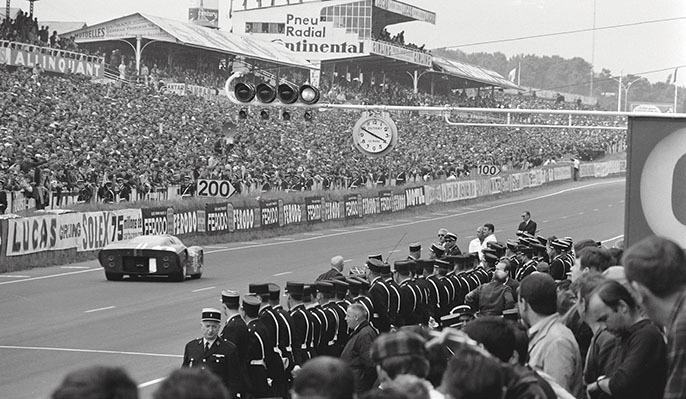
Just 10 mins to go and the gendarmerie is ready to contain the crowd from swarming the winning car and pit lane. Yeah, bonne chance with that, guys… Getty Images
And just like that, the closest opposition to Foyt and Gurney was the Parkes/Scarfiotti Ferrari. Sure, it was six laps down, but the GT40s were far from bullet proof, and now any trouble for the lead car would produce the worst possible result for Ford: defeat by Ferrari. So Gurney and Foyt dialed back their pace, saving their brakes by backing off way early at the end of the Mulsanne Straight and any other hitherto heavy brake zones. While this allowed the ostensibly slower Ferrari to make ground, driving swiftly while leaving a good margin was key. Two of the best drivers in the world were prioritizing winning over the desire to show who was fastest.
"You know the limits of what you can do, and what the car can do," says Foyt. "We was leading all night and all day, and I didn’t want to be the idiot that blew it!"
But he could scarcely believe it when, arms oh so tired from stretching to reach the steering wheel, he pitted for the final time with 2h15m left to run and was informed by the Shelby team that Gurney was missing. He, A.J., would have to remain onboard and do a double stint.
Foyt muttered a few oaths, slotted into gear and the 427cu.in./7-liter V8 MkIV burbled back onto the track. And despite fatigue, his final stint was flawless – fleet but conservative. He let Scarfiotti by, yet the No. 1 Ford still reached the 24-hour mark with a four-lap advantage. Foyt and Gurney were weary but elated, and A.J. beamed on the podium as his co-driver shook the champagne and sprayed Henry Ford II.
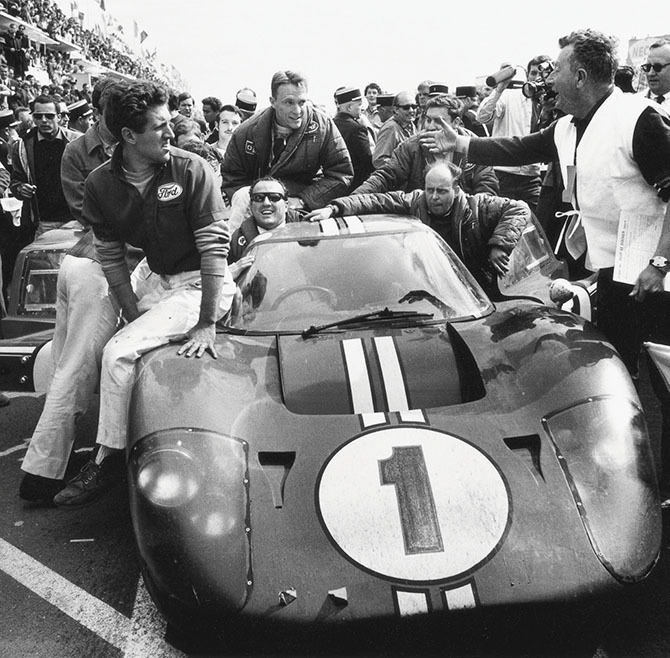
With A.J. Foyt at the wheel and Dan Gurney hanging off the roof, along with most of the Shelby crew, the winning Ford MkIV heads to Le Mans’ victory lane. Getty Images
"I got given a bottle of champagne, too, but it was Dan who really wet him down!" Foyt chuckles in recollection.
That 1967 race remains the only time in history that an all-American driving lineup has piloted an American-built car to overall Le Mans victory. But while Ford would return, winning again in ’68 and ’69, neither Foyt nor Gurney were tempted.
"I had a lot of friends who raced there many times and never won, and I went over as a rookie and won," observes Foyt. "My friend Bob Wollek was a Porsche driver for years and years, and five or six times he finished second or third and never won it. I told him, ‘Hey, there’s nothing to it!’ He said, ‘A.J., you’re full of crap!’
"Anyhow, I went over as a Le Mans rookie and came back a Le Mans winner. What more could you ask for?"
David Malsher-Lopez
David Malsher-Lopez is editor-at-large for RACER magazine and RACER.com. He has worked for a variety of titles in his 30 years of motorsport coverage, including for Racer Media & Marketing from 2008 through 2015, to which he returned in May 2023. David wrote Will Power’s biography, The Sheer Force of Will Power, in 2015. He doesn’t do Facebook and is incompetent on Instagram, but he does do Twitter – @DavidMalsher – and occasionally regrets it.
Read David Malsher-Lopez's articles
Latest News
Comments
Comments are disabled until you accept Social Networking Cookies. Update cookie preferences
If the dialog doesn't appear, ad-blockers are often the cause; try disabling yours or see our Social Features Support.