Mark Sutton/Motorsport Images
INSIGHT: Is there a better road to F1 for young Americans?
Motorsports is a complicated and expensive business, and what can get lost in the cracks are talented drivers attempting to climb through the ranks.
Although talent will always rise to win races and championships, it’s not always a guarantee that they will have an opportunity to be on a grid to show it. At the end of the day, it almost always comes down to financial support.
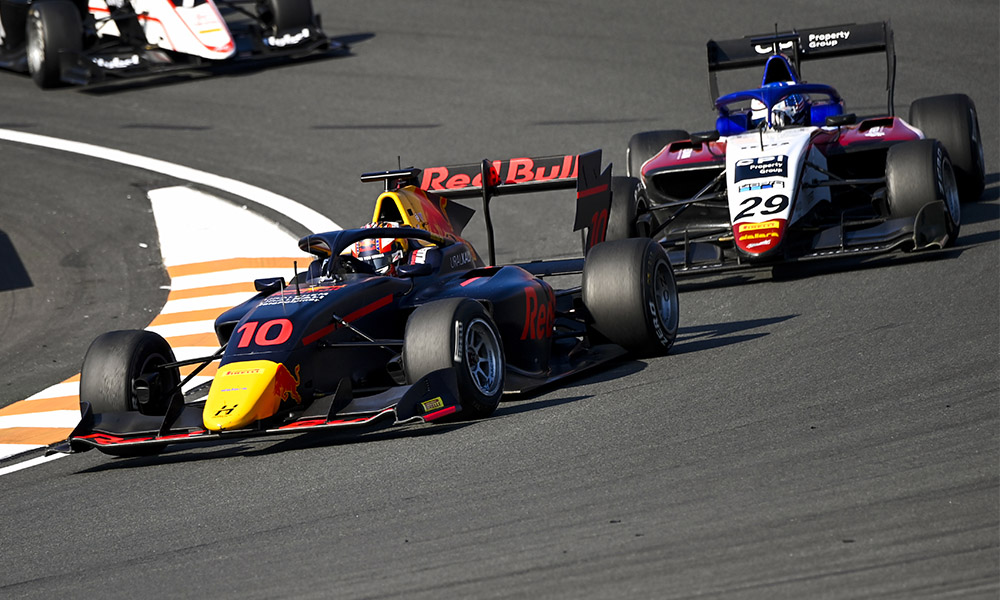
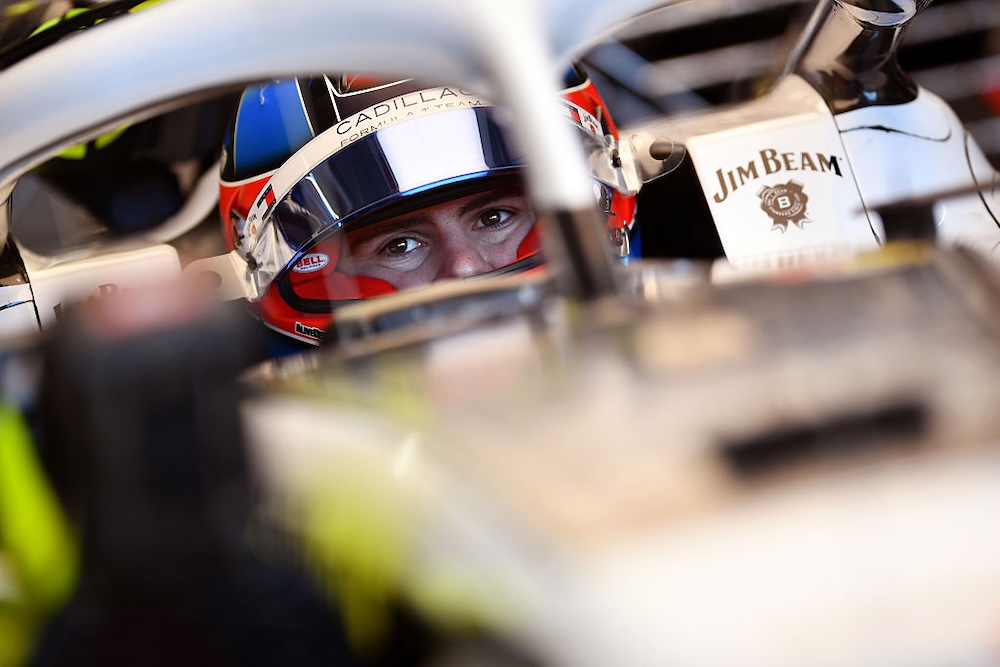
For aspiring young racers, the road to Formula 1 can be costly and cruel. Take the trio of American-born racers competing in Formula 3: Jak Crawford (pictured above, No. 10), Kaylen Frederick and Logan Sargeant (pictured above, No. 29).
All three have taken different paths up to this point. However, the United States hasn’t been represented in Formula 1 since Alexander Rossi’s five-race campaign in 2015. Although popularity for F1 has grown significantly in America, particularly over the last couple of years, history suggests it will be a challenge to put one, let alone three, American drivers on the grid in the near future.
If it were as simple as vying for wins and championships at the junior formula level, then Sargeant would be in the midst of battling in F2 and potentially, part of the rumor mill as a candidate for a 2022 drive in F1. Unfortunately, that isn’t the scenario. Instead, the driver who scored two wins and finished third in last year’s F3 championship with powerhouse Prema Racing saw his hopes of moving up to the next level dashed due to a lack of funding despite his impressive results. The situation left him stalled, with the best opportunity on the table being a return to F3 courtesy of Charouz, where the emphasis has been more on utilizing Sargeant’s experience to develop the car rather than being a squad ready to consistently fight among the front-runners.
In turn, the 20-year-old Floridian has helped elevate the team with three podiums, and sits ninth in the standings heading into this weekend’s season finale in Russia. After that, another offseason at the crossroads looms, with the decision once again coming down to funding. That’s why he believes that the F1 ladder system could benefit from taking a page out of the IndyCar’s Road to Indy blueprint.
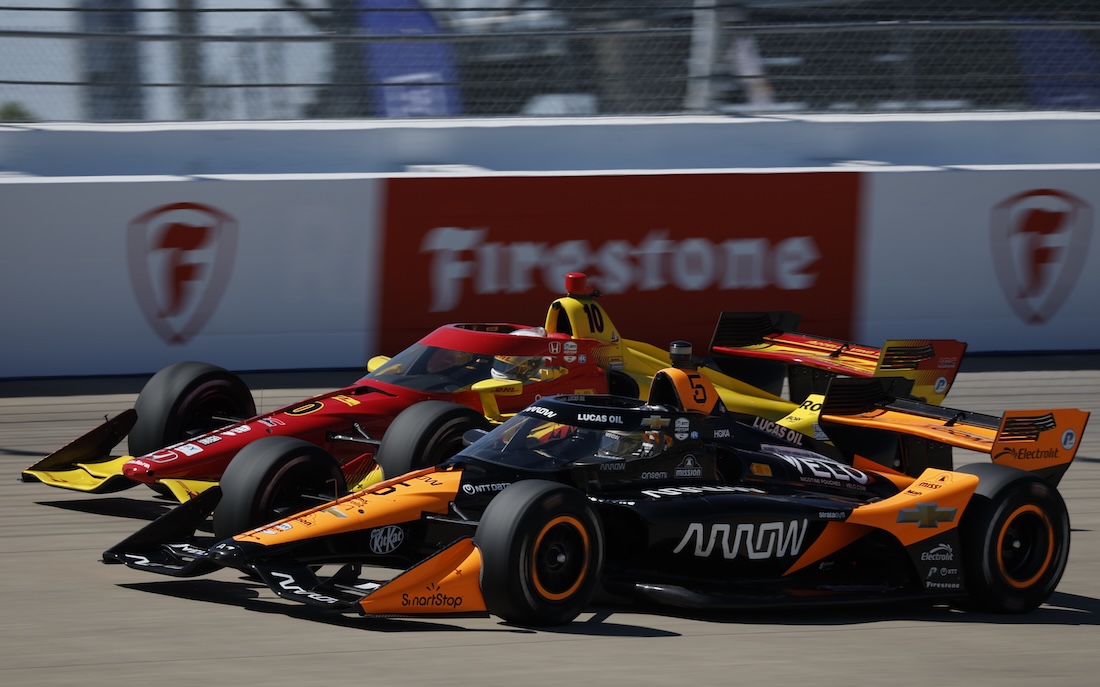
The RTI is organized into three levels -- USF2000 (lowest), Indy Pro 2000 (middle) and Indy Lights (highest) -- with a financial support structure in place to ensure that the champions progress in an effort to put the best possible talent into IndyCar.
“I think the way the path is set up is right; you can have F4 on the regional (level), then F3, F2, F1," Sargeant tells RACER. "I don't have a problem with that, but one thing I do have a problem with is the support structure for the drivers. I don't think that, as a good driver, you're given support to move forward, so to say. It's all up to the driver to pay for the season. Whereas in the Road to Indy, they do support the top three, and that's important to help the sport keep moving forward and get the best talent to the top. Unfortunately, there's a lot -- a lot -- of people out there who do have the talent to be in F1, but they'll never get to see that day.”
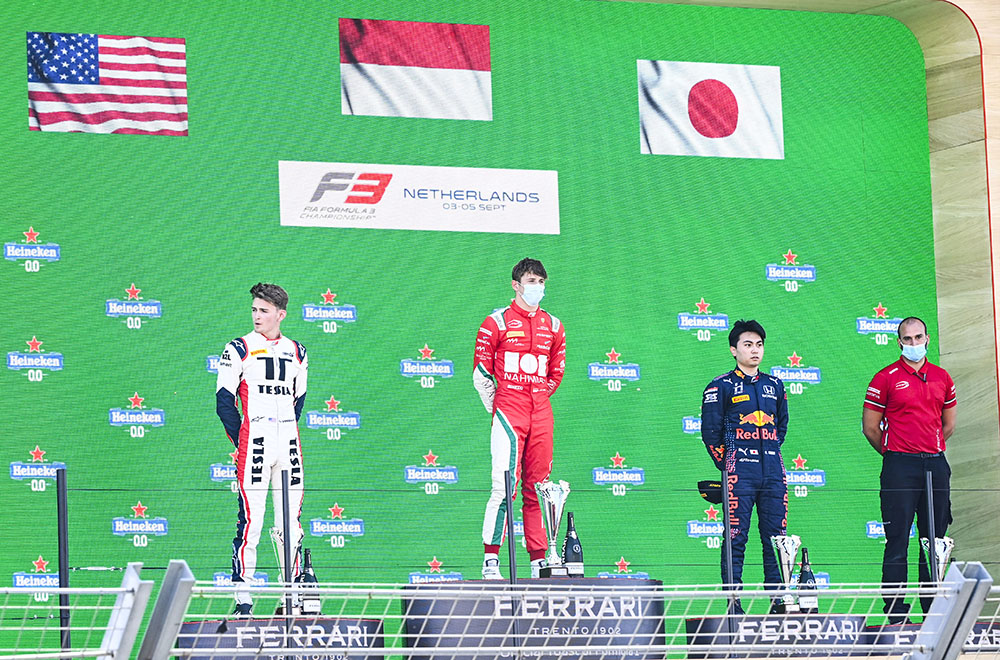
Sargeant (left) would like to see a system in place to support drivers on the path to F1. Mark Sutton/Motorsports Images
There is concern for Sargeant, who also finished third in the 2017 British F3 championship, that he could be among those.
“I'm the only American sitting on over 40 points to get a super license, as far as I'm aware, which I feel like doesn't get recognized enough,” he says.
"Unfortunately, to get into a solid F2 team (you need) a ridiculously high budget. As of now, I don't see that happening. But you never know what might happen in racing; it changes by the minute. It would be a dream if that came through, but you never know.”
It costs between $1-1.5 million to compete for a full season in F3, which becomes anywhere between $1.2-$2 million in F2, with championship caliber seats even exceeding $2 million. For reference, a full-season budget in IndyCar ranges between $5-8 million.
The award package for this year's RTI champions is valued as follows: USF2000, $406,305; Indy Pro 2000, $723,065; and Indy Lights $1,369,425. Both USF2000 and Indy Pro 2000 prizes guarantee a full season seat at the next level for 2022, while winning the Indy Lights title promises a minimum of three IndyCar races the next season. The scholarship program has been a fixture in the RTI since 2011.
Although the Indy Lights championship has yet to be decided with two races remaining (at Mid-Ohio, Oct. 1-3), Kyle Kirkwood, David Malukas and Linus Lundqvist have locked themselves into the top three spots. This means the trio have earned an IndyCar test on the Indianapolis Motor Speedway road course on Oct. 29, the day prior to RTI’s Chris Griffis Memorial Test (Oct. 30-31). It is understood that Sting Ray Robb is also likely to take part in the IndyCar test, courtesy of the RTI scholarship for winning last year’s Indy Pro 2000 title and gaining a full year of experience in Indy Lights.
Additionally, the F4 United States championship and Formula Regional Americas -- an F3-level championship for North America -- have adopted a similar model to the RTI. There is an award package that enables the F4 champion to race the following year in FRA. Meanwhile, Honda Performance Development and Honda Motor Company combined to provide the FRA champion with a scholarship at an estimated value of up to $600,000 to race next season in Japan’s Super Formula championship.
Across the pond, the current system -- or lack thereof -- to drive the best talent forward, pushes a bigger emphasis on funding for the majority, or being aligned with a driver academy to ease the financial burden.
For Crawford, being the only American signed to a driver academy as a member of the Red Bull Junior Team has been a game-changer for his F1 pursuit.
“Yeah, obviously it's not easy for Americans to go race in Europe and follow the Formula 1 path -- all the sacrifices you have to make," says Crawford. "Academies are the best way to F1 at the end of the day if you're not super rich and can't just pay your way up."
Part of being with an academy, though, is that Crawford's fate regarding what series he competes in rests squarely with Red Bull and its head of driver development, Dr. Helmut Marko
Crawford currently sits 14th in his rookie season in F3 driving for Hitech Grand Prix, with a runner-up finish at Spa his best result to date. The 16-year-old Texas native is also running a partial campaign with Motopark in the Euroformula Open Championship, claiming six wins and eight podiums to sit third in the points standings despite not participating in five of the 18 races thus far.
Despite his run of successes in Europe, which includes finishing runner-up for last year’s ADAC Formula 4 title, there is still a need to secure some level of sponsorship, even if that's made easier to some degree under the umbrella of Red Bull.
“At the end of the day, the biggest part is the funding,” says Crawford. “I've found it difficult to get sponsors as an American in Europe. So it's definitely not easy. All the Americans have everything against them, it seems, when trying to get to F1, but it's definitely possible. And being a part of an academy boosts your chances probably 80-90 percent, I'd say. So you definitely want to be with an academy. I think anyone would want to join one at the end of the day if they got the opportunity.”
Frederick brings a different perspective on the topic. He made 30 appearances in USF2000 from 2016-18, finishing a best of fourth in 2017. In 2019, he made the transition to British F3 with Carlin, finishing the season in ninth. He remained in British F3 for a second year and overcame the unique circumstances of the pandemic to capture the title.
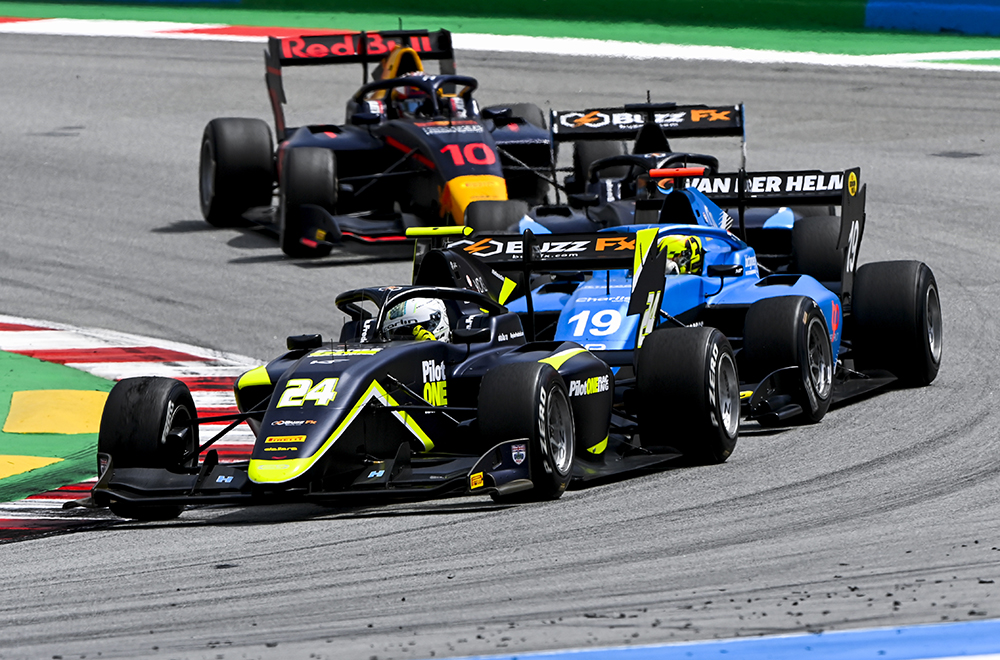
Frederick (No. 24) spent three years in the Road to Indy before moving on to the junior formula ranks of Europe. Mark Sutton/Motorsport Images
The decision to move up to F3 this season, while remaining with Carlin, came earlier this year -- much later than his rivals -- and has delivered less than satisfying results. The 19-year-old Marylander injured his thumb in a crash back in June at the Red Bull Ring, which required surgery -- two screws and an anchor -- and forced him to sit out the next contest in Hungary. He was slated to return at Spa but was put back on the sidelines after testing positive for COVID-19. In all, he’s missed seven of 18 races and is mired down in 24th in the standings. Frederick confirmed he will return for another season in F3, but has not yet committed to a team.
Reflecting on a six-year journey split evenly between the RTI and racing in Europe, Frederick agrees with Sargeant that a financial support structure could make sense, unless there’s a catch.
“There wouldn't be a negative in it having something like that, unless it means that everyone has to pay more to come up with a sort of prize bonus,” Frederick says.
“It's tricky. For me, it wouldn't be a negative. I don't know why it wouldn't be able to be implemented. I just don't really know what would have to happen to make that happen.”
Without such a European support structure, Frederick and others are left to learn from the successes and the failings of those who have come before them until -- if ever -- something changes.
“Look at Callum Ilott -- F2 driver last year, was battling for the championship until the last race," says Frederick. "His Ferrari Driver Academy teammate Mick Schumacher gets the F1 seat, and now he's trying to find another type of drive when he was on the brink of getting an F1 seat. And he's probably not going to get that seat, I don't think, ever.
“I don't know his situation, but it's unfortunately just the way it is. If you have the right ties, you can be in a fortunate situation where if you're in the top three, like (Yuki) Tsunoda was, he didn't win the championship or anything; third (in the F2 championship) and he made it to the AlphaTauri drive. Unfortunately, that's just the way it is right now. Whether that'll change, I have no idea. But in most cases, those situations are like that because they were given a fair chance to prove themselves and they didn't quite make it. I guess they just don't like giving second chances around here. I guess that's the big thing. It's really hard to say. I don't really know what would have to be put in place to make something like that happen.”
Joey Barnes
A regular on the motorsports scene since 2013, Joey Barnes’ career has taken him coast-to-coast from the garages of NASCAR to the paddocks of IndyCar and Formula 1. In addition to founding Motorsports Tribune, his work has appeared in outlets including Autoweek magazine and IndyCar.com. In 2017, he was recognized with an award in Spot News Writing by the National Motorsports Press Association.
Read Joey Barnes's articles
Latest News
Comments
Comments are disabled until you accept Social Networking Cookies. Update cookie preferences
If the dialog doesn't appear, ad-blockers are often the cause; try disabling yours or see our Social Features Support.