Bryn Lennon/Getty Images
Why Mercedes is on dangerous team orders ground
There is no more dangerous ground for Formula 1 team management than when its two drivers fight for the world championship.
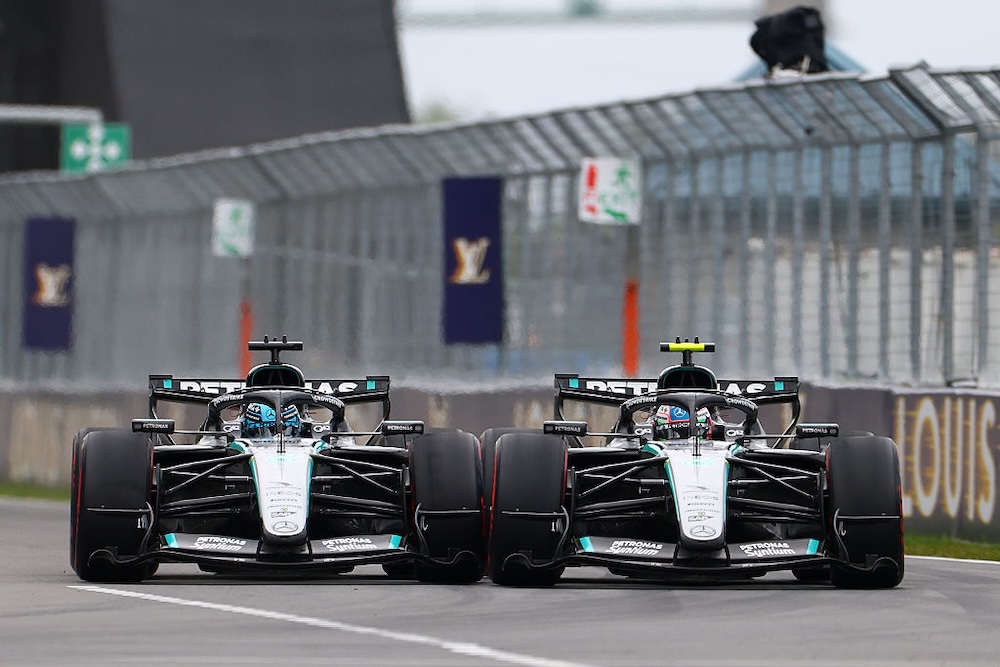
It’s the archetypal good problem to have, the reward for producing a championship-winning car. But the frenetic battles between Kimi Antonelli and George Russell during the Canadian Grand Prix weekend exposed the underlying tension between individual and collective objectives that can derail even a potentially great season.
No matter how well-managed or how well-intentioned the drivers, the fundamental conflict between personal ambition and playing for the team cannot always be squared off. This strain exists in all teammate alliances, but the stakes of a title battle risk making it toxic. Mercedes is a long way from that, but it would be naive to imagine it couldn’t happen.
Much of the wider team orders discourse in F1 is predicated on the wrong assumptions. The feeling is often that it’s about a team favoring one driver or the other, but while that can occasionally be a part of the equation, it’s a far more subtle influence than is widely believed. The real priority for teams, at least the well-led ones, is navigating these situations without it negatively impacting results. This is an easy objective for everyone to agree with in principle, but more difficult to deliver in the heat of competition.
“Our racing intent and the rules of engagement are quite clear in terms of what we want the drivers to do and where the line is of what the team considers acceptable,” said Mercedes deputy team principal Bradley Lord in a podcast recorded by Mercedes after the Canada weekend.
“Broadly, that is make sure they don't make contact and make sure we don't cost the team overall points with how they race on track. But then after that, when things do happen, it’s important to keep communicating and not let things either fester or not get addressed. We have to put it all on the table, work out what we think about it, even if we don't always all agree on everything and then move forward from there.”
The first part of this is logical and easy for everyone to agree on. No driver would argue with the notion that they shouldn’t drive into each other or cost the team points when discussing it in the cold light of day. But when in the cockpit, with a heart rate at 150bpm or more, your life’s work at stake and the absolute certainty that the other guy should cede ground, this can become an alien concept that’s difficult to apply. The drivers will usually insist that they know how to race wheel-to-wheel safely, as Antonelli and Russell did in Canada, which is all well and good until they don’t.
The question there is, where is this line? Put your teammate in a situation where they must back out or you collide, and you can conclude that to fulfill the rules of engagement they should do exactly that. Meanwhile, the other driver could reason that they should never have been put in that position in the first place. Then the collision happens. Teams are desperate to avoid that, although the biggest mistake is to be arrogant enough to imagine that you can control the uncontrollable and eliminate the possibility completely. All you can really do is mitigate, then contain.
That’s why the second part of what Lord outlines is the more significant. You could infer from it the acceptance that often such incidents cannot be prevented, making the more important consideration how you deal with it “when things do happen”. If Antonelli and Russell fight for the world championship throughout the season, they will be close together on track so often that it’s almost inconceivable that there won’t be a clash.
How that will manifest itself cannot be predicted. It might be a Spain 2016-style cataclysm, when Nico Rosberg and Lewis Hamilton conspired to eliminate both Mercedes on lap one, or it could be akin to what happened in Canada last year when Lando Norris rear-ended Oscar Piastri. Those are two extremes when it comes to fallout, the first requiring crisis management and the second straightforward because Norris accepted responsibility immediately and Piastri’s result wasn’t impacted. It’s unusual that it’s as straightforward as in the latter example.
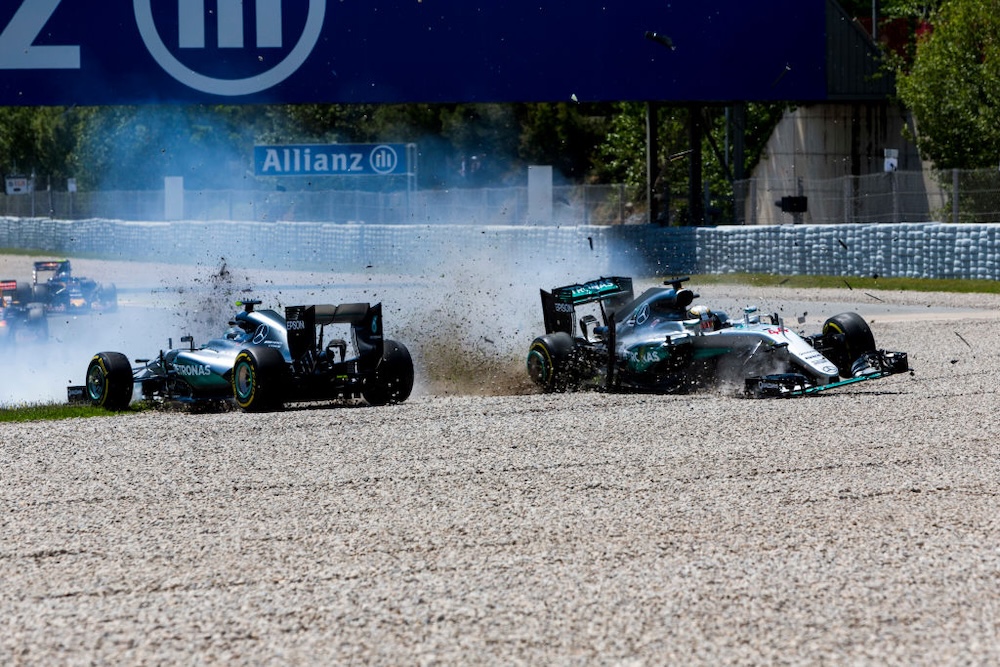
Rosberg and Hamilton's lap one collision at the 2016 Spanish GP was the worst-case scenario for teams trying to manage an in-house championship fight. Zak Mauger/Getty Images
The moment in the Canadian Grand Prix when both drivers were told to tidy it up or the battle would be called off is an example of how to do this, and followed the previous day's sprint race when Mercedes did suffer a little from its drivers battling. It was clear they were given responsibility for being allowed to battle, contingent on them not getting too close to the line or jeopardizing the team’s result, meaning that if they flirt with disaster you can legitimately issue team orders (and hope they are listened to).
It’s also important to remember that while the collision eliminating both cars is the doomsday scenario, there are more subtle variations. For example, such a battle could back you up into the clutches of the competition. In Canada, Mercedes had a handy advantage of 0.3s per lap on race pace over its pursuers, but there will be times where this is more slender and it is under pressure.
Plus, there are other factors to consider such as how it impacts your pitstop window, limiting strategic options and compromising the race in that way. You could overwork your tires, overstress the power unit and any number of other things with downstream effects. Even light contact that has no impact on performance or race result could lead to the need to replace a part, which is something to be avoided in this cost-cap limited era. Those are the complexities the team management lives and breathes, ones that are far more immediate and tangible than the idea they might want one driver or the other to win. The priority is always the team – how do we win, rather than the necessary how do I win of the drivers.
This is why Wolff’s radio messages to Antonelli during and on the slowdown lap of the Canada sprint were so pointed. Consider how these will have sounded to team members who will have heard Antonelli, having dropped to third, effectively lobbying for a penalty for his teammate. Had that been applied, victory would have been lost. Yes, it was only a low-stakes sprint, but telling everyone you work with that you value your own success over the collective is never a good look.
Likewise, you can make a case that Russell should have left more space for Antonelli when they battled at Turn 1, as this signals a willingness to flirt with catastrophe for your own ends. Ultimately, Mercedes still won the race and the only loss was the one point Antonelli shed by falling behind Norris after his rash attempt to pass Russell later in that same lap, but it created discomfort.
While Canada has ramped up the intensity of the battle between Antonelli and Russell, you can argue that what happened is beneficial to the team.
The losses were negligible, overwhelmed by the 18 points hit of Russell’s retirement that cost the team a one-two, but it’s a useful cautionary tale for Wolff to use to keep the drivers in line as far as possible. For Antonelli, the key lesson will be about managing his emotions, not just in terms of calming the radio communications but preventing moments like the Turn 1 incident leading to the emotional misjudgement in making a rash move that resulted in a lock-up. For Russell, it’s impressing on him the possible cost of being too robust in battle. What happened in Canada will have given both plenty to ruminate over.
So what does this mean for the head-to-head that’s to come? First and foremost, it indicates that the intensity will escalate. Yes, Russell is now 43 points behind but his claim that it’s Antonelli’s “to lose now” is incorrect, and it’s doubtful he believes that. It’s certainly a healthy lead, but there will be good and bad days for both to come and it was only really in Miami where Antonelli definitively outperformed him.
However, in Canada there was nothing to choose between the duo, and there were times when Antonelli looked to have the edge on race pace, partly because his more aggressive style made it easier to energize the front tires. That’s the scrap in a microcosm, Antonelli with perhaps the potential to be quicker but Russell with the experience. What follows now will be as much a test of mentality as skill, and Russell is at particular risk of convincing himself the team is somehow more invested in Antonelli prevailing. Too often, that becomes a self-fulfilling prophecy as drivers can see ghosts and react to them in a way that costs them.
It would be foolish to write Russell off. There’s a tendency for knee-jerk reactions to short-term trends, and while what Antonelli has achieved in winning four consecutive grands prix is remarkable the balance of power hasn’t yet shifted in his favor. That doesn’t mean it’s not in the process of doing so, for that is a possibility, but there’s a long way to go in this story.
That means the coming races, probably the whole season, will be all about the two vying for supremacy. That’s a tantalizing prospect for those of us watching, but for Wolff and those alongside him who must ensure that the tension between the individual and the collective doesn’t surface too frequently, it’s going to be a recurring headache. Even if they manage the situation perfectly, that might not be enough to prevent the worst happening.

Edd Straw
Edd Straw is a Formula 1 journalist and broadcaster, and regular contributor to RACER magazine. He started his career in motorsport journalism at Autosport in 2002, reporting on a wide range of international motorsport before covering grand prix racing from 2008, as well as putting in stints as editor and editor-in-chief before moving on at the end of 2019. A familiar face both in the F1 paddock, and watching the cars trackside, his analytical approach has become his trademark, having had the privilege of watching all of the great grand prix drivers and teams of the 21st century in action - as well has having a keen interest in the history of motorsport. He was also once a keen amateur racing driver whose achievements are better measured in enjoyment than silverware.
Read Edd Straw's articles
Latest News
Comments
Comments are disabled until you accept Social Networking Cookies. Update cookie preferences
If the dialog doesn't appear, ad-blockers are often the cause; try disabling yours or see our Social Features Support.