Steve Etherington/Motorsport Images
ELIAS: Mercedes' secret weapon for the F1 preseason
Design engineer Gabriel Elias recently returned to his native Florida after spending the past six years employed at Mercedes F1, where he helped to design the cars that have carried the team to the past seven Formula 1 constructors’ championships.
When I first began working in Formula 1, my perception of pre-season testing was probably the same as a lot of people’s. You imagine these teams having worked all winter on their new car, and then going to the track for this day of reckoning where they find out whether all that work has paid off with the performance they were expecting. That, and some trepidation about what the opposition has been up to during the off-season.
But the truth of the matter is that in my time at Mercedes, when we got to the first test, it was really just about mileage accumulation. We were trying to break the car. We already knew that there was performance, so the first test was essentially for validation.
As time has gone on the teams have become much more prepared for the first test, because they've seen the necessity of getting your mileage in the hybrid era of Formula 1. Mileage is basically gold to race teams -- if you’re not able to go out in testing and get laps, you’ve screwed yourself. And we've seen that over the past few years, when teams have had problems during the first test, or missed days of it altogether because their car wasn’t ready. When that happens, you're losing hundreds of kilometers per day that you need in order to be able to try different setups, different ride heights, different engine modes, different aero packages, all that kind of stuff. You can't do any of that work if you're not running, and recent history shows how big a setback missing that track time can be.
But while you usually arrive at the first test with a good sense of your own car’s performance, you never really know where you are in comparison to the other cars until you get there. All top teams have some form of performance tracker that basically follows and projects the performance of their closest competitors, normalized based on, say, engine mode. So in the case of Mercedes, if we were testing at the start of 2018, the team might say, "OK, Ferrari’s chasing us," and we could take all the data points of their upgrades from 2017 as relatives to our car over the entire season. Then we would essentially project out that, OK, we think they’re going to bring four tenths – that’s just an example – to the car, because of the ruleset for that year, combined with historical data from past years and other inputs.
So we’d have an idea where the competitors are, but no one really knows until they show up. But as far as what Mercedes or any other good team will bring to the circuit, they're going to be projecting out that, hey, we need to find, let’s say, one second in performance from the end of one season until the start of the next, assuming that the regulations stay fairly stable. OK, well we can gain two-tenths from the engine – we’ll call Brixworth (ED: home of Mercedes HPP) and say, "Can you give us 10 horsepower," or whatever that ends up being. We need to find this many tenths in the wind tunnel, and the aeros will be making weekly gains as soon as the model switches over from the previous year to the next one, barring any setbacks. And then let's say we can find a few tenths in mass optimization, vehicle dynamics-related updates, like that. So all of that is set as directives, and then developed in simulation. And that drives our design.
Then once we bring the car to the track, it's almost like, "OK, we're pretty sure we're going to be here or hereabouts, now we just need to make sure that our competitors have followed the track that we projected for them as well." So that's what points the ship at the start of winter.
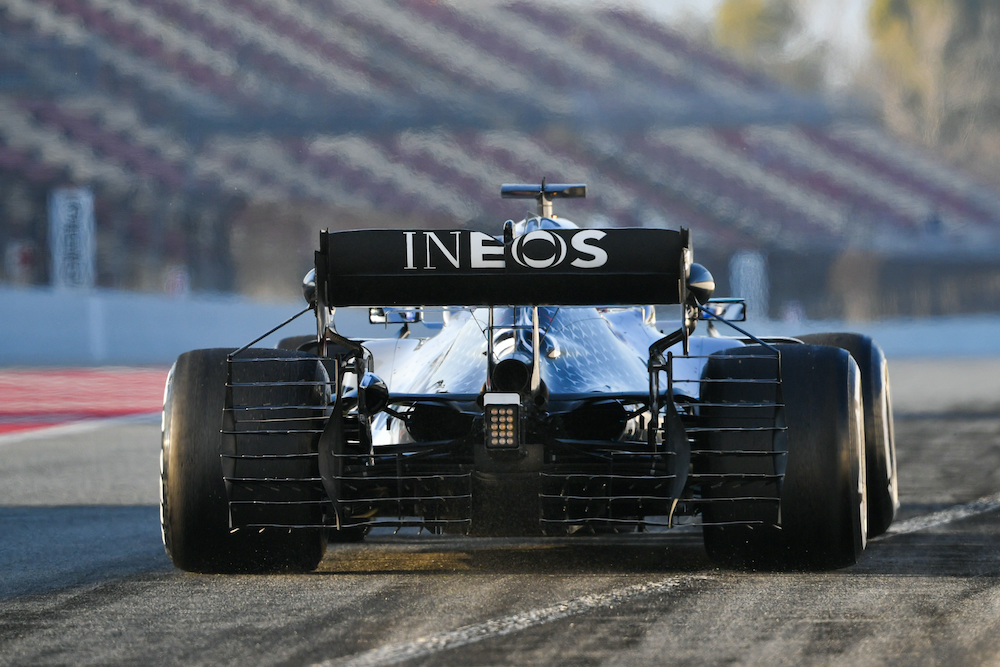
By the time the leading teams show up to F1 testing, they already have a pretty good idea where they – and their rivals – stand. The focus is largely on validating what simulations showed during the winter. Sutton/Motorsport Images
During my time with the team it was rare that one of our rivals came out with something that really surprised us, but there were certainly a couple of occasions when we all started looking at something another car was doing, like, "Whoa, that was gnarly." A couple of years ago at Melbourne, we had an onboard of the Ferrari rear wing and we saw the thing diving -- we could see flexing at speed on the straight. And we're all sitting there like, "How the hell are they doing it?" We were looking at the hinge points at the main plane, as it attaches to the endplates, we're looking at the rear flap…. It all seemed to be on a slider of some sort. And moveable aerodynamic devices are a no-no, but under speed you could probably get away with it, as some teams have done in the past.
That was one where I remember we looked at it really closely, like, "How can we do this?" We tried to scheme up some options that would maybe get us a similar result. But one thing about Mercedes in my time there is the team never brought questionable things to the car. They were always very, very afraid -- and Daimler was always very afraid -- of the optics of going too far into the gray area. I’m not sure that all of our rivals felt the same way, but Mercedes was very keen to avoid what would come with the kind of publicity you’d attract for doing something against the rules. If we brought something to the car that was novel, the technical management was certain they could prove its legality in the event of a protest before it ever went onto the track.
Ferrari gave us a scare another year when they were up by about a second a lap during pre-season testing. And internally, within the team, we were just like, "We are so screwed here." I think that was when they were doing something with their engines, and they were showing it in different places on the track. Remembering the engineering notes, we ended up finding a ton of performance almost inadvertently, and it had to do with ride height. So we made a ride height change, and basically the car just lit on fire -- figuratively -- and we found massive chunks of time. And as I remember, that might've been the afternoon of the last day of the last test before Melbourne, and we found about half a second, just in ride height changes.
That year we also brought a ton of aero development during the season to try to make up for Ferrari having this engine mode that we couldn't figure out. It was almost through sheer luck that we found something, plus the fact that we had superior reliability, which was always the calling card of our car, that we were able to get it done that year. That was a really tough slog of a year, because we just kept bringing parts to the car, trying to get more and more performance. I know that took a lot out of everyone.
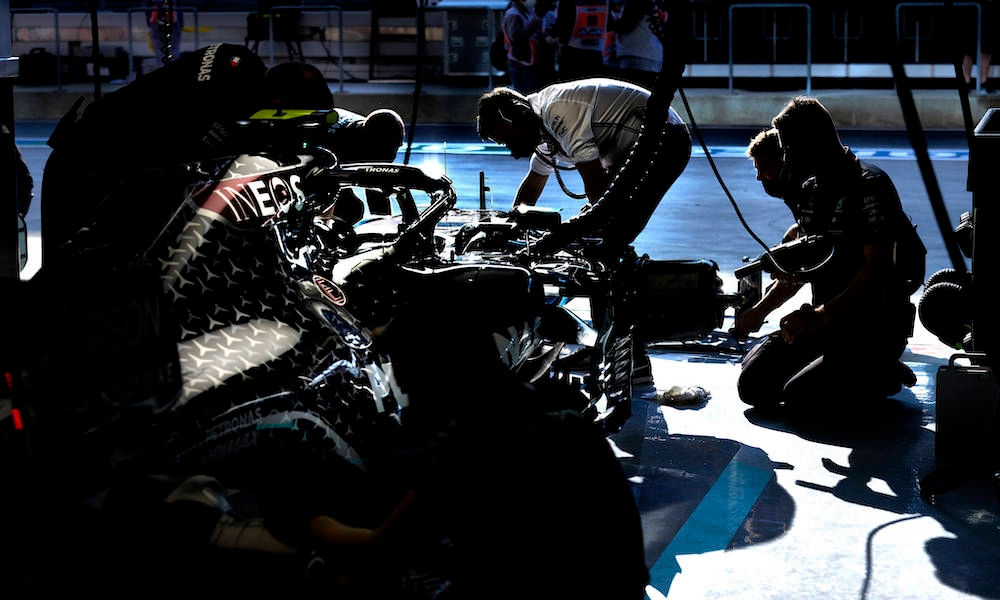
I’ve been asked about what makes Mercedes better than other teams, and the thing that always stood out in my time was the chassis dyno. A lot of people don’t know that there's this massive chassis dyno at Mercedes, and they are now commonplace at other top teams as well. It was purchased and constructed by Honda in 2008, and then Honda subsequently left -- they essentially left the keys in the door and walked out -- but in doing such, they left a multi-million dollar chassis dyno cell that was purpose-built for the F1 team. So the team has this dyno cell that you can put the full chassis on, complete with bodywork.
You run the air through the radiators at speed – it can run all the way up to, let's say, 320 km/h (200mph) or something like that in terms of airspeed. You can replicate all the air densities and air temperatures, and correct for altitude. And it doesn't run to the track time schedule you’d have at the track. It doesn't run from 8:30 a.m. to 4:30 p.m. It runs 24/7. There’ll be three shifts, and if the car goes down -- let's say you got an oil leak, you have to take off the engine, all that kind of stuff -- there are people working 24/7 to get the thing back and running, and complete as many kilometers as possible. Everything you can think of, this thing can do. When Mercedes arrives at the first test, it’s not really the "first" test. They’ve been running in the chassis dyno for weeks.
That’s what will have been happening at Mercedes over the past few weeks: the engine, gearbox, cooling system, hydraulics, everything including the suspension and brakes have been put through the wringer on the chassis dyno, brake and gearbox dyno, and off-car kinematics rigs. I've had things break on the dyno, and it gave me enough opportunity to make a countermeasure almost immediately, before we even got to the circuit. So by the time you get to the track, there’s a fix in place, and now we're getting track time to make sure that the replacement part is OK. And by the time that's all done, you’ve got a solution in place and then you usually can go on the rest of the season with no issues. Most smaller teams don't have that opportunity. When they break something, they're breaking it at the circuit, and then they start the mad scramble to fix it a week before they have to fly to the first race. There's the difference between the top three teams and the rest of the grid.
If Formula 1 wants to make things interesting in the future, they should ban chassis dynos. Just ban them altogether. Teams shouldn't have them: you should get to the first test, and everything should blow up and break. The grid will just change as the season goes on, and then you'll really see who's better at adapting on the fly.
For us, being a well-resourced team, we still had problems, but it seemed like we were able to manage them. We’d have tons of mechanical problems pre-season. In my case, I had one of my radiator designs crack and leak one year, and I was freaking out. The first thing I had to do was come up with an emergency patch to get through the first test, and then I had to redesign the tank so that it didn’t leak in the future. Those kinds of things are very stressful. Myself and a couple of other engineers had to figure out the root cause of this little bit, and do the redesign and manufacturer the redesign all within, let's say, a four- or five-day span in order to get the change to the circuit. We'd overnight it, or stick it on a plane and it would be in Barcelona within two hours, just to get us back running on the track. Mercedes, being so risk averse, always wanted to make sure that we were testing a representative car.
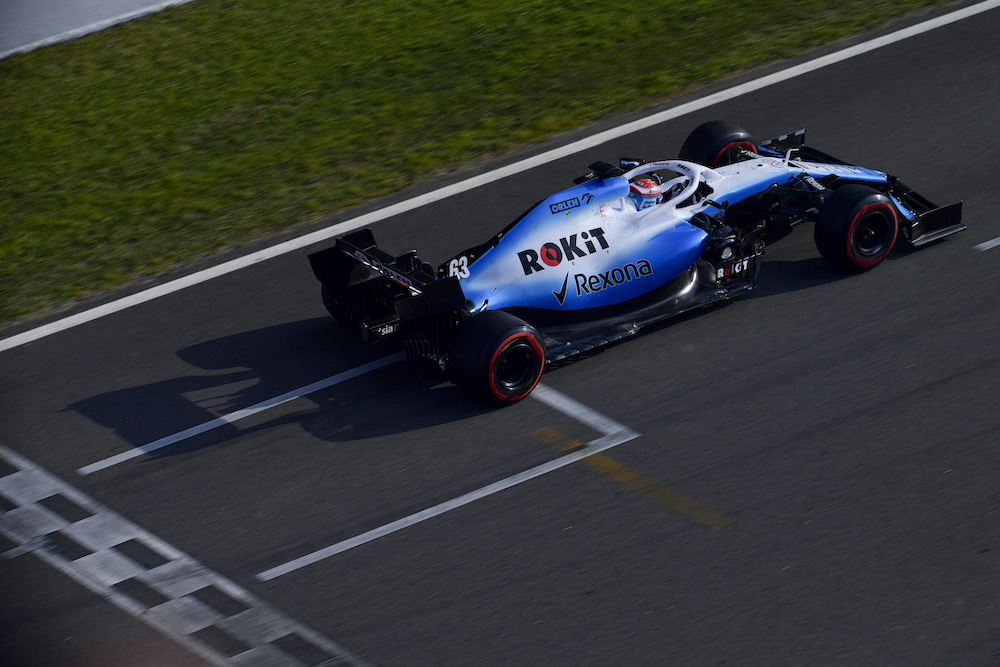
Williams was late getting its FW42 onto the track in 2019, and spent the rest of the year trying to catch up. Jerry Andre/Motorsport Images
By the time the first race comes around, the modified parts have already done… we’d probably do between 400km (250 miles) and 600km (370 miles) a day in testing, multiplied by however many test days you had to work with. There was a kilometer limit that all parts need to pass before they’d go onto the race car, so it was on us to rush all of these fixes to the test as soon as possible, because that's the only way we could race with them. So, nerve-wracking times, for sure.
There were years that went really smoothly, and then we've had years… I can remember in 2017, we broke so many floors. We were cracking the diffuser off the rearward portion of the floor. That’s ridiculously scary, because that's a cat1 fault, or a DNF fault. If the floor breaks, your car is done. Those breaks were happening at the first test, and the reason why they were happening was because we were making 40% more downforce, and we didn't match the strength of the floor correctly for the new downforce level that we were experiencing.
Another year, we broke tons of brake discs. So over time you’d see failures all over the car. But the percentage of failures that Mercedes has at the track is much lower because of all the testing done at the factory prior to the car ever leaving a garage. And that’s invaluable, because you’re working on problems two weeks earlier, and you’re doing it from the comfort of your own home, so to speak. Let’s say a brake disc fails on the brake dyno; you’re in a controlled environment, and you can take time to really understand what happened -- you can do a full analysis on it, you can bring your colleagues into it. But when you're at the circuit, it's just a skeleton crew. You're using the race team’s eyes and ears to relay back to the factory, "Hey, this, this is what broke, you guys look into it." And that distance makes failure analysis even more strenuous.
I’d argue that's the secret weapon for Mercedes. It’s not purely about superior on-track performance, it's reliability because of the things like the dyno and all the other different isolated test cells that were at R&D that allowed the team to prove out the car before we ever had to put it onto a track. And that’s what my former colleagues will have been focusing their energy on before shipping the new car out to Bahrain this week.
Presented by:


Gabriel Elias
Gabriel Elias is a seven-time Formula 1 world champion design engineer. Formerly with the Mercedes AMG Petronas F1 team in Brackley, UK, he currently operates from Miami as an automotive senior designer and director of GME Concepts; a full-service motorsport consultancy. The firm is active with projects working to expand F1’s commercial interests within the United States. GME Concepts is also involved with global motorsport young-driver scouting and driver management.
Read Gabriel Elias's articles
Latest News
Comments
Comments are disabled until you accept Social Networking Cookies. Update cookie preferences
If the dialog doesn't appear, ad-blockers are often the cause; try disabling yours or see our Social Features Support.