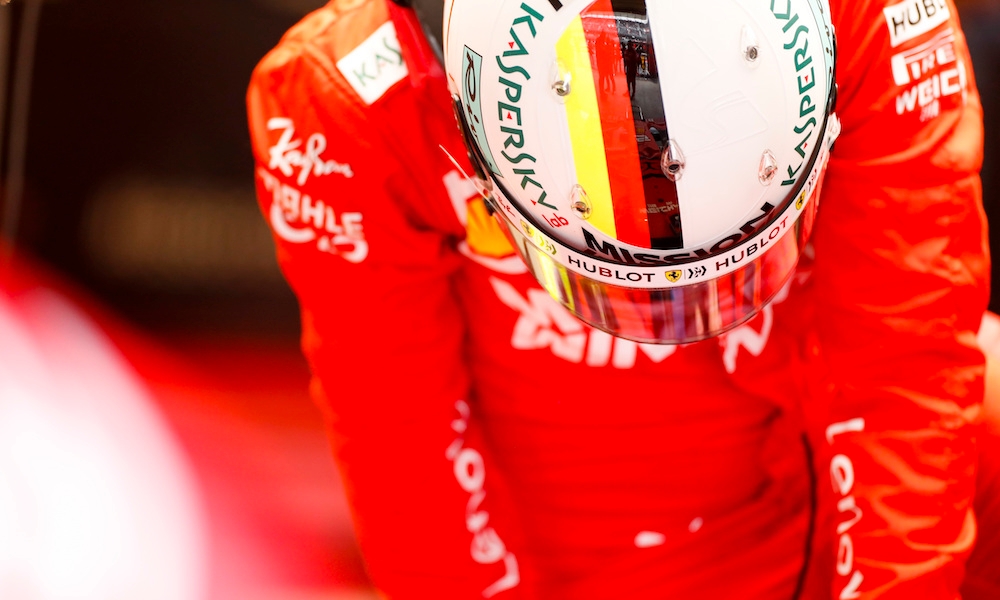
Image by Mauger/LAT
STRAW: Can Vettel save his career?
It was never supposed to come to this for Sebastian Vettel. Not yet, anyway. At 32 and heading into his sixth season with Ferrari, he should be in his pomp and looking forward to several more years as its main man. Instead, he’s standing at an unexpected crossroads of his career.
Vettel would perhaps like nothing more than to head back the way he came and recapture the quadruple-championship glory years with Red Bull. But he can’t bend time to his will, so instead must convince Ferrari he is worth persevering with, and that he represents the right teammate for man-of-the-future Charles Leclerc. If not, he has two other choices; the left turn is Formula 1 retirement, the right turn to some other opportunity in grand prix racing.
While questioning Vettel’s F1 future leads to scorn from his loyal fans, the reality is Vettel has far more to prove this season than a driver with 53 wins and four titles should. Past glories count for nothing given his erratic recent history, as a driver of his experience doesn’t have the luxury of pointing to the genuine high points as an excuse to cover the errors. He is no rookie.
Out of contract at the end of the season and with Leclerc in the ascendancy, can Vettel really save his F1 career in 2020? It’s not a melodramatic assessment of the situation, for Ferrari might easily opt to throw its full weight behind Leclerc and bring in a more compliant or emerging second driver. Vettel must either prove he can once more be the team’s spearhead or, fancifully, that he is willing to ease into a role as obedient support act.
While the question marks surrounding Vettel are bigger than ever, there are reasons for some positivity, as his form over the final third of the 2019 season did improve. Ferrari’s major upgrade package introduced at the Singapore GP in September not only increased downforce – particularly at the front – but also made the car characteristics more to his liking. Vettel prefers a car with a strong front end and a predictable rear so he can rotate the car as he wants and keep the minimum speed up, otherwise the precision he’s looking for isn't achievable. Leclerc, by contrast, is able to be more of a hustler regardless of the car’s characteristics.
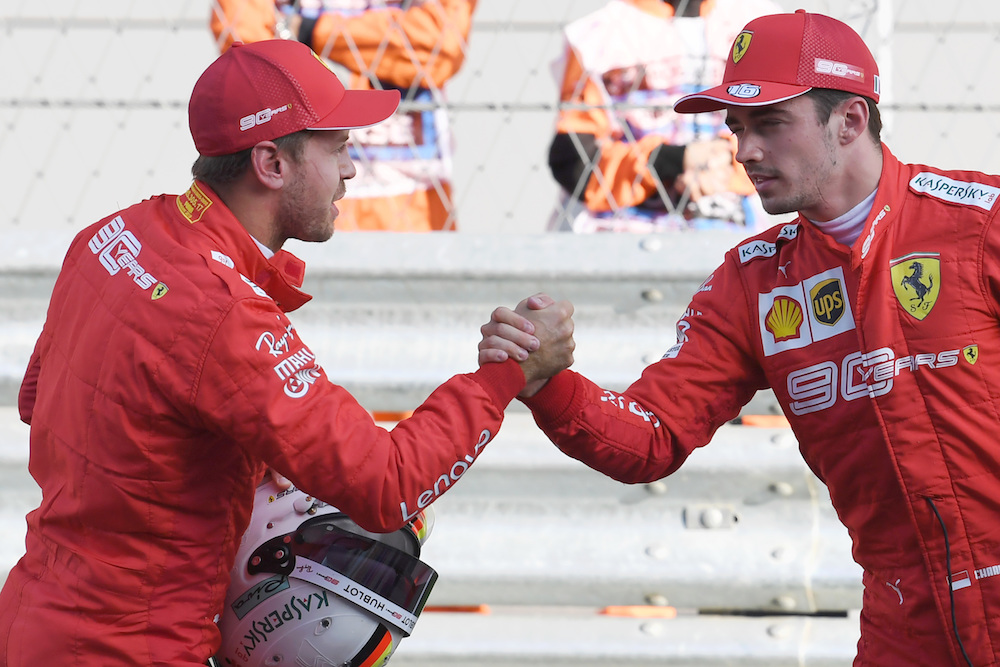
Leclerc presented a stiffer challenge to Vettel's status within Ferrari than the German expected in 2019, and there's plenty hanging on how things play out between the pair this year. Image by Mark Sutton/Sutton Images
Vettel struggled to drive as he wanted at times before Singapore, perhaps never more obviously than in Bahrain, where Vettel qualified three-tenths slower than Leclerc and was visibly hesitant on turn-in. Fast-forward to the Japanese GP in October, and Vettel was able to beat Leclerc to only his second pole position of the season with a storming lap in a car with more front load and a more controllable rear.
That wasn’t the only encouraging sign in the final months of the campaign. Vettel’s race pace at Sochi was outstanding even though it was overshadowed by the debate about whether he should have let Leclerc back into the lead, as ordered by the pitwall. In the seven races from Singapore onwards, the qualifying battle between the pair was also nip-and-tuck, with Leclerc outqualifying Vettel 4-3. Having looked outclassed once Leclerc hit his stride after early struggles, Vettel was suddenly back in the game.
All of this tells us two things. Firstly, that when he’s happy with the car Vettel can be as quick as ever. Even before the Singapore upgrade he had his moments – winning the Canadian GP on the road from pole position prior to his time penalty for rejoining in an unsafe manner – but after, he was more dependable. It also proves that the appetite, the desire, the motivation to haul himself back to the top is still there. That’s not to be underestimated for any elite athlete who must live and breathe their sport. Vettel was fighting for his career, so we know he will have no interest in simply seeing out his contract and pocketing the cash over the coming season. He’s up for the fight.
The problem has never been Vettel’s peak performance. It’s the troughs that are a far greater concern, specifically the alarming errors of judgment. Even during that strong end to the season he hit arguably his biggest Ferrari nadir when he drove into Leclerc during the Brazilian GP. Make no mistake, this wasn’t the 50/50, ‘mistakes on both sides’ collision that Ferrari has publicly tried to dismiss it as. Instead, it was Vettel suffering from a case of red mist after having been ambushed by Leclerc at the first corner. We’ve seen his judgment be impaired by an emotional reaction before, and this was the latest case – one with some shades of his Turkey 2010 collision with Mark Webber.
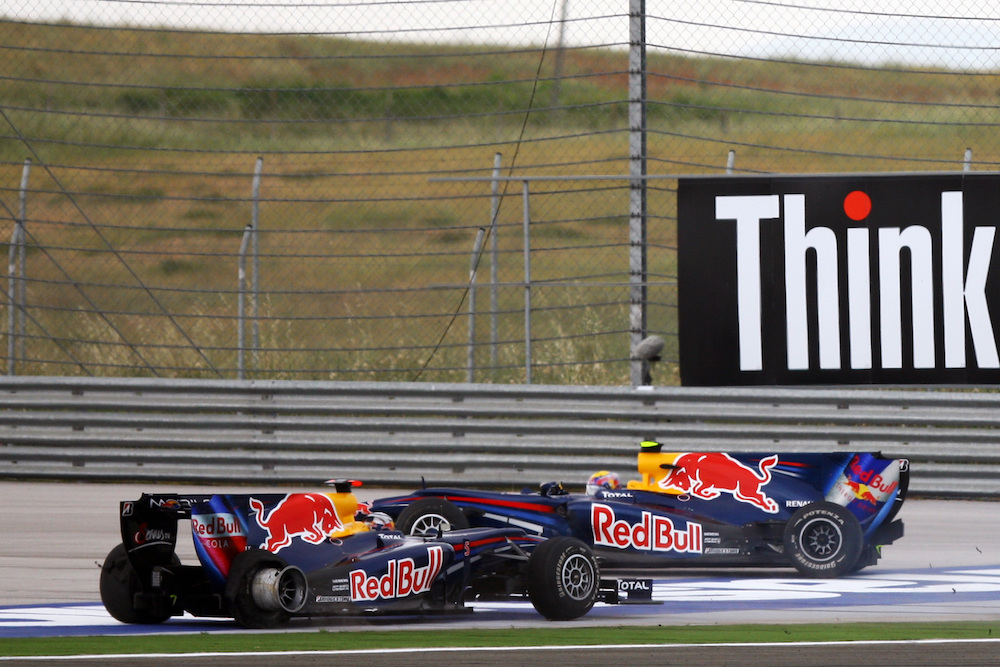
Vettel's collision with Leclerc at Interlagos had echoes of his friendly fire incident with Red Bull teammate Mark Webber in Turkey in 2010. Image by LAT
Behind closed doors, Ferrari team principal Mattia Binotto is understood to have made very clear how he really saw the collision. Say what you want about what happened previously, about Leclerc’s antics in trying to assert himself (such as his reluctance to move back ahead of Vettel during the Q3 qualifying madness at Monza), you cannot justify driving into your teammate on a straight and wiping out both cars. This is Vettel’s big problem: he could get away with some shenanigans at his imperious best, but not when he’s slid into a de facto number two role through his performance levels.
It’s far from the only mistake of recent times. At Monza, an unforced spin early on was compounded by a reckless piece of rejoining. The defense is he couldn’t see cars coming, but it stands to reason that if you go off while running fourth, you have to wait before you can safely rejoin when visibility is unclear. After all, the car he collected was Lance Stroll’s Racing Point – not one of the last in the queue, but one that was running seventh at the time. Again, his judgment was impaired by an emotional reaction to a pointless error.
At Silverstone, he clattered into the back of Max Verstappen, while in Montreal Vettel’s error created the conditions to earn the penalty that cost him victory. Given Leclerc’s problem in Bahrain he could have won there, too, but for spinning while battling with Lewis Hamilton.
The 18 months before that don’t make for more encouraging reading either. A multitude of clashes, a terrible misjudgment at the start of the 2017 Singapore GP, and that astonishing moment of red mist when he deliberately hit Hamilton under the safety car in Baku add up to a catalogue of catastrophe ill-fitting of a driver with four world titles.
Vettel cannot possibly win a world championship while making such regular mistakes. It’s inconceivable that a driver who is prone to emotional errors can deliver consistently over 20+ races to beat this caliber of opposition. He could in the past, but that was in a different environment with a race engineer at Red Bull in Guillaume ‘Rocky’ Rocquelin who knew exactly how to keep him in the right place mentally. Yes, that Vettel vented, but things only very rarely boiled over.
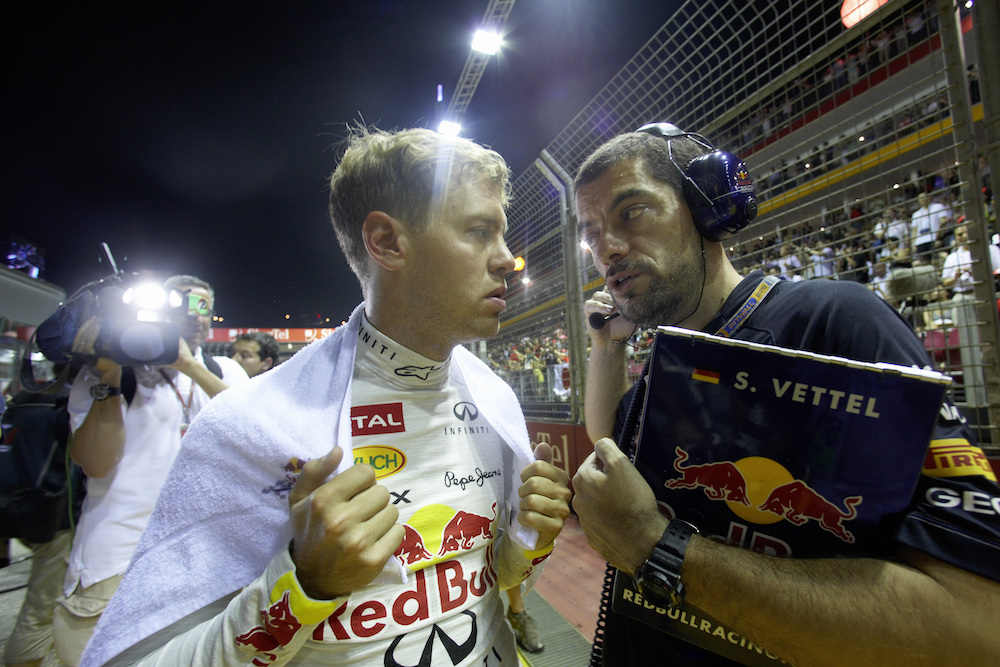
Engineer Guillaume Rocquelin was instrumental in keeping Vettel in a good space mentally during his Red Bull years. Image by Rainer Schlegelmilch
The circumstances of 2020 are hardly tailor-made for Vettel to be the master of his own emotions. The pressure will be intense and, as much as he shrugs off the questions about his future in public, there can’t fail to be an impact on him mentally. It’s only possible to guess what might be going on in his head, but it will certainly be a more tumultuous place when it comes to his profession than what, say, Hamilton is experiencing with everything going so well at Mercedes. And while Vettel publicly is quick to dismiss criticisms, there are hints that he might not have the ironclad psyche of an Ayrton Senna or a Michael Schumacher that really believes it. In some ways, as a character he might almost be too ‘normal’ – meant in the most positive way possible, given the unusual traits needed to be the best in elite sport. Certainly, the portrayal of him as an entitled whiner is entirely alien to the amiable, likeable, engaging Vettel who exists out of the car.
It’s tempting simply to write Vettel off and conclude there’s no way he can save his Ferrari career. After all, this is more than just a difficult spell given that it stretches back to 2017, and if he was going to turn it around, surely he would have done it by now? Leclerc is the man of the future and is on an irresistible trajectory, while Vettel is in what looks like terminal decline.
That might be the way things go, and at best, you’d say Vettel’s chances of being at Ferrari in 2021 are 50/50. But he has a whole season ahead of him in a car that the team hopes will be a championship contender, and he will be telling himself he can do it. Who knows how he will react to staring at career oblivion – perhaps that might be the mechanism that gets him back in the right place for sustained success? The raw materials are in there somewhere, he needs to mine them and deploy them more consistently.
What Vettel’s previous success does earn him is the respect to imagine that he at least has the potential to recover. He can be an astonishingly quick, relentless competitor and showed during his Red Bull days and, in fits and starts at Ferrari, what he can do. He remains the same man who won a race for Toro Rosso, the same one that charged through the field in a damaged car in the wet at Interlagos in 2012 to beat Fernando Alonso to the title, the same man who reeled off a record 13 victories the year after and was an insatiable winner even once the title was secure.
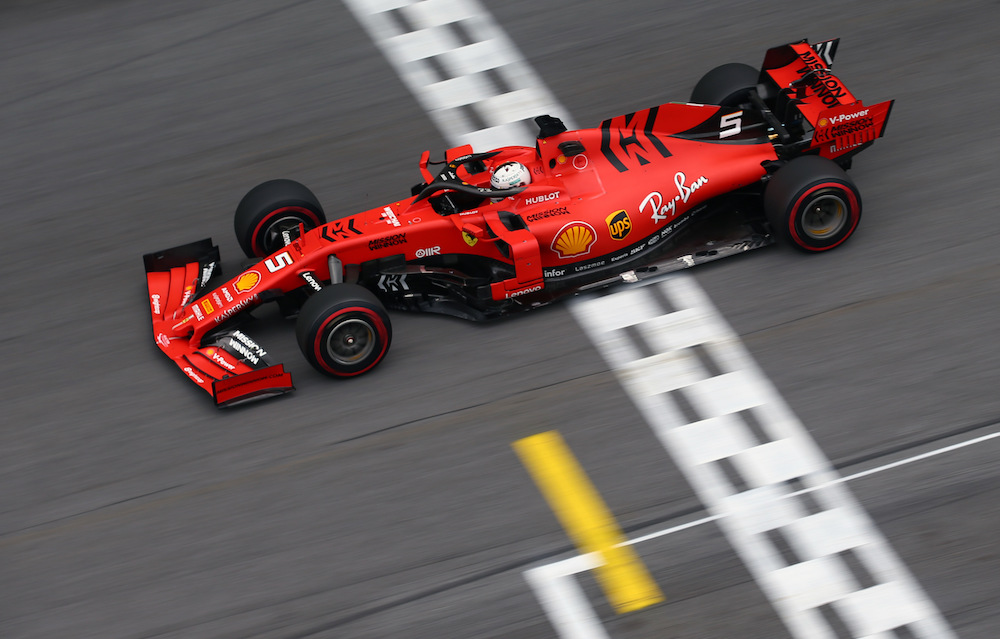
Vettel's past record will count for little if he struggles in 2020 – but it does reinforce that his has the ingredients to turn things around. Image by Andre/LAT
He’s also the same man who mastered exhaust-blown downforce, outclassing as quick a teammate as Webber in the process. People rightly talk about Senna’s blipping of the throttle to keep the turbo spooled up, but Vettel’s creativity in summoning downforce to suit him is another level beyond that. There are flashes of magic in Vettel, they just appear in narrower windows than those of a driver like Hamilton or Schumacher.
Vettel is both that remarkable driver, and the blunder-prone one. He might prove to be more one than the other in the coming season, but one thing is for sure: what happens in the coming months will define his Ferrari career. He’ll be all-in as he attempts to reassert himself over Leclerc, which will make for another combustible alliance for the Ferrari drivers. Vettel will want to bend the team, and Leclerc, to his will. That's a high-risk strategy, and one that bit him last year. But teams will forgive a great driver many sins if they are doing the job on track.
It may be that the die is already cast, that Vettel is doomed to failure. But he’s a four-time world champion, one who has dug deep before and come out on top, so we know he is – or at least was – capable of doing it. You can’t ever count out a great driver entirely while they are still in the race. And the most significant factor in deciding whether Vettel is able to pull back from the brink of oblivion is in his head. If he can get that into peak shape, then he has a real chance.
Either way, it’s going to be one of the defining storylines of 2020 – and of Vettel’s legacy.
Edd Straw
Edd Straw is a Formula 1 journalist and broadcaster, and regular contributor to RACER magazine. He started his career in motorsport journalism at Autosport in 2002, reporting on a wide range of international motorsport before covering grand prix racing from 2008, as well as putting in stints as editor and editor-in-chief before moving on at the end of 2019. A familiar face both in the F1 paddock, and watching the cars trackside, his analytical approach has become his trademark, having had the privilege of watching all of the great grand prix drivers and teams of the 21st century in action - as well has having a keen interest in the history of motorsport. He was also once a keen amateur racing driver whose achievements are better measured in enjoyment than silverware.
Read Edd Straw's articles
Latest News
Comments
Comments are disabled until you accept Social Networking Cookies. Update cookie preferences
If the dialog doesn't appear, ad-blockers are often the cause; try disabling yours or see our Social Features Support.