Image courtesy Ford Performance
Baja 1000 preview: It’s 1969 all over again
Five decades ago, desert racing had already taken hold on the still-primitive landscape of Baja, with the annual National Off Road Racing Association (NORRA) Mexican 1000 in its third running after enjoying a massive boost by ABC’s Wide World of Sports” coverage of the 1968 event. Things were growing so quickly, in fact, that NORRA had added a second Mexican event to its 1969 schedule, the first annual NORRA Baja 500.
The burgeoning sport was quickly surpassing its rather primitive roots, with purpose-built machines and components replacing the simplistic Meyers Manx-style dune buggies, warmed-over production sedans, and rough riding four-wheel drive trucks and Jeeps. Leading that revolution were two vehicles at the opposite end of the mechanical and philosophical spectrum: the Vic Hickey-built Baja Boots and Ford’s tough new Broncos prepared by the legendary Bill Stroppe.
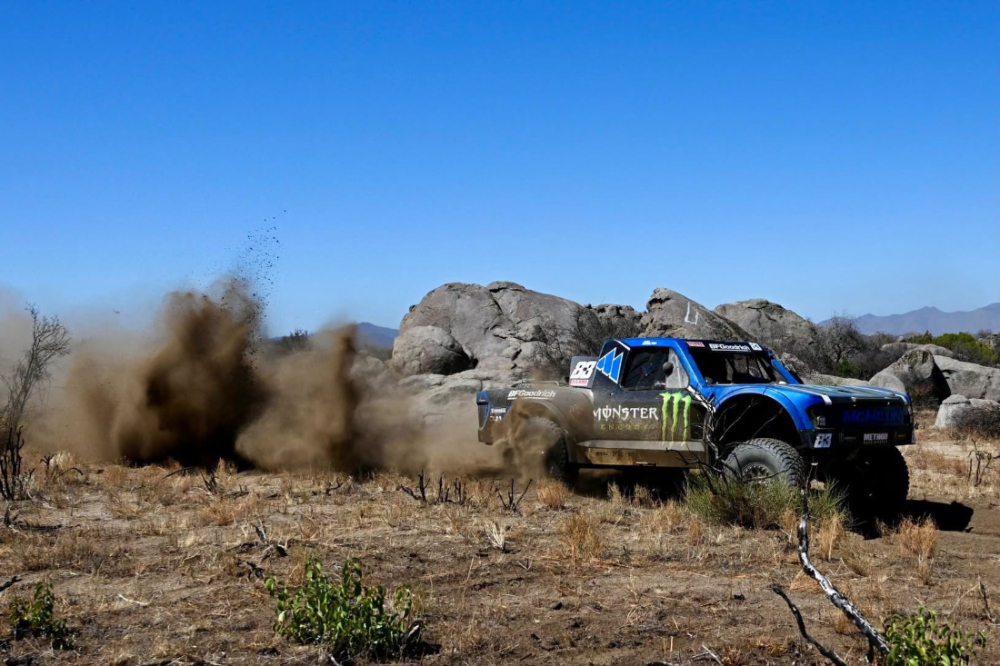

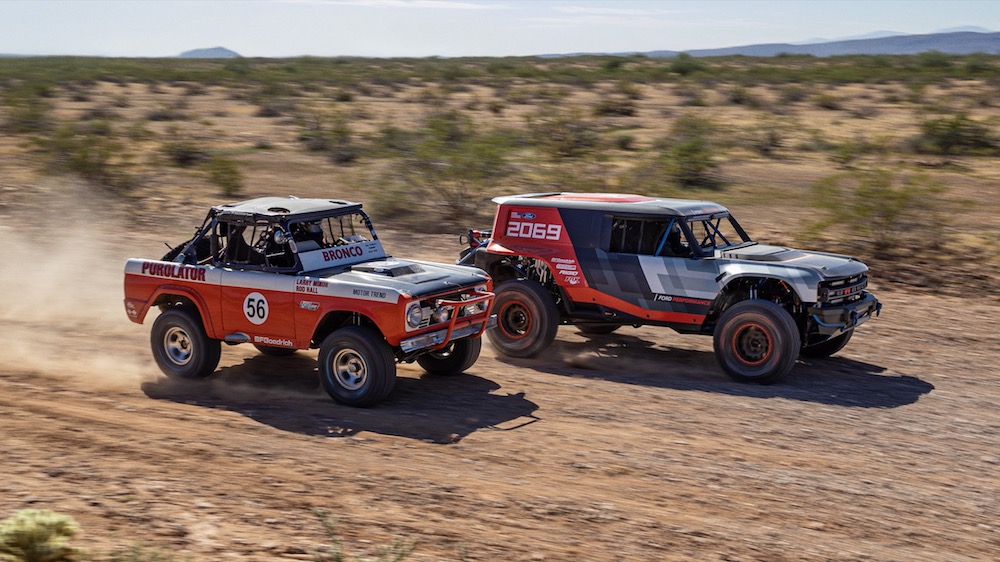
Fifty years later, history is set to repeat itself at this week’s SCORE Baja 1000 in one of the race’s most compelling storylines. A newly unveiled stepbrother to the original Ford Broncos will compete head-to-head with a rebirthed version of the iconic Baja Boot in SCORE International’s Class 2 (for unrestricted cars/trucks including turbo and superchargers).
The road to this weekend’s retro-tinged grudge match wasn’t the result of some grand scheme, but two decidedly different paths organically coming together in time and place.
A total of 265 vehicles have been processed as official entries for Friday’s BFGoodrich Tires 52nd SCORE Baja 1000. The season finale of the four-race 2019 SCORE World Desert Championship will be held over a rugged race course of 800.5 miles starting and finishing in Ensenada. The elapsed-time race will start at 3 a.m. PT on Friday for the motorcycle/quad classes, followed by the start of the car/truck/UTV classes at 10:30 a.m. PT. While the fastest finishers are expected to finish in approximately 16 hours, all vehicles will have a 34-hour time limit to become an official finisher.
A bit of history here: The original Baja Boot won the 1969 Baja 500, while a Stroppe Ford Bronco took overall honors at that year’s Mexican 1000. In many ways, 2019 in Baja will be 1969 all over again.
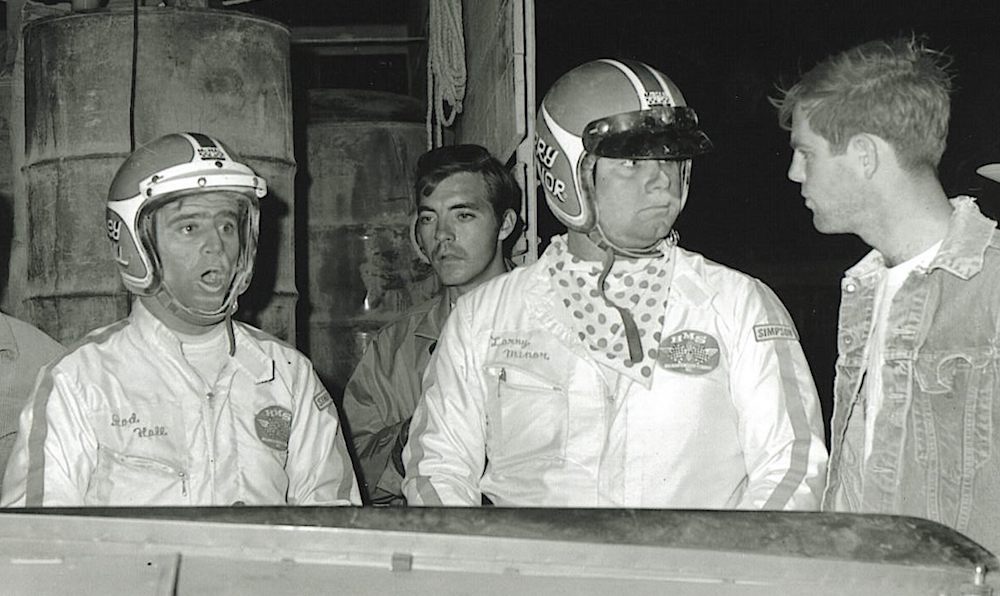
Rod Hall and Larry Minor. Marty Fiolka Collection
In the late 1960s the factory-backed team led by Stroppe represented the powerhouse of the sport, with a driver line-up that included Parnelli Jones, James Garner, Rod Hall and Larry Minor. Minor and co-driver Jack Bayer took overall four-wheel honors at the 1968 Mexican 1000, with Hall and Minor repeating that performance a year later. These victories, using race-prepared production vehicles, led Ford to release limited edition “Baja Bronco by Stroppe” machines via its dealer network in 1971, complete with the now-iconic Stroppe graphics package and race-inspired performance parts.
Fast-forward to the recent SEMA show in Las Vegas, with Ford bringing back its Bronco line-up in 2021 being all the rage. The Blue Oval gathered and displayed an all-star family reunion of famous race Broncos, including Jones’ iconic Big Oly, its golden patina still shining bright after winning the 1971 and 1972 NORRA Mexican 1000s. The underlying speculation was that Ford was going to leverage the occasion to unmask a prototype of the new production Bronco, but instead, it unveiled a well-kept secret factory race program for this year’s Baja 1000.
On a desert lake bed just outside of Vegas, a handful of select media were given the chance to see the new Bronco racer, dubbed the Ford Bronco R Prototype. An unusual combination of production components, prototype styling and Baja race quality parts, the Bronco R is a joint effort between Ford Performance, Geiser Brothers Design and Development of Phoenix, Ariz., and 2018 Baja 1000 Trophy Truck champion Cameron Steele. It features an independent front suspension with 14 inches of travel and a production-based five-link rear chassis design with 18 inches of travel, custom Fox shocks, 17-inch aluminum wheels and 37-inch BFGoodrich tires.
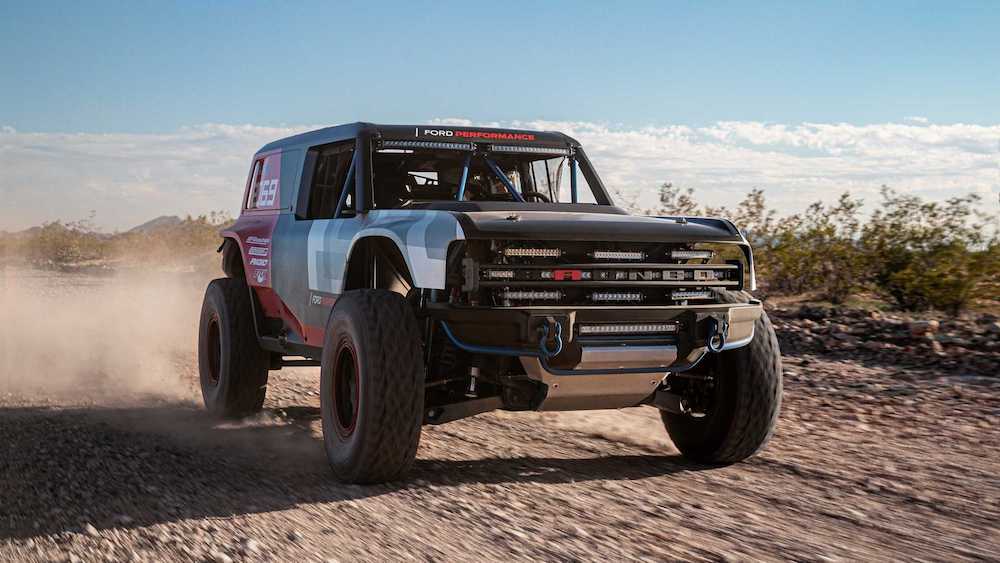
“Like the original Bronco, we kept Bronco R’s design authentic and simple, with a roll cage on a production-style frame, and a five-piece lightweight body on top,” explained Brian Novak, Ford Performance Off-Road Racing Supervisor. “For the endurance needs of Baja’s grueling race miles, we built in a limited number of race-focused parts. But even the twin turbos of the EcoBoost engine are representative of what the production Bronco will offer.”
The No. 2069 Ford Bronco R will be piloted by an all-star line-up of drivers, a list that includes Off-Road Motorsports Hall of Fame inductees Steele, Johnny Campbell and Curt LeDuc, as well as longtime Ford racer Brad Lovell, three-time King of the Hammers champion Jason Scherer, Trophy Truck racer and Ford dealer Steve Olligas, and, most appropriately considering the occasion, Rod Hall’s granddaughter, Shelby Hall.
In contrast, the 2019 effort by automotive visionary Jim Glickenhaus, his son Jesse, and their Scuderia Cameron Glickenhaus has been highly anticipated and publicized. Taking both styling and engineering cues from the iconic Baja Boot, the Glickenhaus Boot is a brand-new production machine, with a racing version soon available to the public. Built in association with California’s Armada Engineering under the watchful eye of Project and Race Manager Darren Skilton, these Boots represent the ultimate in "modern vintage retro-ness".
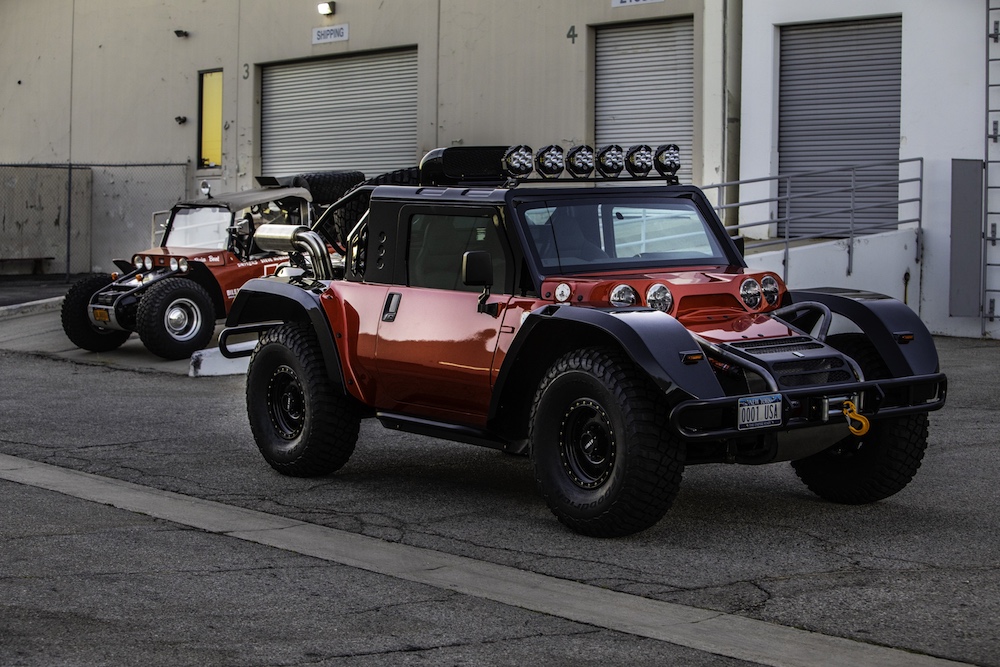
Baja Boot, old and new. Image courtesy Scuderia Cameron Glickenhaus.
Assembled in just 28 days prior to the inaugural 1967 Mexican 1000, Vic Hickey’s Baja Boot was the first true off-road supercar. In an era when Baja race cars could be put together for little more than $400, with a Meyer’s Manx fiberglass body and an inexpensive stock VW chassis and drivetrain, the Baja Boot cost $78,000 to build. It had a massive 112-inch wheelbase when most of the shortened dune buggies only stretched the measuring tape 84 inches. It weighed 3,450 lbs wet when the Manx cars were lucky to break 1,500 lbs.
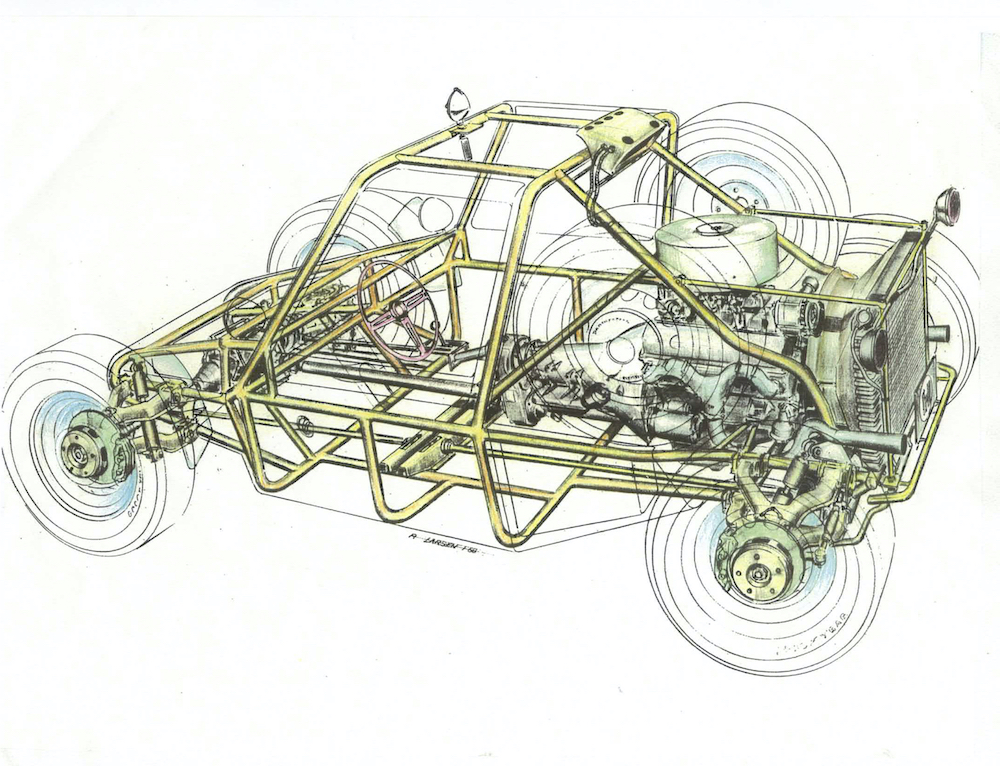
Cutaway of the original Baja Boot. Marty Fiolka Collection.
The Boot’s Camaro 350 cubic inch engine was mounted amidships, and a large, GM truck radiator was stuck all the way in the rear, cooled by a special six-blade reverse pitch fan. The Boot had four-wheel drive with a Dana transfer case that could drive to the front wheels only, along with four-wheel independent suspension lifted from an Oldsmobile Toronado. It featured four-wheel Hurst-Airheart disc brakes, three separate fuel cells with Goodyear bladders, and special 36-inch tall Goodyear tires that provided an incredible 14 inches of road clearance.
A skunkworks project that mirrored much of General Motors’ closet motorsports mentality in the 1960s, the Baja Boot was funded in large part by George Hurst. The inspiration behind GMs “Trailblazer” and other four-wheel-drive projects, Hickey took an entirely different approach to the Baja challenge by building a truly groundbreaking “unlimited” open wheel car – a vehicle he christened with a memorable name because “the thing just looked like an old boot.”
Hickey’s great creation never won the race for which it was built. Under the guidance of Bud Ekins and co-driver Guy Jones, the car did win the 1969 Baja 500 in June of 1969 – finally earning the right to bear the name Hickey had given it two years before. Hickey built a second Baja Boot in 1968. The tandem pair of cars were run out of his Ventura, Calif., shop when actor/racer Steve McQueen purchased them to race on his own.
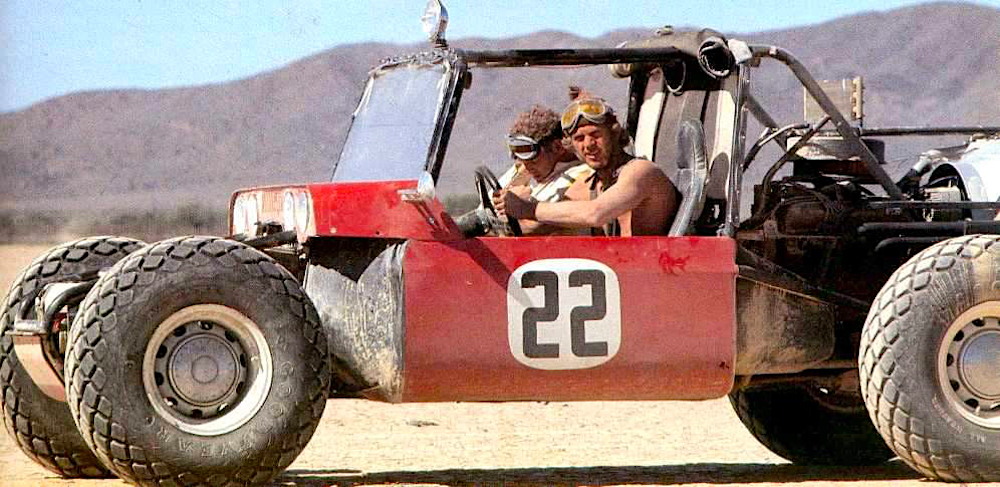
Steve McQueen and his Boot.
While one of the boots ended up in Australia, the original car was found by Bob Law and restored in 2000. That car was purchased in 2010 by Glickenhaus at the Bonhams Auction in Monterey for $199,500 – the largest amount ever paid for a historic off-road race car.
Skilton (a highly accomplished racer and promoter of Mexico’s Sonora Rally) and his crew have been testing and refining the Glickenhaus Boots for months now, putting both versions through their paces in Baja and Southern California. The No. 2022 entry will be driven by Skilton, Viry Felix and John Krellwitz. The four-wheel drive competition version carries 22in. of wheel travel powered by a 650 horsepower LT4 lifted from a Chevrolet Corvette Z06 via a race-prepped Turbo 400 automatic and 37in. BFGoodrich KR2 tires.
Both versions will be made available on a very limited basis to enthusiasts, and rumors have surfaced that the planned SCG 2020 model year production run of five two-door models are already spoken for.
Thus, one of this year’s best Baja 1000 narratives somehow came together 50 years after it all started. It will be the might of a factory versus the ingenuity of a small group of passionate enthusiasts. Ford versus Glickenhaus. Stroppe versus Hickey. No matter which machine crosses the Ensenada finish line first, all of motorsports will be a winner in this ultimate Baja match race.
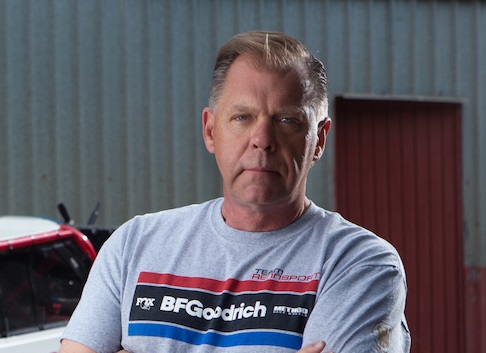
Marty Fiolka
A lifelong enthusiast of off road motorsports, Marty Fiolka raced his first Baja 1000 in 1992 and still enjoys getting behind the wheel via his annual BFG Team Rennsport NORRA Mexican 1000 effort. A graduate of University California at Long Beach, he founded The Rennsport Group in 1995 to execute motorsports public relations programs for Nissan, Infinity, Exxon, Mitsubishi, SCORE International and later became the editorial and marketing director for Dirtsports Magazine. Marty is a current contributor to RACER Magazine and RACER.com as well as operating the promotional agency for Crandon International Raceway and annual Red Bull Crandon World Cup. Fiolka was a 2014 Inductee to the Off Road Motorsports Hall of Fame (ORMHOF) and was instrumental in founding the Wide Open Baja adventure business and Ensenada's Horsepower Ranch. He also served as the associate producer of the original Dust to Glory documentary film and author of two books; 1000 Miles to Glory: The Baja 1000 Story and The Big Blue M: The History of McMillin Racing.
Read Marty Fiolka's articles
Latest News
Comments
Comments are disabled until you accept Social Networking Cookies. Update cookie preferences
If the dialog doesn't appear, ad-blockers are often the cause; try disabling yours or see our Social Features Support.