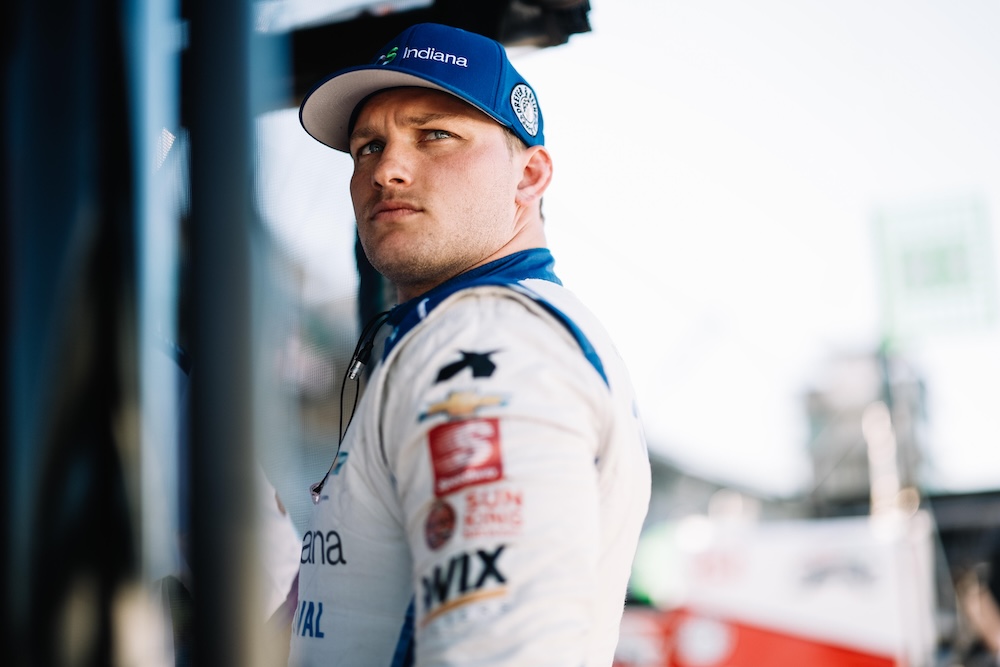
Joe Skibinski/Getty Images
The 2015 Pocono tragedy sent Sage Karam spiralling into depression. Now, he wants others to learn from his journey
Sage Karam runs a landscaping business. He dabbles in real estate. He still races cars on the occasions someone gives him the opportunity, which in recent times have usually come through NASCAR’s O’Reilly Series.
“Since I’m not full-time in racing, it’s kind of about trying to figure out things to do with my time,” he tells RACER.
If he had his way, he’d be at Indianapolis Motor Speedway this month chasing his 10th Indy 500 start, but rising budgets, he says, have priced him out. On the whole though, Karam is doing OK. And that’s a big deal, because for a long time, he wasn’t.
Karam strutted into IndyCar in 2015 as a 20-year-old with a stellar resume in junior racing, a reputation for being a bit intense, and a ton of potential. His rookie ‘season’ wasn’t actually a full season, as he shared the seat with Sebastian Saavedra. But it was a car run by Chip Ganassi Racing, and even with a not-quite-full-time program, it was a heck of an opportunity.
The first part of the season brought about what you’d expect: flashes of speed and promise, punctuated by ‘learning experiences’; some of his own doing, some not. But by the time the series arrived at Pocono for the penultimate round of the season, it looked like things were starting to come together.
Pocono was going to be Karam’s last scheduled start for the year before handing the car over to Saavedra for the finale at Sonoma the following week. The Pocono race is remembered with immense sadness today, but had it not been marred by tragedy, it probably would have been remembered for its absurdity: its final tally of 12 cautions and 33 lead changes tells a lot of the story.
All that attrition and diverging strategies throughout the day had shaken out to where Karam was able to pass Takuma Sato for the lead with 25 laps to go. Four laps later, as he exited Turn 1, the car broke loose, snapped up into the outside wall then ricocheted off the barriers, flinging debris down the road behind him.
Twelve positions further back, Justin Wilson was entering the corner just as the yellows began to wave. He popped out, seemingly to avoid the slowing car in front, and was struck in the helmet by an airborne section of Karam’s nosecone. Wilson’s car slid to the left and slammed head-on into the inside wall.
The gravity of some serious accidents is apparent right after the moment of impact, but anyone watching from afar could have been forgiven for not immediately recognizing this one. The TV cameras were primarily focused on Karam’s car – as you’d expect, given he’d been leading when he crashed – and Wilson was so much further back down the road that the helmet strike was difficult to spot when watching in real time. It just looked like he’d had some sort of accident of his own.
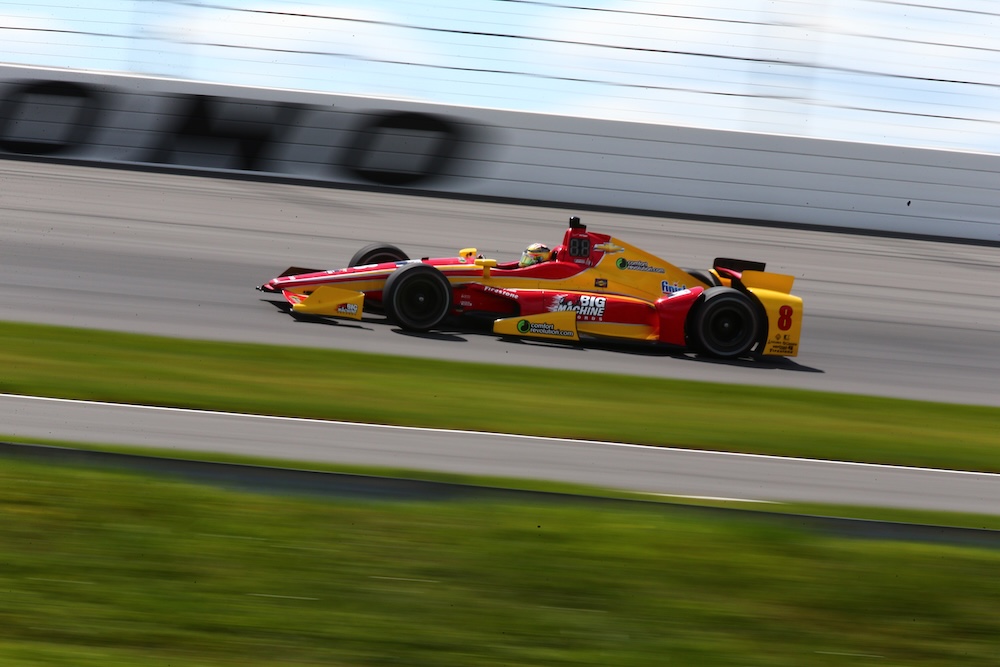
Karam during the 2015 Pocono weekend. Penske Entertainment
Karam was helped out of his cockpit and sat on the side of the car, shaken, sore and winded. Behind him, a few safety personnel began to assemble around Wilson’s wreckage. Then a few more. Each time the TV cameras showed the safety car escorting the field through the first corner, there were more emergency vehicles on scene.
The next part of the story is well-known. Wilson sustained massive head injuries when the bodywork hit his helmet, never regained consciousness, and died a few days later. The impact that killed him was freakishly random; a terrible, one in a thousand outcome produced by dozens of tiny factors aligning in the worst possible way. Karam’s crash, which was the first event in the chain, was no different to similar impacts that occur at some point during most oval race weekends, and end with nothing more serious than a bummed-out interview outside the medical center.
Wilson’s death was an immense loss by every possible measure. He was a beloved husband to his wife Julia, a doting father to his two daughters Jess and Jane, mentor and cheerleader to his brother and fellow racer Stefan, and one of the few people in the sport about whom one genuinely never heard a bad word said. Any time at all spent with Wilson was time well-spent, and more than a decade later, his absence is still acutely felt by those who knew him.
And fans that didn’t have the opportunity to know him personally were robbed of perhaps the only guy who could pull off the nickname ‘Badass’ both as a compliment and an irony simultaneously. He was fast, but he was also one of the least pretentious, most grounded people ever to zip up a firesuit.
While the sport grieved Wilson, Karam was trying to process his own feelings of guilt and grief.
“I went to Sonoma (the week after Pocono), and I was obviously not feeling great,” Karam tells RACER. “I was very out of it and emotional, but I knew I had to be there, and I wanted to support the team. And I'm glad I did, but at the end of the day, I probably wasn't near ready to be in the public eye of the racing world.”
There’s no manual for how to respond to a situation like the one Karam found himself in, where a fairly unremarkable error in a race car – one that several other drivers had already made earlier in that same race – fated him to be forever associated with the death of someone else. It would be a heavy burden for anyone, never mind somebody barely out of their teens.
“I wanted to reach out to the (Wilson) family, but it was still way too early,” Karam says. “I knew Stef, and he knew I would be struggling with this, and he reached out to me and that was big. But I felt at the time that if the family ever wanted to reach out and talk to me, that would be on their terms. It was never going to be on my terms. I was never going to force a conversation on to them.
“So I accepted that quite early. But also, I was so young at that time – I didn’t know right from wrong in those types of situations. And I didn't have a lot of answers. I just wanted answers that really nobody had.”
Mark Glendenning
During his long career in racing, Mark has been placed into a headlock by a multiple grand prix winner, escaped a burning GT car, ridden a Ferris wheel with Ari Vatanen and almost navigated a rally car into a pond. He’s also had the good fortune to have reported on hundreds of races around the world, first while working for a national publication in his native Australia, and later during his years with Autosport in the UK. He moved to the U.S. in 2012, and after a serving as a contributor to RACER he joined the publication full-time in 2015. Mark now serves as Editor of RACER.com, and is also involved in the production of the magazine.
Read Mark Glendenning's articles
Latest News
Comments
Comments are disabled until you accept Social Networking Cookies. Update cookie preferences
If the dialog doesn't appear, ad-blockers are often the cause; try disabling yours or see our Social Features Support.