MILLER: F1 champions at the Speedway
Fernando Alonso is the 15th world champion to take on the Indianapolis Motor Speedway, and he's got history on his side. Formula 1's elite has fared well at 16th & Georgetown.
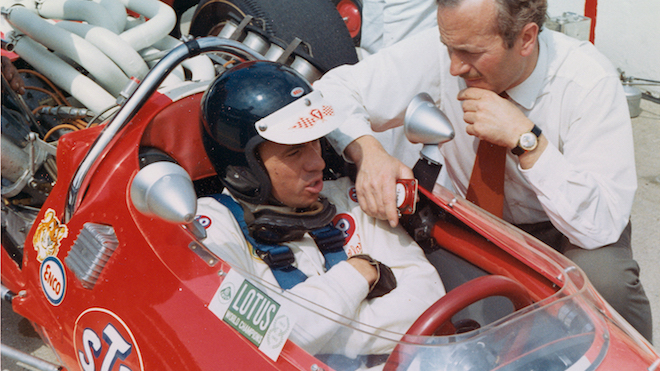
Jim Clark (ABOVE, in 1966), Graham Hill, Mario Andretti, Emerson Fittipaldi and Jacques Villeneuve all made it to Victory Lane, while Jackie Stewart and Nigel Mansell came oh-so-close: F1 drivers in general have adapted quickly to the speed, the walls and turning left all day.
Andretti had already become a household name in the USA and Indy winner when he scored his F1 title in 1978, but he's got a theory as to why those great road racers do so well on ovals.
"It's a lot easier to adapt to ovals than road racing," said Andretti, who watched teammate Mansell win four times on ovals in his rookie season. "There's so much more work to do in road racing, you have to figure out gearing and braking and technique.
"And good road racers are use to high-speed corners – and Indianapolis has four of them."
Of course, it didn't start out so promisingly when Alberto Ascari, Giuseppe Farina and Juan Manuel Fangio led the first wave in the 1950s. Ascari came to Indianapolis as a 44-year-old rookie in 1952, the same year he would win the first of his back-to-back championships with Ferrari – which itself mounted a four-car assault at the Speedway. It was supposed to be five, but 1950 titlist Farina had crashed his car a few weeks before competing in the non-championship Valentino Grand Prix in Turin, Italy.
The bright red Ferraris were assigned to 1950 Indy winner Johnnie Parsons, Bobby Ball and Johnny Mauro, but only Ascari made the show after J.P. bailed early in the month when he realized that the car wasn't up to snuff. Walt Faulkner took over Parsons' ride and instantly said: "This car has no chance of winning," before quitting.
But, despite the fact the Ferrari sported a four-speed gearbox (compared to two for everyone else in Gasoline Alley), was woefully shy of low-end torque and was excessively heavy, Ascari qualified 19th. He got up as high as eighth in the race before a wheel failed and he spun out, eventually being awarded 31st place.
Farina was 49 when he returned in 1955 and passed his rookie test, but didn't qualify. He returned in 1956 but was again was unsuccessful because his engine didn't have the ponies.
The most anticipated rookie was Fangio, the five-time world champion who came to the Speedway in 1958 at the age of 46. As the story goes, he was goaded into coming to IMS by Floyd Clymer, whose Indy 500 yearbooks became legendary. Clymer was miffed because Fangio chose not to participate in the 1957 War of the Worlds at Monza, which pitted American IndyCar drivers against F1 pilots.
Clymer reportedly offered Fangio a $9,000 carrot – $500 for entering, $1,000 if he qualified, $2,500 if he ran in the Top 5 in an American car and $5,000 if he ran in the Top 5 in a foreign-built car. Fangio accepted, and said he would donate whatever he won to charity.
Wheeling George Walther's Kurtis/Offy, Fangio breezed through his rookie test, survived a quick spin and reached 142 mph (it took 142.5 to qualify that May) in practice before abruptly leaving. According to a story in The Indianapolis News, Fangio felt "the car is not in the optimum condition to permit him to uphold his reputation as a word champion race driver". He also cited complications involving a fuel contract.
Two months later, The Maestro retired from competition.
In 1961, Jack Brabham (coming off back-to-back F1 championships in 1959-60) created some mild amusement among the Gasoline Alley regulars when he qualified an under-horsepowered but smooth-handling rear-engined Cooper and finished ninth.
Two years later, Colin Chapman, Lotus, Ford, Clark and Gurney descended upon the Speedway and began digging the grave for the front-engine roadsters. Clark was second in '63, on the pole in '64 and put the Lotus/Ford in the Winner's Circle in '65 – followed by Hill's triumph in 1966 in a rear-engine Lola/Ford. Stewart was leading with nine laps to go when his Lola/Ford lost oil pressure.
Fittipaldi, a two-time F1 champion, had retired following his dismal years with Copersucar, made a comeback at age 39 in CART race in 1984, and captured the Michigan 500 in only his seventh start on an oval in '85.
"I listened to Bill Vukovich on the radio as a boy and I never imagined I'd run at Indianapolis some day, but there was something about ovals that fit my style," said Fittipaldi, who earned his initial Indy victory in a stirring, slam-bang duel to the finish with Al Unser Jr. in 1989. Emmo won again in 1993, but only because '92 world champ Mansell didn't have much experience at restarting on ovals and got snookered.
"It was my fault, I didn't get an early enough jump and those two (Fittipaldi and Arie Luyendyk) just blew right by, so it's on me," said Mansell (RIGHT), who led 34 laps and was comfortably out in front before a caution set up his fateful restart with 15 laps remaining.
Mansell, who turned his back on F1 to join Newman/Haas full-time for the 1993 CART campaign, took the title on the strength of his four oval-track wins at Milwaukee, Michigan, Loudon and Nazareth. Fittipaldi also dominated the '94 race (leading 145 laps) and was trying to lap second place when he crashed on Lap 185.
Meanwhile, one of Mansell's Formula 1 sparring partners attempted to take that rivalry across to the Speedway when three-time world champion Nelson Piquet turned up to race at the 500 in 1992 with Menard. His speed was good, but that didn't count for much when he jumped out of the throttle exiting Turn 4 and crashed into the wall. He returned in 1993 and qualified 13th, but dropped out early on with an engine problem.
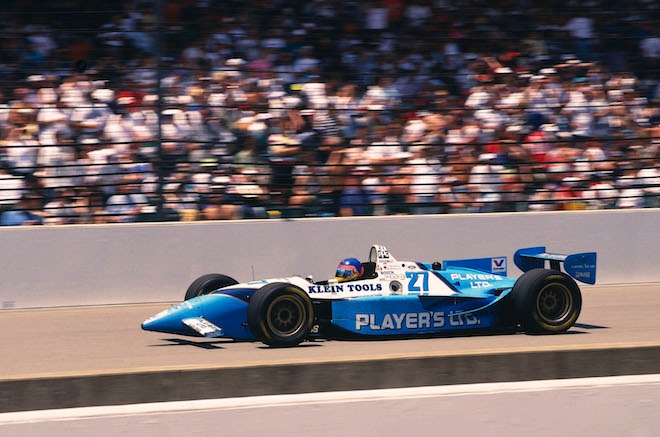
In 1995, second-generation star Villeneuve (BELOW) came from two laps down to put his face on the Borg-Warner Trophy and claimed the CART crown that same season before heading to F1 where he won the world championship in 1997.
Juan Pablo Montoya, who won the CART title in 1999 and 2000 Indy 500 before heading to F1 where he won seven grands prix, believes the latest F1 champ will adapt to the hype, close running and insane restarts.
"Fernando is very talented and smart," said Montoya, a now-two-time Indy winner who is back this month looking for number three. "He'll be just fine."

Latest News
Comments
Comments are disabled until you accept Social Networking Cookies. Update cookie preferences
If the dialog doesn't appear, ad-blockers are often the cause; try disabling yours or see our Social Features Support.