MEDLAND: Headaches and headlines of F1 testing
The way to make headlines during pre-season testing is by hiding things. Sometimes the car's pace, sometimes the car itself.
The latter has been a sure-fire winner for McLaren during the final week in Barcelona, as problems with the Honda power unit resulted in very little running throughout pre-season. With each passing day the tension increased within the team, peaking with two stoppages in half an hour for Fernando Alonso on the final morning.
Alonso didn't speak after his final day in the car – he wasn't scheduled to – but his comments after the second day spoke volumes about the growing divide between the two partners. Alonso admitted at the launch of the car that adopting a new power unit concept was "risky" but a move Honda had to make. By the second test, that message had long been forgotten as the Spaniard started to take a very much 'us and them' approach.
McLaren was promised a much more competitive power unit, and on that front Honda has failed to deliver. The problem is magnified by the progress made by the other power unit manufacturers in the pit lane, with Mercedes continuing to push the envelope, Ferrari looking strong and Renault also moving forward. One team source even described the lap times being set by the front-runners as "a different category" compared to McLaren earlier in the week.
Honda has not been alone in facing reliability issues, but the biggest problem is a lack of understanding as to why the failures have occurred. There were no signs of weaknesses on the dyno, and the Japanese manufacturer has been caught off-guard.
"Everything that has happened has not been seen on the dyno, I believe," Honda's head of F1 project Yusuke Hasegawa told RACER on the final day of testing. "Especially the day two issue and this week's day one issue; we didn't expect such a problem."
The same cannot be said for Renault, with an ERS weakness being flagged up before testing began and materializing over the last two weeks. Armed with knowledge of the situation, Renault was able to begin work early on putting a fix in place and restricting performance to give it a better chance of decent mileage.
Referencing its ERS problems, Renault says "work is in progress to reach an appropriate reliability level for Australian GP." The big question now is whether "appropriate" reliability will allow full performance to be extracted in Melbourne.
Another area where the two differ is Renault's ability to run multiple solutions on track. With two customer teams as well as the works team, Renault had three cars per day supplying information. Honda, by contrast, only has McLaren, so when the car stops there is no more data being gained from the circuit.
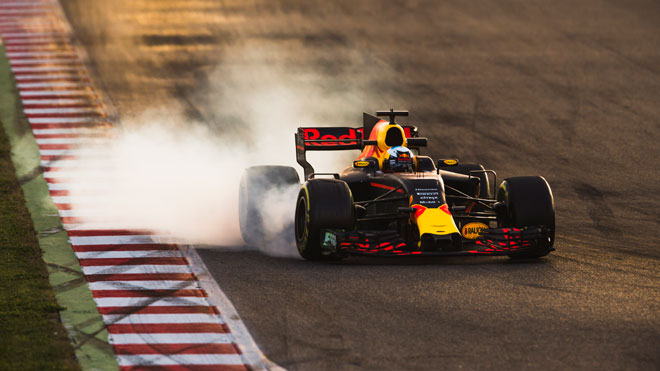
Christian Horner told RACER the Renault power unit's reliability problems are also easier to stomach because the gains in outright performance are at the level the team had been expecting.
"I think we can see drivability is greatly improved, performance looks like a step in the right direction on plan with what was promised," Horner said. "The rest of it is tidying up, which I'm confident that they will manage."
Despite Horner's confidence, there was no headline lap time from Red Bull to quell a growing feeling that Ferrari has stolen a march at this stage of the year. The Red Bull concept is very different to the one employed by the Scuderia and Horner has faith in his team's development plan, but Ferrari's performance throughout the second test has only cemented the belief inside the paddock that it has a good car.
I was reserving judgement on the SF70H at the end of the first week, having seen a similar story unfold throughout previous winter testing programs. But when Ferrari started sandbagging on the penultimate day – hiding the full lap time it was capable of when on qualifying simulations – it was a sign the Italian team is confident about its outright pace. With Sebastian Vettel lifting off at the end of each of his flying laps that were due to be in the 1m18s, the team was barely masking its potential, and was fully aware its rivals would know it was capable of more.
A lunchtime chat on the final day with a number of other F1 journalists revealed a common theme. People want to believe Ferrari is genuinely on the same level as Mercedes, but the exact same feeling struck last year. The longer testing went on, the more everyone convinced themselves, only to find it wasn't the case when racing got underway. This year the Scuderia is making an even more compelling argument...
Last season the two Ferrari drivers boasted the fastest headline lap times, but the gap back to Mercedes was just 0.257s. At that point, little had been seen of the world champions on the soft-compound tires, but this year both Ferrari and Mercedes used the supersofts for their quickest laps and the gap was 0.676s. After posting a 1m18.634s on Friday with more than the minimum amount of fuel in the car, Kimi Raikkonen insisted the team "for sure can go faster" than his best time.
Added to that, on the penultimate day Lewis Hamilton said: "I think Ferrari are bluffing and that they are a lot quicker than they are showing. They're very close to us. It's difficult right now to say exactly who is quicker. But they are very close, if not faster."
Such has been the dominance of the Silver Arrows in the V6 era that even a deficit of over half a second does not appear representative or insurmountable. But with Hamilton using ultrasoft tires on the final afternoon and saying he couldn't have gone quicker without changing settings and fuel loads, Mercedes will have needed to hide a heck of a lot of pace to maintain a clear advantage this season.
Hamilton's quotes were initially taken with a pinch of salt as the title favorite looks to deflect attention from himself, but Friday's performances increased the level of uncertainty surrounding the W08's true pace. At the very least it appears Mercedes has a rival closer than it has ever experienced since the start of 2014.
Add in a tight midfield featuring at least Williams, Renault, Toro Rosso and Haas, as well as the Honda question marks and a slightly unconvincing Force India, and testing has thrown up plenty to ponder when it comes to just how 2017 is going to shake out. We'll start getting some answers to those questions in Melbourne.
Presented by:


Latest News

Comments
Comments are disabled until you accept Social Networking Cookies. Update cookie preferences
If the dialog doesn't appear, ad-blockers are often the cause; try disabling yours or see our Social Features Support.