New-look F3 car to be faster and safer, FIA says
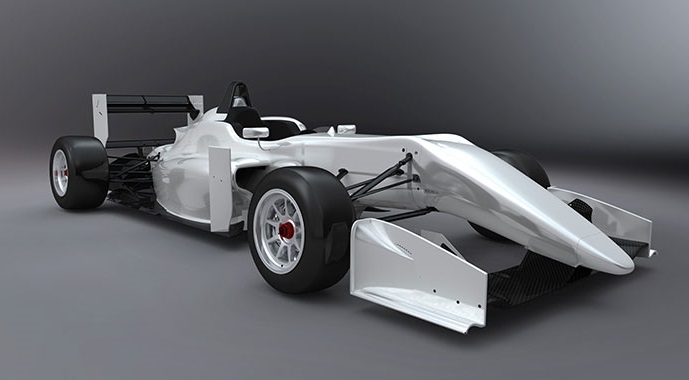
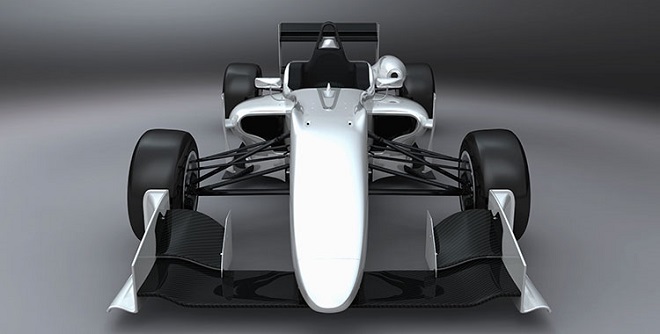
The FIA has detailed design updates to the chassis for the FIA Formula 3 European Championship for the coming season. For 2017 safety and performance upgrades have been implemented which will visibly change the appearance of the racecars.
In accordance with the extension of the homologation period to 2019, the FIA has introduced updated safety standards including latest FIA Formula 1 safety developments. The nose has been lowered, minimizing the risk of a car getting airborne when hitting a rear tire of another car while having the added benefit of a more aggressive F1-style appearance. The front impact structure has been updated, which results in an increase of the impact energy absorption by about 25 percent.
In line with F1 safety regulations, additional secondary U-shaped intrusion panels (Zylon panels) have been added to the sides and bottom area on the front of the car to increase stability. The survival cell of the monocoque has been fitted with additional padding to protect drivers' legs. In addition, wheel tethers have been upgraded to sustain forces of up to 6kJ instead of 4kJ, to further minimize the risk of wheels getting detached from the chassis in case of a crash.
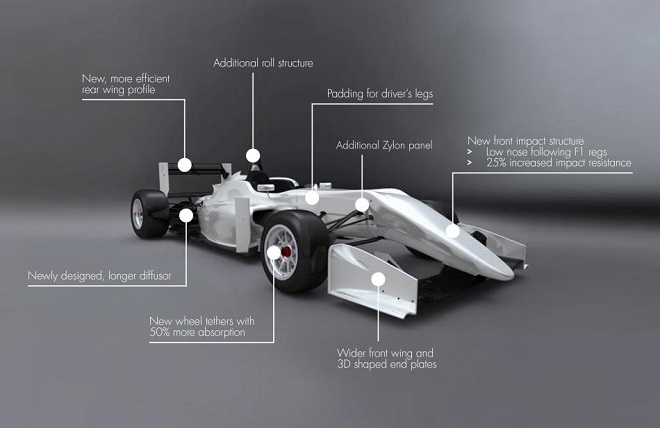
The 2017 safety upgrades follow safety improvements to the roll hoop which have already been implemented in the previous season, adding an additional carbon-aluminium structure to protect the heads of drivers in case of roll-over incidents.
Simultaneously, the regulations have been amended for aerodynamic parts which should enhance the performance of the car. The performance upgrades include new front wing endplates and outer front wing flaps for increased aerodynamic performance. The changes are mirrored in the rear wing with adjusted rear wing end plates and wing profiles to retain the car's balance. In addition, an extended diffuser size will result in increased downforce and reduced drag, hence improving the aerodynamic efficiency of the car.
Regarding the current situation of the FIA F3 field, Domenicali said: "In 2016 we took the important decision to introduce limits to the number of entries in order to avoid the troubles we sometimes had in the previous year when there were up to 37 participants in a single event. This made management really difficult and was detrimental not only to the show, but also to the environment that the drivers need to make the best out of their experience in the category. With a more selective grid, it naturally increases the level of quality of the drivers.
"This happened in coincidence with a difficult moment for all the young categories, as the numbers confirm: while in 2015 the cumulative number of drivers racing in F3, Formula Renault and GP3 was 87, it decreased to 70 in 2016, 22 of which as an average raced in our championship. In this climate, I believe FIA F3 has emerged as the strongest package for drivers moving up the single-seater pyramid. This year, it looks like we may have a slightly higher number of competitors, allowing us to reach the self-imposed limit which we feel is the optimum balance between quality and quantity."
Gerhard Berger, Domenicali's predecessor as Single-Seater Commission president, expresseed his support for the way the series is heading.
"2017 looks like it will be a great year for F3," said the former F1 star. "There are a lot of very talented young drivers coming in, and they will face a tough challenge from the more experienced guys. The racing last season was really close but for the most part it was clean and fair. That's the environment we should be encouraging, and to see the updates to the car for this year and the efforts to cut costs, it should make things even better."

Latest News

Comments
Comments are disabled until you accept Social Networking Cookies. Update cookie preferences
If the dialog doesn't appear, ad-blockers are often the cause; try disabling yours or see our Social Features Support.