Porsche unveils its most affordable competition car: the 911 Challenge
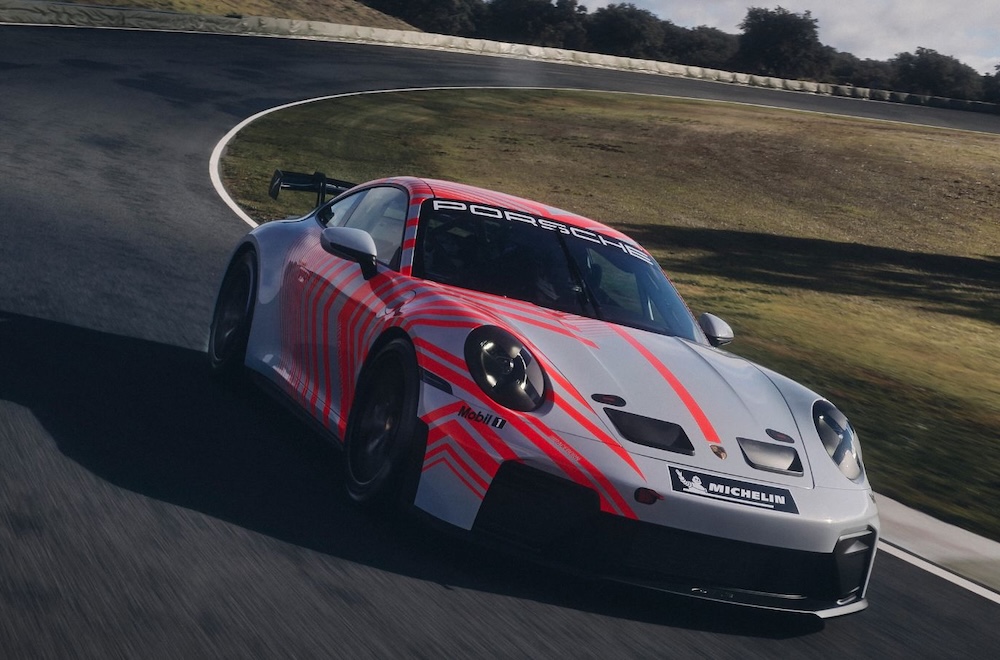
Porsche is expanding its customer racing line-up for 2027 with the new 911 Challenge, a near-production competition car based heavily on the current 911 GT3 and designed to provide an entry point into professional motorsport.
The new model combines production-based technology with motorsport safety equipment and racing-focused driving dynamics systems. Porsche says the structure for operating and spare parts costs has also been developed specifically for the car.
The track-only 911 Challenge joins the 911 GT4 R, 911 Cup and 911 GT3 R as the first rung on the brand's four-car GT racing ladder. It succeeds the original Cayman GT4 Clubsport, and the more recent 718 Cayman GT4 RS Clubsport.
Unlike the 911 Cup racing car unveiled in August 2025, the Challenge makes significant use of production-based GT3 technology. This includes its aerodynamics, seven-speed PDK gearbox, GT3 RS steering wheel with enhanced racing-specific functions and air conditioning.
Adjustable driver assistance systems including ABS, traction control and Electronic Stability Control (ESC) are intended to make the car more accessible to drivers starting out in motorsport, while variable driving dynamics systems include the multi-stage adjustable Porsche Torque Vectoring Plus (PTV+).
Porsche Motorsport's vice president Thomas Laudenbach said the 911 Challenge can be entered in numerous one-make series worldwide from the 2027 season onwards. Specifically in the U.S., it will be eligible to compete in Porsche Sprint Challenge North America, Porsche Endurance Challenge North America, Porsche Sprint Trophy Porsche Club of America and Porsche Sprint Trophy Porsche Owners Club.
“Since their introduction, the GT3 models have shaped Porsche’s identity as a sports car manufacturer like almost no other model range. They are conceived and developed in close collaboration with motorsport,” he said. “With the 911 Challenge, this tradition is being expanded to include a model that allows new customer groups to experience the thrill of motorsport in a 911.“
Michael Dreiser, the head of sales at Porsche Motorsport, said the car brings the driving experience of the road-legal 911 GT3 into customer racing “more directly than ever before.”
“Drivers can get to grips with it without a long learning curve and can complete their first kilometres on the racetrack in a familiar vehicle design,” he said. “We are following a principle here that dates back to the 1960s: our customers receive a race-ready car complete with motorsport safety technology, data acquisition, spare parts support and technical documentation.”
The 911 Challenge retains the 4.0-litre six-cylinder boxer engine largely derived from the production GT3, delivering 379 kW (515 PS) at 8,500 revolutions per minute, with maximum engine speed set at 9,000 rpm.
The modified rear silencer features a catalytic converter in the racing version, but does not require a particulate filter.
Drive is sent through a seven-speed dual-clutch PDK gearbox, as used by the production car. Automatic or manual gear changes via steering-wheel paddles remain available.
The chassis combines production-derived technology with racing components, including items from the 911 Cup. The shock absorbers feature a motorsport-specific characteristic curve, while the standard anti-roll bar is adjustable in three positions.
Treadless racing slicks are mounted on 18-inch wheels using the standard five-hole mounting pattern, following the approach of the recently-unveiled 911 GT4 R.
The racing brake system uses steel brake discs measuring 380 mm in diameter at the front and rear, with the braking technology corresponding to that used by the GT4 R.
The dimensions of the 911 Challenge are identical to those of the GT3, with all key body components also retained.
An integrated air-jack system with three jacks is standard, while a FIA-certified rain light is fitted at the rear. The bonnet uses integrated quick-release fasteners, and the rear wing can be mechanically adjusted through four different angles.
The cockpit is stripped of the equipment required for road use, with all sound-deadening materials, carpets and trim removed.
A welded-in roll cage reinforces the structure and provides driver protection in a collision. Further safety equipment includes a 110-litre FT3 fuel tank, an adjustable racing bucket seat with a six-point harness, and a fire-extinguishing system.
As a package, it's Porsche's most affordable competition car, aimed at both racing novices and experienced competitors, coming in at $275,000 including import fees.

Stephen Kilbey
UK-based Stephen Kilbey is RACER.com's FIA World Endurance Championship correspondent, and is also Deputy Editor of Dailysportscar.com He has a first-class honours degree in Sports Journalism and is a previous winner of the UK Guild of Motoring Writers Sir William Lyons Award.
Read Stephen Kilbey's articles
Latest News
Comments
Comments are disabled until you accept Social Networking Cookies. Update cookie preferences
If the dialog doesn't appear, ad-blockers are often the cause; try disabling yours or see our Social Features Support.