PWC: CEO Greg Gill on 2017, big picture questions
Pirelli World Challenge series posted its tentative schedule, race format, and class structure plans
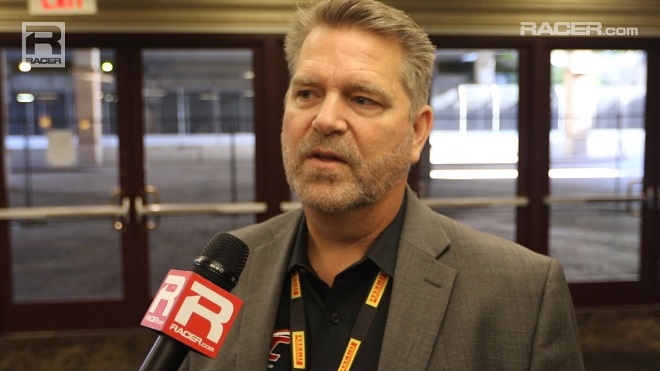
, and with a bit of confusion regarding some aspects of that news release during the Mid-Ohio weekend, RACER spoke with PWC CEO Greg Gill to get a progress report on the final plans for 2017.RACER: The series presented its paddock with a lot of information at Mid-Ohio which led to even more questions about what's in store next year. At the time, you said further discussions would take place with team owners and manufacturers to finalize the schedule, to decide how many events would be run under the standard sprint race format, how many would fall under the SprintX mini-endurance format, and so on. How have those talks evolved in the last four or five weeks?
I think the big question that has been out there is are we going to be going back to Sonoma with IndyCar in 2017, and where would our August TBD date be run? There's still not a firm update on that. We have heard about the Utah Motorsports Campus, that they hope to have their confirmation in the next few weeks. If that happens then that is our August date. While we are at Sonoma for this year's event, we hope to have a finalization and that announcement on joining the IndyCar weekend for the Pirelli World Challenge race. That will be the carry-over items for that Mid-Ohio weekend.
One of the other items we have been working on for SprintX is evaluating exactly how points are earned. That will be discussed when we get to Sonoma. Manufacturer points, driver points, do we allow tire changes? There's a lot of very basic information that has not been discussed at all that we plan to release at Sonoma and give the teams.
Again, nothing is set in stone, but everything else here is what we are working on. We are obviously five months before the green flag drops in St. Petersburg, so we do have time. And we want to make sure that everybody is included as we go through this process.
RACER: As it was presented at Mid-Ohio, half of the events next year would be standard and the other half SprintX. Are you still looking at that 50/50 split? And how has the full onboarding of the GT4 class, and TCR a year later, been coming along?
GILL: It would be five Sprint weekends with IndyCar and then five SprintX weekends on our headliner weekends. That is still what we are operating with, and it is subject to change, if the market dictates differently, but that is what we are operating under right now.
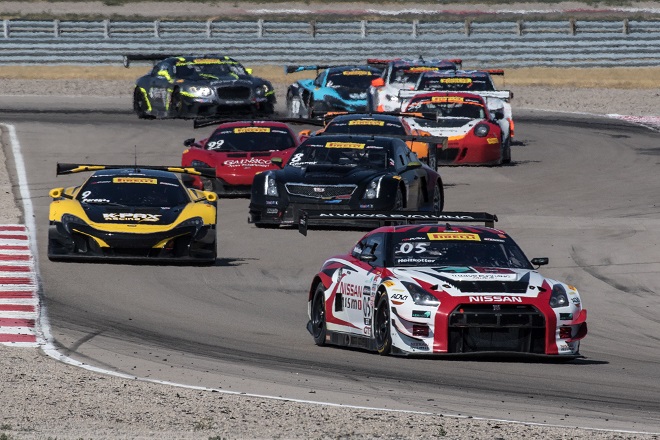
The GTS class, which is becoming all run under GT4 specification, that has been exciting to see. We've certainly heard that Chevrolet is coming in with a GT4 product, we have heard the same thing from Ford, although I don't think any formal announcements have been made. But we have heard of different European manufacturers adding GT4 cars. And we see tremendous growth there for next year. We are really excited about it. It comes down to what manufacturers are able to get cars done and homologated and when we will see what St. Pete brings us, but I'm really looking forward to that, it's going to be some of the most exciting racing.
The other aspect you mentioned, TCR, that has been an ongoing discussion. A really critical issue to us is that we think TCR is a great opportunity but we want to make sure that manufacturers have cars in the States, and cars are available and parts are available. Again, the response of the paddock has been good.
We put together a plan that Jim Jordan worked on to bring out what our plan was for the touring class and showing an evolution into TCR. That will, again, depend on how the manufacturers get engaged and what they bring to market. Early indications are that they are excited for 2018 and we could potentially some races in 2017, a demo at least.
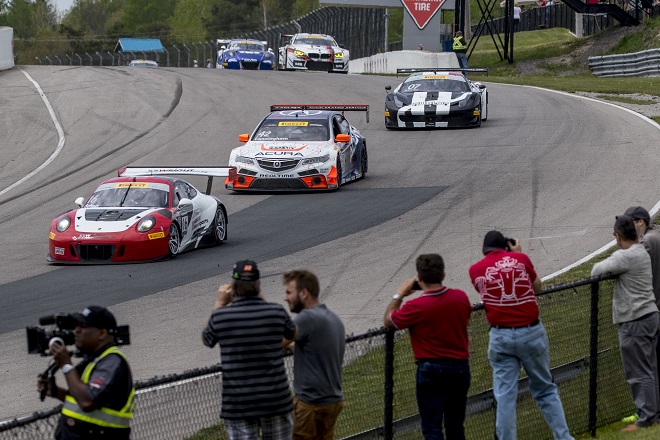
GILL: Let's talk about the genesis behind that. You mentioned about banging the drum. Really, we do want to do that in some senses. Based on what we have always said, we are focused on our customers. Our customers are the ones that brought us GT3. First you had Marcus Haselgrove in the paddock and now he is here as a series official, and at the time Geoff Carter, who is now at IMSA, pushed for it which was very forward thinking and my predecessor agreed to it. And there we were.
We were excited, we knew we were adopting something new. I started on the job right at the time that decision was made and we had just done a demo run at Sonoma. But you have to think about that in context. In 2013 at our championship race, we had six cars in the GT class.
Let's remember, when we made those decisions, we were the first. And when you are the first in your category it is always challenging and you have to take some arrows and take some chances. But that has been our focus because we have always wanted to be there for our customers and address what they have as a need and interest.
That turned out to be a very good decision for us. GT4, it is important to note that even though it has been announced and discussed, we have been racing GT4 cars all year and we've been telling people all year that GT4 is in Pirelli World Challenge now. I think that is a key point.
Each time it comes out as a slightly different nuance. The GT3 platform was something that came under homologation from the FIA. GT4 is coming under homologation from the SRO. Each time there's different areas to respond to client needs. Especially when you compare GT4 and GT3, there's a huge cost to implementation.
ABOVE: Acura NSX GT3
RACER: It won't be lost on sportscar fans that we'll soon have GT3, GT4, and TCR-based classes in PWC and in IMSA. Outside of IMSA's endurance format and PWC's sprint format, does sharing GT3/GT4/TCR formulas provide both sides with enough differentiation in the marketplace? Will the class crossover help or hinder growth?
GILL: To answer your bigger-picture question, and to come back to the TCR angle of the question, how does that work in the American marketplace? Oh my goodness, wouldn't it be better if someone decided to just run cars without a global homologation and that be a differentiation point for them. That is certainly an interesting question.
When we thought about that, we looked at it from the complexity issue of today's vehicle dynamics and cost, and determined these GT3/GT4/TCR platforms are more cost-effective, especially when you look at TCR, to bring that into the loop now. You could very quickly have people come to us, both manufactures and teams, saying that if you do not stop the escalation in TC we were going to have several hundred-thousand-dollar TC cars. That does not work for our customer model, so we look at TCR as a new alternative that has much more affordable price point.
When the competitive dynamic comes out between racing series, there is such a difference in strategy, in fans, in time of watching between an endurance race versus a sprint race, that it's apples and oranges.
Another key differentiator is that we keep our GT4 cars separate from the GT3 cars so the fans know exactly what they are seeing and the television broadcast gives you the benefit of separate coverage.
When you have both classes together – which we had for many, many years – that becomes more of a challenge for the broadcasters and the people covering it to be able to give each class its due time. It's like the prototype cars in the endurance race are the main parts of the story and they're going to try to cover all the other classes equally, but how can you do that? It becomes a little more challenging.
Back to the original question, we see people coming out of drag racing, coming out of IndyCar and they come over and they're watching sportscar racing, and I think that benefits all of us. If people enjoy sportscar racing, that's what really matters. Having a common platform with [IMSA] with GT3, GT4, TCR, I think is good for the industry and good for the sport.

Latest News
Comments
Comments are disabled until you accept Social Networking Cookies. Update cookie preferences
If the dialog doesn't appear, ad-blockers are often the cause; try disabling yours or see our Social Features Support.