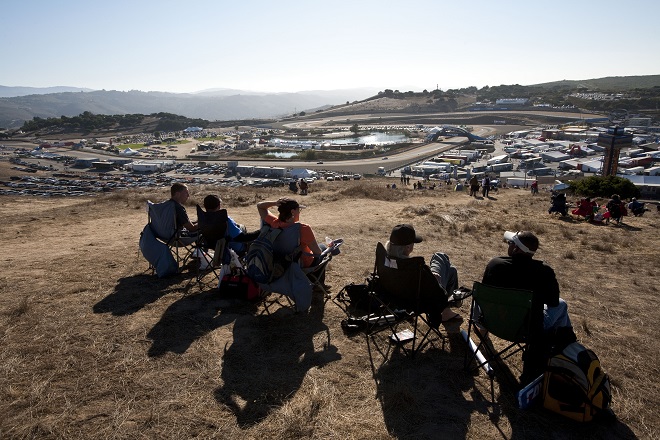
PRUETT: End game in the battle for Laguna Seca
The battle for control over Mazda Raceway Laguna Seca read like a poorly-written high school play when it came to light last year. Old grudges, new backstabbing, and general hostilities pierced the illusion of serenity and stability at the famed coastal circuit, and while the situation has steadily improved over the last 12 months, one truth remains unchanged: Laguna Seca, as we know it, is flirting with extinction.
Faced with pulling the plug or preventing its closure, Monterey County – owners of the 59-year-old road course that lives within a public park – and its board of supervisors have rallied and made a number of smart decisions aimed at revitalizing the weathered property. That's the good part. It has also taken a better approach to finding a new or improved external management team to run Laguna Seca, and that's another positive.
Now the real work to keep the facility from becoming a fading memory begins.
Friday, Aug. 26 marked the final day of jockeying for the groups that want to become the long-term stewards of Laguna Seca. The "Request For Service Proposals" (RFSP) documents containing their respective plans to lead the circuit out of its dilapidated physical and financial state and into the light were due by the end of the day, and based on the timeline set forth by the county, a winner (or winners) of the Laguna Seca Lottery will be chosen at some point in September.
Like most of the ongoing saga with the property, history plays a significant role in its present and future, and for that reason alone, it's worth rewinding the clock to run through the messy situation from 2015 because it continues to have an immense influence on where the track is heading, and whether it will survive.

Last year, Monterey County and its board (a mixed panel of elected and appointed officials) reached its breaking point with the non-profit Sports Car Racing Association of the Monterey Peninsula (SCRAMP) organization.
Citing numerous issues with SCRAMP--the circuit's one and only management firm since the facility opened in 1957, the board craved a return to the days when Laguna Seca produced meaningful income for the county. Frustrated by the situation, the board embarked on a secret mission to find a new management solution, SCRAMP eventually found out, a war of words ensued, and the relationship started an ugly march toward divorce court.
Once the details began to emerge, we learned that Monterey asked International Speedway Corporation (ISC) – part of NASCAR's for-profit empire – to consider replacing SCRAMP. There's no question SCRAMP was delivering well below the county's expectations, but locally, the covert efforts to ditch its deeply-entrenched track managers for a monolith like ISC gave the impression the board skipped past negotiating a cease fire and went straight for the nuclear option. It also revealed the massive divide that stood between the board and SCRAMP. In the court of public opinion, the take-no-prisoners tactic left the county looking small and petty.
In its defense, the county's interest in ISC wasn't misguided or ill-considered. With more than a dozen major circuits under its ownership umbrella, ISC's name stands above all others in the track management business. Asked by the board to determine whether it could increase the limited profits SCRAMP was generating from the track, make wholesale facility upgrades to the aged property, and restore Laguna Seca's diminished presence in the industry, ISC obliged and went through its due diligence process to assess whether those needs could be met.
With full recognition of the board's ham-fisted efforts to engage NASCAR, SCRAMP wasted no time in pointing out the county's version of trying to run a 59-year-old mom'n'pop store out of town to make way for Walmart. It followed that up with a "Keep Laguna Seca Local" PR campaign to call attention to the county's wandering eye.
Whether it was based on its findings while reviewing the track's financials, SCRAMP's embarrassing anti-NASCAR PR initiative, or a combination of the two, ISC stepped away from the warring Monterey natives and booked a one-way ticket back home to Daytona Beach.
Monterey's board, caught in a domestic spat that went public, was forced to reconcile with SCRAMP in order to complete the 2015 season and begin planning for (and through) 2016.
Knives were sheathed, the nuclear codes were locked away, and a new, short-term agreement was drafted between the county and SCRAMP to ensure the doors remained open and business went ahead without interruption.
FAST FORWARD
That brings us to today, and Laguna Seca's new reality. Changes are coming, but will those changes return the circuit to its former state of prominence and prosperity?
Monterey is pinning its hopes on whoever wins the next concession contract to transform the facility on its behalf. It means the board's continued practice of sub-contracting the management of Laguna Seca leaves no room for mistakes when a selection is made in September.
Plenty has been written over the last month about the three groups that have emerged as the primary candidates to gain control of Laguna Seca, and it's believed two main contenders have been identified. To start, in the mother of all plot twists, SCRAMP has joined forces with ISC in a bid to hold onto the circuit for its 60th year and beyond.
Even if it's chosen by the county to continue as its service provider, SCRAMP, as a standalone management entity with hundreds of volunteers, will lose sole control of the circuit with ISC in the frame. One way or the other, decades of SCRAMP's steady presence will change when the 2017 racing season arrives, and in an old-timey region like Monterey, it might not be easy for some to accept.
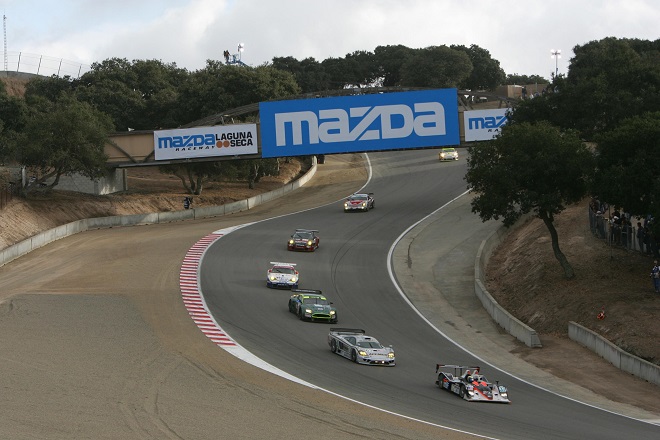
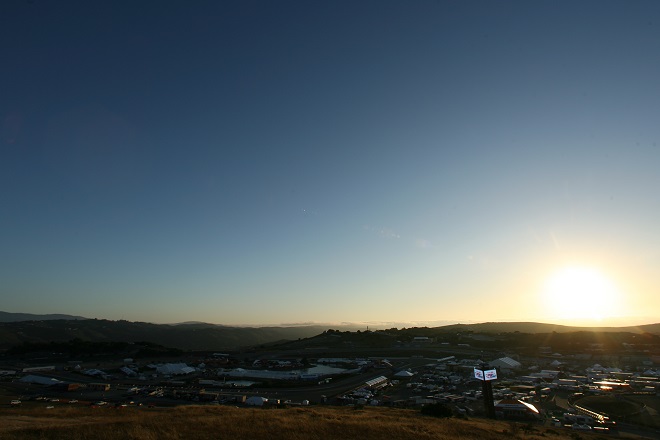
The next group is comprised of Monterey (and motor racing) heavyweights under the Friends of Laguna Seca (FLS) banner. Among its senior brass, major automotive event promoter Gordon McCall, automobile restorer and vintage racing maven Bruce Canepa, financier and one-time Laguna Seca savior Ned Spieker, and former Charlotte Motor Speedway VP Lauri Eberhart provide the board with a united front of local interest. Add in Canepa's sizable role in facilitating the Rolex Monterey Motorsports Reunion (pictured, Marshall Pruett photo) on behalf of SCRAMP, and it's hard to understate the degree of influence FLS wields.
And finally, famed Long Beach Grand Prix founder and renowned race promoter Chris Pook has joined forces with Monterey restauranteur Landon Hoffman to present a third known group to vie for the circuit's control. Sources suggest that Pook's team could be a distant third in the race.
All three have met with the county, made formal presentations, and some have even held friendly private meetings to gauge their respective interests in wanting to run Laguna Seca. The trio possesses distinct strengths and weaknesses, and opening with SCRAMP/ISC, one immediate concern involves lingering bad blood and resentment between the board and its current track managers.
The wounds went deep in 2015, and it would be easy to imagine that grudges still exist. With the board holding all the power in the relationship in light of the RFSP process, would the county would want to see changes to SCRAMP's leadership group before continuing with ISC added to the mix?
It's just a hunch, but with SCRAMP's top-heavy organizational structure in mind, it's a struggle to see how it receives a new management contract without some personnel changes attached to the deal.
The inclusion of ISC, however, could also be the cone of silence SCRAMP has needed since Laguna Seca began running at an annual loss. With ISC's well-honed team of business managers and support staff ready to descend on the circuit, this combo has two things the others cannot offer: A massive army of non-profit volunteers with decades of Laguna Seca-driven experience, and a matching army of for-profit business hawks sharpened through years of feeding NASCAR's bottom line.
ISC brings immediate legitimacy to SCRAMP; SCRAMP brings subject matter expertise and throngs of loyal supporters to the relationship, and as a unit, the board has a best-of-both-worlds proposition to consider.
Using the full benefit of hindsight, it also prompts the question of why SCRAMP fought to drive ISC out of Monterey last year instead of trying to form its current alliance. It's just a guess, but with a SCRAMP/ISC package offered to the county in 2015, I'm not sure the recent RFSP process would have been deemed necessary.
The pressing issues today are whether the board and SCRAMP can work together in a cohesive manner, and if bringing ISC in to shoulder the business side of running Laguna Seca is enough to hold onto the property. There's also one more question associated with SCRAMP/ISC that could torpedo its proposal, but we'll save that for the next section.
Amusingly, one motorsports-related site went as far to select FLS as the best choice to run Laguna Seca without bothering to interview the other parties, and maybe that speaks to the charm FLS have spread during the campaign portion of the lobbying process.
As the home team, the FLS doesn't carry any of SCRAMP's baggage or suffer from any of the anti-ISC rhetoric that arose in the area. Positive, engaged, clean and familiar, most of its members could run for mayor of Monterey and stand a decent chance of getting elected.
The majority of the FLS group has amassed considerable wealth and wants to inject a large volume of cash to provide an immediate makeover for the throwback track. With most of the circuit stuck in the rustic 1970s, and the county in dire need of taking Laguna Seca out of the red and into the black, the value and importance of the financial success achieved by the FLS leadership (and the high-powered connections they have with other business leaders) cannot be overemphasized.
An assembly of Fortune 500 types who want to save Laguna Seca by pumping millions into the facility is a once-in-a-lifetime occurrence, and the county needs to recognize the opportunity – and extreme benevolence – that FLS is willing to provide cannot be matched by the other parties.
FLS gives Monterey a powerful option to counter whatever it might find attractive with SCRAMP/ISC, but the group also has a few issues that could temper the county's enthusiasm.
Although FLS is comprised of business mavericks, it's missing a deep pool of staffers with circuit management experience and, minus the hundreds of volunteers, FLS is light on infrastructure. On motivation, strength of its hierarchy, and willingness to spend Laguna Seca into the 2010s, FLS is without peer, but below its proverbial boardroom, the rest of the building is rather empty.
So, is SCRAMP/ISC, with its deep infrastructure and broad for-profit and non-profit racetrack management experience the best choice for Monterey, or is FLS the clear No. 1 pick for all the reasons above? To borrow a line from Dwayne Johnson, aka The Rock, "it doesn't matter."
BEGGAR'S BANQUET
Spend a few minutes perusing the county's RFSP document, which provides firm guidelines on what it's looking for in the next concession agreement, and one thing stands out: Monterey doesn't want to fix Laguna Seca's broken business model; it wants a giant hand-out from Laguna Seca's next track managers to solve the facility's problems with pallets of cash.
Presented with an opportunity to perform a top-down review of how it landed in the current mess, and then intelligently address the issues that got SCRAMP in hot water, the county has taken the easy way out by searching for racing's equivalent of the golden goose.
With a limit of five major events per year that can be run without its world-famous (and asphyxiating) decibel limitations, the track has become a ghost town between those "Big 5" as other Californian road courses – places where sound restrictions are less of an issue – continue to benefit from Laguna Seca's lost business opportunities.
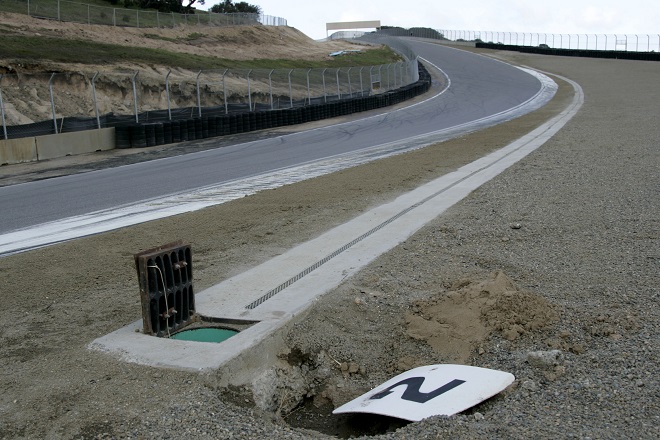
Decidedly underused and underperforming, the county had a chance to reboot Laguna Seca through an RFSP process that asked for long-term business solutions. But as the document's authors state over and over again, Monterey just wants the next management team to make it rain.
On the financing and construction needed to perform facility-wide improvements, the board wrote: "It is not envisioned for the County to finance the extensive capital improvements that will be desired for [Laguna Seca] to prosper and justify the capital investment."
On the track's ridiculously overdue need to repave the worn 2.2-mile road course, the board wrote: "As mentioned previously, County's desire is to have the new Concessionaire be responsible for funding and executing."
And what about the business-killing sound levels? "County has no plans to process a change to the sound restrictions."
And on the general need for a top-to-bottom facelift, the county passes the buck yet again: "Within the next few years there is a need for substantial capital investment in [Laguna Seca]; existing funds remaining in the [Track Maintenance Fund] will not be available. It is expected that a new Concessionaire will be capable of providing additional resources to address capital needs and will propose a sufficiently long term for the Concession Agreement such that Concessionaire will obtain a return on investment that covers its expenditures for capital expenses."
Monterey's RFSP only needed a single sheet of paper with one sentence that reads: "We'll give you the contract if you pay for all of our mistakes and problems, and we'll give you a long noose to reduce the likelihood of being hanged." In the county's eyes, the management team selected for its next concession agreement will have the honor of putting up all the money and being tied to a lengthy contract to try and recoup its loan. And that's considered winning?
At its core, this RFSP process is little more than a vastly overreaching Kickstarter page.
As we wrote last week
, SCRAMP should have all of its debts to the county repaid by the end of the month, which is fantastic, but that's old money. Monterey wants new money, and lots of it which, as far as anyone knows, is not part of SCRAMP's current reality. So what about its partners at ISC? Could it reach into NASCAR's overflowing cash reserves?Highly unlikely. ISC, as a publically traded, for-profit entity with shareholders to appease, would never be allowed to invest large sums for capital investments in a property it doesn't own. From the estimates I've heard, something in the range of $50-75 million is needed to take Laguna Seca into the new millennium. Even if ISC was allowed to spend $5 million, which would be unfathomable, it would be a drop in the bucket.
Without any wholesale changes to how Laguna Seca can be used and developed by a company like ISC through more major race dates and softer sound restrictions, the county appears to have steered the RFSP process towards the most prosperous outcome.
Thankfully, the FLS team is said to have made decent progress in raising its initial goal of $50 million to spend on Laguna Seca, and the men and women that form the group are fully aware of the county's frothing attraction to the cash it can visit upon the facility
THE MAGIC NUMBER?
SCRAMP wants to save Laguna Seca, has a large and willing staff ready to act, but lacks the funding to remodel and grow the property. FLS wants to save Laguna Seca, lacks the people (below upper management), but has a war chest that can solve just about every problem by the end of the decade. ISC wants to run Laguna Seca, would benefit from controlling a Northern California road course (in opposition to Sonoma Raceway which is owned by its archrival Speedway Motorsports, Inc.) has the hardened staff to step right in and make it happen, but can't bring meaningful sums of money to the equation.
Parsing through the positives and negatives presented by the three parties/two teams, it seems fortunate that the county chose to amend the RFSP to reserve its right to select more than one winner. Given the chance to place an outside vote, I'd nominate SCRAMP, ISC, and FLS to steer Laguna Seca forward.
It wouldn't be easy; finding the proper balance of control between the trio would involve bumps and bruises, and at least in regard to SCRAMP and FLS, there's no doubt both groups have the track's best interests at heart. Would ISC, as the only for-profit entity in the proposed relationship, continue to find value if the FLS controlled the purse strings? And what would it gain if SCRAMP remained in place and the FLS held the thing the county wants most?
As the strong business partner to SCRAMP, ISC has leverage in any contract with the board. Add FLS to the conversation, and that might not be the case, but the county would be smart to find ways to appease ISC and benefit from its experience.
If it can see past the staggering eight-figure investment FLS says it can bring, Monterey might realize its RFSP process has not produced a perfect answer with any individual team, but it has yielded an amazing ensemble to consider.
UNHEALTHY CHANGE
The need for a vastly improved oversight structure is another takeaway from the problems the county and SCRAMP have created in recent years. Monterey, with its aforementioned elected and appointed board members, has used an independent vendor to run the Laguna Seca circuit and the park that surrounds it, for decades.
During that span, board members served their terms, come and gone, and with every change, new people are asked to govern a highly unique property without being required to have any specific knowledge or expertise on the topic.
A local agricultural leader, stay-at-home mom or dad, or surf shop owner could find themselves in charge of dictating Laguna Seca's business affairs, and while that doesn't mean the people on the board aren't capable of making the right decisions, there's also no reason to assume the massive complexities that have impacted the circuit's health are best handled by whoever earns a seat on the board.
In light of the board's built-in turnover, and the lack of hardcore business requirements for the county's board members, Monterey might consider hiring a track expert – a dedicated Laguna Seca business manager and liaison – to act on its behalf.
Just as it expects the next on-site management team to fix the track's financials and make wholesale facility upgrades, I would expect the county to realize it needs to upgrade its abilities to effectively oversee the property from its end.
Monterey can certainly vilify SCRAMP for its shortcomings, but in light of the embarrassing "gimme-a-handout" RFSP document it produced, the county's shortcomings are just as obvious. What has it done to ensure the next track managers won't end up in a similar position? Has the board altered its structure to fortify its member's weaknesses? Has it made any demands or provided education for members who possess a complete lack of business experience? Board members might be able to vote on where to place a new stop sign, but would any have the aptitidue to manage the racetrack for a day?
It's far too convenient to think that hiring a SCRAMP/ISC or FLS is all that's required to trigger a new gold rush. Monterey has great options to consider, but without fortifying its board with some form of track/business expertise, the same weaknesses will leave the new managers prone to failure. Hiring a board-affiliated track expert to fill that knowledge void seems like a no-brainer.
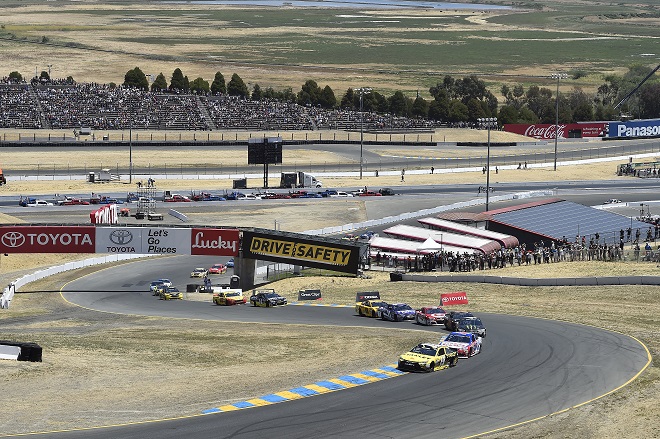
Sonoma Raceway (pictured) is, in almost every practical sense, a for-profit version of Laguna Seca. The rolling road course, like its Monterey counterpart, faces the same challenges with noise restrictions, declining interest in motor racing, and it's also packaged in a somewhat remote location.
Despite the shared obstacles, Sonoma Raceway is healthy, has more than 100 tenants delivering steady monthly income, and hosts marquee events with NASCAR, IndyCar, and the NHRA. It's a busy facility that, while far from perfect, is an excellent example of what Laguna Seca once was and could become with some changes.
And that's where we'll close. Monterey will announce its choice(s) to run Laguna Seca in September, and at that point, it will be up to the board and the management group(s) to create a new concession agreement. This is perhaps the only chance for the circuit to break free from the heavy sound and usage limitations that have turned it into a dying star.
Yes, the RFSP said no sound restriction changes are likely, and as a whole, the document seemingly asked the contenders to submit their proposals on how they would run the property under the same shackles applied to SCRAMP. If the locals, and the contract winner(s) are wise, they'll demand changes to how the county uses Laguna Seca.
Does it mean unlimited sound restrictions? No. Does it mean adding condos to the infield? No. But if the best the board can come up with is to ask a new or improved management team to take Laguna Seca into the future while being tied to the same old limitations, the circuit's doomed.
Decent, passionate people want to take on the responsibility of running the facility, and having spoken with all three teams, and at length with the two key contenders, they've acknowledged success or failure is hinged upon creating a healthier contract.
The fight for control over Laguna Seca has nothing to do with the parties engaged in the RFSP process. It's going to take place at the negotiating table between the county and those trying to save the beloved circuit.
Years from now, will you and I be able to take our children to Laguna Seca for their first racetrack visit just as my father did with me in 1975? The answer to that question rests squarely on the shoulders of Monterey and its board of supervisors.

Latest News


Comments
Comments are disabled until you accept Social Networking Cookies. Update cookie preferences
If the dialog doesn't appear, ad-blockers are often the cause; try disabling yours or see our Social Features Support.