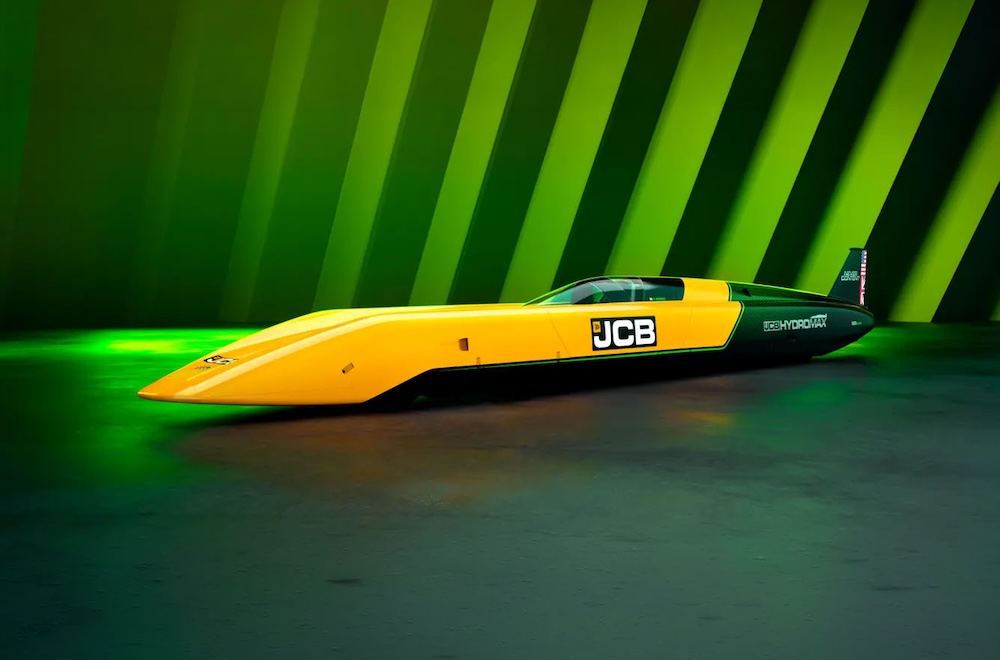
Why a heavy equipment powerhouse is chasing a hydrogen land speed record
JCB – not exactly the byword for high performance, is it?
Yet, 20 years ago, the British construction and agricultural equipment manufacturer turned heads by producing the Dieselmax streamliner and going on to set a land speed record for diesel cars with it.
Now, it’s doing it again, with another alternatively-fueled machine which will take to the Bonneville Salt Flats this summer in a new class set up by the Southern California Timing Association (SCTA) and the FIA. The Hydromax, as you might have guessed, is hydrogen-powered. But this isn’t a serene fuel cell vehicle that’ll glide to a record without shouting about it – it’s got a combustion engine. Two of them, in fact.
But why is a heavy equipment company chasing a speed record again?
“Why not?” JCB chairman Lord Anthony Bamford pondered to assembled media, including RACER, earlier this week. “But also, it is a good way of showing the improvements in technology, particularly in hydrogen, and showing hydrogen working at extreme temperatures, and I think it's a good way to show to our customers... they've got engines, which probably only do 30 miles an hour, but it's good because we sell engines to other people, and I think that shows the stretch.”
At this point I can probably imagine where your thinking is taking you: Company sponsors project, slaps their name on it, and takes the credit. Job done. But no. While there is some help from the likes of Prodrive, Ricardo, and Xtrac, Hyromax is very much a JCB project, and those two combustion engines referenced earlier are JCB’s own off the production line.
Sure, they’ll be strengthened to meet the demands of speed record-chasing, but they’re essentially the same units being developed for JCB’s production products. JCB has developed fuel cell machines too, but with their complexity and costs making them impractical for customers, Lord Bamford put the challenge to his team to develop a hydrogen engine.
That was in the summer of 2020. By December 7, the first prototype was running.
“You've got the same strong block, flywheel, [and] crank,” said Tom Beamish, JCB’s advanced projects deployment manager. “What we've done is really work hard on our turbocharging technology. All of our diesel engines have a turbocharger, but the turbocharger on this engine is actually very powerful. It's only very small.
“When we first started, we had a turbocharger the size of the dustbin. We thought we need lots of air to need a big turbocharger. We've actually shrunk it right down, because if we go very small but very fast, we can get the transient response we need. So this turbocharger spins up to 250,000 RPM.”
The engine works similarly to a conventional engine, but with hydrogen mixing with air instead of gasoline or diesel. The hydrogen is injected at less than 10 bar, compared to the 1000 bar pressure of diesel in JCB's other engines, and that was the result of extensive computational fluid dynamics (CFD) simulations that took some time to get right.
“We'd run it overnight on cloud computing, and in the morning we’d have a look at the results,” said Beamish. “We did 40 iterations of this, 40 days worth of versions. We then built an engine, and we had rubbish correlation.
“What we realized is actually the models that were designed with hydrogen... nobody had ever done it before, so we had to scrap it and go back and start again. So we've now done over 180 iterations of that to get that mixing just right.”
Of course, diesel engines use compression ignition instead of spark plugs, so JCB had to adapt there. Chasing high performance, they naturally looked to motorsport, using the same types of spark plugs used in endurance racing car engines. A sound route to take in theory, but it proved to be too much.
“It's fair to say when we first started, it was like putting a thunderbolt into the cylinder. We sort of overdid it,” Beamish said. “You don't need much to get that spark to go. When we first started, we used Le Mans 24 Hour race car spark plugs. Guess how long they lasted? 24 hours. We've since worked with the supply base so we get up to a standard service interval on this energy.”
By putting its turbocharged hydrogen-powered production engines into a land speed record car, JCB isn’t just chasing headlines and marketing clout. The project will serve real purpose in proving the engines’ capabilities and serving as a research project to improve the engines further down the line as JCB’s product time continues to expand.
“We're learning here how to make our hydrogen engines powerful when we look to the future,” said Ryan Ballard, engineering director at JCB. “The engines in this car are the same foundation [as JCB’s conventional engines but have] 800 horsepower each, 1600 combined.
“It's really important to us as we look to bigger machines, 20-tonne machines, 30-tonne machines, when we need more power, it's helping us to understand how to do that from our own engines. Clearly, we don't need 800 horsepower race engines in an excavator, but it does, again, help us to develop future projects.
Beamish added, “We always learn through doing projects like this, and actually our last speed record, the world's fastest tractor, that informed a lot of the information on turbocharging for the hydrogen engine. So you see this kind of lineage and legacy throughout the various different exciting, different projects that we've done, and how that then feeds into the existing machines that we have.”
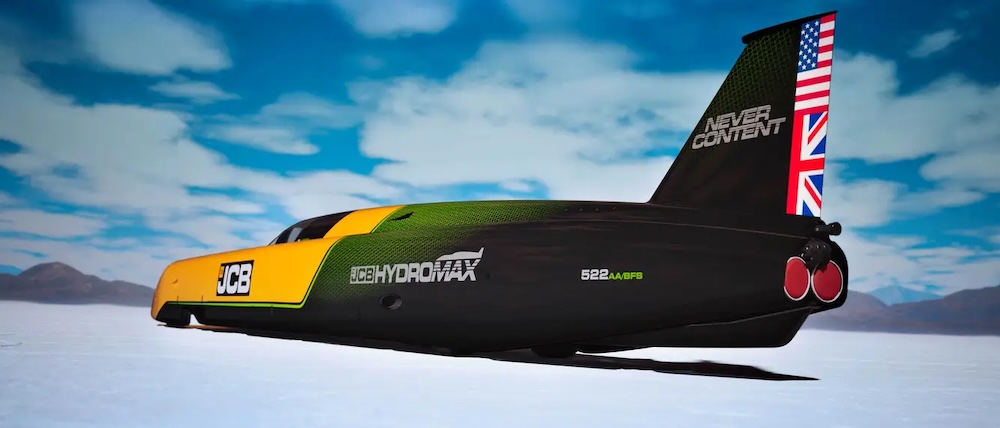
The engines will be at each end of the car driving all four wheels though Xtrac six-speed sequential gearboxes. Between them, the driver will sit in a carbon tub, surrounded by a spaceframe construction shrouded in composite bodywork. Unlike Dieselmax, the cockpit is more central to give the car a better center of gravity, and the car's aerodynamics have been improved by 10% over Dieselmax, with 4% of that improvement coming from the implementation of NACA ducts rather than snorkels used previously.
But while most talk of aerodynamics in motorsport centers around downforce, Hydromax maintains a stance of near-neutral buoyancy: lift would create instability, but downforce would create drag, slowing it down. There is also a new reprofiled nose that not only helps guide air over the car, but also houses one of two ice tanks which will be used to cool the engines (using 250kg of ice per run).
Just behind that nose on the underside of the car has been designed to displace salt to the sides as the car moves along. The idea came from the late Ron Ayres, designer of the aerodynamics on Dieselmax, who realized that most cars running on salt fail to reach their potential because salt is more draggy than a sealed surface.
Another potentially limiting factor aside from salt are tires. During Dieselmax's run, the car couldn’t push past 350mph because the tires were unable to handle anything higher. This time they have been redesigned by Goodyear using sustainable materials in their construction, exhibiting more centrifugal growth than the ones used previously, so the car won't be constrained by them.
JCB is aiming for over 350mph with Hydromax. Although, there are road cars clocking 300mph nowadays (the Bugatti Chiron Super Sport 300+ was the first), by using production engines, and the broad challenges of developing them puts into perspective the scope of what JCB is trying to achieve.
“Had they started with a 74 horsepower digger engine and then managed to boost that up to 800 horsepower, put two of those in the car and then powered it by hydrogen, that would be impressive,” said Hydromax driver Wing Commander Andy Green OBE, who holds the overall land speed record of 763.035 mph. “And then to go 15% faster, it's a square law, so 15 times 15. So we're looking at the third more drag than the Chiron had to cope with.
“Then to run on a loose and relatively loose and slippery surface out on the salt flats, because you need the distance, because you're running half ton JCB digger engines as your core power plant, there are some challenges in there.
“If you were going to start with a race car engine, it would be easy, but that's not the point. This is about showcasing JCB can do something that the rest of the racing world is struggling to do with race car engines, they can do with digger engines. That's extraordinary.”
Green, an RAF veteran, drove JCB’s Dieselmax back in 2006, having previously taken the overall record in 1997 with ThrustSSC (and was tabbed to drive the Bloodhound SCC to over 1,000mph until he stepped down from the as-yet-unrealized project three years ago), but he wasn’t expecting this latest challenge at first. And with a career in the skies behind him, thoughts of hydrogen’s brush with aviation last century were on his mind.
“It was a complete surprise when I was invited in March last year to come and have a chat about this new project,” he told RACER. “My background is as an aviator. Aviation and hydrogen do not have a good history, so I had a few questions. And the more they talked, the more I went ‘actually, you know what? Everything I know dates back to the 1920s. These guys are 100 years from there,’ at least in terms of having a proven industry standard product.”
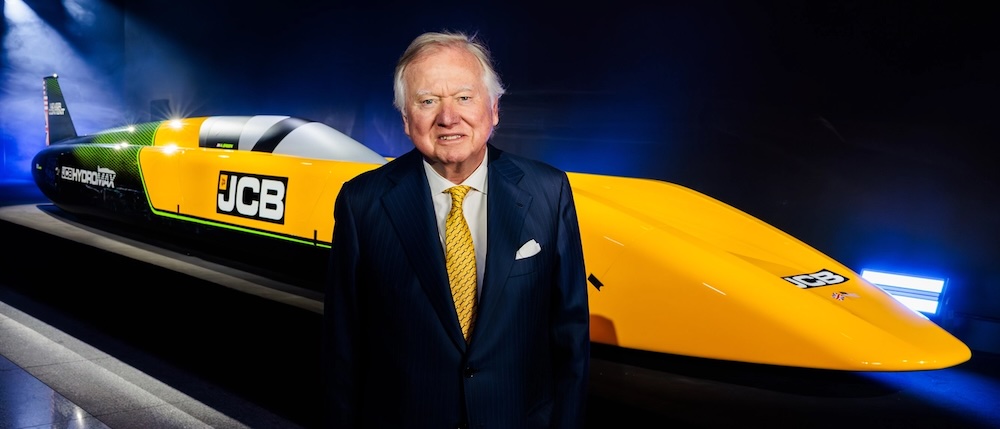
Why would a company that makes heavy machinery chase a hydrogen land speed record? Why not, counters JCB Chairman Lord Anthony Bamford (above). Although he also sees an opportunity to showcase hydrogen's potential.
Similar skepticism has been thrown the motorsport world’s way too, which has all but entirely been dispelled by the likes of Extreme H and Toyota’s hydrogen-powered sports car and rally prototypes. Nevertheless, safety has been a key consideration of the Hydromax project.
“They are doing this to an incredibly high safety standard, because it's licensed all over Europe, and it's already being tested and run safely on building sites,” Green said, referring to JCB’s other hydrogen projects that preceded Hydromax. “If you can give in to a builder and run it in those kinds of harsh conditions, it’s kind of indestructible. So it reset everything I know about hydrogen.
“It's clearly understanding all of the technology, working with the team to work [everything] out. So a sensor failure, one of the hydrogen pressure sensors, if there's a backup in the system, it’s barely worth mentioning. Do I actually even need to know if there's a backup in that? No, I don't. If the backup fails as well, and now there's a chunk of the system not monitored that might be worth telling me.
“Safety critical bits like all of a sudden you start to detect a change in the suspension, because we can't run tire pressure sensors. There's no tire pressure sensor that will actually take the rotational speed. They just don't make them. So we were looking at the actual positioning of the suspension arms dynamically all the way through the run. If that configuration changes, it could be because one of the tires is starting to lose air. That is a lot more significant, and that is a 'shut car down right now' and slow down and figure out if it is actually a tire pressure, or just a sensor. But it could have safety implications.
“That is a level of safety that five-10, years ago, just wasn't available and is still new technology for Bonneville. So we're going to Bonneville with a product that is a level of construction, design and operating safety above anything that's been before.”
Compared to Dieselmax, Green says Hydromax is better because "they've managed to make a lighter, more slippery car actually generate more power out of the engines”, but that doesn’t mean matching the previous car’s 350mph benchmark will be straightforward. Bonneville is almost a living, breathing creature in its own right, and the course it will take to isn’t as long as the one its predecessor ran on, despite being in the same location.
“The salt flat is actually about two miles shorter,” he explained. “We had 11 miles back in 2006; last year the track was just over nine miles long. So immediately that's less acceleration distance, less stopping distance. So the car is going to have to work harder just to repeat what Dieselmax did 20 years ago.
“Plus, the salt surface varies from year to year. Last year it was a little bit more crumbly, a little bit less grippy, probably going to be slightly higher drag. Hydromax is going to have to do better just to repeat the 350 mile an hour record.
“So setting an FIA world land speed record target for a hydrogen internal combustion engine, 350 is actually a really hard target. The fact that all of the numbers are saying this car will be able to do it with loads of engineering safety built into it at the same time, which we didn't have the capacity to do 20 years ago because of technology and materials, is absolutely brilliant.”
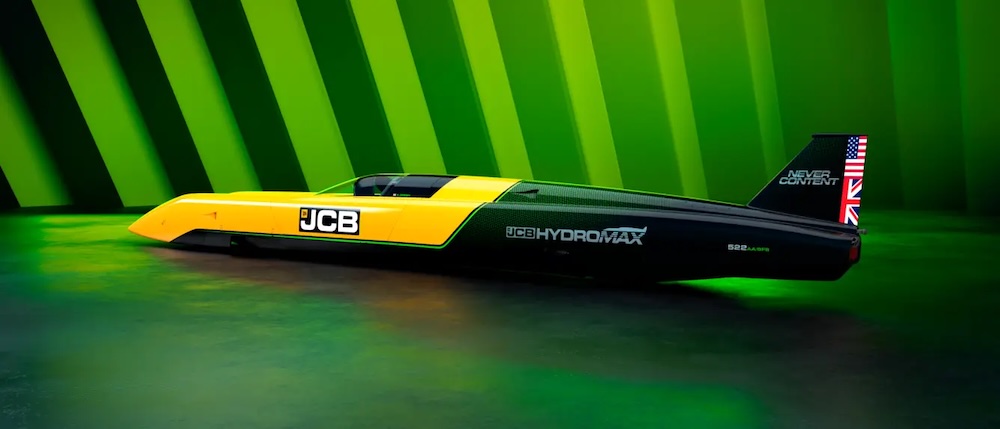
Hydromax hasn’t yet turned a wheel, but will in a couple of weeks when it conducts its initial low speed runs in the UK. Until now, simulation has been a key part in getting it to where it is but for Green, it hasn’t helped in the same way it would a typical racing driver.
“We've looked at simulation,” he said. “We did a lot of simulation work with Bloodhound; a lot of simulation work with ThrustSSC. It's very useful to understand the dynamics of the vehicle, but not actually useful for driver training, simply because it's as much a systems management task as anything else.
“The actual handling of the car on the surface is so dependent on the car and the surface and the conditions on the day, it's very difficult to simulate and it's very expensive to build that simulation for relatively small gains.
“So driver training simulators, we haven't done. You actually learn just as much by going on a track day in a reasonable performance car and actually just developing the feel of front end sliding, back end sliding, and how to manage that. Although it's in a straight line rather than a curve, still the same principles (of) working out what's going on, which set of levers will correct it.”
Green’s no stranger to speed records, and JCB’s done it before too, so everyone knows what to expect, right? Perhaps not. Pre-event testing will take place, but as Dieselmax showed, that could provide false ideas of what’s to come.
“The way Dieselmax worked, when we actually got to the salt, was not what we were expecting, because it didn't work the way we worked in the UK,” Green said. “It turns out that it was a real struggle to get the twin-turbo diesel engines on boost at Bonneville, and we worked at that continuously for a week, and just cracked it by the end of speed week to get our first 300mph passes in.
“Is it going to be easier with a single turbo and hydrogen on paper? Yes. I can't actually answer that question, because you cannot simulate running a car at 300 plus miles an hour at 6000 feet (of elevation) until you're actually in the desert at 6000 feet, doing those sorts of speed.
“We've got NACA ducts, which have some real advantages over the previous intake system for Dieselmax, but they are different, and they're also feeding a single turbo, rather than a twin turbo, which has some pros and cons.
“So there's going to be a lot of learning as we go. There are a lot of things, again, for instance, anti-lag technology. It has been around for a long time, but nowadays we can not only change the spark any way we want to create an anti-lag effect, you can also change the injection. And there's also the water injection; that's what stops hydrogen blowing the engine up at 800 horsepower. All of that is literally from firing pulse to firing pulse, adjustable on board to help the engine, so it should be easier.
“But ask me again in the middle of SpeedWeek, and I'll tell you whether it's working as we expected. That's part of doing this, and part of what JCB will take out of this. It’s how to get the best out of our engines. And more importantly, they'll bring a team back who are so well-prepared for whatever their next project is, because they've had to solve problems.
“They’ve got the whole world watching what they're doing on a day-by-day basis, and they need to learn how to do that to show that precision and excellence in the most high pressure with only a few days only to actually get a result.
“That's one of the things they came back with 20 years ago. Once they got over the PTSD from the experience, they finished up as a remarkably strong and well developed group of engineers. That's exactly the process they're going through now, and it's really impressive to see already how strong an engineering team that's becoming. I can't wait to get there!”

Dominik Wilde
Dominik often jokes that he was born in the wrong country – a lover of NASCAR and IndyCar, he covered both in a past life as a junior at Autosport in the UK, but he’s spent most of his career to date covering the sliding and flying antics of the U.S.’ interpretation of rallycross. Rather fitting for a man that says he likes “seeing cars do what they’re not supposed to do”, previously worked for a car stunt show, and once even rolled a rally car with Travis Pastrana. He was also comprehensively beaten in a kart race by Sebastien Loeb once, but who hasn’t been?
Read Dominik Wilde's articles
Latest News


Comments
Comments are disabled until you accept Social Networking Cookies. Update cookie preferences
If the dialog doesn't appear, ad-blockers are often the cause; try disabling yours or see our Social Features Support.
.png?environment=live)