SVRA: Choice Pre-War cars impress at Sonoma
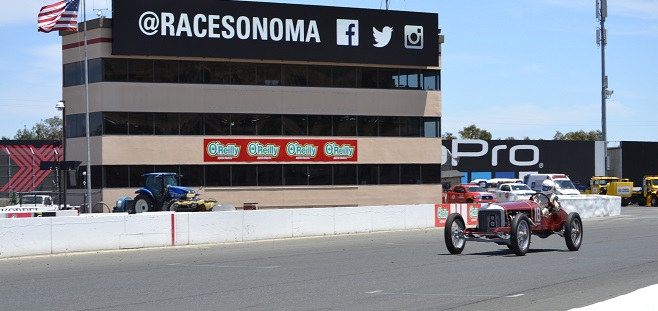
The recurrent theme at this weekend's Sonoma Historic Motorsports Festival is its position as the SVRA series' largest gathering of historically authentic and significant racecars on their 16-race schedule. SVRA officials are intent on expanding what they call their "Gold Medallion" category. These cars are authentically restored, maintained and held to the highest standards for doing so. There is no better example of that than the event's Pre-War field where the paddock scuttlebutt places the collective value of the cars assembled as something north of $40 million.
Others dispute that number to say it significantly understates the value – but you won't find an owner who will talk specifics about his or her car. In this world everyone plays their cards close to the vest. That's because there are literally millions of dollars at stake in terms of property value.
"This area of the country has a tremendous concentration of collector cars," says Peter Giddings, who is running his 1932 Alfa Romeo Monza Grand Prix car this weekend. "Racecars are no exception. There are a great number of remarkable examples here."
Click on the thumbnails below for larger images.
{igallery id=7226|cid=518|pid=5|type=category|children=0|addlinks=0|tags=|limit=0}
One incredibly historic racecar is a 1934 Alfa Romeo Tipo B. Driver Erickson Shirley (his father, Jon, is the owner) offers extensive documentation to prove it is the car Italian legend Tazio Nuvolari drove to victory in his most famous Grand Prix accomplishment of a career that spanned three decades of big-time achievements. The race was the 1935 German GP, held amid Adolf Hitler's relentless aggression in Europe. Hitler poured a lot of his country's wealth into building the prowess of the Mercedes and Auto Union teams. The result was the legendary Silver Arrows racecars – easily the most advanced engineering of the era.
The 1935 race was at Germany's Nurburgring road course that was 14.2 miles with 174 turns at the time. An unexpected equalizer developed when rain soaked the track resulting in conditions that put a premium on driving talent. The race was chock full of challenges in general and for Nuvolari in particular but he prevailed to lead eight Silver Arrows at the finish (left, LAT archive photo). Historians rank the epic contest as one of the most dramatic upsets in all of motorsport – even to this day. Certainly for Hitler, losing his home country GP was massively disappointing. For those he blamed it may well have been much worse.
While Shirley is adamant about the car's history, he is equally enthusiastic about the experience he has driving it. He wrestles with the distinction between an historic racecar and a museum machine that may only rarely see a parade lap.
"This car is raced regularly and that means it must be maintained. There is a philosophy about what you replace on the racecar and stay true to its character and identity. It's important to preserve what it is, but still appreciate that it is a racecar and not a museum car," Shirley says. "If I take this car to Goodwood, for example, and it's raining, well, I have to think hard about the risk of damaging it. While I enjoy racing it and believe it should be raced, I have to weigh that against its value in high risk situations."
Shirley respects that he sits in a seat once occupied by the maestro, Nuvolari. At the same time, he simply relishes the pleasure of driving an amazing racecar at high speed. It's a sensory experience. He has touched speeds as high as 165mph on straights.
"When I talk to race drivers about driving a car, it's not so much about its history. They're like kids because they get excited about what it feels like. That's what I love about racers, their enthusiasm," Shirley continues. "Otherwise it's like describing a recipe but not letting someone eat the food."
Sharing paddock space with Shirley is fellow Alfa Romeo owner/driver Greg Whitten with his 1932 P3. Whitten reports that this machine not only won the 1934 Monaco Grand Prix with driver Guy Moll but also the 1935 Mille Miglia after undergoing a reconfiguration to touring car. It may be the only car ever to earn such a distinction. Whitten presents it in the configuration of the Mille Miglia winner.
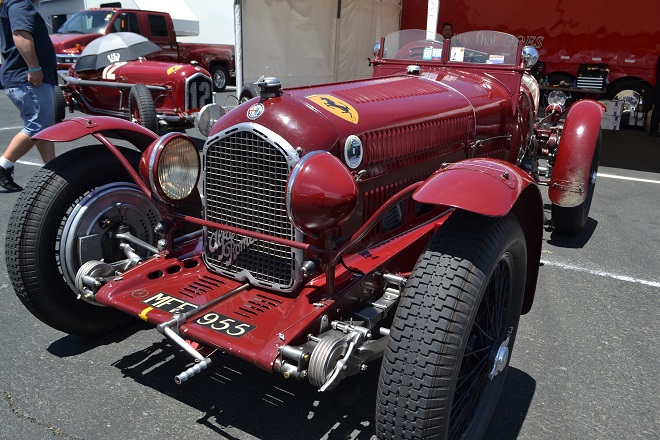
The 1936 English Racing Automobile (ERA) R6B of owner Charles McCabe is now in the same stable as the most successful ERA ever, known to aficionados by it's nickname, "Remus." That car, once owned and raced by Prince Bira of Siam (the country now know as Thailand), is also owned by McCabe but he only races it in England. While McCabe freely admits his 1936 car is far less distinguished in terms of achievements than his Remus, it remains authentic. The car underwent development work during its competitive years throughout the 1930's with such modifications as hydraulic brakes. Today it is as it was in 1938.
McCabe works closely with fellow ERA owner Paddins Dowling, who is driving his ERA R2A this weekend. Dowling shares that his car has some noteworthy history as only the second ERA ever produced. It won standing start records for both the kilometer and the mile at England's concrete paved, closed circuit track, Brooklands, in 1934.
Another Brooklands record breaker is one of the most unique and eye-catching cars at Sonoma this weekend – the 1930 Morgan Super Aero of owner Larry Ayers. The machine was of the "cycle car" variety with a twin cylinder 1084 cc engine and just three wheels. These racers at times competed against motorcycles. In fact, pictures from its original racing days show daredevil riding mechanics hanging off the side of the tiny car on corners for weight distribution in the manner of the old motorcycle sidecar racers. Ayers' Super Aero explodes to life with rapid-fire blasts through its wraparound exhaust pipes with the rhythm of a machine gun but also so high-pitched that Giddings, who is in a nearby paddock spot, had to cover his dog's ears.
Click on the thumbnails below for larger images.
{igallery id=6175|cid=518|pid=5|type=category|children=0|addlinks=0|tags=|limit=0}
The powder-blue French racing colors of Nathanael "Sandy" Greene's 1925 Bugatti T35 caught the eyes of early bird race fans strolling the paddock on Friday. Authentically restored to the point of painting around bodywork grime and corrosion collected over the decades, Greene adheres to the philosophy of many who meticulously restore the engine, drive train and all chassis elements but preserve the hard-earned aging of the bodywork. Accident damage, of course, is repaired.
Greene reports that his Bugatti sports the first metal alloy cast wheels – a departure from the convention of wire wheels in the 1920s. While his documentation records reveal an engine crankcase change in 1933, the car is otherwise almost entirely original. There are interesting details on all the cars that seem charming today but were purely utilitarian in their time. An example is a leather holster affixed to the Bugatti cockpit with several small pockets, each one carrying a spark plug.
The Pre-War cars, while no more or less authentic than other run groups here this weekend – such as the featured fields of Historic Trans Am and Can Am – tend to draw stares because of their age. Some date back to the years just before World War I, such as owner Brian Blain's 1911 National that finished seventh in the first Indianapolis 500, or his 1916 Sturdevant.
Despite the diversity of designs, engine noises and vintages the cars at Sonoma this weekend not only have owners committed to preserving their authenticity but also drivers who run them in anger. As Erickson Shirley will tell you, these are not museum pieces.

Latest News
Comments
Comments are disabled until you accept Social Networking Cookies. Update cookie preferences
If the dialog doesn't appear, ad-blockers are often the cause; try disabling yours or see our Social Features Support.