BUXTON: Haas - F1's feelgood factor
I'd planned to write this piece in the immediate aftermath of the Australian Grand Prix. Politics overtook it a fortnight ago, and still rumble on today, but if anything I'm rather glad all the bickering over qualifying stopped me from penning the article I originally had in mind. Because today, the narrative has gone far beyond an everyday positive story, and has transformed into a wondrous sensation.
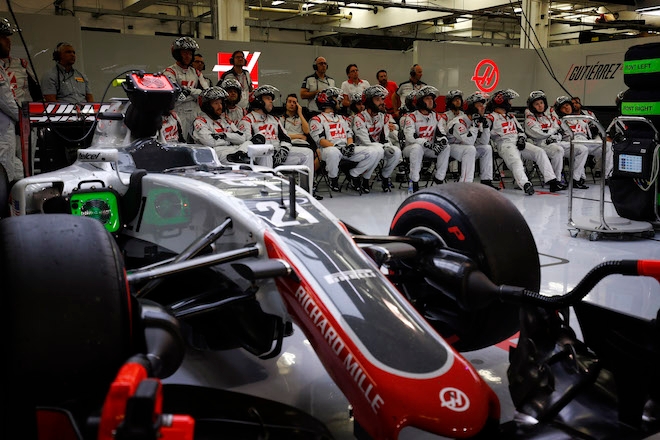
The Haas F1 team's competitive start to the 2016 season has been a joy to behold. From their first baby steps on track, through to two consecutive top-six race finishes in their first two grands prix, it is the good news story the sport needs at a time when so much negativity floods the headlines.
Haas is first team since Toyota in 2002 to score points on debut, and has done so at a fraction of the rumoured $1.3 billion it took the German team to make it to its first race. (Conservative estimates stand at $1.1b. The largest I've heard is $1.5b). Haas became the first team since fellow Americans Shadow to record two top-six finishes in their first two races.
We could stat-off all afternoon. The long and the short of it is that Haas has turned up and done what nobody else has in over a decade. Not only that, but the team is a serious proposition. It is here to race, and now everyone knows it. The team hasn't got its pit stops sorted, it hasn't managed to dial the car into anything like a decent setup yet, it still has some early season upgrades to bring to the table and yet it is mixing with the likes of Red Bull and Williams. It sits ahead of the mighty Renault and McLaren on the constructors' table. Romain Grosjean has more points than Sebastian Vettel.
I bet Ferrari loves that.
There will always be negativity, of course, and it didn't take long for the first barbs to come out after Australia. Williams's Pat Symonds was quite vocal, stating that he didn't agree with the manner in which Haas has gone about making its debut, questioning its merits as a constructor given how much of the car has been purchased rather than home-made.
Pat has been in this game a long time, and so his opinions are widely read and well-respected. But he would do well to have looked back through the history of the sport to the birth of the very team by whom he now finds himself employed.
Frank Williams Racing Cars entered Formula 1 in 1969, running a Brabham BT26A (RIGHT). It bought that car straight off the shelf. In 1970, the team began an association with the De Tomasso sportscar manufacturers to build Frank a racing car designed by a certain Gian Paolo Dallara (whose eponymous car design shop is responsible for designing the Haas VF16).
In 1971 it switched back to a third-party chassis, this time a year-old March 701 (later a 711). Indeed, even after the arguments and split with Walter Wolf and the establishment in 1977 of Williams Grand Prix Engineering, the team's very first car was ... a customer March 761. This little history lesson always makes me chuckle whenever anyone at Williams denounces the idea of customer cars in Formula 1.
Haas has done nothing wrong. There is a strict list of parts that can be outsourced, and a list of parts that a team must make itself. Had Haas not stuck rigidly to this list, it would not be allowed to compete. The rights and wrongs of that list are neither here nor there. The rules are the rules, and Haas has done an outstanding job within the parameters of the regulations as they stand. Isn't that what Formula 1 is all about from a technical perspective? Finding advantage within a set of strict regulations to outthink your rivals?
And as if to put a final nail in the coffin of the Williams argument, doesn't Williams itself sell technology to rival teams? Indeed, Manor has a technical partnership with Williams through which the Grove team supplies Manor with transmission and suspension components. So which is it? Anger at teams buying in parts, or not minding so much when one is profiting from that same capability? Sounds like someone wants to have their cake and eat it too.
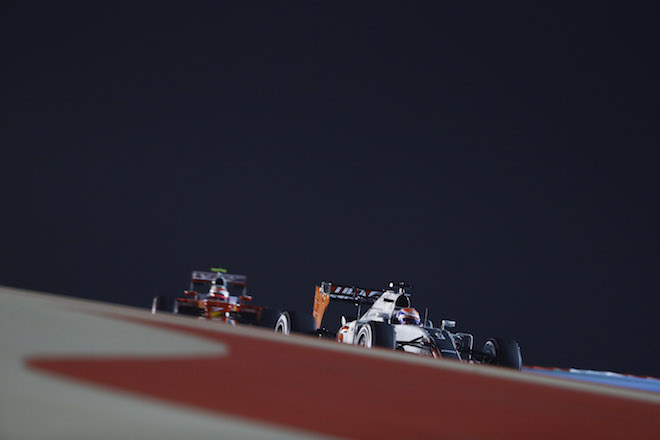
It is hugely sad to see the struggles of Sauber in 2016, with talk around the team suggesting that its financial situation is dire indeed. When one compares the history of Sauber and its current plight, to the seeming ease with which Haas has turned up and been competitive from the off, it is perhaps unsurprising to learn that there are some in the Formula 1 paddock whose noses have been put out of joint by the arrival of the American upstarts. Sauber's mess is of its own making. It has had chance after gilt-edged chance to sell and ensure its future. Perhaps Alfa Romeo will come to the rescue. Perhaps not. But its problems should not be used as a stick with which to beat Haas.
What Haas has shown is that, under the regulations as they are currently written, it is possible for a new team to be competitive. It also shows what can be done within the regulations to race on an affordable budget, by buying in that which it is not essential to make oneself. If anything, the example of Haas is that there exists a different business model in Formula 1, and that blindly sticking to the ways of the past and the strict aged understanding of "that which constitutes being a constructor," because that's the way it has always been, is churlish. It may not be the right way for everybody, but Haas has shown that there is more than one way to get things done. And thank heavens.
I have long argued in favor of allowing new teams to run old customer cars. My reasoning is that when one looks back at the plight of Virgin/Marussia, HRT (RIGHT), Lotus/Caterham and USF1, it is impossible to be of any opinion other than that they were ill-prepared. A leg up is what was needed to allow them a baseline from which to be competitive. Their handicap was always too great. Allowing a new team a two-year grace period in which to run an old car, before forcing them to become a genuine constructor for year three, seemed to me to be perfectly reasonable.
With the list of parts it is possible to purchase, and the determination of what constitutes a constructor now eased somewhat, the need for customer cars is perhaps less pressing. Haas was certainly favored by a loophole which they worked to their advantage by using as much wind tunnel time as they could. The fact that they weren't racing in 2015 meant that they weren't considered a constructor, and thus fell outside the very severe restrictions placed on current teams.
It has long been claimed that Ferrari made use of its association with Haas by seconding staff to work for the American team, and get around the wind tunnel restrictions by using Haas' wind tunnel. Whether that did or did not happen, that particular loophole has now been closed. But if Haas did use such an oversight to its advantage, can we really be angry about it? It is through finding these advantages that teams make themselves competitive. This is the great technical challenge of the sport.
Haas F1 will not finish in the points every weekend. But for now, we should all enjoy watching their success. In the history of Formula 1, 165 teams have entered the sport. Only 11 survive today. That means 154 have failed. We should take much heart from the knowledge that it doesn't like Haas will be making it 155, anytime soon.
Presented by:


Latest News
Comments
Comments are disabled until you accept Social Networking Cookies. Update cookie preferences
If the dialog doesn't appear, ad-blockers are often the cause; try disabling yours or see our Social Features Support.