Robin Miller's Mailbag for November 18, presented by Honda Racing / HPD
http://hpd.honda.com/
and on social media at@HondaRacing_HPD
and https://www.facebook.com/HondaRacingHPDYour questions for Robin should continue to be sent to millersmailbag@racer.com We cannot guarantee we’ll publish all your questions and answers, but Robin will reply to you. And if you have a question about the technology side of racing, Robin will pass these on to Marshall Pruett and he will also answer here.
Q: I would like to hear your take on the hiring of Mr. Jay Frye as the new IndyCar President. Being closer to the inside workings of IndyCar than most of us, what is your gut feeling that Mr. Frye will be able to succeed where so many others (some very qualified people) have come up short? Will the Indy braintrust be willing to go along with his recommendations and suggestions to improve the sport? Will we return to a full season again? (it should be eight and a half to nine months long). He seems like he has the brains and the fortitude to succeed. I have my expectations up for the future of IndyCar. Give us all hope.
Ron Hofslund
RM: To be technical, Jay is the new president of competition and operations – Mark Miles remains the president of IndyCar and overall boss along with IMS and Hulman & Company. Frye's experience in NASCAR (managing a successful team) gave him insight into rules, politics, sponsorship, personnel and survival. Of course this isn't any different than what Derrick Walker brought to the table, and this job is much bigger than one person can/or should handle, but he's got Miles' support.
My hope is that Jay is allowed to hire a couple of smart lieutenants for Race Control and future car/rules and is given a decent budget to improve the current infrastructure. Other than last May, Derrick was always front and center and in the line of fire and had an open door policy, and I think Jay (who is a good communicator) will follow suit. He got Phoenix back on the circuit, so hopefully he'll have a big say in the schedule, but don't expect Miles will ever let it go past mid-September.
Q: I am holding my breath that Jay Frye can survive and succeed as the new Director of Competition and Operations. I think I need to send him some chain mail, so he can have a fighting chance against the lances that will be aimed his way. Of course they will be coming from behind him, but it may help. Competent and good people don't survive very long in your town.
Deborah Schaeffer
RM: Car owners are a needy, greedy bunch with short tempers and short memories who always think they're being screwed. Right now Ganassi, Penske & Co are big supporters but, as history has shown us, that could change on one call that doesn't go their way or a rule change or a price increase. Like I wrote last week, shark repellent should be Frye's daily cologne.
Q: Now that IndyCar has a new leader I would like to mention, yet again, that I don't understand why the cars have to cost so much. I get it that we will have spec cars from now on, but aren't there cheaper alternatives? I don't think the hyper-expensive pieces no one can even see, such as mega-thousand-dollar dampers, add anything to the show. Having the cars lose mechanical grip on bumpy corners might make it more fun to watch and more of a driver challenge. If a much cheaper car was implemented wouldn't we get more cars in the show, allowing guys like Conor Daly get rides?
Tom Phillips
P.S. I always enjoy your insights and, even more, I like your articles/videos about past racers who didn't make the "first team," such as Jack McGrath.
RM: I don't know the answer, but you are spot on – IndyCars are way too expensive, and with such paltry purses there is no incentive for anybody to join the club. Not even for the Indy 500. I asked Richard Childress once why he didn't field a car at Indy and he said it didn't make any sense to spend $1 million to run for $250,000, and he's spot on. The imbalance of risk vs. reward is the biggest deterrent to luring new owners and until the costs are greatly reduced or the purses are greatly enhanced, it will remain a closed shop.
Q: What do you think of Jay Frye? Do you think he has the stones to handle the job. I sure hope so. I hope he has the right stuff to get IMS back on the right track. What do you think will happen to the Boston race? I hope the politicians don't mess it up. Is A.J. going to make it to Indy next year? Just finished reading Wallen's book on Ray Crawford. Very interesting read.
Don Betsworth, Torrance, CA
RM: It's not a matter of stones – it's being surrounded by good people. I like Jay's personality and people skills but one man can't rescue IndyCar racing. The whole culture needs an overhaul. I think the politicians will decide whether IndyCar is racing in Boston or looking for a backup race.
Q: Seems like Miles and IndyCar got their man and hopefully he can be Chief Brody and not Quint in the end. Aside from the uncertainty of the Boston GP it's looking like a good off-season so far. Honda got its wish for aero, which should hopefully lead to both them and Chevy signing at least three-year contracts. Road America is back, Phoenix is back, and St Pete just got extended. All this good news is making me nervous that TGBB will gain even more responsibility!
Jake Murray
RM: Miles hand-picking Frye could have been a cost-saving measure since he was already in house and on the payroll, but it could also be a good sign that the newest boss will have the support that Randy Bernard and Derrick Walker didn't. Financially and behind closed doors. I think Barnhart will continue his role of vice president of racing operations and handle the details of Race Control, but won't be the chief steward.
Q: I just read at another auto racing site that ISC has some "capital improvements" in mind for Phoenix International Raceway; namely, the start/finish line could be moved to the backstretch. What are your thoughts on how such a rearrangement might affect the quality of racing for the Indy cars? (I've also made my ticket purchase for the spring race).
Garrett from San Diego
RM: A good source in Phoenix says the answer to your question is "maybe". PIR is in need of facility updates but with $400 million being spent on Daytona, not a lot is left for the oval built for IndyCars in 1963 (and opened in 1964). If something does happen, it probably wouldn't be until 2018-2020 range, and one of the suggestions was to move the start-finish line past Turn 2. But it's all iffy right now and contingent on ISC giving PIR the money to make any major changes or improvements.
Q: I read the article about the Indy aero kit debacle in the most recent RACER hard copy edition, and I have to wonder why the series bothered with this exercise given the cost against the benefit? Now some of us are getting heat from other posters about the fiasco that is quickly becoming the Boston race, and my question is, how can the series run headlong into scheduling an event without having all of the hurdles crossed and obstacles cleared before announcing the event on the schedule? Yet again management looks bush league and ill-prepared to run a professional sports organization. Just my take as we prepare for the final two races in both F1 and NASCAR.
Neil Rubin
RM: The only two groups that really wanted aero kits were also the ones that funded it – Honda and Chevrolet (although the car owners likely would disagree and claim it cost them a lot more than originally promised). People kept saying why doesn't IndyCar just abandon them, but they'd already spent millions of dollars and (in GM's case) lots of time developing them. So when your two big dogs want a bone you give it to them. And I know Derrick was also a big fan of aero kits.
As for the schedule, dating back to the CART days it's always been the practice to announce a race when the city or government had given it the green light without any money changing hands. The Boston mayor endorsed IndyCar, and now we're seeing the expected backlash. I recall Paul Newman trying to get a street race in Philadelphia and he finally gave up because of all the politics. And that was P.L. NEWMAN! It does look bush league, but you don't ever see it in F1 because the check clears before Bernie ever announces anything.
last Mailbag
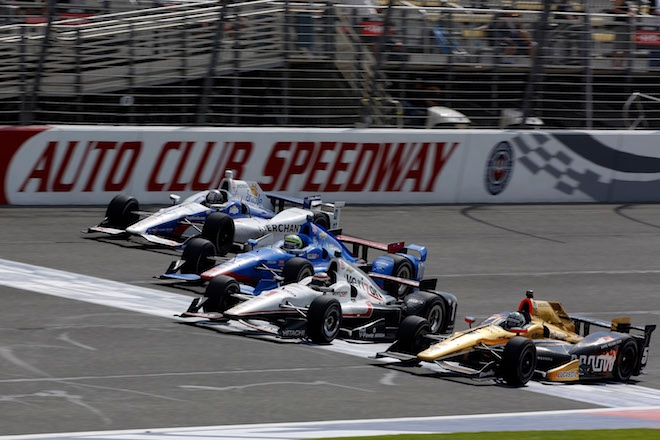
really angered me. I looked at the 2016 schedule with mixed feelings. Sure there is an interesting new street course, and two tracks returning with great history, but we lost some venues which I thought had some good racing, historical/ traditional value and potential for growth. Fontana is a track I have mixed feelings about. Always good racing, lots of passing but I still recall Greg Moore losing his life there as well. This year I was like everyone else, on the edge of my seat for the whole race. I can't delete it from my PVR, actually. Really was one of the best races in recent memory period; the stats prove that this track has a history of consistently producing great racing. Oh well, another great venue gone.I request a RACER Poll on Fontana:
a. Too dangerous, never go back.
b. No point returning without a good date/ time for attendance.
c. Use what we learned from this year, tweak the aero and go back.
d. Never liked Fontana, don't care.
Listen to AJ's comments after the race, I'm not sure he really understood what anyone was concerned about, another day at the office for him. Andretti's comments made me a new fan, no whining. It's not supposed to be safe, these guys are supposed to be braver than me, not just better drivers. I believe with some minor tweaks the racing could be almost as good and slightly safer for the drivers. Fan safety should be easy as you could close all the lower seats and use the area for add space. Should we bail on Indy too? It's kind of dangerous isn't it?
Sean Ogilvie, Vancouver BC
RM: OK, not really sure why I angered you, but I understand you are upset IndyCar isn't going back to Fontana and you are not alone. I think that race helped increase IndyCar's ratings for the rest of 2015 and, yes, danger is part of the attraction – always has been, and always will be. It's what sets open-wheel apart from stock cars and sportscars. And, in this case, even though it was a terrible date and time, the attention it generated on television offset the lack of paying customers.
Q: IndyCar has seemingly tried most everything to get fans back - except cutting cornering speeds way down! Such a move would allow the elimination of the stupid push-to-pass button. Do they ever discuss it? It would get at least the hardcore fans back immediately. It would also allow them to schedule races at more different venues. It is such a no-brainer!
Ron Thomas
RM: Well, push-to-pass is only used in street and road races – not ovals – but I do like the idea of increasing the straight-line speeds and slowing the cars in the corners by 20-25 mph. Rick Mears has been preaching this for a long time and I think the fans would enjoy watching the drivers slide through a turn rather than just be, a blur of downforce.
Q: Just a quick question, what's up with Mathew Brabham? Is he getting a ride anywhere for next year?
Fredy, San Diego, CA.
RM: He recently ran a truck in Robby Gordon's series, tested a stock car before that and also ran a Formula E race. It looked like he figured in Andretti Autosport's future plans but that appears to be on hold without a big sponsor.
Q: OK Miller, obvious question. Isn't now the time to strike at COTA and negotiate a race for the 2016 schedule? Apparently they'll have a fall opening. Didn't see that one coming.
Jim, Indy
RM: One of the problems with COTA was that Eddie Gossage always threatens to pull his race at Fort Worth if IndyCar goes to Austin. But, until IndyCar does something to make those Texas races watchable and maybe draw a crowd again, not sure how much leverage Edwardo commands. I guess we'll sit back and see if COTA will even be around in a year or two after seeing the state is pulling back. Obviously, IndyCar is a much cheaper alternative than F1 and would put on a better show, but can the track survive?
Q: Thanks for the video feature on Johnny Rutherford. He certainly was a helluva racer. And talk about a committed ambassador. In 1966 after that famous sprint car crash, when he still couldn't drive because of his broken arms, he attended races as a 'spectator'. At the USAC sprint car race at the Tulsa Fairgrounds, JR sat in the announcer's booth and functioned as the color commentator for the local track announcer, and was terrific. Unfortunately JR's appearance was overshadowed that night by the crash that took the life of Buffalo's Ron Lux. Of course JR's commentary was respectful and understated given the circumstances. Despite the fact that many of the same stars that drove at Indy were still racing on the dirt that night, I more clearly remember JR's turn at the microphone.
Steve C., Ithaca, NY
RM: J.R. is a great storyteller and has an amazing memory for the smallest of details about a car, a lap, a gear or a driver during his ascension in open wheel racing. I need to go to Fort Worth and spend an afternoon getting all those stories on video for RACER.com, then head down to Houston and do the same with A.J.
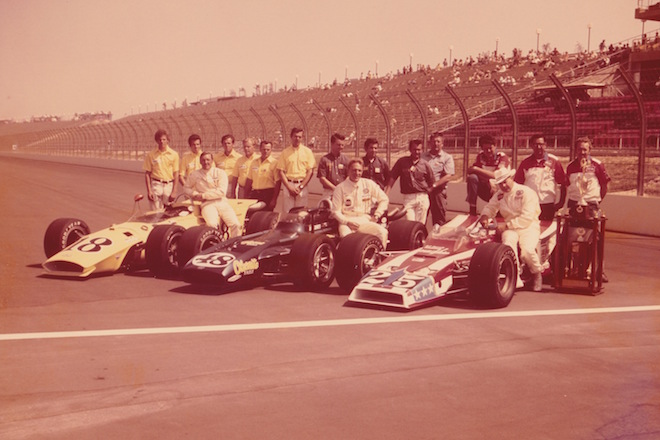
The coolest thing about Rutherford was his persistence and great self-confidence in that he was one of the best. It was 1970 (ABOVE in the front row with Dan Gurney and Lloyd Ruby in the inaugural California 500 at Ontario) when he really climbed back in everyone's radar before McLaren scooped him up in 1973. Didn't know much about Lux, other than I think he was a protégé of Jim Hurtubise. He made three Champ Car starts in '66 and finished sixth at Trenton before losing his life in the USAC sprint show you watched.
Q: Love the new Bench Racer video series! Here's my nomination for someone to cover this winter; midget specialist Bob Swanson. When Chris Economaki was asked who he thought was the best driver he's ever seen he surprisingly chose Swanson, even though Chris saw virtually every great driver in the world from the '30s to the '90s.
Steve, Eden Prairie, MN
RM: Thanks for watching, started the series last winter and it's fun to look back at the great drivers, cars, tracks and races. Swanson was a three-time starter at the Indy 500 (led 34 laps in 1937) and finished sixth in 1940 but his claim to fame came in the midgets. He won the first ever Turkey Night Grand Prix and many features before losing his life during hot laps at Perryville, Ohio. He was only 27.
Q: Your mention of Jackie Howerton in the previous Mailbag aroused my curiosity. Is he still involved in the racing biz in any capacity?
As a kid, I watched JH, Emmett Hahn and others have some great battles in the Oklahoma/Kansa/Missouri supermodified circuit. This was before Howerton moved to Indy to pursue a USAC career and Emmett became the entrepreneur responsible for the Chili Bowl. (Jack Zink poured a lot of resources into that series after ceasing his Indy 500 efforts as well.) The last I heard of Howerton, he was building (and rebuilding) hot rods. I always wondered why he gave up his driving career. Was it financial, injury or just a case of time-to-move-on with life?
Steve C., Ithaca, NY
RM: Jackie was good in midgets, sprints and dirt cars (shown ABOVE in his finest moment in 1974, beating Al Unser and Mario Andretti to win the Hoosier Hundred) but other than some laps at Phoenix for Pat Patrick's team, never got a chance in Indy cars. His fabrication business was beginning to pick up in the late '70s so I think that's why he quit driving – he'd gone as far as he could. Today, he and Steve Moal build hot rod roadsters in Prescott, Arizona.
Q: Why aren't the Lights running in Long Beach? It's been a tradition for years now to get there early, have a Bloody Mary and a breakfast burrito and watch the Lights race from the Irish pub right before turn six and the backstraight. The Lights have always been a great race at Long Beach. I'm very disappointed.
CAM in LA
RM: The short and honest answer is that the promoter and series owner Dan Andersen couldn't agree on a price.
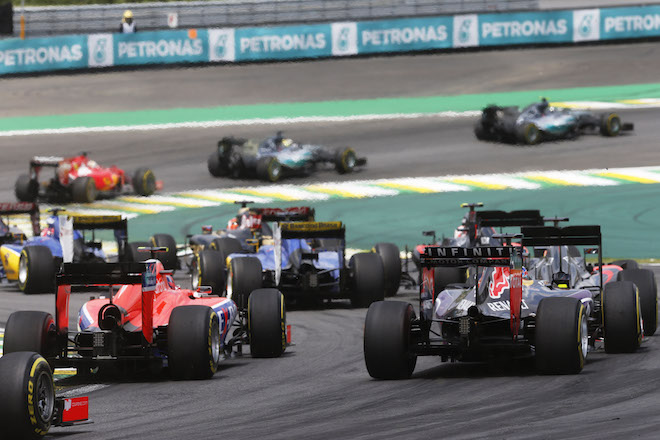
Q: I read about the guy trying to buy Manor F1 team which is losing money and I am struggling to understand the economics of F1. Do the big teams make money? Does the revenue sharing from the TV package, sponsorship, and merchandising put them in the black? It seems they never really seem to complain about the money while the smaller teams are always saying they are broke. I know the smaller teams don't see as much of the TV money but I really struggle to understand how any team can foot the bills for this racing. Yet every year it happens and people like Haas just want in. What am I missing?
Justin Klug
RM: I want our editor Mark Glendenning to weigh in on this but the only revenue sharing I know of is the television money. Paul Stoddart told me once that the $50 million he received from TV is the only reason Minardi was able to be on the grid. Obviously, the top teams usually have multi-million dollar sponsors to go with the multi-millions they get from television so some of them might make money. But building your own car and developing it is expensive so I wonder how many teams are in the black?
MARK GLENDENNING: Forbes had a good breakdown of Red Bull Racing's finances a couple of years ago, when the team was at the height of its dominance. In short, its total revenues for the season were just shy of $375 million - but its net profit was only $7.5 million. And remember, that was for a team that had just reeled off a four-year championship streak. The formula for distributing prize money (which includes TV money) from F1 to the teams is stupidly complicated, but it depends in large part upon that team's finishing positions both the previous year, and also over the previous three years. Here's how the FOM payments to the teams shook out for 2014: Ferrari ($164m), Red Bull ($156m), Mercedes ($126m), McLaren ($98m), Williams ($83m), Force India ($60m), Toro Rosso ($54m), Lotus ($51m), Marussia ($48m), and Sauber ($44m).
Certain teams, particularly Ferrari, get various bonuses based upon their importance to the sport, which is why the Prancing Horse took the most money despite only finishing fourth in the standings. It's also worth noting that those prize money payments are only made to the top 10 teams in the Constructors' table. In seasons with 22 or more cars, the teams that finish below tenth get roughly $9.5m, which is only about a fifth of the budget needed to put two backmarker cars on the grid. Additionally, the bigger teams are obviously more attractive to sponsors, and might also get manufacturer support.
Q: I know you regularly field questions/comments about you writing a book concerning the history of IndyCar/Champ Car/CART. Your response is usually the same - basically, that A.J. would kill you if you wrote the book ... perhaps a half-serious/half-joking response. Regardless of your true reasons, consider me one of the many who would urge you to do a book detailing the history of American open-wheel racing over the past 50 years. Never mind that others have or may in the future publish such a book. Your unparalleled knowledge and insight, passion, irreverent sense of humor, and disregard for what others think (well, perhaps except for A.J.) are exactly why you are the perfect individual to write such a book. Please reconsider and write this much-needed book. We need it for these long IndyCar off-seasons!
Rick Johnson, Lynnwood, WA
RM: Well I appreciate your kind words Rick but for now I guess the closest thing to a book will be the weekly videos I do here on RACER.com about the history of open-wheel racing. I know my pal Gordon Kirby is planning a book on IndyCar's history, and it will be a good one.
Q: Any speculation that Smoke [Tony Stewart] may now expand into IndyCar ownership and/or perhaps even a one-off for the 500 after next year?
David Spear
RM: We keep saying it makes sense as long as Chevrolet has a dog in the fight so maybe after he stops driving in NASCAR he'll pull the trigger.
Q: Will you be going to Tucson for the USAC sprint car finale this weekend? Robert Ballou is leading Dave Darland and Chase Stockton going into the final three races of the year. Ballou's story is a good one as he has mostly been a small budget team competing against the regular big names in USAC like Darland, Tracy Hines, Stockton, Clauson and the other badasses. Ballou has the most sprint car wins this year and has been on a hot streak during the second half of the season. Ballou has a good lead heading into Tucson but don't count out Darland or Stockton. Hope to see ya there!
Mike Hickman
P.S. Ballou's mechanic, Derrick Bye, is another good story. He has a regular job building roads and bridges during the week and wrenches for Ballou on the weekends. He and Ballou build the cars and are basically a two-man team leading the toughest national division in open wheel racing on dirt.
RM: Good story and thanks for the information on Robert and his chief mechanic. First time I saw Ballou run Eldora was in the Four Crown years ago when I worked at SPEED and he was nothing short of breathtaking for 40 laps. But his interview afterwards was priceless. He said it was tough to beat all those kids and then we found out he was 18. Obviously, he's a gasser and it looks like he's smoothing out as well. A 60-point lead over Darland with three races remaining this weekend in Tucson is healthy but hardly safe. I won't be attending but I'll be watching on LoudPedal.TV.

Latest News
Comments
Comments are disabled until you accept Social Networking Cookies. Update cookie preferences
If the dialog doesn't appear, ad-blockers are often the cause; try disabling yours or see our Social Features Support.