At the Coronado Speed Festival: Homage to 1915
Auto racing isn't new to the San Diego area and it didn't start with the first of 18 runnings of the Coronado Speed Festival vintage races dating back to 1997. In fact it was 100 years ago when the sport made its first big impression in the region. Some of the brightest stars of the day converged on nearby Point Loma for one of the major contests of the year on a 5.982-mile public roads course.
Point Loma is visible from the U.S. Naval Air Station North Island on Coronado Island, the venue of the SportCar Vintage Racing Association (SVRA) sanctioned speed festival. It was there on Jan. 9, 1915 that 18 snarling purpose-built, top-level racers complying with the American Automobile Association's (AAA) "Class D" – or biggest engine displacement category – launched into battle.
The field was comprised of some of the stoutest wheelmen anywhere, many of whom still conger up legendary tales among racing aficionados: Barney Oldfield, Bob Burman, Eddie Rickenbacker and Earl Cooper. In addition to these men three others were Indianapolis 500 veterans: Tom Alley, Eddie O'Donnell and Art Klein. Elite West Coast talent Louis Nikrent, winner of the grueling 1909 "Cactus Derby" Los Angeles-to-Phoenix off-road race, was also among their number.
Most of the cars were state-of-the-art, too, with Stutz, Maxwell, Duesenberg, Mercer, and Peugeot heading the list. The era of the specials was dawning with three of those lining up for long-time AAA starter and New York Times columnist Fred Wagner – a Carling, Shields and the Tahis Special. The Tahis is the only original 1915 competitor to return to the Coronado Speed Festival this year. Another car, an Ono, perhaps the oldest unrestored racer in existence and a unique combo of Fiat chassis with Pope motor, was entered but failed to start. It, too, is at Coronado.
The race proved to be a bone-jarring rugged contest typical of the era some call "The Heroic Age." Aside from the still-new Brickyard at Indianapolis and the wood planks of Playa Del Rey the use of a paved running surface was yet a luxury and these, the waning days of America's first great road races, still offered up rugged, craggy, crushed-stone or dirt public passageways.
In just the first lap two cars fell by the wayside when Gordon Huntley's Mercer bounded over a railway crossing to blow three tires and hurtle off course destroying his radiator and narrowly averting a collision with a carload of spectators. Elsewhere on the course Duesenberg's Jack Callaghan lost control on a curve to strike a telephone pole and bust off two of his front teeth on the steering wheel. In the spirit of the rugged men of the day he returned to the race later as relief driver for teammate Eddie O'Donnell.
The thump-inducing terrain of the circuit and associated debris took its toll throughout the race. Louis Nikrent's Mercer broke a fuel line. Rickenbacker snapped a connecting rod. Ignition trouble and a subsequent fire eliminated Oldfield's Maxwell. In the end Earl Cooper claimed the trophy in his Indianapolis-built Stutz (ABOVE). It took him four hours, 40 minutes and 10.8 seconds to complete the 305 miles. Local boy Billy Carlson gave San Diegans something to cheer about with a surprise runner-up performance. Only six cars survived the grind.
The race, organized by local Shriners, was a civic-boosting affair aimed at supporting the Panama-America Exposition that ran concurrently. At least for a day it literally overran the exposition by attracting an estimated 50,000 spectators to the fair's scant 6100 attendees.
The other objective was to showcase the thriving San Diego community and fuel its growth. By that measure it at least contributed to the goal as steady expansion produced congestion that made future editions of big-time racing not feasible. Somewhat a victim of its own success, the Point Loma contest was never staged again.
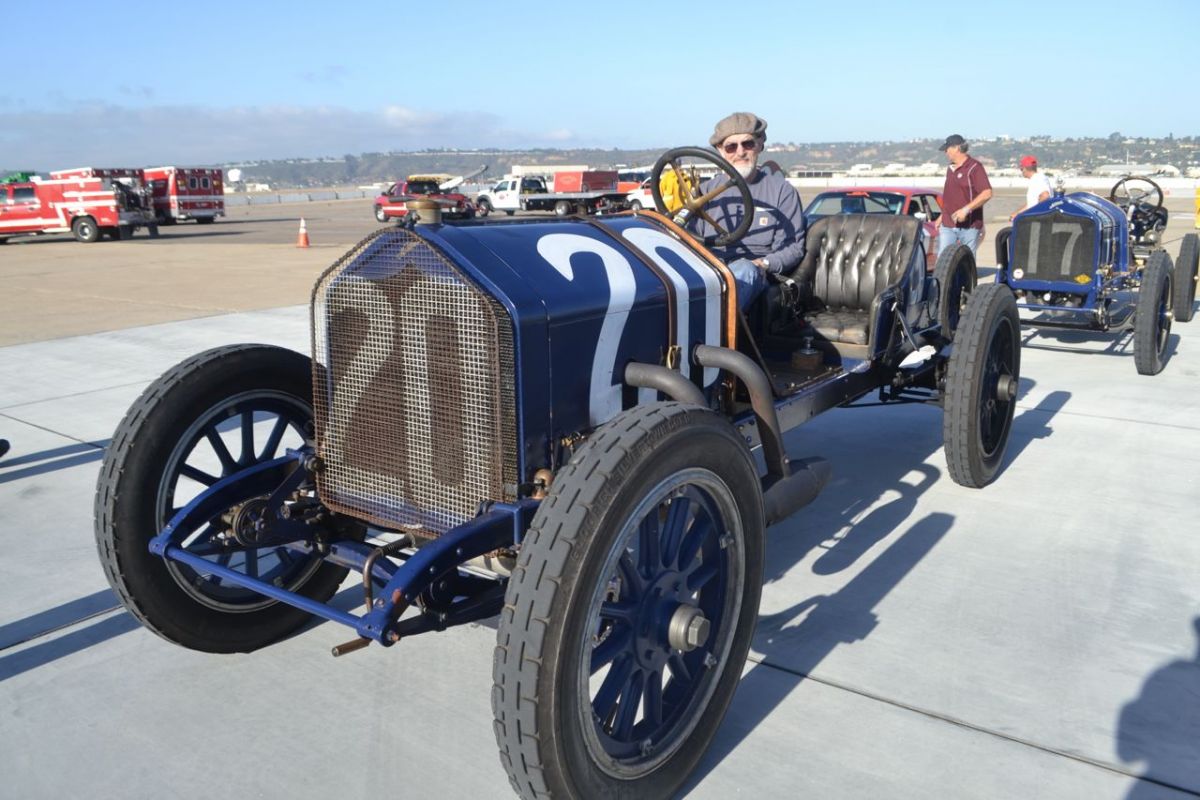
True motorheads never forget, though and hence we have the SVRA-endorsed "re-enactment" at the Coronado Speed Festival. Led by Brian Blain, who owns a 1910 National racer (profiled on RACER.com in June) driven to seventh place in the first Indianapolis 500 by Charlie Merz, 12 authentic race cars of the era have gathered in homage to the pioneers of the sport so many love.
Like the 1915 race Blain believes this event, perhaps better termed an homage rather than reenactment, will likely never be staged again. The logistics of pulling together a meaningful gathering of such rare vehicles, the complications of operating them, the delicacy of their aging parts all combine to produce significant challenges.
Such issues proved daunting for a January celebration of the centennial of the original event by the local Horseless Carriage Club. They attempted to stage their show on many of the original public roads. This introduced complications of coordination with city police and the reality of stop-and-go travel the old cars simply don't tolerate.
"I don't think this will happen again in our lifetime," Blain says. "The cars are so rare and expensive to transport and operate."
What has worked extremely well is coordination with Coronado Speed Festival race officials. This is especially true of working with the SVRA, a group whose purpose is to provide venues to race valuable vintage cars.
"These are priceless, temperamental cars. They all have non-synchromesh transmissions. No front brakes. If you want to go from 80mph to 20, you have to plan a half mile ahead," Blain explains. "When you can work with a guy like Tony Parella (SVRA President & CEO) it's a huge advantage. He understands what we're up against. And the airport course is beautiful and smooth."
Still, Blain shares that there are times when he questions if the effort is worth the reward. The expensive and time-consuming tasks involved are performed without financial compensation. He and the other car owners are fueled by passion and rewarded by sharing with others.
"Maintenance is such a gigantic job," he says. "We come home and look at all the wear and tear we have to repair. Sometimes I just want to park them. But, no, I just believe it is important for people to see these cars running, not parked in a museum. If you have never smelled an engine burning castor oil, you just have not lived."
Period cars entered at Coronado. Asterisk calls out the two original entries from the 1915 race.
1) 1913 Mercer
2) 1912 Ono*
3) 1910 Fiat S61
4) 1913 Isotta Fraschini Typo IM
5) 1913 EMF
6) 1914 Franklin
7) 1914 Tahis Special*
8) 1915 Ford
9) 1911 National
10) 1912 Packard
11) 1916 National
12) 1916 Sturtevant-Auburn
Click on the thumbnails below for larger images:
{igallery id=1370|cid=397|pid=5|type=category|children=0|addlinks=0|tags=|limit=0}

Latest News
Comments
Comments are disabled until you accept Social Networking Cookies. Update cookie preferences
If the dialog doesn't appear, ad-blockers are often the cause; try disabling yours or see our Social Features Support.