BMW of North America 40th anniversary special: Won and Done
Three years, two cars, one initial aim and major collateral success. That's how BMW's return to a werks effort in U.S. sports car racing should be remembered.
First came the mighty 580hp BMW V12 LMR which, built by the Williams F1 team, operated by the legendary Schnitzer Motorsport squad, and driven by talents such as JJ Lehto and Jorg Muller, seemed to have the right stuff...
"It's fair to say that the V12 LM of 1998 had not been a success at Le Mans," says Schnitzer's team manager since 1978, Charly Lamm, "but it's also true to say that it was done in a big rush. So Gerhard Berger, who had become competitions director with BMW, made an agreement with Frank Williams and Patrick Head to build the V12 LMR car as a precursor for their Formula 1 program together.
"It was fantastic. Williams provided a group of engineers in an extra facility – really good, smart people – and we delivered the engine. Gerhard, who had raced for us very successfully in European Touring Cars in the 1980s, appreciated our ability to run cars in endurance races. We'd won the 1985 Spa 24 Hours together."
But even with all these stars aligned, it was a shock to win first time out in the 1999 American Le Mans Series, conquering the 12 Hours of Sebring (RIGHT). For BMW to go on and finish second in the championship, despite missing two rounds due to its pursuit of 24 Hours of Le Mans glory, was no less impressive.
At Le Mans, Sebring winners JJ Lehto, Tom Kristensen and Jorg Muller missed out on a win when a stuck throttle caused Lehto to crash, but the sister V12 LMR of Yannick Dalmas, Pierluigi Martini and Jo Winkelhock was able to claim the honors ahead of a factory-packed field.
Post-Le Mans, Lehto and Steve Soper added three more ALMS wins, falling just two points short of a Teams' title for BMW.
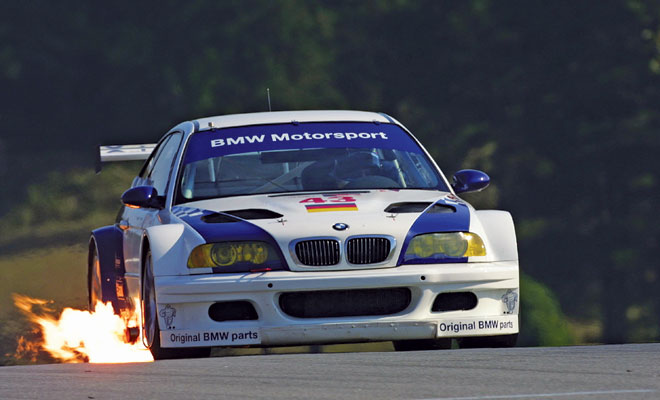
In 2000, Lehto and Jorg Muller claimed two more ALMS wins for the V12 LMR (LEFT), but there was a new plan brewing: The M3 GTR with a flame-spitting 470hp V8 at its heart...
Says Lamm: "That decision was made in August 2000 as F1 was now the frontline championship for BMW in Europe. But BMW of North America was keen to continue, as the M3 and 3-series are so popular in the U.S. A one-off GT homologation rule allowed a road-going version of the E46 M3 with a 4-liter V8 instead of the inline-6. That gave us a fantastic car for beating Porsche in '01.
"We borrowed six-cylinder M3s from Tom Milner's PTG team to pick up points in the first race because the timeline for the V8 had been frantic – the project only started in December 2000! Then the V8 GTRs were shipped to the U.S. – we'd had a team facility in Los Angeles since 1999 – and they were great. The V8 gave the M3 more power and better weight distribution."
While Porsche 911s took the first three rounds of the 2001 ALMS, M3 GTRs won the other seven – five and the prestigious GT Teams' title for Schnitzer-run BMW Motorsport, and two for PTG. The initial plan was to continue in ALMS, but the Balance of Performance rules for '02 would have stifled the M3s, so the decision was made to withdraw. Still, the GTR had accomplished its mission, and Lamm looks back with fondness on Schnitzer's three-year U.S. adventure.
"Racing in America is fantastic," he says. "Open paddocks and a strong connection to the fans. They would thank us for coming all the way from Germany! Very friendly."
Some 15 years later, it's clear that BMW and Schnitzer captured not only prestigious trophies, but also the hearts and minds of North American race fans with a brief, yet very sweet ALMS success story.
M3 HAS RACING IN ITS DNA
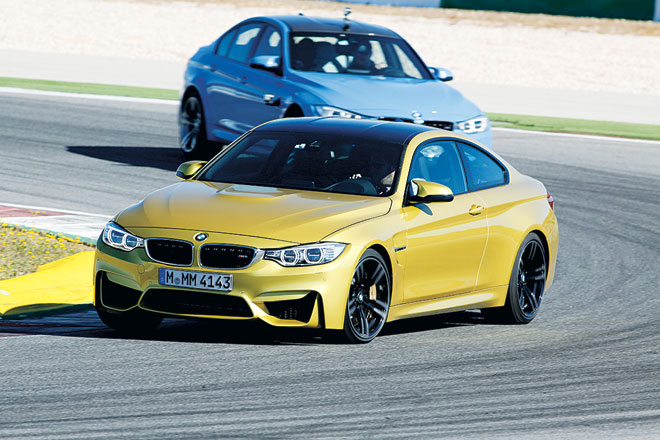
Six generations and 40 years on from its debut, the BMW 3 Series rules the sports sedan class. It's BMW's bestseller, and has motorsport pedigree, at the apex of which is the M3.
The latest M3 (sedan) and M4 (coupe), while able to carry up to four passengers and a trunk full of groceries, also remain great track day weapons. A carbon fiber roof, driveshaft and engine brace, along with carbon-ceramic brake rotors, saved 180lbs over the previous model to help increase the power-to-weight ratio by nine percent.
Coupled with a more efficient twin-turbo engine, a rear subframe bolted directly to the body without rubber bushings, integrated lap timer and more, the M3/M4 line begs a question: "Where's the nearest racetrack?"

Latest News
Comments
Comments are disabled until you accept Social Networking Cookies. Update cookie preferences
If the dialog doesn't appear, ad-blockers are often the cause; try disabling yours or see our Social Features Support.