Bob Bondurant – Making history, 50 years ago
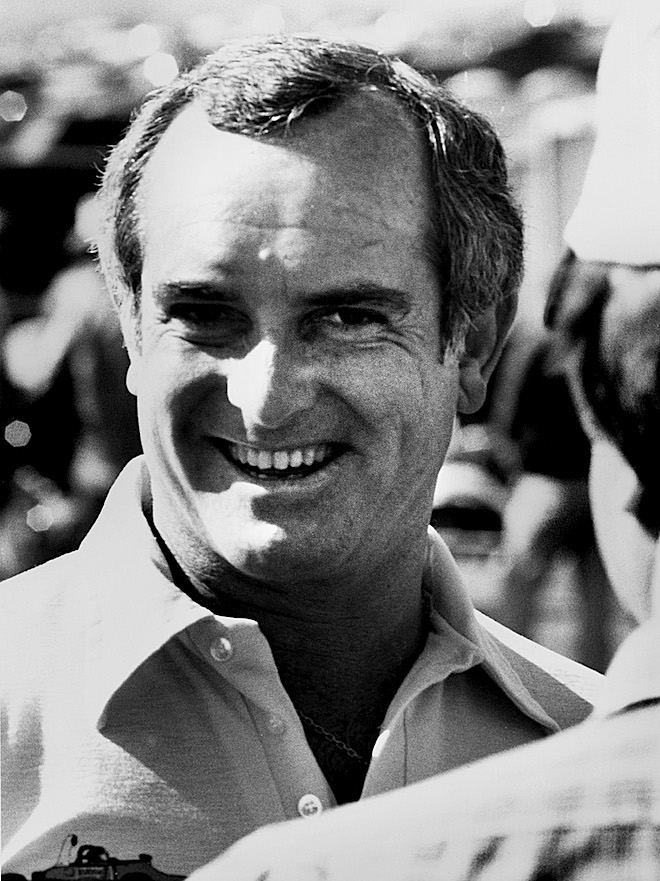
Dan Gurney is the only driver to win a Formula 1 Grand Prix in an American-built car and is disappointed no one followed in his wheel tracks. Fellow East-coast-born/West-coast-domiciled Phil Hill was impatient for another American, Mario Andretti, to join him as a U.S. World Champion. And Mario himself regularly expresses disgust at the lack of American presence in F1. That’s understandable: never mind the championship, it’s 37 years since a U.S. citizen has won even a single F1 race.
And 82-year-old Bob Bondurant – still fit, still fast, still working – is bewildered as to why no American driver has conquered the international sports car stage as he did 50 years ago today. Mario Andretti and Eddie Cheever played major roles in Ferrari and Jaguar clinching the Manufacturers’ championship in 1972 and ’88 respectively, each contributing four victories, but had there been a drivers’ championship in the world sports car scene in 1965, Bondurant would be the first and last star-spangled global champ.
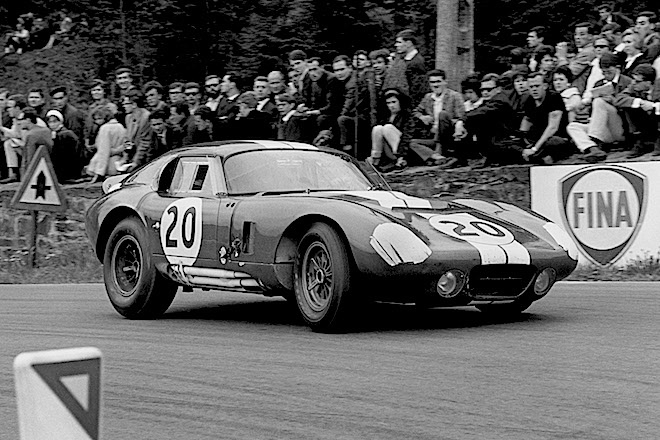
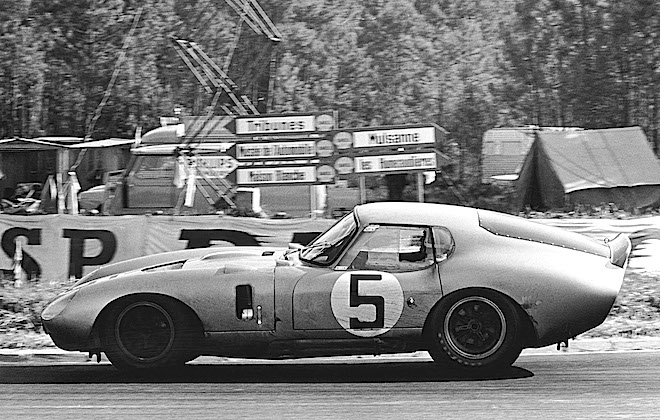
Bob’s triumph in the Shelby Ford Cobra Daytona Coupe was a significant one, coming as it did at the height of the Ferrari vs Ford war. It was also a comprehensive one – seven wins from 10 races. But it was also a very personal one, as it went against his team owner’s wishes. If that sounds bizarre…well, it is.
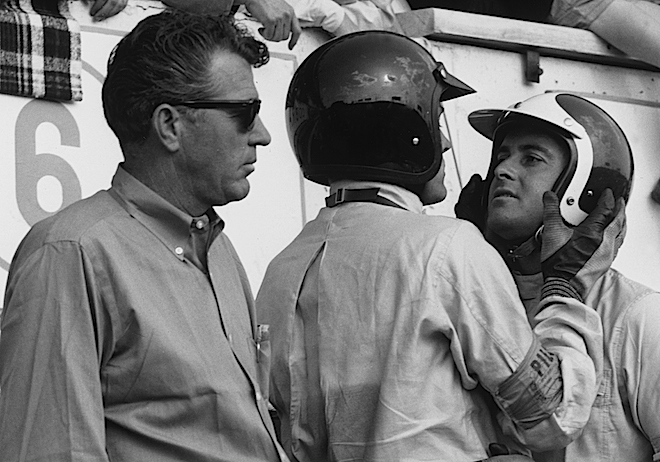
In 1964, Bondurant had raced the Cobra roadster and the slippery and striking Daytona Coupe model for Carroll Shelby. Together they had achieved great success, with Bondurant and Gurney (LEFT, with Carroll Shelby on left) sharing the winning Coupe at the 24 Hours of Le Mans (BELOW). In fact, had Ferrari not forced the FIA to un-sanction 1964 round at Monza, there’s a strong chance Bondurant/Shelby could have scooped the title honors a year earlier. For ’65, the situation changed. While Shelby American would still run the cars at Daytona and Sebring, the European events would see the Cobras operated by British team, Alan Mann Racing.
Say what?!
Bob is a mild-mannered man and even now allows himself only to say that Mann's words "pissed me off,” but one suspects at the time his astonishment indignation was overflowing. He and Richie Ginther had finished third in a Ford GT40 at the Daytona 2000kms in February, and then in March, Bob had won the GT class in the Cobra Coupe at Sebring 12 Hours partnering Jo Schlesser. Oh, and if anyone needed reminding, he was defending GT class winner at Le Mans. Robert Bondurant of Evanston, Ill., had no need to be subservient to anyone.
Perhaps inevitably, this cock-eyed team arrangement served merely to strengthen his resolve. He would let the stopwatch and the results sheet tell the story of who was really king Cobra driver…
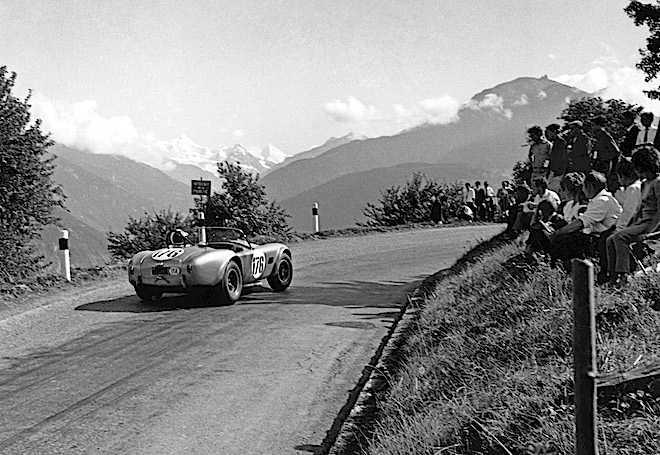
Just as he wasn’t intimidated by tree- and ditch-lined tracks, Bondurant – unlike some of his co-drivers – had never been intimidated by the Cobra Roadster, feeling that its drag-inducing open cockpit was far more of a drawback than the squirreling of the rear end in high-speed corners. But then his smooth driving style doubtless helped calm a wayward chassis, which is why he threw the Cobra roadsters up the European hillclimbs (LEFT, Sierre-Montagna in ’64), throttle-steering his way though hairpins as assuredly as he tackled 150mph corners at Monza, Le Mans or Spa. But Bob admits the roadster’s lack of straightline speed had been a considerable handicap when Ferrari’s 250 GTO was capable of 180-plus, so the Peter Brock-designed Daytona Coupe’s 195mph capability more than helped redress the balance. As one can imagine, it had been crucial to his ’64 Le Mans win, given the chicane-free Mulsanne Straight.
“But the Coupe was better in every area,” Bob points out. “There were further suspension improvements for ’65. We were strong under braking, although so were the Ferraris, but we definitely had more torque than them. And our car was fantastically reliable. We just didn’t break down that year.”
School [of High Performance Driving]
. I treat the gearstick like an egg, gently smooth it into place rather than slamming it in like everyone else was doing. And then I was trail-braking, too, instead of hitting the brake pedal hard at the end of the straight. You’d see the guys who did that would often slow too much and then have to go back on the gas harder which would upset the balance of the car and use up its rear tires too quick. I was keeping the brakes gently on after turn-in but carrying more speed into the turn.“It was all about saving the car for an entire stint and, in the long races, needing fewer parts swapped out in pit stops. I’d kept on refining the technique.”
As well as taking less out of the car, a silken touch took less out of the driver, too. Physical exertion can cause mental fatigue – a crucial situation to avoid when lapping slower cars or in the literal and figurative heat of battle. For that reason, Bob kept himself extremely fit – unusually so, for that era – going jogging and doing regular pushups. His wife Pat, 22 years his junior, has a note of awe in her voice when she remarks that Bob still works out every day, and the proof is obvious. In his ninth decade, Bob looks capable of fitting in the same racesuits he wore half a century ago.
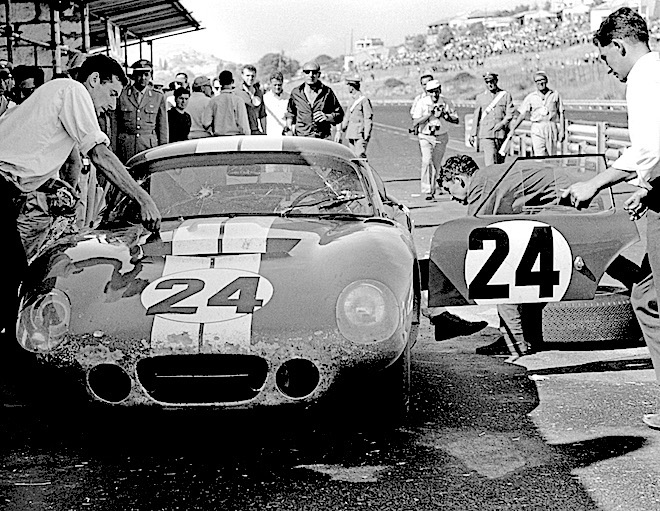
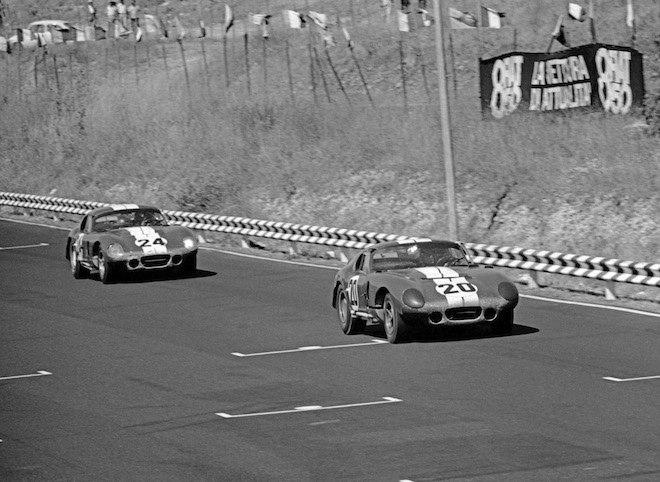
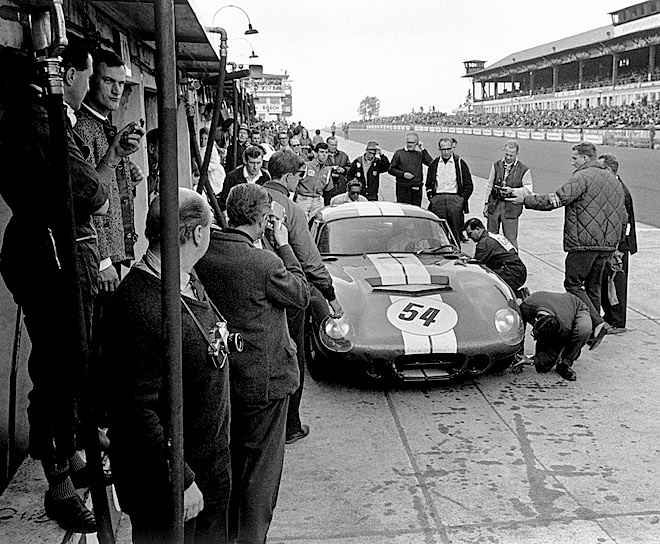
(ABOVE RIGHT: Sears leads Bondurant at Enna. They wouldn't remain in this order for long, after Bondurant incurred heavy windshield damage - as seen in the pitstop at TOP.
Endurance driver par excellence though he was, Bondurant was no cruiser and wasn't merely a safe pair of hands. His aforementioned determination to prove his worth fired him up in a way that Alan Mann surely didn't intend. For all but one race that year, Bob outqualified “the British car,” and he paid mere lip-service to the whole team orders nonsense since he saw no logic in it.
“I was there to win,” he explains simply. So whether he was supposed to be running at least 500 yards behind his teammates, or leading them but being instructed from the pit wall to slow down to let the other Cobra catch up and pass, Bob had a technique devised whereby he’d cruise past pit lane “and then drive like hell the rest of the lap!”
That he was able to execute that plan speaks volumes for Bob’s instant, natural pace… as does the fact that at "The Green Hell," as Jackie Stewart would label the 14.1-mile Nurburgring, Bondurant set a GT lap record that would stand for 15 years! Sure, the Shelby Cobra Daytona Coupe was a fast car, but if one car outqualifies the other two examples by 14 and 18 seconds, the driver deserves huge credit.
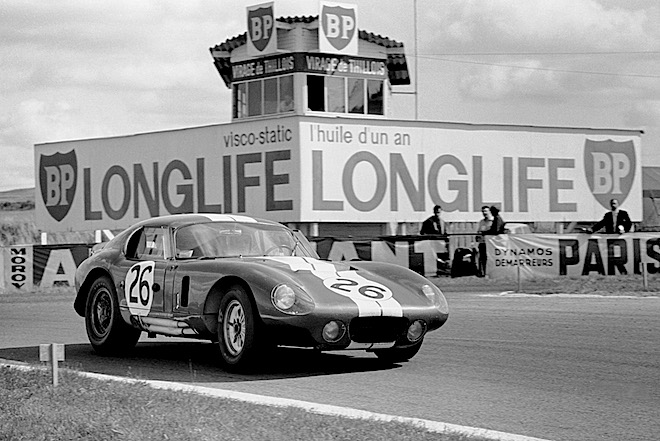
“That was the race where we won the championship," says Bondurant recalling that warm night-to-day race in the Champagne region of France. "The fact that it was Fourth of July weekend was coincidence but a very nice coincidence and I felt very proud,” he recalls, before dismissing the irony of defeating the very pro-British “enemy” within the team on Independence Day. “I’d have felt the same way if I’d been in that situation with a group from anywhere else in the world,” he insists. "It was what the Shelby team deserved having come up with this fantastic car."
So proud was Carroll Shelby of his car’s triumph over Ferrari, that he rated that 1965 International Manufacturers’ title above the personal satisfaction he’d felt after winning the 24 Hours of Le Mans as a driver six years earlier, sharing an Aston Martin DBR1 with Roy Salvadori.
As for Bob, the immense personal satisfaction of a seven-win season was doubled many years later.
“Carroll Shelby had a gathering of everyone he could summon from that title-winning team,” says Bondurant, “and we had this get-together at Sears Point [now Sonoma Raceway]. I was giving hot laps of the track, and Alan Mann approached the car, and asked ‘Can I ride with you?’ I said, ‘Are you sure you want to do that?!’ But anyway, he did, and I gave him a couple of real 'ten-tenths' laps around there! Afterward, he said, ‘I can see why you were so fast and why you always got our car to the finish. You’re so smooth while going flat-out.’ I said, ‘Well, thank you.’ And that sort of broke the ice and he apologized to me for what had gone on in ’65. That was good.”
Here’s not the place to delve into detail about Bondurant training the much-missed James Garner to do his own driving in the Grand Prix movie… which of course would also prove useful for his driving in The Rockford Files series. Nor should we spend too long pondering Bob’s class-win-that-got-away at Le Mans in ’67 in the Corvette, or the career-ending crash in a Can-Am McLaren later that year at Watkins Glen. Let’s instead revel in the fact that Bob Bondurant beat enemies and teammates to become the spearhead of Shelby Ford’s success with the Cobra Daytona Coupe and clinch the sports car crown for America.
Enjoy the video… and have a happy Fourth of July.

Latest News
Comments
Comments are disabled until you accept Social Networking Cookies. Update cookie preferences
If the dialog doesn't appear, ad-blockers are often the cause; try disabling yours or see our Social Features Support.