.jpg?environment=live)
Andrea de Cesaris: His F1 career in pictures, 1980-’94
who died Sunday, Oct. 5
, made his Formula 1 debut as a baby-faced 21-year-old (BELOW) in 1980.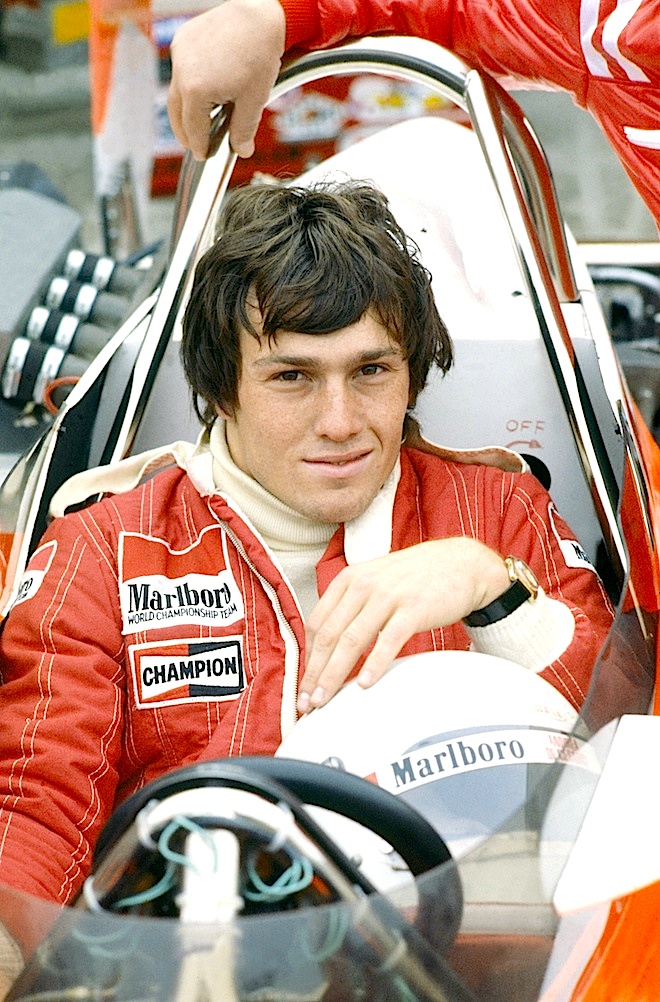
De Cesaris showed strong pace for a rookie, qualifying eighth on his debut at Montreal (ABOVE) but his engine let go. In Watkins Glen he started 10th, but spun off in the early stages of the race.
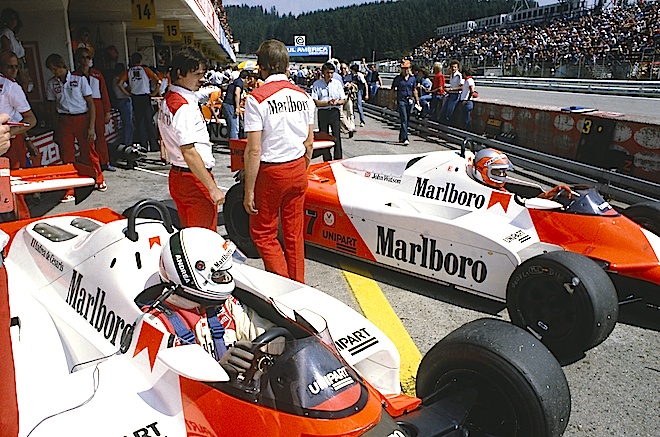
In 1981, he rejoined Ron Dennis, who was now in charge of McLaren. De Cesaris had raced for Ron's Project 4 team in Formula 2 and, with Marlboro money oiling the wheels of career progression, the Italian found himself alongside John Watson (BOTTOM).
While the experienced and wise Irishman went on to finish sixth in the championship, with a victory at the British Grand Prix and a handful of other podium finishes proving McLaren's resurgence from the doldrums, de Cesaris had an awful year, peppered with several wild moments and accidents. Dennis let him go at season's end.
It's worth noting, though, that when Andrea became an innocent victim of the Gilles Villeneuve-triggered shunt at Silverstone, he was running ahead of his teammate, who went on to score the win.
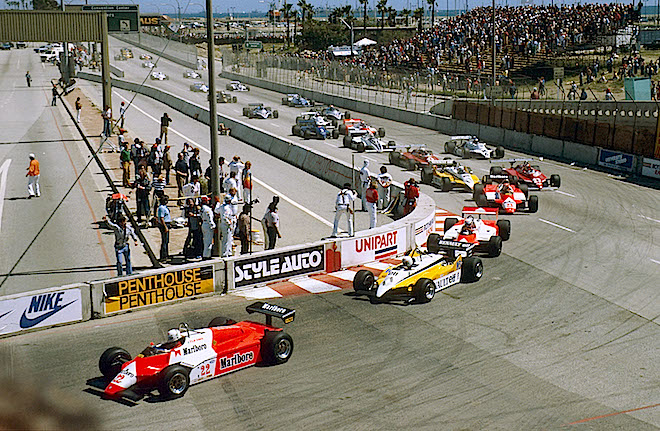
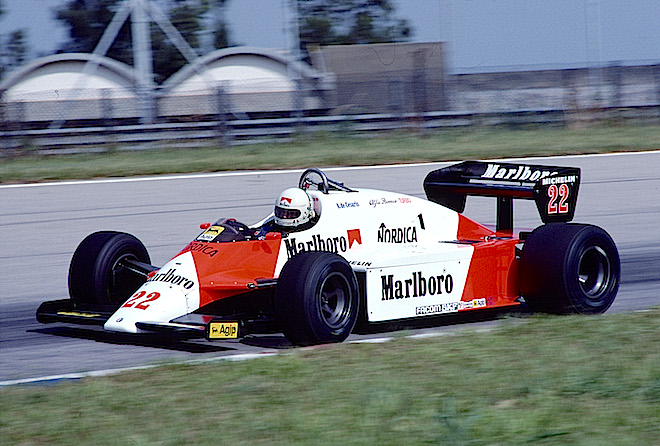
Once more armed with Marlboro money, Andrea found himself at another team backed by Philip Morris cigarettes – the Alfa Romeo Autodelta team with which he made his debut. (The Alfas were identifiable from their McLaren "brothers" due to their black front and rear wings and far more orange on the rear bodywork.) In Andrea's first year there, the sole highlight was pole position at Long Beach (ABOVE), but after Niki Lauda passed him at one-third distance, the Italian crashed out. His first podium, at Monaco, could also be regarded as a high point but it was a race that he, along with about five other drivers, could have won. In AdC's case, he ran out of fuel.
De Cesaris went on to finish 17th in the championship with just five points (which were awarded 9-6-4-3-2-1 to the top six at each GP), but there were far fewer accidents, the miserable points tally far more attributable to the Alfa Romeo's lamentable reliability, whether armed with a normally-aspirated V12 or a turbo V8. Giacomelli suffered similarly, finishing 22nd in the table with just two points.
In 1983 (BELOW), with Giacomelli gone, de Cesaris effectively became team leader, as new partner Mauro Baldi was rarely on his pace. Andrea responded admirably and again, the self-induced incidents reduced. Twice – at Hockenheim and the season finale at Kyalami – he finished runner-up, but there was a true "one that got away" moment at Spa-Francorchamps, where he was leading comfortably before first a slow pit stop and then a blown engine eliminated him.
Andrea would finish the year with 15 points, eighth in the championship. That would remain his highest points tally and .position, despite 11 more seasons in F1.
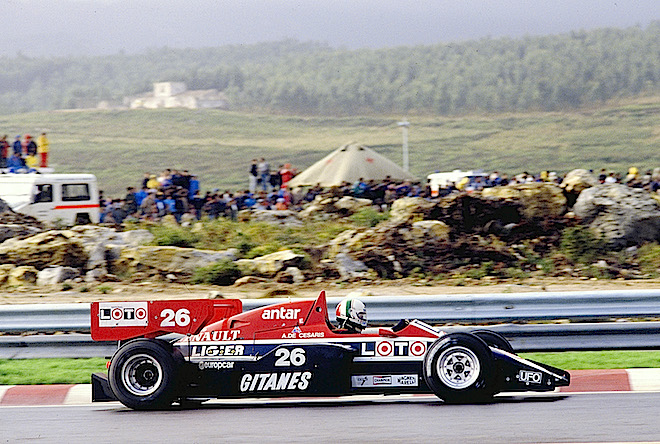
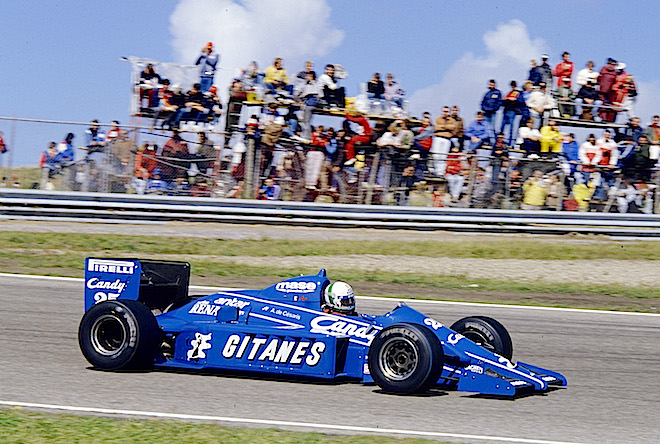
At Ligier for 1984 (ABOVE) and ’85 (BELOW), de Cesaris' wild crash-prone ways returned, and were particularly highlighted in the second year by partnering the surprisingly swift but calm veteran Jacques Laffite. One race after this particularly alarming multiple barrel-roll in the handsome JS25, de Cesaris was fired mid-season by team owner Guy Ligier. Fourth at Monaco (always a de Cesaris favorite) had been the sole highlight.
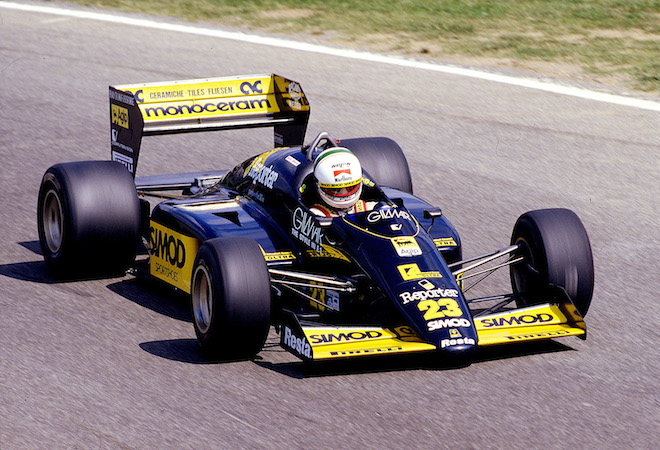
In 1986, the Italian joined the fledgling Minardi team (BOTTOM) but the team was a backmarker, and he only finished once. Depending how you look at it, De Cesaris showed well against rookie teammate Alessandro Nannini, 8-8 in qualifying. Nannini, of course, went on to prove to be one of the best "second-tier" drivers in F1 - very good with occasional flashes of greatness – until a helicopter accident ended his F1 career before his prime.
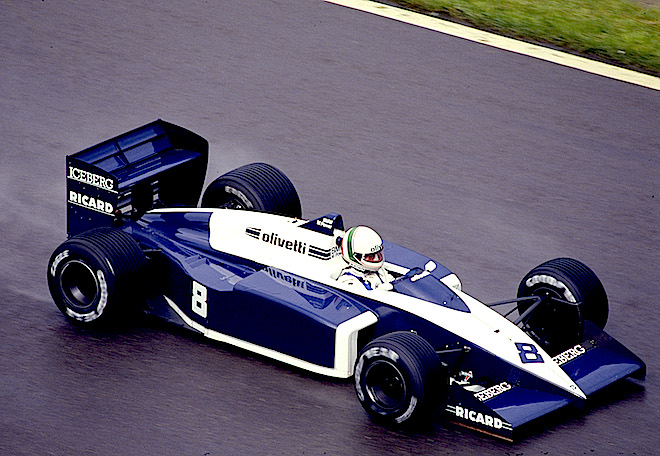
The lovely-looking Brabham BT56 (ABOVE) could have been de Cesaris' salvation in 1987, but it was the first post-Gordon Murray design, and team owner Bernie Ecclestone was on the verge of closing the team down. The Megatron-serviced BMW was nowhere near the Hondas, TAG-Porsches or Renaults in terms of power, fuel consumption or reliability, and the season was a struggle. Still, de Cesaris shone at Spa, with a podium finish, beaten only by the two McLarens of Alain Prost and Stefan Johansson. He also compared well to his highly respected teammate Riccardo Patrese.
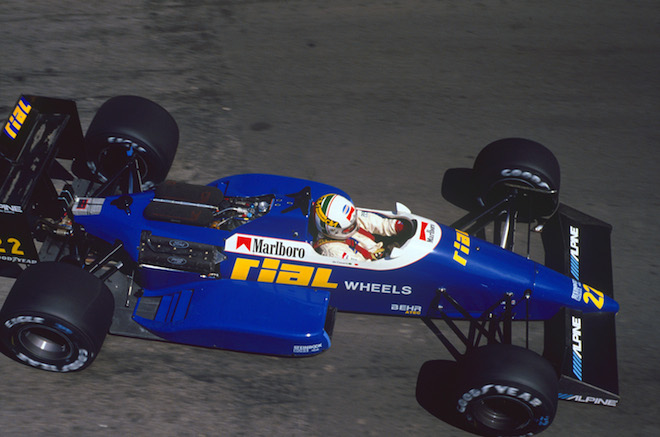
However, with the demise of Brabham, Andrea was out of work again at season's end, until he got picked up by the new and tiny Rial team. Rial could only afford to run one car, and therefore needed an experienced driver, and with a car designed by Gustav Brunner (who'd designed the 1987 and ’88 Ferraris), de Cesaris responded in a thoroughly mature manner. There was just one points finish, a fourth place at Detroit (BELOW), but Andrea was further endorsing the view that he'd grown out of his wild ways.
That wasn't quite true, in fact. He remained Jekyll and Hyde in the cockpit. With Marlboro money pushing him toward the second-year BMS Scuderia-Italia team in 1989, de Cesaris found himself partnering rising star Alex Caffi. At Phoenix, he covered himself in ignominy by squeezing Caffi into the wall as his compatriot came up to lap him. Just one race later, at Montreal, Andrea drove beautifully on a rain-soaked track to take third, behind the Williams-Renaults of Thierry Boutsen and Patrese.
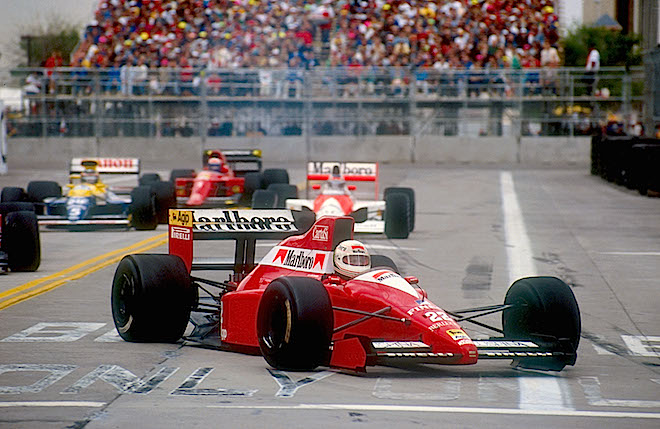
That would be de Cesaris' first and last points of ’89, however, as the car was hampered by Pirelli tires when the majority of the opposition was on Goodyears. Paradoxically, the Italian firm's rubber is also what allowed him to qualify third at Phoenix in 1990 (BOTTOM), but that second season in Scuderia Italia's Dallara ended with no points, largely due to a long litany of retirements.
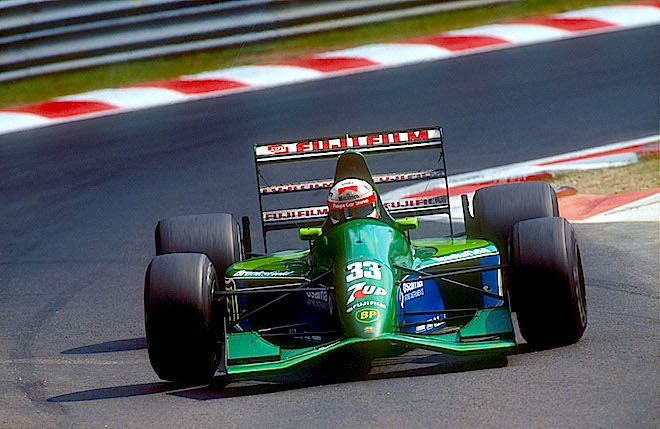
There was much criticism of Eddie Jordan after Jordan Grand Prix was launched and EJ revealed Andrea de Cesaris would be one of his drivers in the team's inaugural season. (There was a double connection, by the way, as Andrea had raced against Eddie back in Formula 3 when the Irishman was another aspiring grand prix racer, and the first guy to drive the pretty Jordan 191 penned by Gary Anderson was Andrea's first full-time F1 teammate, John Watson.)
More importantly, Jordan's choice was vindicated when de Cesaris hit a fine seam of consistency. The car suffered reliability issues at the start of the season, but in the middle of the season, Andrea had a run of four top-six finishes in five races. And then there was Spa.…
Primarily, that race and the Jordan team's connection to it is the fact that de Cesaris' teammate Bertrand Gachot was in a UK jail for assault, and so Eddie and Formula 1 discovered the startling talent of Michael Schumacher, who qualified seventh. But the equally stunned de Cesaris, after being outqualified by the debutant by 0.75sec and four places, responded superbly on race day, and was pressing eventual winner Ayrton Senna for the lead when his engine went sick.
Despite a fine showing in the 1991 season overall, with only a few lapses of judgment and providing the majority of the points that enabled the Jordan team to finish a remarkable fifth in the Constructors' Championship , de Cesaris had to depart when Eddie, with debts accruing, did a deal with Barclay cigarettes which was incompatible with Andrea's Philip Morris ties.
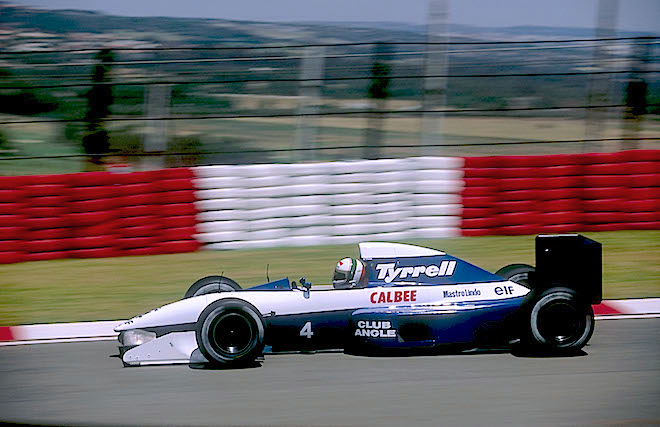
A move to Tyrrell was a happy combination of talents in 1992, with de Cesaris using the fine-handling, Harvey Postlethwaite/George Ryton-designed Tyrrell 020B (BELOW) to punch well above the team's financial weight. Andrea finished ninth in the championship for the second consecutive year, and Tyrrell was sixth in the Constructors' points.
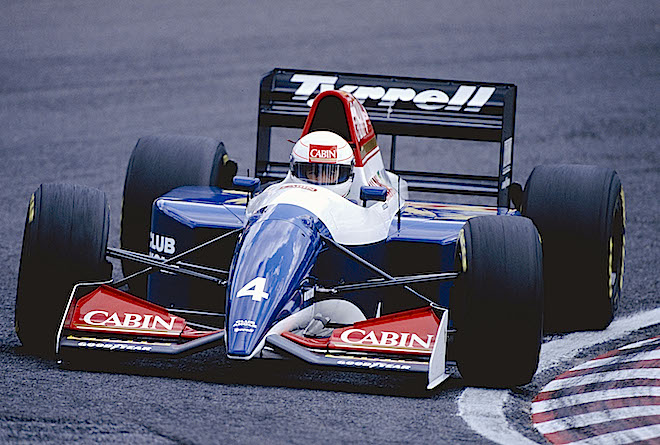
A switch from Ilmor to Yamaha engines in 1993 was disastrous, however, in terms of reliability and Andrea failed to score a single point that year, either with the aged 020C or the mid-season upgrade, the 021 (BOTTOM).
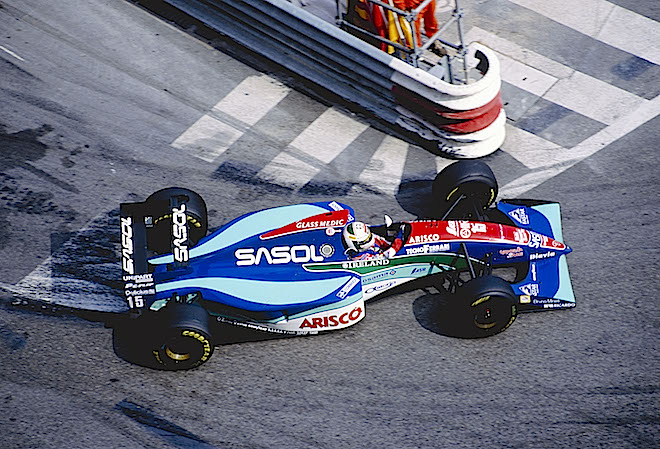
At the first of these, San Marino, Andrea was slow and unfit, and eventually crashed, but at Monaco two weeks later (ABOVE), he edged sophomore and rising star teammate Rubens Barrichello in qualifying, and went on to finish fourth.
In this summer of tragedies and controversies, de Cesaris wasn't without a drive for long. Sauber driver Karl Wendlinger had put himself out of action and into a coma after a dreadful crash in Monaco, and while Sauber ran just one car in Spain, for incumbent Heinz-Harald Frentzen, Peter Sauber called up de Cesaris for Canada – the Italian's 200th Grand Prix start.
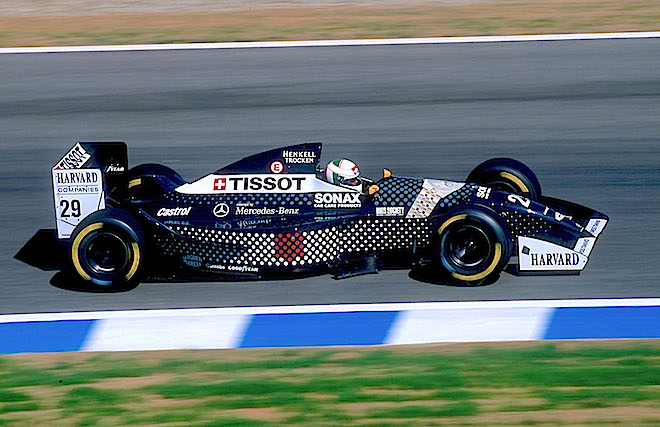
At the following event, Magny-Cours, Andrea finished sixth and it would prove to be the final points finish of his F1 career. Comprehensively outpaced by Frentzen, de Cesaris nonetheless drove with maturity for most of the remainder of the season (BELOW). However, Peter Sauber had promised to run Wendlinger if the Austrian was fit enough for the final two races, and though Karl wasn't ready, Andrea couldn't be contacted (he was on holiday) and so JJ Lehto got the ride.
De Cesaris had already decided that his F1 career would end that year, and after five podium finishes in his 208 grands prix, he retired with a sad record he holds to this day – most GP starts without ever winning a race.
Andrea went on to become a successful financial broker and an accomplished windsurfer. However, the racing fraternity became reacquainted with him briefly in 2005/’06, when he signed up for the curious three-races-and-done Grand Prix Masters series, and in his first race in 11 years, he finished fourth in Kyalami (BOTTOM), behind Nigel Mansell, Riccardo Patrese and Emerson Fittipaldi.
To Andrea's family, friends and fans, RACER sends its condolences, and salutes a man who sprinkled displays of brilliance over his long and tortuous Formula 1 career. His inherent speed and attractiveness to sponsors helped many struggling teams look far better than they were, and he was a 100 percent dedicated racer.
Presented by:


Latest News
Comments
Comments are disabled until you accept Social Networking Cookies. Update cookie preferences
If the dialog doesn't appear, ad-blockers are often the cause; try disabling yours or see our Social Features Support.