.jpg?environment=live)
ROAD CARS: Cadillac ATS and CTS
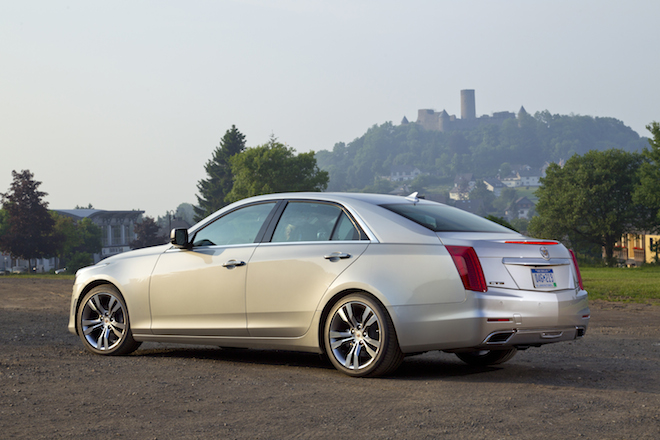
Strange things have been going on at GM these past couple years. As Buick’s sedans have headed upmarket and Chevrolets have gone from anonymity to discreet handsomeness, Cadillacs have become an acquired taste in the looks department. Of course, aesthetics are purely personal and we should all be grateful to the few brands who are determined to be distinctive, but the latest CTS is surely one of the more divisive current designs among car enthusiasts. If you like straight lines applied with vigor, you’ll probably love it.
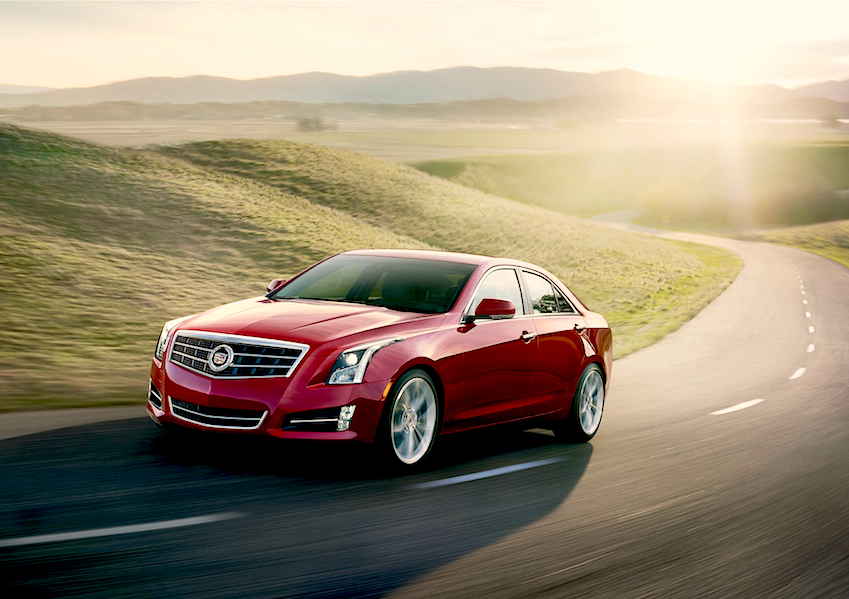
The ATS, however, running the same GM Alpha platform but on a 109.3-in (as opposed to 114.6-in.) wheelbase has cleaner styling, and promises a more sporty experience as it aims squarely at the BMW 3-series and Audi A4. In that purpose, it’s successful, despite (because of?) our version’s 3.6-liter V6 engine that sounds perhaps too intrusive for a Cadillac and a six-speed gearbox that is not the most prompt at kicking down. But, if you’re really going for it, presumably you’d use its lovely magnesium paddle-shifters, and in this semi-auto form, the car behaves how it should, and won’t override your choice of ratio. With 321hp towing around 3400lbs, the ATS (BELOW) is fast – think 5.5sec 0-60mph – but its behavior around turns is what really puts it into BMW 3-series territory. Its steering is not as communicative as its German rival, but then Bimmer probably has the best electric steering out there. The Caddy’s is at least direct, weighty and rapid. More importantly, the chassis doesn’t struggle to keep up with it.
The CTS, belying its greater size, weight and emphasis on luxury, is remarkably agile too. It’s slightly quicker to slip into understeer, as you might expect, and its responses are a little more muted, but the payoff is that the longer wheelbase allows a smoother ride than in the ATS. Yet the biggest progress the gen-3 CTS shows over the gen-2 is in its body control in high-speed cornering. Where you could feel the older car wobble a little during rapid changes of direction, or give a little shudder over ridges, the new car is more fluid. Despite the low profile tires on both our cars, they showed no tendency to just follow road indentations, and the lack of torque steer thanks to rear-wheel-drive is always welcome.
CUE infotainment system
which is not instinctive, but is logical if you make the effort to learn it. Trying to explain it here would be foolish, but if someone of my limited interest/smarts in such matters can figure it out, so can anyone else, given time. So potential owners need not be put off by reports of CUE’s overelaborate nature. However, the actual buttons to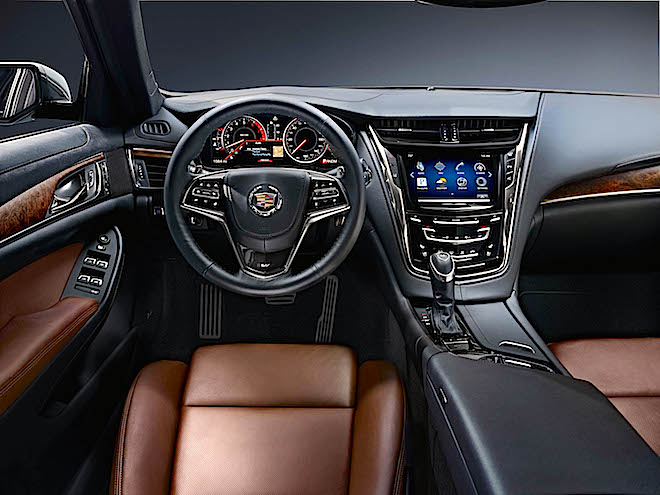
There is little to complain about in terms of the quality of the interior (CTS pictured RIGHT). Both cars used seat leather that felt like it had been chosen for the purposes of comfort rather than merely to look and smell good, but that’s not to say the chairs are sofa-squishy; they’re supportive and comfortable for long distance travel and don’t leave you sliding around when cornering. Legroom is not good in the rear of the ATS if the front passengers are tall and have pushed their seat bases almost as far back as they can go. In the CTS, rear-seat legroom is adequate, if not generous. On the plus side, the trunks of both cars are far bigger than outward appearances would suggest.
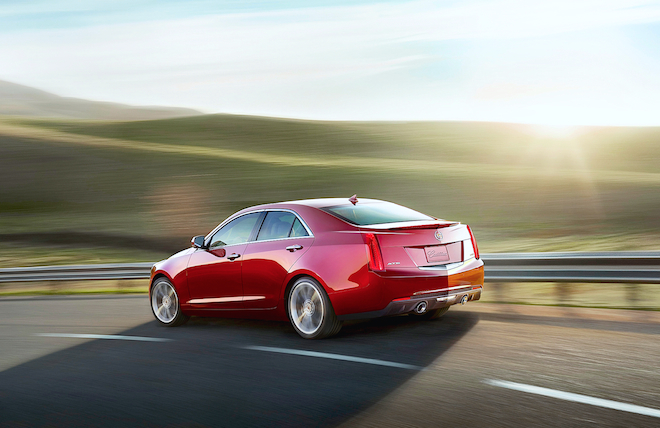
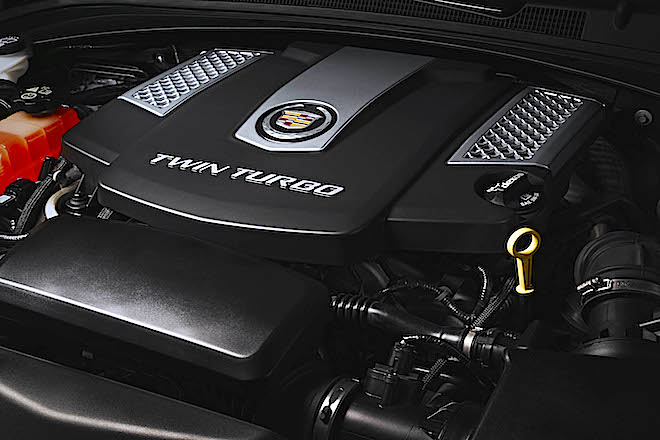
The CTS 2.0T Premium comes in at a weighty MSRP of $61,800 while the ATS 3.6 Premium (LEFT) is $47,095. I’d recommend BMW devotees to try the ATS as an alternative to a 335i; the Bimmer feels slightly more nimble, the Cadillac more substantial and generous with its standard kit. The CTS Premium has pretty much every luxury you can think of, and you can get this engine for around $55k. But I can’t help feeling that’s still a serious sticker price for a car endowed with a two-liter engine, however commodious and luxurious its cabin. I’d sooner have more engine and fewer toys. Wonder if there’s a stripped down version of the the CTS-Vsport, which has the 3.6-liter V6 but with twin turbochargers, resulting in an attention-grabbing 420hp. Hmm…
As RACER readers though, you may just want to summon your inner Johnny O’Connell and get one of the last of the 556hp gen-2 CTS-Vs, in sedan, wagon or coupe form. They’re some of the finest all-’rounders America has built in the past 10 years.

Latest News

Comments
Comments are disabled until you accept Social Networking Cookies. Update cookie preferences
If the dialog doesn't appear, ad-blockers are often the cause; try disabling yours or see our Social Features Support.