.jpg?environment=live)
Marshall Pruett’s Tech Mailbag for May 22
Fire away with your tech questions about F1, IndyCar, TUDOR Championship, WEC, Pirelli World Challenge or whatever else that comes to mind from the world of road racing. Please send them to PruettsTechMailbag@Racer.com. We can't guarantee your letter will be published, but I will always reply. -Marshall Pruett
Q: "The most eye-catching penalty for the Chevy/Penske combo is for running afoul of Rule 12.1, Traction Control, which states: "Traction or launch control is not permitted. (Anti-stall routines are permitted for the sole use of preventing engine stoppage)....Manufacturers and drivers often accused their rivals of having traction control secretly enabled, with steering wheel-mounted rotary switches – the same style reference in Rule 11.2 for adjusting fuel mixture – or other, more ingenious methods used to activate or de-activate its functionality."
What sort of "ingenious" methods could be, or have been rumored to have been used? Any word on what specifically the Penske team did that other Chevy teams didn't?
Darrick Smith
MP: I've heard a few suggestions this year about extra special functions on Penske's steering wheels, but those comments have come from outside the team, so it's nothing more than speculation. There's a fine line being straddled by engine manufacturers with their respective throttle mapping. Because the Dallara DW12 used fly-by-wire throttle technology, engine manufacturers can create different maps that have unique response characteristics. If a driver has excessive wheelspin coming off of a hairpin, he or she can turn a dial on the steering wheel to dial back how the throttle responds – if pushing the throttle 50 percent normally gives 50 percent of the power, switching to a softer throttle map could see that 50 percent travel deliver only 25 percent power, for example.
That's the basic explanation. With the spec McLaren ECU, manufacturers are capable of creating 3D maps that take throttle input, power and torque data and can tailor it to meet what will deliver the best output by dialing boost or revs up and down. It's not a subject either manufacturer will talk about, much less reveal how they go about their throttle mapping. My suggestion, when we get to Detroit, is to watch one of the in-car feeds IndyCar makes available and monitor how often drivers use the big rotary knob to adjust throttle maps. It happens more often than you might think.
Help me – I'm confused. I see where the drivers, Robin Miller and the rest of the free world is blaming the car for the inability to bring off a standing start in Indycar. In an Indycar pit stop doesn't the car roll to a stop, then launch on a signal to return to the track? How is this different that a standing start and if the car can do one why not the other. Or are the drivers just not interested.
Eric Bunn
MP: A standing start is meant to be a procedure done with efficiency – as little wheelspin as possible – and great timing to get the best launch. A pit stop, while incredibly similar, is more aggressive, with wheelspin and a less formal timing method to work from. The standing start is about meeting a bunch of different criteria on setting the right throttle position, revs and bite point for the clutch, then waiting for the lights to go out. Leaving the pits happens off a hand signal or radio command and involves dumping the clutch and going like hell. It's the difference between trying to bowl a strike and having to knock down a single pin – both involve similar actions, but the levels of precision differ greatly.
Q: Big fan of the mailbag. Which IndyCar teams have already switched to their second engine of the season? I know the Schmidt cars, Kimball and Huertas all changed to their second already. You said Power mileaged out and the No. 27 engine and Aleshin had failures in 500 practice. How close are other teams to reaching the minimum mileage threshold?
Ray, Flemington, N.J.
MP: I was having this very conversation with a senior engine manufacturer rep yesterday. The answer is: I don't know. IndyCar, at least through 2013, was quick to publish such info, but as the discussion went on Wednesday, there seems to be a significant lag time in this info leaving the competition department and landing with the PR team to distribute. We'd normally have a list of engine status by now. I know all of Chevy's cars, except for the engine losses suffered by Ed Carpenter in practice and Charlie Kimball at Long Beach, hit their 2500-mile limit and changed to fresh motors. As you noted on the Honda side, there were two known issues, and some did not reach the 2500-mile window, which prompted Honda to call for unapproved engine changes and take a hit on their Manufacturers' points tally.
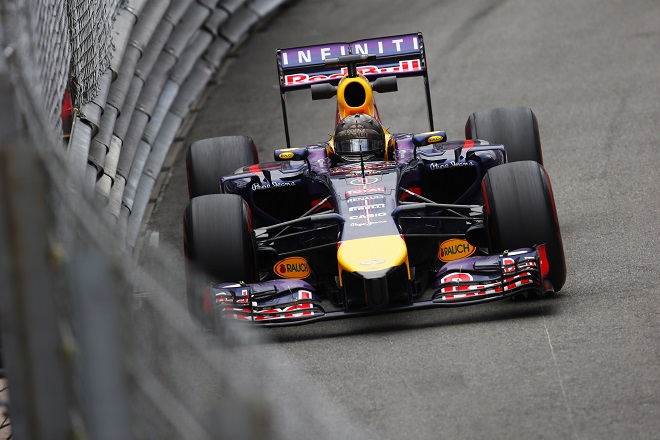
Q: "A V6 with different compression rates": Williams head of vehicle performance Rob Smedley
"But if you gain sufficient fuel to be able to spend a little bit of fuel on generating electricity": Renault's F1 engine chief Rob White
What are they talking about, Marshall?
David Thompson
MP: without the context of their conversation, I can't exactly say, but I'd assume Smedley was talking about an increase in power and/or increase in sound. With more power comes more energy and more energy leaving the engine makes more sound. As for White's comments, I assume he's talking about being able to generate more electricity from the MGU-H (turbo ERS system) by allowing their drivers to use more throttle.
Q: Can you explain the visor protector some drivers used at the Indy GP? I'd never heard of such a thing till it was mentioned in Robin Miller's Mailbag from last week. It sounds like one of those technologies that will quickly migrate down stream and by the end of 2015 every Formula Ford guy in the country will be wearing one. That's kind of how it goes isn't it?
I love your Tech Mailbag articles and enjoy keeping up with the latest via Facebook.
Bryan Cohn
as I wrote in another piece today
, should we be looking at using reinforced visor strips to improve a specific problem, or look at a addressing the bigger issue of open-wheel drivers having their heads exposed? A Zylon visor strip will help then next time a strike from a spring happens in that location, but it won't do much against a flying wheel or suspension piece.Q: How do teams change the cars from pole day to race day?
Vince
MP: Most of the changes involve aerodynamics and moving from extremely low downforce figures to higher rates that work better in traffic and in the corners. Suspension settings are also modified to help the Firestone tires maintain grip throughout a 30-lap run, and boost settings are dialed back after the short-term increase used for qualifying.
Q: I am catching up on e-mails so I hope the questions and comments made are something not presented by others and addressed by you. Why did the IndyCar officials not follow what F1 does in having a crew member stand where the car is, but behind the wall on both sides of the track so if any car fails to start or flubs occur at the start immediately a visible yellow flag is waved AT the place where the problem occurs? I saw no instant warning of a problem. It was not raining so vision in the back was not completely blinded. This track is very narrow on the straight with limited space to get around a stalled car. The cars were bunched too close together. There should have been much more distance between the cars.
Did they not even try to do a fail safe analysis to determine weaknesses, then inform everyone what could happen and make suggestions what to do in case of a stall? Walker stated they are aware the electronic system used by Indycar is not robust and needs some work to make it absolutely reliable. If it is not reliable why use it? This is a serious admission of a safety hazard not fixed. What company supplies the electronics to the F1 and IndyCar teams for standing start control? F1 has not had a failure in a long time. I think engine management is a Microsoft system, not sure if the starting system is the same software company designed and issued electronics. I am sure only one system is used in F1. So why can't IndyCar find out what F1 uses and perhaps get immediate help in redesigning the crappy system they now use?
There are plenty of experts in software development for systems like this that could be used to get a quick fix initiated in case they cannot adopt the F1 system or the F1 system supplier will not work with Indycar for whatever reason. It is insane to stick to a broken system just because one thought it was a good idea to do standing starts. That kind of leadership is one expected of our Congressional farce, not by intelligent Indycar race control management.
Thomas Grimes, Woodway, TX
last week's Mailbag
. There was a yellow flag waving, but with all the dust and such, not to mention drivers focusing on the road ahead, it wasn't the most effective solution. As you'll read, I think we need to go to an in-cockpit warning system.
Thanks for the TechMailbag it's the best.
Pete Olik
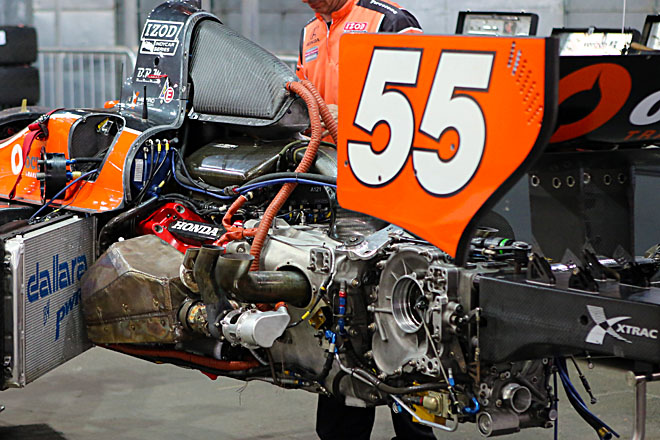
MP: The basics are the same between both series in this regard. An Indy car engine is mounted directly to the back of the carbon fiber Dallara DW12 chassis, the clutch and flywheel is mounted to the crank, and the longitudinal transmission is connected to the clutch/flywheel through an input shaft. The transmission is bolted to an outer shell called the bellhousing, which is sandwiched between the tranny and engine. In NASCAR, the transmission is bolted directly to the back of the engine and a long driveshaft connects the tranny to the rear end at the back of the car.
Because Indy cars are rear-engined machines, there's no need for the long driveshaft or rear end – the proverbial rear end is contained within the transmission case ahead of the gear cluster. It's all packed tightly together – one after the other – which helps performance through better weight distribution.
Q: I recently watched the video of Simon Pagenaud at the LBGP testing with a GoPro camera, helmet-mounted. The most impressive thing was the sound, yes that high-revving, screaming sound that in most cases is not properly captured by today's in-car-cameras. Pagenaud's video reminded me of my all time favorite in-car-camera shot from the 1993 French GP, the in car was mounted over the drivers right shoulder facing backwards to the right-rear tire and wing. The car was the Larousse-Lamborghini V-12, the sound was so intense that you could hear the rush of air being sucked into the fuel injection trumpets – just awesome.
Is the sound determined as to how the mic in the camera is exposed or is it more of a technical thing. As we know some in car audio had F1 cars sounding like sewing machines (sadly)
John Mylenek, Baltimore, MD
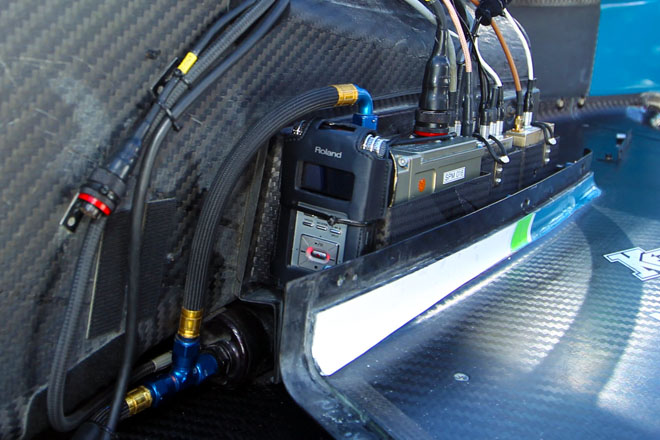
MP: Generating quality audio with small video cameras like the GoPro is always going to be a challenge due to the compact nature of the unit. Simply put, those cameras are meant for high-quality video, not sound. With the in-car stuff I've done using GoPros and the Drift HD, using an external audio recorder has been the only solution to get proper sound matched up to proper video. On an Indy car, I take my Roland R-09HR and have one of the mechanics install it in the right sidepod. In sports cars, it all depends on the vehicle.
The upcoming issue of RACER Magazine has a feature I wrote on racing audio – you might enjoy it.
Malsher's recent interview with Villeneuve
, it seems the current Indy car has an obvious problem for speedway racing; too much downforce and not enough power. These cars are right on the cusp of having pack racing at Indianapolis. I know asking for a large increase in power simply isn't feasible, but how hard would it be to ask the engine manufacturers to plan on running full boost levels at ovals in maybe two years? Or, how hard would it be for a slight displacement increase along the same timeline (2.4L or maybe the traditional 2.65L)?On the other point, downforce, would it be difficult for Dallara to design a new underwing that cuts down the downforce levels (specifically for oval use)? Maybe even something close to a flat bottom? I think this would be necessary if horsepower increased, because these cars are so slippery. I imagine the cars would probably be a little harder to drive as well. I think these steps would further remove IndyCar from the IRL formula and bring it closer to its' traditional roots. And the series might not need to impose arbitrary wing angle restrictions on
superspeedways anymore.
John in Dayton
MP: Great questions, John. The Dallara DW12's biggest issue in achieving faster speeds at Indy isn't actually about excessive downforce, but unexpectedly high drag. Teams sometimes run downforce levels figures below the actual weight of the vehicle in qualifying – as light on downforce as they can make the car – and it's done in desperation to shed tiny amounts of drag. I've written about it a dozen different ways since the car debuted, and don't mind rehashing it: Dallara missed their low-drag numbers on the DW12 by a considerable margin in speedway trim. The concept was for miraculously low drag that would then allow engine manufacturers to run low-boost engines. With both targets being hit, we'd see big speeds at Indy, but it simply didn't happen. Boost levels went up for qualifying to compensate for the DW12's drag issues, and now we're seeing more interesting lap speeds. Of all the things aero kits should bring next year, improved drag figures will be the big advancement.
On engine displacement and boost, I've asked multiple times about going to 2.4L to make more power without placing more stress on the engines, but the manufacturers like 2.2L. 2.4L, coincidentally, was the original displacement they chose, but one manufacturer asked for a 200cc reduction to better align with the displacement of their small production engines.
As for running at higher boost throughout the race, I'd love to see IndyCar give manufacturers some Month of May leeway. Forget the mileage requirements, build something special, something unique and more powerful, and put on a show. No one tuning in to watch the Indy 500 knows or cares about missed drag figures, low-boost engines or the need for those engines to last 2500 miles before they can be rebuilt. That's inside baseball stuff. Indy is open-wheel's one chance each year to connect with a giant crowd and to build lots of new fans – why not break it out of the season-long rulebook and let the manufacturers cook up something truly exciting?
With Ford recently saying that custom engines have no allure for them (and thus not interested in IndyCar), what are some of the challenges that would have to be solved to use a production-based engine in IndyCar? How feasible is it?
Doug, Stafford, VA
MP: Yeah, after reading Edsel Ford's quotes regarding IndyCar, they sounded more like something you'd hear after a long night at the pub than something measured and rational from a senior executive. Ford's 2.0-liter Duratec turbo, which powers its Global RallyCross cars, has production roots, is small, and packs a big punch with 600hp or more on tap. Dimensionally, it would be the easiest option to fit the Dallara DW12. The three main issues to consider would be its weight, reliability and longevity. Chevy and Honda built their engines to the 248-pound minimum, which includes some of the ancillaries. Ford would be challenged to get down to that figure. The motor is built to churn out a ton of power and torque – especially torque – in short bursts, and hasn't been developed to go two hours straight at a Mid-Ohio or Texas. The last item is the 2500-mile rebuild threshold, and I don't actually know how long their GRC engines last, but at maximum power, I'm guessing 2500 miles would be a stretch. It could be done, though, if they wanted to come and play.
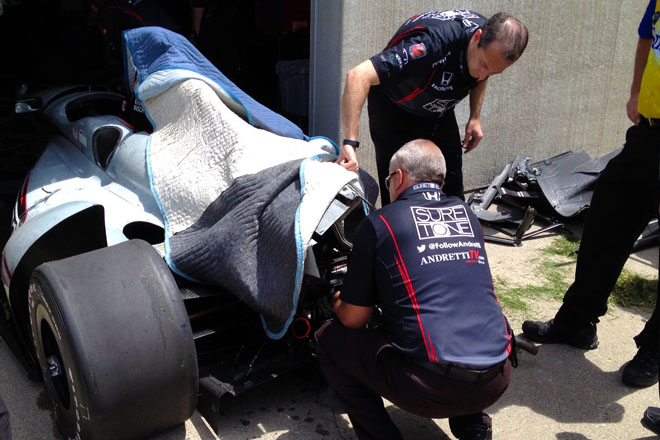
Q: I'm watching the Monday practice session and the announcer just made the comment about if Kurt Busch has to go to is backup car, then he has to start from the back. Makes me want to ask you, what defines an Indy car? How much repair and replacement can they do and still have it count as the original car? New body kit, new engine, new tires, replacement chassis parts, replace the electrical boxes and other parts during the repair. Does it just have to get down to still having the chassis piece that has the serial number on it?
John in Charleston
MP: It used to be the chassis itself was the "car." It comes with racing's equivalent of a VIN number – a chassis plate with its requisite info, but thanks to IndyCar's Rule 8.4.3.9, aka the "Busch Rule," I'd say the series has, by its own rulebook, taken that definition and thrown it away: "If a Qualified Car is involved in a crash, the Entrant may replace the Qualified Car with another Car and start the Race in the Qualified Car's position. If a Qualified Car is unable to start the Race for any other reason, INDYCAR shall determine if the Entrant is permitted to replace the Qualified Car with another Car and start the Race in the Qualified Car's position or if the Entrant is required to start the Race from the rear of the starting field."
So, if an entrant decides to change his engine before it reaches 2500 miles, his driver will be sent to the back of the grid. If a driver damages his car beyond repair between qualifying and the race, the driver can step into a different chassis that didn't go through qualifying and won't lose his or her grid position.
Make sense? Not to me...
Graham, Luton, England
MP: Rather than tell Chris's tale for him, I asked the man himself to spin that yarn:
I started racing when I was seven years old in Quarter Midgets. Like karting often is, racing was a family
affair back then and we worked on our own cars and engines. When I moved up through the ranks of
Sports 2000, Formula 2000, and even briefly in Indy Lights we ran our own teams. So I had been
experienced in driving, car preparation, and even engine building to some extent early in my career. I was racing Formula 2000 and even started in Indy Lights while I went to university. At the university of Pennsylvania I was enrolled in their Management and Technology program and earned dual BS degrees
in Mechanical Engineering and in Strategic Management. While racing Indy lights I did not engineer my
own car (although some of my race engineers might say I tried to). I injured my neck in 1998 in a
testing crash at Nazareth and although I finished the rest of the season after missing a few races, my
driving career fizzled out after that. In 1998 I had already been helping my brother in Barber Dodge,
then again in 1999 while I also looked for a new ride. At the end of 1999 he landed an Indy Lights ride
with Andretti Green Racing, and they were looking for someone to engineer him. He suggested me and
that is how I really moved full time into the engineering side. Jeff actually drove the same Indy Lights
chassis I had driven in 1997 with Team Green.
As far as the Ganassi side, my full time role is to be the lead engineer on the #10 Target Chip Ganassi
Racing Indy car, driven by Tony Kanaan this year. But I also have been involved with the sports car team mainly at the 24 Hours of Daytona in various capacities since 2005. For the past few years I have served
as the lead engineer when Chip runs a second entry in the TUSCC, Grand-Am, or whatever other series.
At times I have been involved with Indy Lights when Chip was running cars there. Basically my main job
is the Indy car, but I engineer when and where Chip, Mike Hull, and Julian Robertson (our technical director) send me. And I am only one in a list of engineers that operate as a team trying to win races.
At times some of us have interacted with the NASCAR guys, and we do share some technology, tools and expertise, but generally the NASCAR stuff is kept separate from the IndyCar and Sports Car stuff.
I guess you could say I was volun-told at first, but we are all racers at heart. The original conversation
was, "We'd like you to engineer the 02 car at Daytona." The opportunity to engineer a competitive
car in one of the world's biggest races...I'm in!
Q: As an IndyCar fan I was quite disappointed to see the series going back to the "closed pits under yellow" rule on road and street courses during the winter. From a safety standpoint, this rule is probably the best, but it offers a huge, unwanted influence on the outcome of the races from a competition standpoint.
Yann
MP: It's a two-way GPS-based system made by EM Motorsport (
http://www.emmotorsport.com
) that tracks each car and their proximity to pit lane, using the distance and speed to determine the countdown. Yes, this system could certainly be used in IndyCar, or any other form of circuit racing, but added costs for IndyCar owners at the moment would go over like a fart in church.Q: Could you please explain how the IndyCar teams switch over a car from right-side fueling for the road courses (including the Indy GP) to left-side fueling for ovals? I know that's one of the things the teams had to change on their cars after the Indy GP to be ready for 500 practice. Does the fuel cell have a buckeye on both sides, with the extra one being covered with bodywork...or does the design allow the buckeye to be swiveled around to the proper side for each race?
Mark
MP: There are two ports, with teams moving the buckeye to either side depending on the circuit layout. They use a simple carbon panel with four screws to cover the unused side, but that side is also used for refueling during practice through a dry-break connection.
Q: After watching Ben Bretzman's video segment on dampers (by the way, the video answers were truly awesome – hope you keep that coming although I realize people had time due to the weather at Indy) it struck me that a ton of focus, naturally, has been on damper development. Looking ahead, do you foresee team engineering organizational changes down the road when aero updates may force teams to have different expertise on board? Could this potentially be good for the new crop of engineering students currently being groomed?
Kyu Lee
MP: Great question, Kyu. Chevy and Honda already provide significant aero data to their teams, and with both aero kits coming directly from their primary aero/engineering vendors (Pratt & Miller for Chevy, Wirth Research for Honda), I don't foresee teams stocking up in aerodynamicists when they already have a ton of brainpower from P&M and WR. You're absolutely correct on dampers (and springing) being the biggest differentiator between teams. It's the one area where entrants are mostly free to do whatever they want (within the rules), and as a result, it's where a ton of money and resources are spent.
I'll ask a future-minded question: With manufacturers looking for more relevant ways to tie their racing activities back to production car technology and advancements, does it make sense to open an area like damping for teams to spend a small fortune each year? The fan can't see it, and road cars aren't improved as a result, so why is it open? How about engine electronics? How about opening the cockpit electronics – dash display, communications center, etc. – for manufacturers, computer companies, tablet makers or cell phone companies to use IndyCar racing as a mobile test bed for their next wave of products? If we're going to let teams spend money, or encourage manufacturers to spend more than they already are...or want to invite new companies and industries into the sport, maybe we need to think of areas with a wider appeal than dampers and might get the average person interested in what's going on.
Q: I was reading the article on RACER.com about Renault expecting engine penalties. It stated that among the Renault-powered cars there were power units with components that are at different stages of development. I thought that the hardware design was frozen for the season back in February and any changes could only be to control software except for "reliability" reasons, which would have to be shared to all manufacturers. Is Renault just doing reliability updates and, as the article indicates, since they are having more issues early in the season, they are progressing through specifications of various components faster than Mercedes and Ferrari? Could you clear up the power unit and specific component penalties that are in place now?
Daniel, Atlanta, GA
MP: The rules say no more than five engines (I refuse to use the term "power unit"), and within that engine system, they define six separate areas (engine, its control electronics, MGH-H, MGU-K, the energy storage unit, and the turbo) where five of those individual systems can be replaced (five turbos, five energy storage units, etc.). The FIA has gone down an interesting direction, as you note, requiring serious homologation to be done with componentry, but with F1 being F1, development and improvement is core to the sport. Chevy and Honda followed a similar practice – especially in the first year of their new turbo IndyCar engines in 2012 – where the rate of development often exceeded the intended mileage requirements the series imposed. In order to get the latest updates which would provide more power and/or reliability, fresh engines would go in before the minimum mileage threshold, earning drivers a 10-spot grid penalty after qualifying. With Renault (and Ferrari) falling well behind Mercedes, forfeiting grid positions is an easy choice to make in favor of having faster and more competitive powerplants as new developments become available.

Latest News


Comments
Comments are disabled until you accept Social Networking Cookies. Update cookie preferences
If the dialog doesn't appear, ad-blockers are often the cause; try disabling yours or see our Social Features Support.