.jpg?environment=live)
Marshall Pruett’s Racing Tech Mailbag for March 27
Welcome to Marshall Pruett’s Racing Tech Mailbag. If you have questions about the technical side of the sport for Pruett, who spent most of his life working as a mechanic and engineer in open-wheel and sports car racing, send them to PruettsTechMailbag@Racer.com. We can't guarantee your letter will be published, but Marshall will always reply.
Love the Tech Mailbag. Phil D. asked a question (Part 1, March 20) about which I have been wondering: Why do the new F1 single-turbo engines sound worse than all other turbo race engines?) Your reply was interesting, yet didn't seem to directly answer the "Why?" part. Your final comment ("Hopefully F1 will follow IndyCar’s lead) seems to imply that the F1 sound could be improved by a rules change. If so, how?
In both series, why not a 120 degree V6? Lower center of gravity, no secondary harmonics, room for diffuser tunnels, plenty of room for a "hot V", though it would be wider.
Randall Rich, Citrus Heights, CA
MP: Like Robin’s Mailbag, we get asked and answer the same questions on a regular basis, and this is one I touched on in a previous Tech Mailbag, but I’m happy to answer it again and the problem the new F1 turbos face (I refuse to call them “Power Units”) is a lack of power. The more power being made – the more violence and fury going on inside the combustion chambers – the more prolific the sound. F1’s new engines, due to the big increase in KERS assistance, do not need to make wicked amounts of horsepower on their own. That’s not to say the new F1 turbos are weak, but they are not being asked to crank out 900hp. If the engines were being pushed harder to make more power, you’d have more force being expelled from the exhausts and get an angrier note that might be more pleasing. Turbos, as a simple function of how they work, muffle sound energy, so it takes some almighty power to overcome those losses. Higher revs would also help and add to the quality of the sound with the new engines, but keep in mind that during the 1980s, the scariest F1 turbos rarely revved beyond 12,000 rpm – the same used today in the Verizon IndyCar Series – but 3000 rpm down from 2014 F1 motors.
Take a listen to some of the controlled explosions that were 1980s F1 turbos…
[soundcloud url="https://api.soundcloud.com/tracks/141613931" params="auto_play=false&hide_related=false&visual=true" width="100%" height="300" iframe="true" /]
What was the purpose of the "drooping mustache" high-speed oval front wing on Reynard Indy cars? Was it simply to allow uninterrupted airflow under the car, or was there a more esoteric aerodynamic reason?
I read or heard somewhere the negative dihedral of the wing actually helped improve the pitch sensitivity of the car when negotiating high-speed, banked oval turns. Any truth to this?
Chris Pericak, Charlottesville, VA
MP: They helped in the ways you mention, Chris, but they were created for the same reason they were used in F1: more surface area. The rules called for a maximum wing width, and with the higher, angled mounting, teams had more wing surface and could run them at lower angles while making similar levels of downforce. For teams with shorter wings, more angle was needed, which meant more drag… Smart stuff.
Why do the engines have different horsepower for different types of courses in Indy car?
Vincent Martinez, Arcadia, CA
MP: In a general sense, because that’s all they need to achieve the speeds IndyCar wants to see, and more specifically, with the minimum engine mileage thresholds set by the series, it would be nigh-on impossible to reach 2500 miles before rebuilds if teams were fed all 750hp at every round. If and when engine manufacturers are allowed to charge more for an engine lease and shorter mileage thresholds, we could see lots more power everywhere. Until then, we’ll have tailored power levels for each type of circuit.
I've been a fan of IndyCar since 1992 and I started following F1 in 2012. I understand that in F1 many of the teams construct their own cars and some still build their own engines. This type of racing is reminiscent of IndyCar back in the '90s when there were several different chassis, engine, and tire combinations and teams carried on development work continuously in and off season.
With similar open-wheel designs, how is that in F1 the positions are usually separated by several seconds or more? Even during IndyCar's "golden" era when each team developed their own aerodynamics, shocks, etc., the races were very tight and I don't recall that the competitors were as spaced out as they are in F1. If I had to guess, I imagine that F1 teams engineer their cars to smooth the flow of air exiting behind to ameliorate the effect of the draft.
Jonathan, Los Angeles, CA
P.S. I know that today's IndyCar is nothing like the ones of old when they had 900hp or more. Do you think any of the IndyCars from the '90s or '00s could have competed with F1 in terms of speed/lap time?
MP: Jonathan, the answer is in your question. Other than engines (and in some cases gearboxes and rear suspension), F1 teams make almost everything themselves. 11 teams of designers and engineers trying to build the best mousetraps with different budgets, resources, experiences, ideas, etc. Although today’s F1 rules are very limiting, you’re bound to have a lot of variances with so many people responsible for each car. Indy car teams did plenty of their own development work, and even created new parts, but for the most part, they were all bolted onto customer cars. If each team had to do the whole car from scratch, the lap times would have been all over the place.
It’s hard to say on the CART/F1 comparison. I think a 1999 Reynard-Honda on qualifying boost and gummy Firestones would embarrass today’s F1 cars, but a friend who raced in CART and tested in F1 disagrees.
“The only thing those [CART] cars were missing was the aero,” said Dario Franchitti when I posed your question. “And possibly the damping technology of the current cars. That’s the challenging thing. Slow-corner mechanical grip, the CART cars would destroy F1 cars. High-speed corners and under braking, F1 cars would destroy our old cars. In F1, the braking force is unlike anything you’ve ever felt. In CART, you’re on the brakes and the thing just kept going and going… But it sure would be fun to get a few cars and answer the question.”
Pagenaud video
. Does this signal the return of the helmet cam to the Indy TV broadcasts?Chuck, Chelmsford, MA
MP: I wish, Chuck. The Simon videos are done by two guys with a GoPro, some gaffer’s tape and a helmet, but if IMS Productions wants to start fitting helmet cams, I’ll be first in line to request the footage.
I am a racing fan, who follows everything on four wheels. I have two unrelated questions. First, what is the difference between a NASCAR crew chief and an IndyCar crew chief/engineer. Like how different is Steve Letarte's job compared to Ben Bretzman's?
My second has to do with Lola's proposed IndyCar. They were planning on having two distinct-looking yet virtually equal body types, as well as swappable portions of the car for a Indy Lights chassis. Do you think that the new aero kits for 2015 are going to be something like that? Keep up the mailbag, it's lots of fun!
Nick, Baltimore, MD
MP: Great question, Nick. A Letarte directs his crew and makes setup calls. A Bretzman is responsible for setup calls without the crew oversight aspect. It’s hard to say what Chevy and Honda will come up with for aero kit designs and executions. I keep asking IndyCar for a final (final, final, final) version of the aero kit regs, and am told there are still a few areas being massaged. Until I have the latest and greatest in front of me, anything I’d offer would be conjecture.
When in history (and up to what point) were IndyCars and Formula 1 closest in performance in terms of lap times on road courses? They were pretty close in performance in the early '90s, right?
Doug
MP: Hard to answer because modern F1/Indy cars haven’t run on the same track at the same time or in the same year. We had the USAC race at Brands Hatch in 1978 on the short course, while F1 raced on the long course at Brands, and that’s as close as we’ve come in Europe. The turbo Indy cars made ridiculous power at the time but had rudimentary aerodynamics, while F1 cars, starting in ’78, saw downforce take off while working with less power. On the same short course, I’m sure Mario Andretti’s Lotus 79 would have had the upper hand by a wide margin. More recently, we had the Detroit GP which ran with F1 through 1988, and was taken over by CART in 1989. Ayrton Senna took pole for the 1988 event at 1:40.606; Michael Andretti set the 1989 pole with a 1:41.7.
I have a question regarding the recovered energy usage in Formula 1. So the rules are written so that the cars have access to a set amount of recovered energy per lap for the Kinetic system, what I am wondering is if there is a limit to the amount that can be recovered? If not, couldn't teams basically recreate the blown diffuser by using excess energy to keep the turbo spun up even more than the engine needs and diverting the excess air to the diffuser?
I'm also wondering what your take on Audi deciding against using the ERS-H is.
Daniel, Atlanta, GA
MP: Energy recovery isn’t an issue, but storage capacity is, giving F1 teams some practical limitations on how much they can capture and re-use. Keeping the turbine spinning is part of that the new turbo KERS unit already provides, but the boost itself is fed into the motor; siphoning off of that charge would reduce horsepower, and that’s not a worthy tradeoff. I doubt the excess would deliver much value as a workaround for blowing the diffuser.
I’m not surprised on Audi’s choice, although it was something they were really keen on last year. I first heard about it prior to the COTA WEC round and asked my man Ullrich Baretzky, Audi’s mad engine scientist, about it. He couldn’t say much, but there was a hope it would produce a KERS charge that proved worthy of its addition. He also wasn’t exactly overwhelmed by adding more weight and yet another electronic system to the powertrain. The reasons cited by Audi for its removal fall in line with Baretzky’s concerns last September.
Double points for the 500-milers makes sense and as you’ve said, creates some oval parity, especially considering the double headers. However, the points for Indy 500 qualifying seem like overkill, even knowing that they want both days to have meaning. If a championship contender wrecks out on Saturday and his main rival wins pole both days, that’s a 41-point swing, just for qualifications. At the least, all other races should award 6 points for pole, then 5-4-3-2-1 for the rest of the fast 6. Leading the most laps in a race should be bumped up to 5 and the 1 point for leading a lap should only be for a green flag lap. Doesn’t a 1-point swing for all other poles versus 41 at Indy seem over the top?
Mark Z, Discovery Bay, Calif.
MP: There you go thinking again, Mark… ;-) Part of IndyCar’s desire to add some of the missing prestige to the "500" comes in items like this where rewards for doing well come with big gains. I get why they’re doing it, but it still seems a bit heady handed.
I have a question that while I think the answer is very brief, my question is not easy to explain. So I'm going to include a video.
At Indianapolis or other ovals on the straights, the cars go down the center of the track. When a car finishes the curve is very close to the wall. After, moving to the center of the track, before turning and moving back near the wall again. Apparently it is an unnecessary movement. Near the wall, to the center, of the track then near the wall again. Why do not always close to the wall?. I think it's for turbulence at the end of the wall. Is that right?
Hector
MP: Great question, Hector. It’s to shorten the lap distance by as much as possible – the less distance traveled, the less time it takes to complete a lap. Drivers swing out as they approach the corners to apex and carry as much momentum as possible, but on the long straights connecting Turn 4 to 1 and Turn 2 to 3, there’s small gains to be found by moving to the inside of the track.
Someone at work asked me a question I couldn't answer: How much do racecars pollute? I'm pretty sure NASCAR wouldn't even come close to passing any state emissions test, but what about IndyCar using ethanol and F1's hybrid technology?
Steve, Indianapolis
MP: I’m not sure of that’s something anyone has accurately measured this in IndyCar or F1 (please send me a link if the data exists). I’ve read stories where estimates are made (http://www.theguardian.com/environment/2007/mar/02/formulaone.sport), but can’t vouch for the numbers. You hear every now and then that racing should be banned because of the needless pollution, but it’s hard to point to motor racing as a serious contributor to the problem. If there’s been one eco-friendly evolution in terms of exhaust pollution, the eye-watering, growth-stunting, make-birds-fall-out-of-the-sky additives used in F1 and IndyCar fuels from the 1980s and early 1990s have been written out of the rules. Toluene was the toxic chemical of choice at the time, and as more of it was added to the fuel blends, turbo engines began to break the 1000 horsepower barrier. The fact that prolonged exposure could cause birth defects? Meh… As an aside, I worked on a team that used ELF F1 fuel in the early 1990s, and managed to spill some on the asphalt while fueling our car in the paddock. After I was done filling the car and put everything away, I came back to mop up the grapefruit-sized spill. Not only was the fuel gone, it had turned the asphalt into a fine powdery material. Yikes. I can still smell the stuff today.
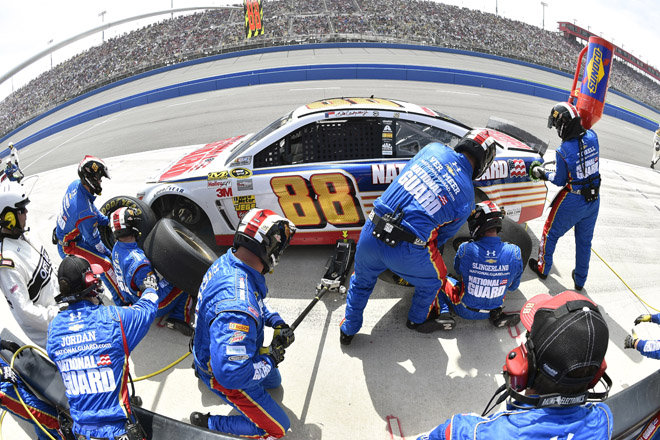
Gary, Anza, CA
MP: I asked a friend who recent drove in NASCAR and he had me laughing at the simplicity of the answer: “A torch and a hammer! All they do is heat up the rear end with a torch and use a big hammer to get the camber number that’s OK with NASCAR. If it’s too much, they heat it up and hammer some out.”
Is there a rule in place for 2015 when the aero kits are introduced preventing Honda/Wirth and Chevy/Pratt & Miller from producing front wings that produce loads of downforce with ground effects and the diffuser? With a higher nose funneling the air under the car that would take more emphasis off the rear wing to produce less turbulent air wouldn’t it? Hope big of an advantage could that be over the current Dallara aero kit?
Daniel Kincaid
MP: Yes, the rules define what aero kit manufacturers can and can’t do, and the go/no go regions on the car. Even if that wasn’t the case, going nuts on front wing aero would move the Center of Pressure too far forward. You’re right – anything to reduce wing angles will help dial down drag and improve fuel economy, but if you think of the car’s balance, tilting the equation too far in one direction will create an understeering or oversteering mess. Given the chance, designers would rather use ground-effects tunnels to make most of the car’s downforce to reduce the reliance on draggy front and rear wings.
How can both manufacturers move ancillaries to the engine (turbos moving forward in case of Honda) if the car has a standard engine cover? Will they have more freedom once the aerokits are introduced next year?
Carlos Villalobos, Santiago, Chile
MP: Nothing has really changed beneath the engine cover area, although both manufacturers have revised the turbo piping from the airbox. The turbo placement changes happened lower in the sidepod area. Chevy, with its twin turbo, used the same exact space in the sidepod they use today, but within that area, they’ve reconfigured their exhaust and turbo layout slightly. Honda, which is new to the twin-turbo layout, took a fresh approach and pushed everything as far forward as the chassis allowed. The turbo piping is butted up against the back of the Dallara DW12 tub, if you want to know how aggressive they went. It’s a gorgeous installation, and hopefully it delivers the performance gains they’re seeking. If it does, look for Chevy to follow suit with their next exhaust system.
Question 1: Indycar is going forward with aero kits in 2015, but the next engine change cycle is 2016, correct? If that's the case, wouldn't this year's Honda and Chevy engine changes have to anticipate the concept and general configuration of their aero kits for next year, especially for cooling and packaging? Or will IndyCar give them some leeway if one of them finds that they have painted themselves into an aerodynamic corner?
Question 2: You mentioned that Honda's twin turbos are moved very far forward in the car, which I assume means they are away from the engine probably in the side pods. Are they so far away from the engine that they have their own separate cooling/oiling systems?
Question 3: You mentioned that Chevy's turbos have not moved. Where are they?
Ed Joras
MP: 1) 2017. 2) they are moved forward, not away from the engine. They do not have additional systems. 3) On either side of the exhaust ports.
I've heard several times before, Goodyear blame the Cup teams when a tire fails...basically saying that the car was setup to aggressively. I understand this to mean camber settings primarily. Do IndyCar teams have the same ability as Cup teams to lean on certain corners or aggressively adjust the camber? Firestone seems to have an impeccable record but it's not clear to me if IndyCar teams have the same ability to abuse the tires as Goodyear makes it seem like Cup teams do.
Clint, Chicago
MP: It’s not really an issue in IndyCar because the cars don’t run extreme camber settings on ovals. You’ll see big numbers on road and street courses, but the tires don’t receive constant loadings and heat build-up in those events like Cup cars do by pounding around an oval lap after lap. Plus, the folks from Firestone are steadfast about their teams staying within the recommended pressure and temperature windows. And with telemetry – something you won’t find in NASCAR – IndyCar teams monitor their tires in real time. If anything falls out of an acceptable range, alarms are triggered.
How does IndyCar intend to enforce the "team abuse" rule? Is a team going to turn itself in? LOL, these guys are race teams. No. Is an engine maker going to turn in its paying customer which was being overseen by an OEM engineer? I don't see that as likely, either.
So....does IndyCar get enough telemetry data via the Cosworth system/Rule 14.17.15 in order to make the call? Would it require that data plus something said on the team radio, perhaps, or can Indycar demand additional data from the team in the event there's some evidence that an "abuse" situation has occurred?
Seems to me that this is something that has to be codified as "against the rules" but enforcing it would not be trivial. Maybe that's the best kind of rule, the one that has such a strong penalty that no one pushes the limit?
Steve Jarzombek
MP: You might be surprised, Steve. Chevy and Honda are less than enthused about the costs to provide engines, so if either sees a driver has intentionally blown an engine – something that would be hard to do without being noticed – I’m fairly positive they’d go straight to IndyCar. Paying for an unnecessary block ventilation isn’t something either brand would want to swallow.
OK, so I just wanted to come out and say I'm getting tired of some of my older fellow race fans criticizing young fans saying that we aren't into racing, that we don't have attention spans for it, and that is why IndyCar is in trouble gaining fans. Listen, I'm 21 years old, I've been watching IndyCar racing my entire life! Yet despite this, Last season was the first FULL season I watched and kept track of every single race from the beginning to the end all season long. Last season was incredible. It had some awkward moments and I know it doesn't have that CART-era glory, but the racing is fantastic and I don't see what some people are complaining about. Yes there is always room for improvement but that does not mean the series sucks.
Also, let me say that the idea that my generation just "doesn't get" the excitement of racing is just absolutely foolish. I have many hardcore gearhead friends. They never were quite into watching pro racing, though. All it took was inviting them all over to watch Le Mans with me a few years ago and that's it they are hooked! New active fans to racing just like that, didn't take much...
I'm a passionate enthusiast, I watch ALL types of motorsport. Especially with the power of the net I can watch series I can't even see on TV in the states with my friends, like the British Touring Car Championship, for example, which is a series that is currently rivaling it's 1990s golden era in terms of popularity TODAY.
So I just wanted to demonstrate that YES plenty young people including those under 18 LOVE racing today and is still enjoyed. If the BTCC can rival it's golden era in terms of popularity and grid numbers, IndyCar can too! You can even look at what NASCAR manages to do. It's all about organizing the series correctly. Increasing popularity is definitely possible with young fans. Let's stop blaming youth for the lack of popularity in IndyCar, please! We were so excited when we heard Indy wanted to come to our home city of Providence. You know how many fans that would attract? Young ones too? Despite the naysayers, there are many ideas for the series to grow!
Derrick, Rhode Island
MP: Preach on, my young open-wheel brother.
Any thoughts? I mean, what were people expecting? This is the frontier F1 chose.
Dan, Louisville, KY
MP: It’s funny, Dan; until the new F1 turbos came out, I thought the 2.4-liter V8 engines were the worst-sounding grand prix engines since the early 1960s. Other than dialing up the revs to 20,000 or something silly, F1’s stuck with the sound they have. It’s not like the new motors have a bunch of extra crap hanging between the turbo and exhaust to remove and improve what we hear. Personally, I’m more surprised an emergency meeting to fix the Dirk Diggler noses wasn’t called between Melbourne and Sepang.
Hypothetical scenario: a current Indy car, F1 car and Sprint Cup car cross the starting line side by side in a flying start at the Indianapolis Motor Speedway. They run 10 laps at their maximum. After 10 laps, what is the running order, and what are the gaps between the three cars? Next, you repeat the exercise at a natural terrain road course like Mid Ohio. What is the result there?
Mark, Centerville, OH
MP: That’s a fun one, Mark. Assuming the F1 car is setup for the IMS oval and has similar low-downforce wings, it might be fastest of the three. It’s lighter, makes more power (with KERS contributing) and is smaller dimensionally. If IndyCar permitted qualifying boost, it could be close, and the Cup car would be a moving chicane. No clue on the gaps. Same deal at Mid-Ohio. Nothing corners or stops like an F1 car, and its power-to-weight ratio trumps the other two cars.
What is the white coating on the exhaust pipes on the Chevrolet IndyCar engine? Ceramic? What is the purpose? Performance, safety, aesthetics?
Alan K, Raleigh, NC
MP: It’s a thermal coating, Alan, designed to contain heat within the exhaust.
Your thoughts about this story: Red Bull owner Dietrich Mateschitz threatens to quit F1 over Daniel Ricciardo's exclusion and quieter engines
Sean J
MP: Good ole’ Mateschitz. I didn’t bother reading it because the “threatening to quit” routine is one of his greatest hits. I’m sure Bernie & Co. ignored it just like the dozen other times they’ve heard it from him.
I've been reading the 'bags with Robin Miller and you for several weeks, and I wanted to thank you for sharing your highly educated thoughts on what's going on in "pro" racing in the US. I was wondering what your thoughts were on the NASA Super Unlimited rule set, which basically allows any fendered four-wheel vehicle to compete as long as it passes safety inspection. Is this what is needed to revive racing in the U.S., a class of racing where your only limitations are your imagination and your budget? Or is it this BS high-buck spec racing where innovation and intelligence is choked off in the name of "making everything fair?"
Also, PWC is where I'd spend my money rather than flush it down the toilet in IMSA if I had a GT car. ELMS is where I'd spend it if I had a P2 car. Thanks for your time!
Joe
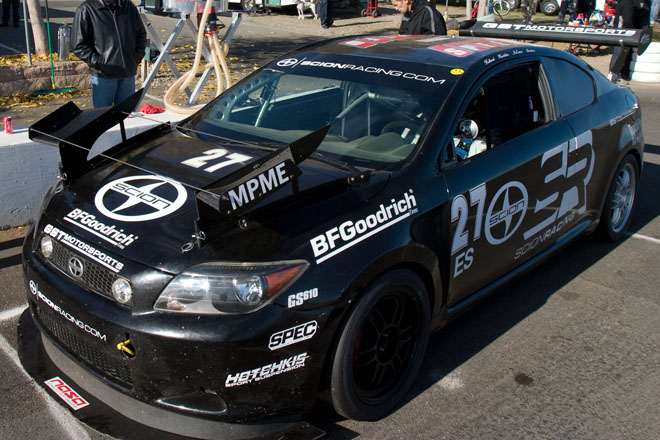
MP: Funny you should ask, Joe... I built my little Scion tC, back in 2007 (pictured, TOP), to NASA Super Unlimited rules. Reminds me...I need to dust it off and get it out and running again. You raise a great point. Pardon the "back in the day" moment I'm about to have, but I grew up at a time where in order for the average person to go racing, you had to buy a production car and turn it into a racecar. It was an entirely different mindset. We don't see this happening very much today, and as you illustrate, the turnkey racecars cost a fortune. You'll get a lot of people building Spec Miatas, or Spec (BMW) E30s, or similar cars that aren't very expensive and have plenty of parts readily available to order online, but you don't get many people taking a Corvette Z06 and making them into fire-breathing monsters, etc. It still happens, but at a greatly reduced rate. I built the tC with a big group of friends and colleagues, chose it because it was weird, and wanted to put something funky and fast on the track. I hope that same spirit continues, and NASA's SU category is a perfect home for crazy homebuilts.

Latest News


Comments
Comments are disabled until you accept Social Networking Cookies. Update cookie preferences
If the dialog doesn't appear, ad-blockers are often the cause; try disabling yours or see our Social Features Support.