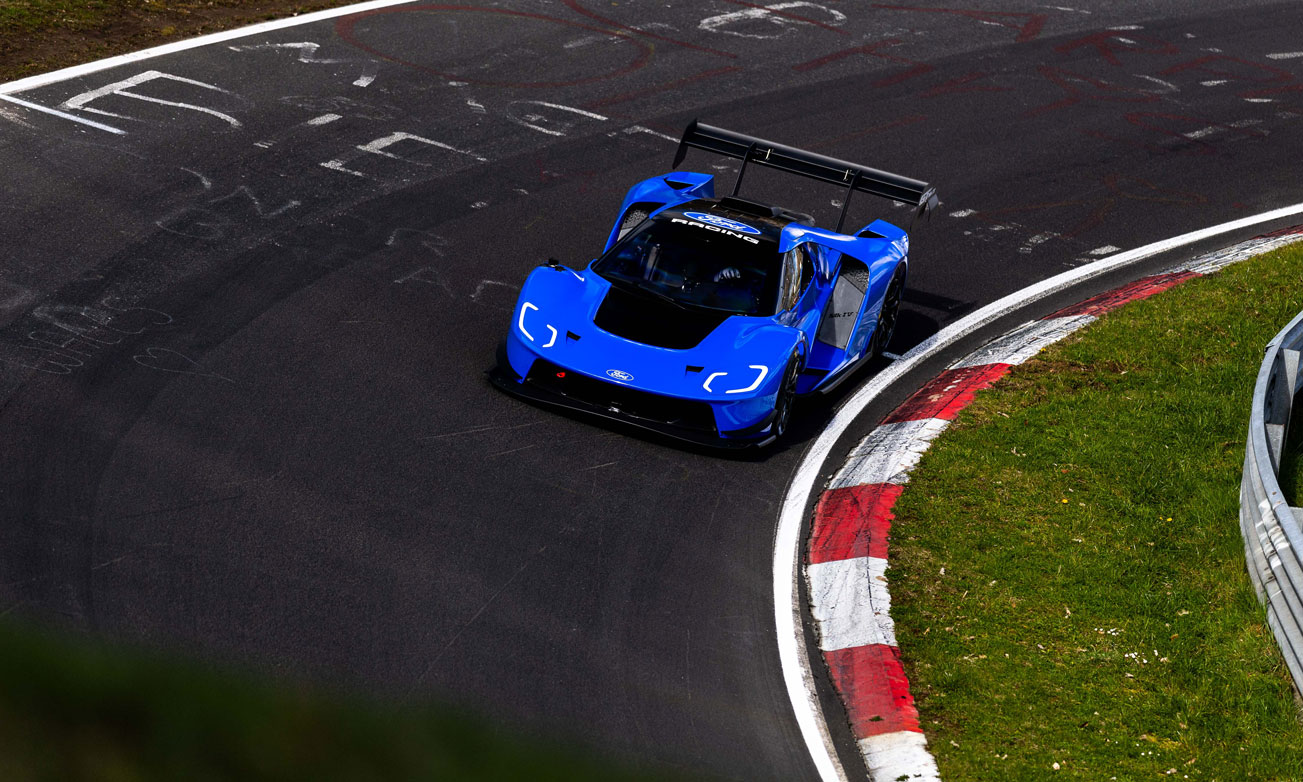
Ford Racing
Presented By
Ford Racing
How the Blue Oval tamed the Green Hell
Automotive manufacturers love to talk about the DNA connecting their road car and motorsports programs.
And rightly so. Modern road cars owe much of their remarkable reliability and efficiency to lessons learned and technologies developed under the pressures of on-track competition. By the same token, virtually none of the manufacturer racing programs we see today would exist without delivering a direct benefit to the showroom.
But there's also something to be said for letting the vehicles themselves do the talking. Just look at the Baja 1000, where Ford Racing's run of success over the past few years says more about the performance and durability of vehicles based on the production Bronco than any conventional commercial ever could.
Germany's Eifel Mountains are a long way from the dust and rocks of Baja California, both geographically and in character. But they offer an equally memorable setting for a mic-drop moment, particularly when you focus on one especially spectacular stretch of road winding through those mountains: the famed Nürburgring Nordschleife.
Despite being surrounded by trees, the Nordschleife offers nowhere to hide. Revered and feared in equal measure, the "Green Hell," as it is famously known, is the ultimate proving ground for manufacturers looking to put their vehicles to the test.
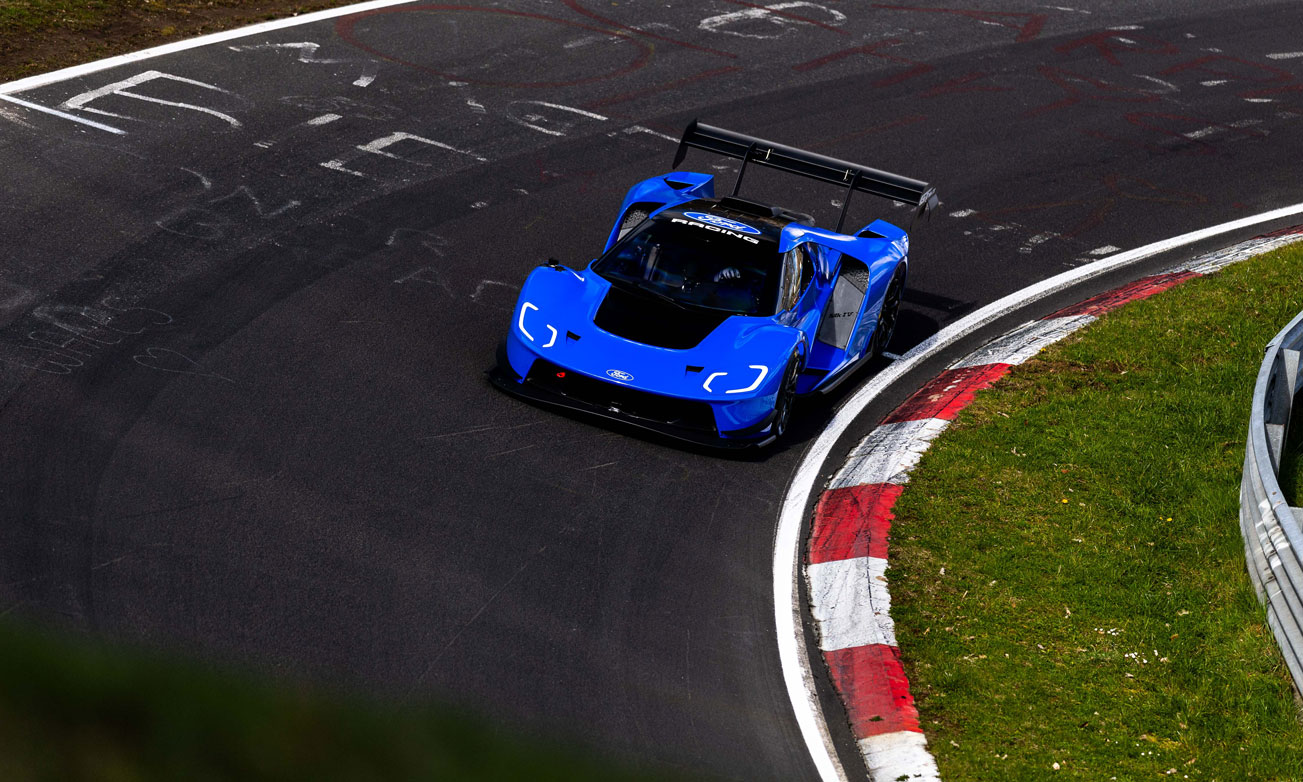
In Ford's case, the mic-drop moment lasted just 6m15.977s, the lap time that put the Blue Oval into the record books earlier this year as the fastest American OEM ever to lap the Nordschleife's 12.9-mile circuit. The achievement was the product of a potent combination of Ford Racing's engineering prowess, the talents of factory driver Frédéric Vervisch, and the mechanical potency of the Ford GT Mk IV.
"Driving the Ford GT Mk IV at the Nürburgring is an experience unlike any other," said Vervisch, whose resume includes two Nürburgring 24 Hours victories, as well as being part of the winning Mustang GT3 lineup at the 2025 Rolex 24 At Daytona.
"The car is an absolute weapon, a true extension of your will. Every input is met with an immediate, precise response. Through the Kesselchen, over the Flugplatz, it just inspires confidence, allowing you to push harder and harder.
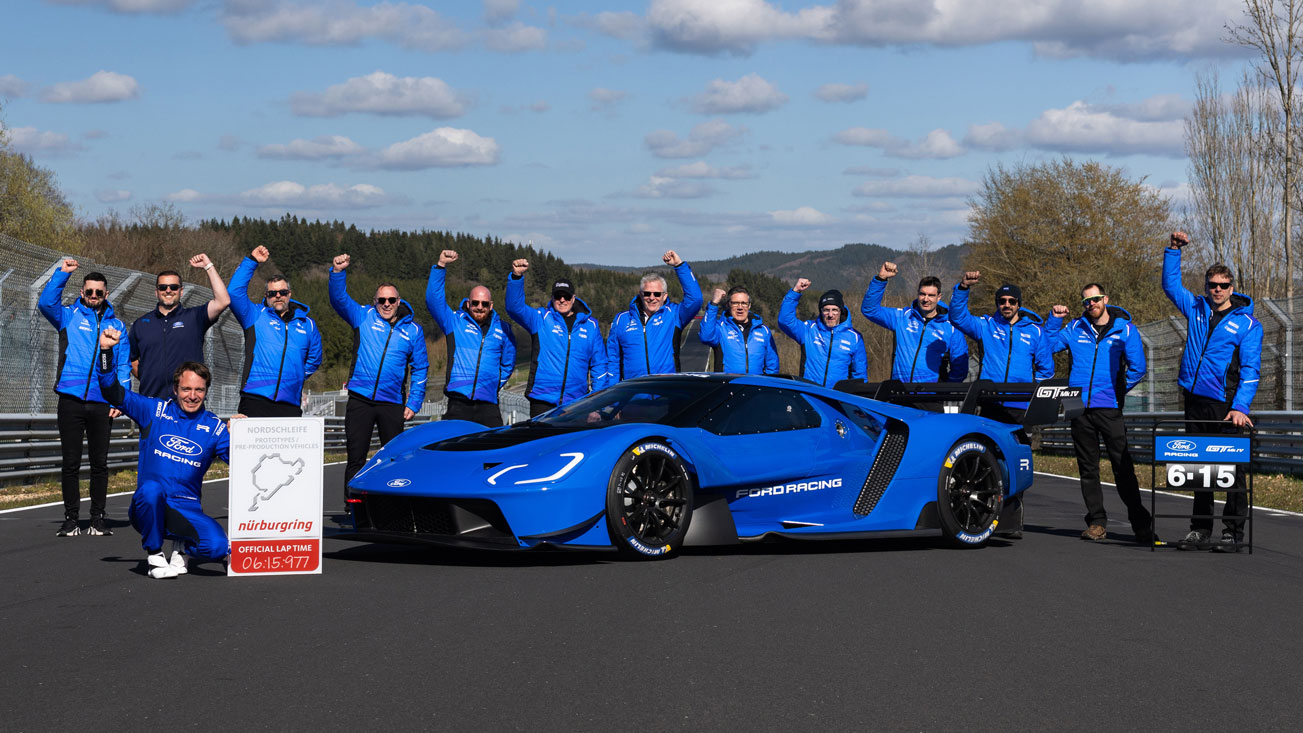
The Ford GT Mk IV's performance was a testament to a great car, a top-shelf driver and some serious engineering firepower. Image by Ford Racing
"You feel the history of the track, and you feel the immense capability of the Ford Racing engineers who poured their hearts into this machine. To set these records is a dream come true, a testament to what's possible when passion meets precision."
As Vervisch suggests, the GT Mk IV has scant regard for compromise. Power comes from a specially engineered twin-turbocharged Ford EcoBoost engine producing more than 800 horsepower, paired with an electronically controlled, semi-active Adaptive Spool Valve (ASV) race suspension system developed by Multimatic.
Other features include a longer wheelbase, a bespoke racing gearbox, and a carbon-fiber "long-tail" body designed to maximize aerodynamic efficiency.
The lap time also makes the GT Mk IV – a track-only supercar that represents the final iteration of the current generation of the Ford GT – the fastest car currently available for purchase to have lapped the Nürburgring Nordschleife. (With production limited to just 67 examples, however, you'll have to move at GT Mk IV speeds to secure one.)
Meanwhile, the Mustang GTD, which helped pave the way for the GT Mk IV's achievement when it became the first car from an American brand to break the seven-minute barrier at the Nordschleife in 2024, returned in 2026 and shattered its own record with a 6m40.835s lap in the new Mustang GTD Competition.
In both cases, the cars were driven by Ford Racing and Multimatic factory driver Dirk Müller, with Ford Racing engineer Steve Thompson also demonstrating the GTD Competition's capabilities with a 6m49.337s lap.
"When we said, 'Game On,' we meant it," said Jim Farley, president and CEO of Ford Motor Company.
"Mustang GTD was always meant to bridge the worlds between GT3 race cars and street-legal supercars, and the GTD Competition takes this to the next level to continue keeping Europe's elite up at night."
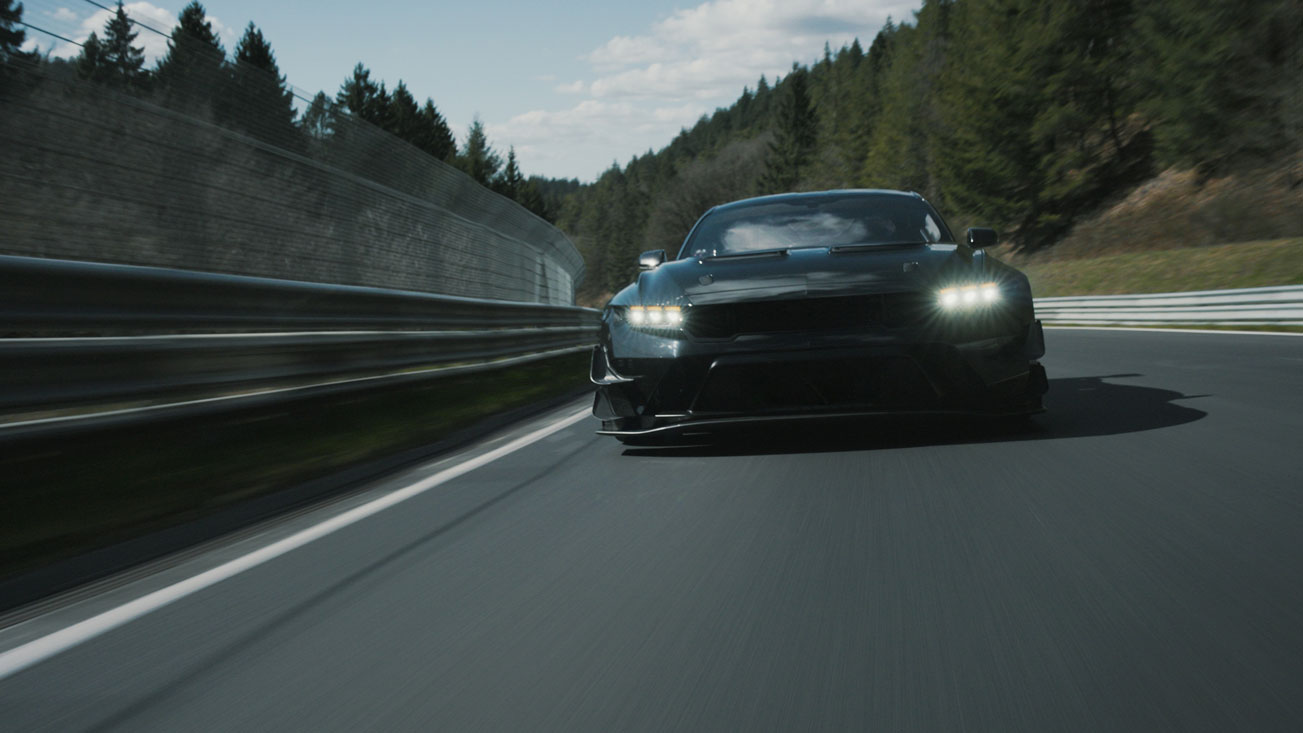
The Mustang GTD obliterated its own class record around the Nordschleife. Image by Ford Racing
The new lap shaved approximately 11 seconds off the Mustang GTD's previous benchmark. Some of that improvement can be attributed to developments across the car itself, including hardware updates and an aggressive approach to tuning that pushed the GTD Competition's 5.2-liter V8 beyond its predecessor's 815 horsepower.
On the aerodynamic front, the engineering team introduced modifications to the rear wing, secondary dive planes, and rear carbon-fiber aerodynamic discs, increasing downforce without compromising efficiency or aerodynamic balance.
Add in weight reductions throughout the car and new high-performance Michelin tires, and the result was a package capable of delivering another remarkable Nürburgring performance. The engineering team's determination was evident in Thompson's achievement, too: despite having relatively little experience at the Nordschleife, he managed to lap the circuit in 6m49.337s.
"You don't run a 6m40s at the Nürburgring on hardware alone," said Mark Rushbrook, global director of Ford Racing.
"The GTD Competition is the direct result of pouring our hardest-learned motorsport lessons into a street car, backed by a team of engineers who sacrificed their nights and holidays to squeeze out every possible millisecond."
But while Nürburgring records – or class wins at Baja, for that matter – make the headlines, the real story is the philosophy underpinning those achievements. Ford uses racing to make its road vehicles better, then puts those vehicles back into the racing environment to prove what they've learned.
“The Nürburgring proves that our motorsport lessons don't stay on the track. They are engineered directly into our road cars," said Rushbrook.
"Our racing engineers compete to make Ford vehicles better. For us, every ground is our proving ground."
For more insight on Ford Racing and how it’s always striving to redefine possible in motorsports series across the globe, check out fordracing.com. And to find out how Ford is taking lessons learned in the world’s fastest laboratories, from the 24 Hours of Le Mans to the Baja 1000, to help design the vehicles you drive, check out ford.com.
RACER Staff
Read RACER Staff's articles
How the Blue Oval tamed the Green Hell
Latest News
Comments
Comments are disabled until you accept Social Networking Cookies. Update cookie preferences
If the dialog doesn't appear, ad-blockers are often the cause; try disabling yours or see our Social Features Support.