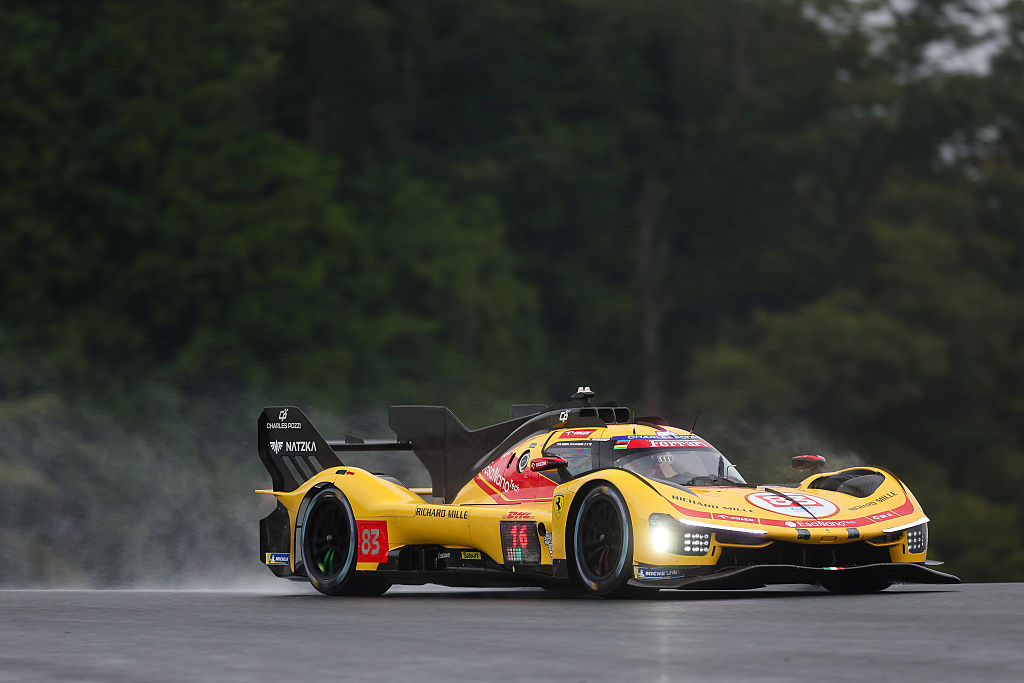
Jakob Ebrey/Getty Images
BoP or not: Should the next Hypercar ruleset fine-tune Balance of Performance or ditch it entirely?
After the remaining FIA World Endurance Championship titles are decided in Sunday’s season finale at Monza and the championship heads into the winter break, the single biggest talking point behind closed doors as attention shifts toward the 2027 campaign will be the finalization of the 2030 Hypercar regulations.
Since the framework was presented back in June at Le Mans, the target has long been to finalize the complete set of regulations (shifting the formula to a single platform) by the end of this calendar year. Meeting it would give the manufacturers involved sufficient time to establish budgets, complete the necessary approval processes, and develop and test a new car ahead of the start of the 2030 season.
The process has been slow, though, prompting key paddock members to suggest to RACER that introducing the new cars in 2030 could ultimately become unrealistic if key decisions aren’t made in the weeks ahead. If not, then a delay to 2031 could become necessary.
The time required to debate and draft the rules, along with several key points that remain under discussion, has proven as challenging as expected, even though, according to Ferrari head of endurance race cars Ferdinando Cannizzo, “some principles have been agreed already.“
“The target is to decide in a few months because we need to start with a new project in the second part of next year,” Antonello Coletta, the head of Ferrari’s endurance programs and Corse Clienti, added. “After that will be complicated. If we start at the end of 2027 or the start of 2028, we will need to jump to 2031. The target of the manufacturers, the federation and the promoter is to define the final rules in the first months of next year.”
Ferrari, the 2025 Hypercar manufacturers’ world champion and a three-time Le Mans winner in the current era, is a key voice in the room and is therefore keen to disclose some of the matters still under discussion, putting the timeline challenges ahead into context.
Perhaps the biggest question mark concerns the future role of Balance of Performance – the ongoing process that keeps the performance levels of the cars close – in the new formula. Although the framework never explicitly stated it, the general belief among the rulemakers in the fallout of the announcement was that BoP would remain part of the regulations, alongside a five-year freeze on car development (except for changes directly related to reliability, safety, or a significant performance deficit) to contain costs.
However, Coletta believes a solution could still be found that would eliminate the need for BoP, or at least significantly reduce its influence on the ruleset and racing.
“Now we are around the table, all together to define a unique platform,“ he said. “With a unique platform, we can write the rules very clearly, and the final goal should be for us to delay the BoP.
“If you remember, the BoP was born with different platforms: four-wheel drive, two-wheel drive, LMDh, LMH. But if we have a unique platform, I think that you can have a very, very good chance and reposition the championship around the table with a meritocracy, without discussion every day about the BoP, mystery BoP, and so on.
“Of course, around the table there are manufacturers, and many manufacturers have different ideas. The idea for Ferrari is to have a unique platform with strong rules, with a chance to make the car with our efforts.“
Any such change would involve several considerations, including its compatibility with a regulations package featuring either significant development restrictions or a multi-year freeze on updates, as well as the option to utilize common components and chassis, which, in theory, shouldn’t put manufacturers at an inherent disadvantage.
“The discussion is very complicated,“ Coletta continued. “But today we have BOP up and down. If we have a little percentile of intervention, then it should be a solution. We need to have marginal intervention, not a lot.
“If we consider new rules without BoP, but with very strong rules and you define that you can modify the car, I don’t know, one time a season, then you put this cost into your business plan, and the situation is completely clear. The difference is if you leave the door completely open, and in this case the costs would explode. But if rules are very close and you have the possibility to improve the car in little parts, the situation will be clear.“
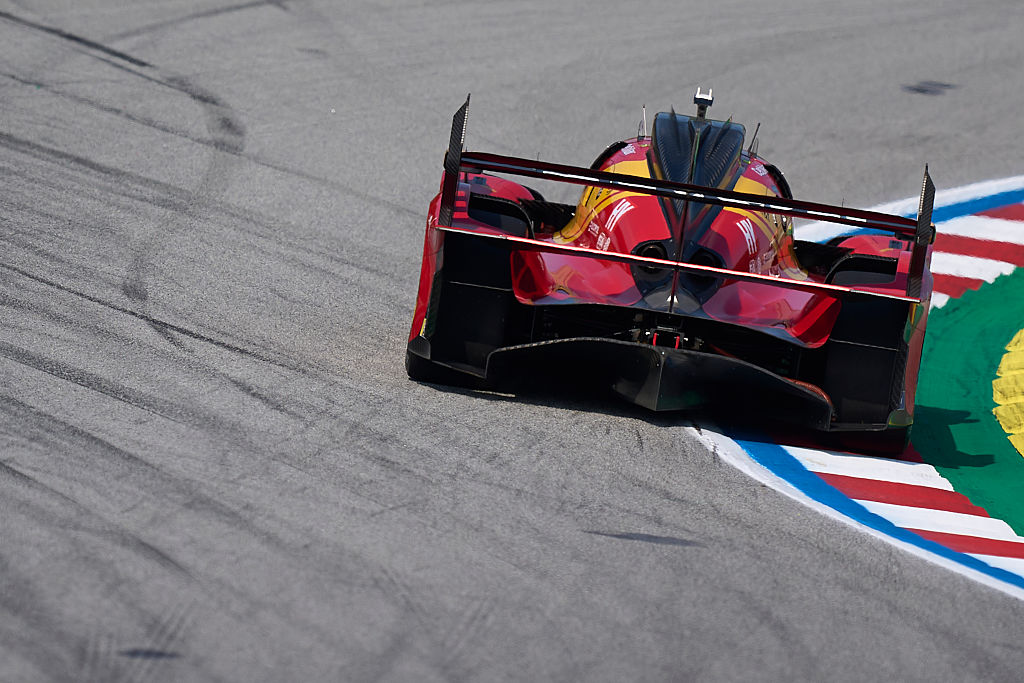
While lauding the simplification of the rules, Ferrari wants to keep 4wd options in the mix. Pablo Rodriguez/Quality Sport Images/Getty Images
The overview of the rules presented back in June also specified that all cars would be rear-wheel drive and hybrid-powered. However, this is another area where Ferrari, like Toyota, continues to push back, with both manufacturers favoring the retention of a four-wheel-drive concept.
“When you are around the table, you need to battle for some ideas, you need to examine,“ Coletta said. “Our idea is that endurance gives a good chance to test some parts of the car and put the good ideas into a road car. Today, in road cars, four-wheel-drive hybrids are probably the future. But it will be complicated to maintain the four-wheel drive.
“This is our idea because all the street cars head in this direction, but when you are around the table you need to lose some issues and gain other ones. An important consideration is that it’s not more expensive to have four-wheel drive. The difference in the end is very little.“
Regardless, finalizing a final set of regulations in the early months of 2027, ahead of a full presentation – likely at Le Mans in June – will require all parties involved to find common ground.
Each manufacturer has its own priorities regarding budget levels, technological complexity and relevance, brand identity through car design, and how the formula should be governed. That is before considering the board-level discussions that will need to take place surrounding approval for new programs and cars at an increasingly volatile time for the automotive industry, particularly in Europe.
The costs associated with every adjustment, change and regulatory decision in the regulations will come under scrutiny and be debated extensively. Everyone will need to work out what’s acceptable and what’s not for them to invest millions in the formula.
For Ferrari, which holds a unique commercial position – in part because it has built up a Rolodex full of high-end, loyal customers that it can utilize to help fund its program to a level others can’t – its main red line remains the ability to develop a bespoke chassis.
“The idea for Ferrari is to have a unique platform with a chance to make the car with our efforts, not to share the gearbox, electronics, some parts,“ Coletta explained. “If other manufacturers have been able to share mechanical parts, why not? We prefer to put our horse on the front of a car if the car is a Ferrari. We have to have a chance to make the car.
“Ferrari’s views may be different from other manufacturers’ views, but in the end it’s time to sit down around a table, discuss it together, find a good agreement and understand each other. We need to understand which is the best compromise or trade-off. Clearly, something which will be affordable that will allow manufacturers to develop cars is something we should take care of, and we need to be ambitious and brave enough to understand which technology to develop for the future.“

Stephen Kilbey
UK-based Stephen Kilbey is RACER.com's FIA World Endurance Championship correspondent, and is also Deputy Editor of Dailysportscar.com He has a first-class honours degree in Sports Journalism and is a previous winner of the UK Guild of Motoring Writers Sir William Lyons Award.
Read Stephen Kilbey's articles
Latest News

Comments
Comments are disabled until you accept Social Networking Cookies. Update cookie preferences
If the dialog doesn't appear, ad-blockers are often the cause; try disabling yours or see our Social Features Support.